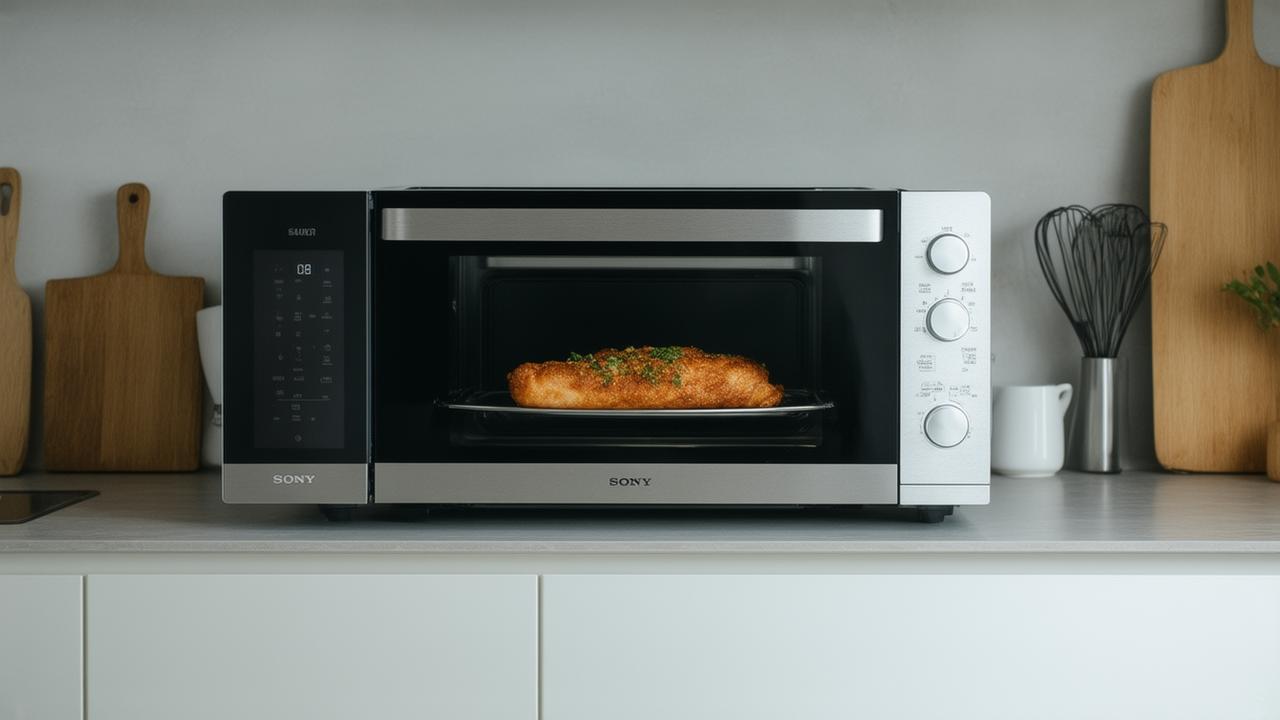
The first time I saw it, it sat quietly in the corner of a test kitchen, no bigger than a bread maker, humming softly like it was thinking. No blinking clock. No yellowed plastic door. No accusatory beeping every time you forgot your leftovers. Just a smooth, rounded front panel, a small window, and a glow that felt—oddly—more like a campfire than a microwave. A tray of cold roasted vegetables slid inside, the door clicked shut with a gentle thud, and within moments, an aroma bloomed through the room that made every tired lunch in a sad breakroom microwave feel like a bad memory. This, the engineer beside me said, could be the beginning of the end for the microwave oven.
The Silent Revolution on Your Countertop
For decades, the microwave has been king of convenience—fast, familiar, and famously imperfect. It heats from the outside in inconsistent patches, rubberizes yesterday’s pizza, and nukes the joy out of anything delicate. But it’s everywhere. So when you hear someone say, “This might replace the microwave,” it sounds like wishful thinking at best, marketing buzz at worst.
But this new device—let’s just call it a precision heat oven for now, because names are still shifting in labs and startup pitch decks—doesn’t feel like a gimmick. It feels like the moment when phones got cameras, or when bicycles quietly gained electric motors. Everything still looks familiar, but the experience changes completely.
Instead of blasting food with random radio waves, this oven uses a combination of highly directed infrared, smart sensors, and algorithmic control to heat your food with eerie accuracy. It’s not just “hot”. It’s evenly hot, in the right places, at the right time. The kind of heat that makes broccoli stay green instead of grey, that leaves a croissant flaky instead of soggy, that warms soup without turning the rim of your bowl into a molten halo.
Standing in that test kitchen, you could watch it work through the small window. A soft, amber light washes the food, not that harsh fluorescent glare of an overworked microwave but something more like a sunset captured in a box. No spinning plate. No random cold center. The device maps the internal temperature of your food in real time and adjusts its energy output on the fly, like a tiny weather system responding to heat fronts and cold pockets.
How It Works (Without Making Your Brain Hurt)
Talking to the engineers behind it, you learn quickly that the secret isn’t in a single new technology, but in how a few familiar things are combined. There’s infrared heating—the same kind of radiant warmth you feel from a campfire or the sun on your face on a winter morning. There are thermal sensors, so small and fast they can read shifting temperatures across your food in fractions of a second. Then there’s the invisible brain: a control system that constantly tweaks intensity and duration to hit exactly the temperature the food needs, where it needs it.
Imagine you’re reheating a plate of last night’s dinner: some roasted chicken, a pile of vegetables, and a scoop of rice. In a microwave, you’re making a deal with chaos. Maybe the rice stays icy in the center. Maybe the chicken dries out. You stir, rotate, guess, reheat, repeat.
In the precision heat oven, the sensors read how each portion responds to the infrared energy. The dense chicken warms more slowly, the fluffy rice warms faster, and the device compensates in real time. It isn’t just heating the plate; it’s effectively talking to your food, moment by moment, shifting the pattern of energy like a conductor guiding an orchestra.
There is no spinning carousel, no “hot spot,” no mysteriously boiling patch of sauce next to a chilled fragment of carrot. Instead, the whole plate comes out at a comfortable, even eating temperature—warm enough to satisfy, not so hot you need a fire extinguisher for your tongue.
Efficiency: The Quiet Superpower
All of this would just be a neat party trick if it didn’t also tackle the elephant in the kitchen: energy use. Microwaves are often assumed to be energy-efficient simply because they’re fast. But speed is not the same as precision. Microwaves can overshoot, waste energy on the container, or spend extra seconds compensating for uneven heating.
The new oven, by contrast, is ruthlessly targeted. It doesn’t heat the air around your food much. It doesn’t need to preheat like a full-sized oven. It focuses its energy on exactly where it’s needed, tightly directed and tightly timed. When independent testers compared its performance to microwaves and conventional ovens, the results were startling.
| Task | Traditional Microwave | Conventional Oven | Precision Heat Device |
|---|---|---|---|
| Reheat 1 plate of leftovers | ~3–4 minutes, uneven heat | ~12–15 minutes, preheat required | ~2–3 minutes, even heat |
| Estimated energy use per reheat | Baseline | 2–3× baseline | Up to 30–50% less than baseline |
| Texture & moisture retention | Often dry or rubbery | Good, but slow | Consistently high |
The numbers alone are impressive: tests suggest this device can use up to half the energy of a typical microwave for many everyday tasks, especially reheating and light cooking. But the human side of that efficiency is just as powerful. Food that tastes better is less likely to be wasted. Leftovers feel like a second, smaller feast instead of a pale echo of yesterday’s meal.
The Sound and Smell of the Future
There’s another difference you notice after a few minutes with this new oven: the sensory footprint. Microwaves are oddly anonymous. They hum. They beep. They smell mostly of steam and overworked plastic. It’s like a machine pretending not to exist in your kitchen, doing its job behind a curtain.
This device is more… conversational. It glows softly while it works. The hum it makes is lower and calmer, more like a distant fan than a buzzing transformer. When a slice of bread goes in to be revived, the smell that emerges after a minute or so is that same warm, yeasty scent that escaped from your oven the day it was actually baked. When a bowl of chili heats, you smell cumin and tomato and smoke, not just generic “hot.”
Visually, it feels less industrial. No harsh digital clock glaring 00:00 at you like it’s judging your life choices. Instead, there might be a simple progress bar or an intuitive icon that shows what the oven is doing: warming, finishing, resting. It doesn’t shout; it informs. And when it’s done, it gives you a gentle chime—a soft tone—rather than a frantic alarm.
There’s something almost paradoxical about this: a device that’s more high-tech than a microwave, but somehow feels more human, more aligned with the natural rhythms of cooking, more respectful of the ingredients you bring home from the market.
From Frozen to Fresh-Like
The real magic trick, the one that makes even the most skeptical food people lean in, is what it does with frozen food. Not the kind you proudly vacuum-sealed yourself, but the everyday frozen dinners, veggies, and leftovers that get shoved in the back of the freezer, forgotten until a weeknight runs off the rails.
Drop a rock-hard block of frozen curry, a lasagna, or a container of soup into a microwave, and you’re setting yourself up for a game of culinary roulette. Will the edges burn while the center stays icy? Will the cheese turn into a thick rubber mat? Will the sauce separate into watery layers?
With the precision heat oven, the process is almost eerie. It treats frozen food as a puzzle rather than a problem. The device starts slow, reading how the ice melts, how the surface responds, how steam begins to rise. It uses that information to tailor the next moments of heating, aiming for a steady climb rather than a violent blast. When you open the door, you’re not left stirring half-frozen, half-boiling contents. Instead, you find something that smells and looks like it should have taken much longer than it did—sauces glossy instead of split, pasta tender instead of mushy.
Why Experts Think Microwaves Are on Borrowed Time
So why are energy researchers and kitchen technologists quietly saying: “This could replace the microwave”? It comes down to three overlapping reasons: efficiency, quality, and adaptability.
Efficiency is the star headline. Global households pour staggering amounts of energy into reheating food every day. A device that can cut that energy use by a third, or even half, at scale, suddenly matters a lot. Test labs are finding that this new device uses less electricity not just because it’s fast, but because it wastes less—less hot air, fewer overheated plates, more of the energy going into the food itself.
Quality might be even more important to the people actually living with these machines. Food that’s gently, evenly heated is simply more satisfying. That matters if we’re serious about making home cooking sustainable, affordable, and attractive. When leftovers feel like a second, fresh meal instead of a punishment, we throw away less and cook at home more.
➡️ Bird experts expose the winter fruit trick that turns robins into garden addicts
➡️ Goodbye microwave: here’s the appliance that will replace it, and it’s much better
➡️ Many households waste money by using appliances at the wrong time of day
➡️ Growing anger among exhausted seniors as more “cumulants” are forced to keep working after retirement just to survive while politicians brag about economic success
➡️ Forget vinegar and baking soda: pour half a glass of this simple ingredient and the drain cleans itself effortlessly
➡️ Day will turn to night as astronomers officially confirm the date of the century’s longest solar eclipse, a rare event expected to create an extraordinary spectacle across several regions for all
➡️ Heating: the 19 °C rule is over, here’s the temperature experts now recommend
And then there’s adaptability. Microwaves are great at blunt-force heating. This new device can, in principle, learn. Its software can be updated. It can adapt new programs for new dishes, new containers, new types of food. Some prototypes are already experimenting with recognizing what you put inside—a slice of pizza, a piece of fish, a bowl of pasta—and adjusting automatically. That’s a step away from the one-size-fits-all “high, medium, low” of conventional microwaves toward something more like an intelligent cooking companion.
Will We Miss the Microwave?
Of course, no technology disappears overnight, and the microwave has dug in deep. Dorm rooms, office kitchens, rural homes, city apartments—they’re all built around the idea that a microwave is a given. There are habits and rituals attached: the late-night popcorn, the hurried coffee reheat, the emergency defrost.
Yet every major shift in kitchen tech has followed a similar pattern. There was a time when people couldn’t imagine replacing the wood stove, or living without a percolator on the hob. Now, induction cooktops, smart ovens, and burr grinders have slipped into everyday life, reshaping our expectations almost without us noticing.
This new wave of precision heat devices won’t arrive as a revolution with a drumroll. They’ll show up quietly: in design-forward kitchens, in eco-conscious homes, in apartments where counter space is precious and energy bills bite a little harder each year. The first people to adopt them may be food lovers tired of rubbery leftovers or parents looking for safer, more reliable ways to warm meals for kids.
And then, one day, someone will move into a new home that comes with a sleek little box on the counter—not a microwave, but something better. They’ll heat their first plate of pasta and realize, almost absentmindedly, that there’s no cold center, no splatter-scarred interior, no mechanical whine. Just warmth, aroma, and the quiet sense that the kitchen has caught up with the rest of the modern world.
When that happens at scale, we’ll look back at the microwave the way we now look at dial-up internet: an important stepping stone, yes—but also a relic of a time when “fast” was good enough, even if it wasn’t particularly smart or kind to the things we love to eat.
Frequently Asked Questions
Is this new device safe compared to a microwave?
Yes. Unlike microwaves, which use electromagnetic waves to excite water molecules, this device relies primarily on controlled infrared and thermal sensing, technologies already common in everyday appliances. It’s designed with layered safety systems, cool-touch exteriors in many models, and automatic shutoffs if something overheats or burns.
Will it cook food faster than a microwave?
For many tasks, it’s similarly fast or slightly faster, especially for reheating plates of mixed foods or frozen items. The big difference is not just speed, but consistency and quality: food comes out evenly heated, with better texture and moisture.
Can it fully replace an oven too?
For some households, it might. It can handle reheating, light baking, crisping, and even some roasting. However, for large roasts, trays of cookies, or big batch baking, a full-sized oven still has advantages in capacity.
Does it work with the same containers as a microwave?
In most designs, it’s more flexible. Because it isn’t using microwave radiation, it can often safely handle a wider range of materials, including some metal pans, though manufacturers will still specify what’s recommended. Food-grade ceramics, glass, and many existing containers should remain compatible.
Will it be much more expensive than a microwave?
Early models are likely to cost more than basic microwaves, similar to how induction cooktops once did. Over time, as production scales and competition grows, prices are expected to come down. The energy savings and improved food quality may offset the higher upfront cost for many households.
Do I need to learn new cooking skills to use it?
Not really. The device is designed to simplify rather than complicate. Most tasks involve choosing a basic setting—reheat, crisp, bake, or defrost—and letting the internal sensors do the fine-tuning. Over time, you might discover advanced modes, but everyday use should feel as simple as, or simpler than, a microwave.
When will these devices become widely available?
Some early versions are already entering the market through select brands and high-end kitchen lines. Over the next few years, as more companies adopt similar technology, you can expect to see them appearing in mainstream appliance stores and built into new homes as a standard feature.





