The list began, as most lists do, with something small. “Milk.” You wrote it on the back of a receipt with a pen that was beginning to fail, the ink stuttering over the waxy paper. The letters weren’t pretty, but they were yours: a little slant to the right, the tail of the “k” swooping lower than it should. You folded the receipt and slid it into your pocket. Hours later, in the grocery store, your fingers knew exactly what they were searching for. That crumpled bit of paper felt like a promise, like a second brain you could touch.
The Quiet Drama Inside Your Head
Now imagine the same list on your phone. You flick open your notes app, type “milk,” “eggs,” “spinach,” and tap a tidy little checkbox beside each. There’s a thrill in that tiny checkmark; it’s so clean, so absolute. But if you could watch your own brain in those two moments—pen in hand versus thumb on glass—you would see very different shows lighting up the neural stage.
Modern brain imaging has made something quietly obvious: writing something by hand and typing it into a device are not the same task to your nervous system. They are entirely different experiences, involving different networks, movements, and even different layers of consciousness. Your body knows it. Your memory knows it. And your attention—especially in a world of constant pings and pixels—definitely knows it.
But this isn’t a lecture on why you should burn your phone and move to a cabin with a notebook and a lantern. It’s a story about what happens in the space between your fingers and your brain, and why a handwritten list—even the messiest, most coffee‑stained one—can change the way you think, remember, and feel in ways a digital list almost never does.
How Your Hand Shapes Your Thoughts
Think back to the last time you scribbled something quickly on paper: a to‑do list on the fridge, a note on a sticky, a reminder on the back of your hand when you couldn’t find anything else. The paper had a subtle grain. The pen caught slightly if you moved too slowly. Your wrist rotated, your fingers tightened, your eyes followed the line you created in real time. It was a full‑body moment, even if it lasted only a few seconds.
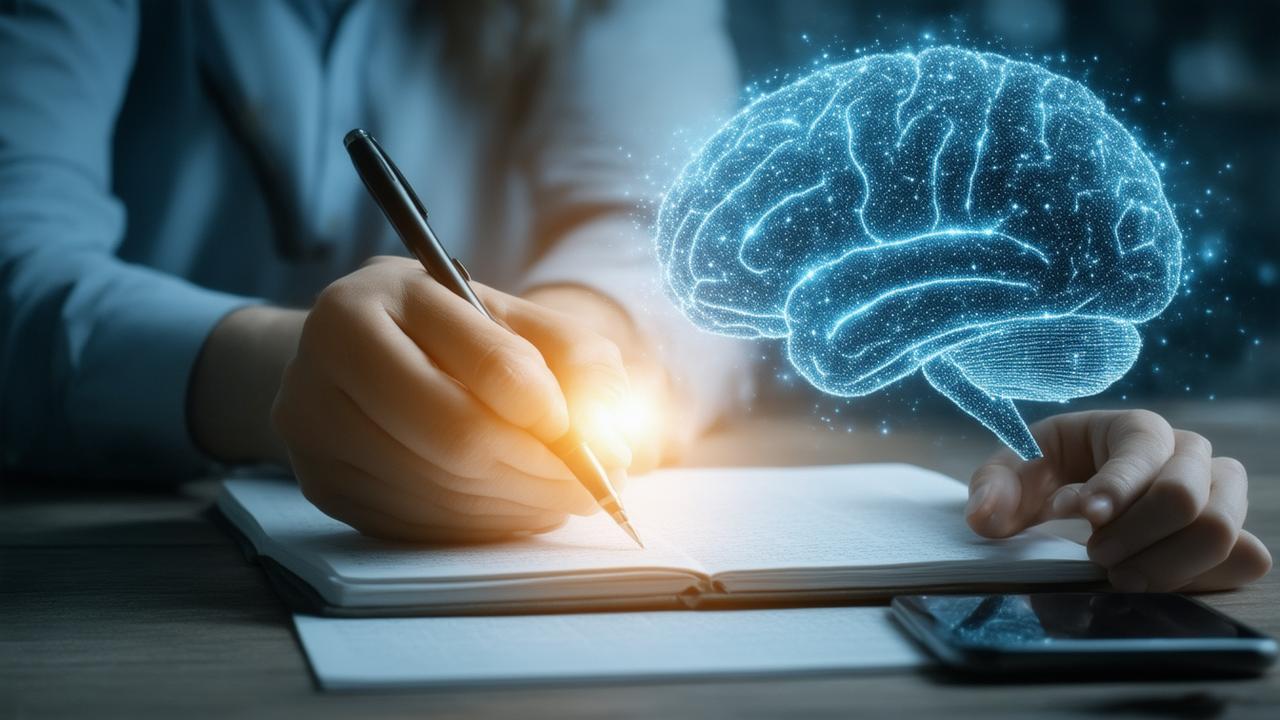
Handwriting is deeply physical. Your brain must coordinate fine motor control, visual tracking, spatial planning, and language processing all at once. That orchestration wakes up networks that digital typing often lets doze. As you write “Call dentist,” your brain doesn’t just store the words; it stores the particular motion of each curve and angle, the small stutters and accelerations of your pen. These extra layers of movement become extra hooks for memory.
There’s a sensory rhythm in handwriting that your brain leans into: the scratch of pen on paper, the tiny resistance as the nib meets the page, the variation in pressure as you emphasize a word you really don’t want to forget. The act itself invites you to linger for a fraction of a second longer on each item. It’s subtle, but those extra micro‑moments let your brain actually meet the information, not just pass it through on a conveyor belt of taps.
By the time you finish a short handwritten list, you’ve traced those words not just onto the page, but into your neurology, leaving echoes in motor cortex, sensory cortex, and the networks that knit meaning and memory together. You’ve ‘drawn’ your thoughts into being—and your brain almost always remembers what it draws more than what it merely taps out.
Digital Lists: Fast, Frictionless, and Forgettable?
Pull out your phone and open your favorite list app. The glass is smooth, uniform, indifferent. Every letter looks the same as every other letter. Whether you’re adding “buy birthday card” or “apply for new job,” the font doesn’t flinch, the spacing doesn’t shift. Your body barely does, either: a thumb slides, a finger taps, a cursor blinks. Efficient. Neat. Bloodless.
Your brain loves the convenience. Digital lists are fast, searchable, shareable. You can color‑code, set alarms, move items around with a flick. You can cross off tasks during a commute, in a meeting, or in bed with the lights off. But that very ease comes with a trade‑off: less friction often means less imprint.
Typing is repetitive and standardized. Every “T” feels like every other “T” to your muscles. Your brain doesn’t need to choreograph a new movement pattern; it just fires pre‑learned keystrokes. The sensory detail is thinner—no paper fibers, no ink thickness, no tiny drag of a ballpoint running out of juice. Without those small variations, there are fewer sensory anchors to hold a memory in place.
Digital lists also live inside devices that are designed to fragment your attention. The same rectangle where your grocery list sits is also where messages arrive, news alerts flash, and social feeds beckon. You open your list to add “lemon zest,” and two seconds later you’re reading about a storm on the other side of the planet. The list becomes just another tab in a crowded mental browser.
Yet digital lists do have strengths: they’re great for complex projects, collaborative tasks, and anything time‑sensitive. The brain appreciates structure, reminders, and visibility. The danger isn’t that digital lists are bad; it’s that they’re so frictionless, we can mistake having written a list for having really engaged with what’s on it.
The Memory Difference You Can Feel
Let’s try an experiment in your imagination. Tomorrow morning, you make two lists of the same five tasks. One list you write by hand on a scrap of paper; the other you type into your phone. Then, without looking, you go about your day and see which list your brain recalls on its own.
Chances are, the handwritten one will feel closer to the surface of your mind. Not necessarily every item, but the shape of the list—its order, the way the third line dipped slightly, the word you underlined twice—will linger like the memory of someone’s handwriting on a letter. The digital list, by comparison, may feel more like a document filed away: safe, but psychologically “elsewhere.”
Handwritten lists encourage what psychologists call “deep encoding”—a stronger, more elaborate way of storing information. You don’t just capture the content of the task (“buy batteries”); you also encode the context (where you were when you wrote it, what the paper felt like, how urgent it felt when you pressed harder on the word “buy”). These extra details form a web, and memory loves webs.
Digital lists usually invite “shallow encoding.” Because typing is quick and uniform, you might rush through adding items, trusting the device to remember for you. You outsource not just storage, but effort. The brain registers, “This is safe out there; I don’t need to hold it in here.” It’s useful, but it changes the relationship: your list becomes less of a mental partner and more of a warehouse.
You can feel this difference most clearly with emotionally loaded items. A handwritten note that says “Call Mom” can tug at you when you stumble upon it, the ink carrying a hint of the moment you wrote it. The same words in a digital list might slide past your eyes between other notifications, vulnerable to the endless scroll. One lingers in the body; the other skims the surface of attention.
Focus, Calm, and the Ritual of Pen and Paper
There’s a reason so many people keep drifting back to notebooks, even as apps grow sleeker and smarter. The ritual of making a handwritten list often feels slower, quieter, and oddly grounding. When you sit at a table with a scrap of paper and a pen, the world narrows. The boundaries are simple: this page, these words, this moment.
Your nervous system recognizes this simplicity as a kind of rest. No pop‑ups, no badges, no animations nudging at the edges of your vision. Just you and the act of choosing what matters enough to be written down. The pace of your thoughts often changes to match the pace of your hand. You may notice yourself breathing more deeply, pausing to decide what really belongs on the page.
Digital lists tend to live in a landscape of constant context‑switching. You might open your list to check what’s next, only to be pulled into a text thread, an email, or a breaking headline. Your attention splinters, and each return to the list costs your brain a little bit of energy.
➡️ Bird experts expose the winter fruit trick that turns robins into garden addicts
➡️ Goodbye microwave: here’s the appliance that will replace it, and it’s much better
➡️ Many households waste money by using appliances at the wrong time of day
➡️ Growing anger among exhausted seniors as more “cumulants” are forced to keep working after retirement just to survive while politicians brag about economic success
➡️ Forget vinegar and baking soda: pour half a glass of this simple ingredient and the drain cleans itself effortlessly
➡️ Day will turn to night as astronomers officially confirm the date of the century’s longest solar eclipse, a rare event expected to create an extraordinary spectacle across several regions for all
➡️ Heating: the 19 °C rule is over, here’s the temperature experts now recommend
With paper, the boundaries are more forgiving. A handwritten list can become a quiet anchor in a noisy room: tucked beside your keyboard, clipped to the fridge, or folded into a pocket like a small intention. Crossing off an item is not just a tap; it’s a gesture. You drag your pen through the words you’ve turned from intention into action. Your muscles participate in the completion, and that physical act can make the accomplishment feel more real.
| Aspect | Handwritten List | Digital List |
|---|---|---|
| Sensory Experience | Rich: texture of paper, pressure of pen, unique strokes | Minimal: uniform tapping, smooth glass surface |
| Memory Encoding | Deeper: engages motor, visual, and spatial networks | Shallower: relies mainly on visual and semantic processing |
| Attention & Focus | Helps single‑tasking, fewer distractions | Competes with notifications and multitasking |
| Emotional Impact | Personal, tangible, often more meaningful | Efficient but emotionally neutral |
| Flexibility & Organization | Freeform, creative, but harder to rearrange | Easily sortable, shareable, and searchable |
Finding Your Own Balance Between Ink and Pixels
This isn’t a competition between old and new, parchment and processor. It’s more like learning which instrument to play for which song. Your brain responds differently to the tools you use, and once you know that, you can choose with more intention.
For lists that really matter—goals you want to sit with, projects that scare or excite you, habits you want to build into your bones—handwriting gives your brain more to hold on to. A Sunday evening ritual of writing the week’s priorities on paper can create a small island of calm, a way of telling your nervous system: “This is important. Pay attention.”
For complex logistics—travel details, shared chores, deadlines that need reminders—digital tools shine. They keep things from slipping through the cracks, especially when life gets busy. Your brain doesn’t have to juggle every ball itself; it can rely on well‑designed nets.
You might find a hybrid works best. Some people keep a handwritten “big picture” list for the day or week and use digital apps for the granular stuff. Others draft ideas and priorities on paper, then transfer only the most crucial items to a digital system that will nudge them at the right time. The point is not to be pure; it’s to be aware of what each medium does to your thinking.
Next time you feel scattered, try an experiment in slowness. Close the apps, find a scrap of paper, and let your hand move. Notice how the act of forming each letter slows your thoughts just enough to hear them more clearly. Notice which tasks feel heavier or lighter when they’re written in your own uneven lines instead of a perfect, uniform font.
In the end, your brain is not trying to choose sides. It’s trying to make meaning. Sometimes meaning lives best in a neatly synced checklist that follows you from laptop to phone to watch. And sometimes, meaning lives in a crumpled note in your pocket that smells faintly of coffee, the ink smeared where you pressed your thumb, the word “call” underlined twice. Both are lists. Only one carries the exact shape of your hand.
FAQ
Does handwriting really improve memory compared to typing?
Yes, for many people it does. Handwriting engages more of the brain—motor control, touch, visual tracking, and spatial awareness—creating more cues for later recall. Typing tends to be more uniform and less physically varied, which can lead to shallower encoding of the same information.
Should I stop using digital lists altogether?
No. Digital lists are incredibly useful for organization, reminders, and complex or shared tasks. Rather than abandoning them, consider reserving handwriting for important priorities, planning, reflection, and anything you especially want to remember or feel connected to.
What kinds of lists work best on paper?
Big‑picture plans, daily priorities, personal goals, creative ideas, and emotionally significant tasks often benefit most from being handwritten. These are the lists where deeper thinking and stronger memory matter more than speed or searchability.
Can I get similar benefits by using a stylus on a tablet?
Using a stylus to handwrite on a tablet sits somewhere between analog and digital. Your brain still performs handwriting movements, which can support memory and focus, but the sensory feedback is usually less rich than paper. It can still be a good compromise if you prefer digital storage but want some of the cognitive benefits of handwriting.
How can I combine handwritten and digital lists effectively?
One approach is to start your day or week by handwriting a short list of top priorities, then use digital tools to manage detailed subtasks, deadlines, and reminders. You can also photograph important handwritten lists for backup, or transfer only the key items into your digital system while keeping the original paper list as a tangible anchor.





