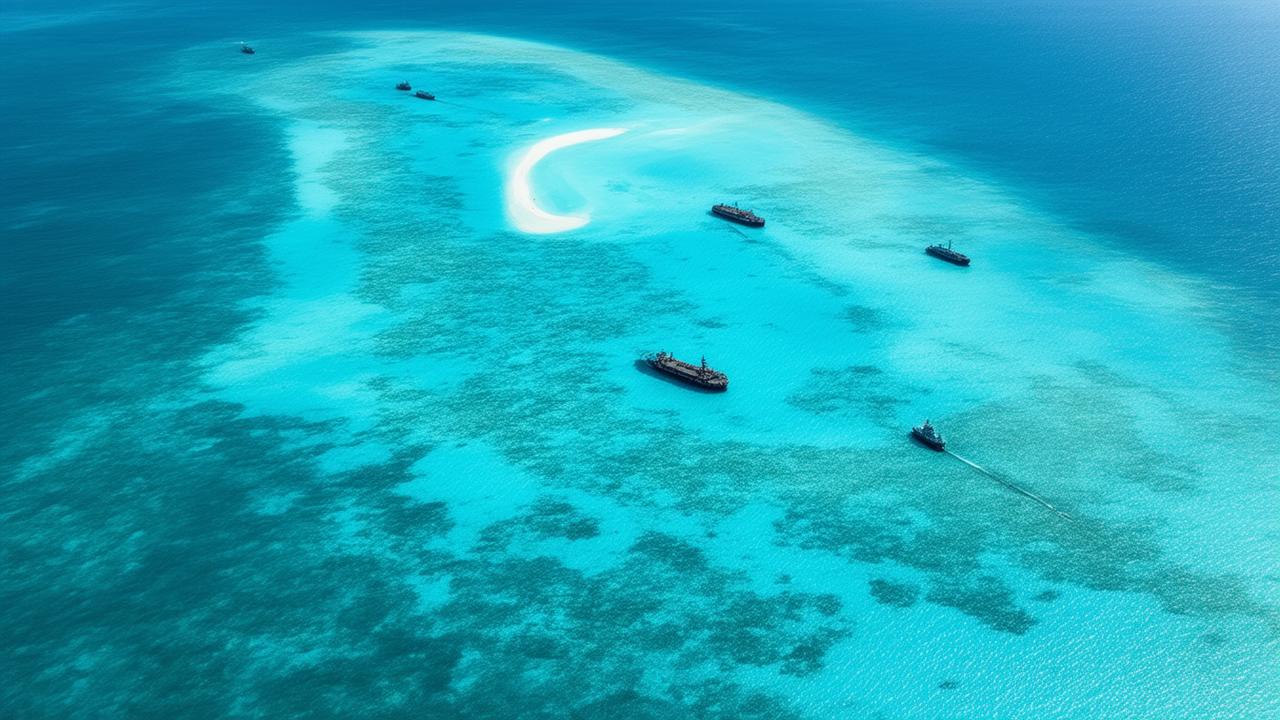
The first thing you notice is the color of the water. From above, in the grainy satellite photos that have been watched and re-watched by analysts and armchair observers around the world, the blue isn’t uniform. It’s bruised by milky turquoise swirls—plumes of sand billowing through once-clear currents. Sleek ships trace looping paths through the sea, hoses arcing like strange metallic proboscises, pumping millions of grains a second into the shallows. Where there was once only open ocean, something is rising. Not a reef, not a shoal, but an island—an entire island—being assembled in slow, sandy breaths.
The Ocean That Became a Construction Site
To understand what China has done in the South China Sea, you have to imagine the ocean as a construction site—no fences, no warning tape, just a vast blue canvas crisscrossed with machinery. For more than a decade, fleets of dredging ships have worked around the clock, under blazing tropical suns and long monsoon nights, digging up sand and crushed coral from the seafloor and dumping it onto half-submerged reefs.
If you could stand on one of those reefs before the transformation, you’d feel it under your toes only at the very lowest tides—a slick, rough skeleton of limestone, crowded with coral heads and crabs and barnacles, just barely breaking the surface before sinking again beneath the waves. The air would taste of salt and plankton and the faint metallic tang of distant ship exhaust.
Now imagine coming back a few years later. What was once a ghost of land has become a blunt, geometric presence. The smell is no longer just salt and sea; there’s wet concrete, hot rebar, fresh asphalt. The sounds aren’t only the hiss of waves and the snap of shrimp in the reef. You hear engines, rotors, boots on gravel, the clatter of construction gear. In places like Fiery Cross Reef or Mischief Reef, the transformation has gone beyond surreal. Kilometer-long airstrips run in perfect straight lines across what used to be living coral. Harbors are carved out to welcome gray-hulled warships. Radar domes—white and bulbous—peer out over endless horizons.
Through this relentless choreography of sand and machinery, China has done something both simple and audacious: it has turned contested specks and underwater features into hard, visible land. Land that can host buildings, airfields, radars, missile batteries. Land that can be pointed at on a map and circled in ink: “Ours.”
The Alchemy of Sand and Power
How to Build an Island From Nothing
On paper, reclaiming land from the sea is not new. Cities like Singapore, Dubai, and Hong Kong have all extended their shorelines outward, shaving hills and dredging seabeds to gain a little more room on their crowded coasts. But what’s happening in the South China Sea is different in both scale and setting: this isn’t about making more waterfront for apartments or airports. This is about making stakes in the middle of a disputed ocean.
The basic process looks almost brutally straightforward. First, identify a target: a reef, a low-tide elevation, a rock that barely qualifies as one. Next, bring in the dredgers—massive trailing suction hopper ships that lower their pipes to the seafloor like straws and vacuum up sand, silt, and broken coral. The slurry is then pumped onto the chosen reef, spreading out in pale fans over the shallow water. Layer by layer, the seabed rises.
Satellite imagery has captured this in real time: light, cloudy patches blossoming in the turquoise shallows, then coalescing into rough ovals and triangles of pale, raw land. Over months and years, those shapes are stabilized with concrete revetments and seawalls, then leveled and capped with runways, roads, and buildings. The ocean, once three-dimensional and alive, is compacted into two dimensions of asphalt and concrete—flat, hot, and resolutely human.
Describing it that way makes it sound like a kind of magic trick, a slow-motion summoning of territory where none existed before. But it isn’t magic; it’s power, applied persistently and on a colossal scale. Tonnes upon tonnes of sand, moved by fleets of machines, underwritten by political will and a long, strategic view of the future.
Why Build Islands in the Middle of the Sea?
To get a sense of the why, look at a map at night—not of lights, but of shipping routes. Thin arcs of digital ink trace the paths of container ships, tankers, fishing vessels, and naval patrols. The South China Sea looks like a junction box of global trade. A major fraction of world commerce—oil, gas, raw materials, electronics, food—slides through these waters on any given day. Beneath the waves, the seabed holds its own cache of resources: hydrocarbons, fisheries, minerals.
This is a sea ringed by many countries—China, Vietnam, the Philippines, Malaysia, Brunei, Taiwan—all with their own visions of history and their own lines on the map. Some of those lines cross, overlap, and contradict one another. In this tangle of claims, the simplest thing you can do to strengthen your hand is to establish a presence that can’t be ignored.
A reef underwater is a tricky thing to argue over. It shifts, it erodes, it doesn’t fit neatly into the neat categories of international law. But an airstrip? A radar station? A concrete pier? Those are unmistakable statements. They say, in effect, “We are here. We intend to stay.”
China’s artificial islands function as unsinkable platforms—floating, yet fixed in place—extending its reach deep into the South China Sea. They offer places to refuel, to monitor, to project strength, and to host a permanent human presence in waters that were once the domain of fishers and passing ships alone.
Life, Smothered and Rearranged
What Happens to a Reef When It Becomes an Island?
Before the dredgers arrive, a reef is not just a pile of rock. It’s an intricate, living city—corals building homes out of calcium, fish threading through branching coralline streets, sea cucumbers vacuuming sand, algae capturing sunlight and remaking it as food. The water is so clear in many places that sunlight paints dappled patterns on the seafloor, and every crevice harbors something: a shrimp, a slug, a shy octopus.
Dump sand on top of that, and the effect is not subtle. The added sediment smothers corals, clogs the gills of fish, and clouds the water so that light struggles to penetrate. The reef’s architecture, built grain by grain over centuries, is flattened in months. It’s like turning a complex metropolis into a parking lot using a single, grinding, unrelenting tool.
The damage spreads beyond the footprint of the new island. The dredging plumes drift with currents, fine particles hanging in the water column for days or weeks, settling on nearby reefs and seagrass meadows. Nesting grounds for turtles, feeding grounds for sharks, the nursery habitats for reef fish—all feel the blunt force of sediment and noise.
Scientists who have studied similar projects elsewhere describe how reefs can take decades, even under ideal conditions, to begin to recover from this kind of disturbance—if they recover at all. In a warming, acidifying ocean, where corals are already bleaching and struggling, adding a layer of dredge-sand and concrete is less like a wound and more like an amputation.
From Quiet Atoll to Militarized Landscape
Even once the construction stops, the newly born islands do not go quiet. They hum and churn with activity. Generators rumble day and night. Aircraft roar overhead. Lights burn through the darkness, confusing the rhythms of seabirds and sea turtles. Fuel, food, and materials must be shipped in; waste must go somewhere—often into the surrounding waters.
Where once the horizon was a simple line of sky meeting sea, it’s now broken by antennae and towers, by patrol boats idling just offshore. The sensory world for any remaining wildlife has been completely rearranged. Instead of the soft flicker of bioluminescence and the glow of the moon, there is the stark buzz of floodlights. Instead of whale song or the grating call of terns, there’s the layered din of engines and mechanical hum.
Numbers in Sand: Trying to Grasp the Scale
It’s easy to get lost in metaphors—paradise paved over, floating fortresses, concrete archipelagos—but the numbers behind these projects are staggering in their own right. Analysts poring over satellite imagery have tallied up the pace and volume of construction, trying to turn shifting shapes of sand into something our minds can grasp.
| Feature | Approx. Area of New Land | Key Constructions |
|---|---|---|
| Fiery Cross Reef | ~2.7 square km | Runway, harbor, radar domes, housing |
| Subi Reef | ~4 square km | Runway, large port facilities, radar |
| Mischief Reef | ~5.5 square km | Extensive harbor, airfield infrastructure, storage |
| Other Features (combined) | Dozens of square km | Smaller outposts, helipads, docks, radars |
Each square kilometer of land represents millions of cubic meters of sand and rubble shifted from the seafloor to the sky. Each runway is not just stripes of paint but a permanent stamp on a once-fluid space. Multiply that across the Spratly and Paracel island groups, and you get a new map of the South China Sea—one in which human-made shapes increasingly rival the natural ones.
Lines on Water, Lines on Maps
When Geography Becomes Argument
Stand on one of these newly created islands and look outward, and the sea might look much as it always has: a glittering, restless expanse. But on charts and in conference rooms, it has been redrawn, thickened with claims and counterclaims, dotted with exclusion zones, patrol routes, and “facts on the ground”—or rather, on the sand.
International law distinguishes between different kinds of features: rocks that can support human habitation, tiny reefs that vanish at high tide, fully submerged banks that never see the sun. These distinctions matter because they define what kinds of rights can be claimed—over waters, over seabeds, over the resources below. But when you pour sand until a reef is an island, you’re not just changing the landscape; you’re bending the categories themselves.
➡️ Marine biologists warn of a troubling shift in orca interactions with vessels, as new research suggests learned aggression and humans refuse to change course
➡️ Psychology explains why overthinking at night is closely linked to the brain processing unresolved emotions
➡️ The forgotten kitchen liquid that leaves grimy cabinets smooth, clean, and shiny again with surprisingly little effort
➡️ “I’m a hairdresser, and this is the short haircut I recommend most to clients with fine hair after 50”
➡️ Drivers receive welcome news as new licence rules are set to benefit older motorists across the country
➡️ New spacecraft images expose interstellar comet 3I ATLAS with a level of detail scientists never expected
➡️ A retiree wins €71.5 million in the lottery, but loses all his winnings a week later because of an app
Diplomatic statements bristle with phrases like “freedom of navigation,” “historic rights,” and “rules-based order.” Patrol vessels from various nations weave careful, sometimes tense paths near these new islands, each maneuvering both at sea and in the realm of symbolism. A flyover becomes not just a flight, but a message; a dredger becomes not just a tool, but a declaration.
From afar, it can feel abstract. But zoom in, and you can almost feel the hot tarmac under your feet, see the salt spray blowing against walls that did not exist a decade ago. Borders used to be lines drawn along the fringe of land. Here, it’s the other way around: the line came first, and then the land was manufactured to meet it.
What Remains, and What Comes Next
There is a strange dissonance in all this. On one level, the idea that humans can build islands from scratch, miles out at sea, is a testament to our ingenuity. We have turned sand and steel into floating suburbs, offshore airports, artificial peninsulas. We can wrestle with waves and win, at least for a while.
But ingenuity isn’t the same as wisdom. The islands in the South China Sea are not being built on empty canvases. They’re being placed on living, breathing, ancient systems that evolved over millennia: coral reefs that buffered storms, fed communities, sheltered biodiversity that we have barely begun to understand. When we erase those systems under fill and concrete, we’re not just rearranging geography; we’re narrowing the future—for fishers, for coastal communities, for the ocean as a whole.
Stand at the edge of one of these new islands at dusk, and you might glimpse both futures at once. On one side: runway lights flickering on, the growl of a cargo plane descending, the geometric comfort of roads and barracks. On the other: a darkening sea, still heaving with life in the spaces that haven’t been buried yet, the faint dart of flying fish in the last of the light, the shadow of a distant storm on the horizon.
The sand that made these islands came from somewhere nearby, pulled out of the seabed in great, churning clouds. But in another sense, it came from far away—from decisions made in cities, in ministries, in war rooms, decisions about security and status and the stories nations tell themselves about who they are and what they deserve. The islands are their physical embodiment: the point where those abstract stories meet muscle and machinery and the quiet, indifferent pulse of the ocean.
By dumping tonnes of sand into the sea, China has drawn new shapes on the map and, with them, new tensions, new questions. The islands are there now, concrete against the blue, unlikely to be unmade. The harder question is what we build on top of them, not just in a literal sense, but in how we choose to live with the seas and each other in the shadow of this bold, unsettling act of remaking the world.
Frequently Asked Questions
Are these artificial islands natural in any way?
No. While they’re built on natural reefs or shoals, the islands themselves are entirely engineered—created by dredging and piling sand and rubble, then stabilizing it with concrete and other structures.
Why did China choose to build islands instead of using ships or platforms?
Islands offer permanence. Unlike ships or temporary platforms, they can host airstrips, ports, and large buildings, signaling long-term presence and control in contested waters.
Do these islands change legal rights over the sea?
Under prevailing interpretations of international law, artificially created islands do not generate new territorial seas or exclusive economic zones. However, they can reinforce de facto control on the water and in the air.
How do the islands affect marine life?
The dredging and landfilling process can devastate coral reefs, smother habitats, and cloud nearby waters with sediment. This harms fish populations, reefs, turtles, and other species that rely on clear, healthy coastal ecosystems.
Can the damaged reefs ever recover?
Some degree of recovery is possible over decades, but where reefs have been buried under thick layers of fill and concrete, the original ecosystem is effectively lost. Nearby areas might rebound slowly if dredging stops and conditions improve.
Are other countries also building artificial islands?
Several countries have engaged in smaller-scale land reclamation or construction on reefs and atolls, but the scale, speed, and militarized nature of China’s projects in the South China Sea are unprecedented.
Is building islands like this sustainable in the long run?
Environmentally, it is highly disruptive. Structurally, the islands may face erosion, storms, and sea-level rise. Politically, they can fuel regional tensions. In all three senses, their long-term sustainability is uncertain.





