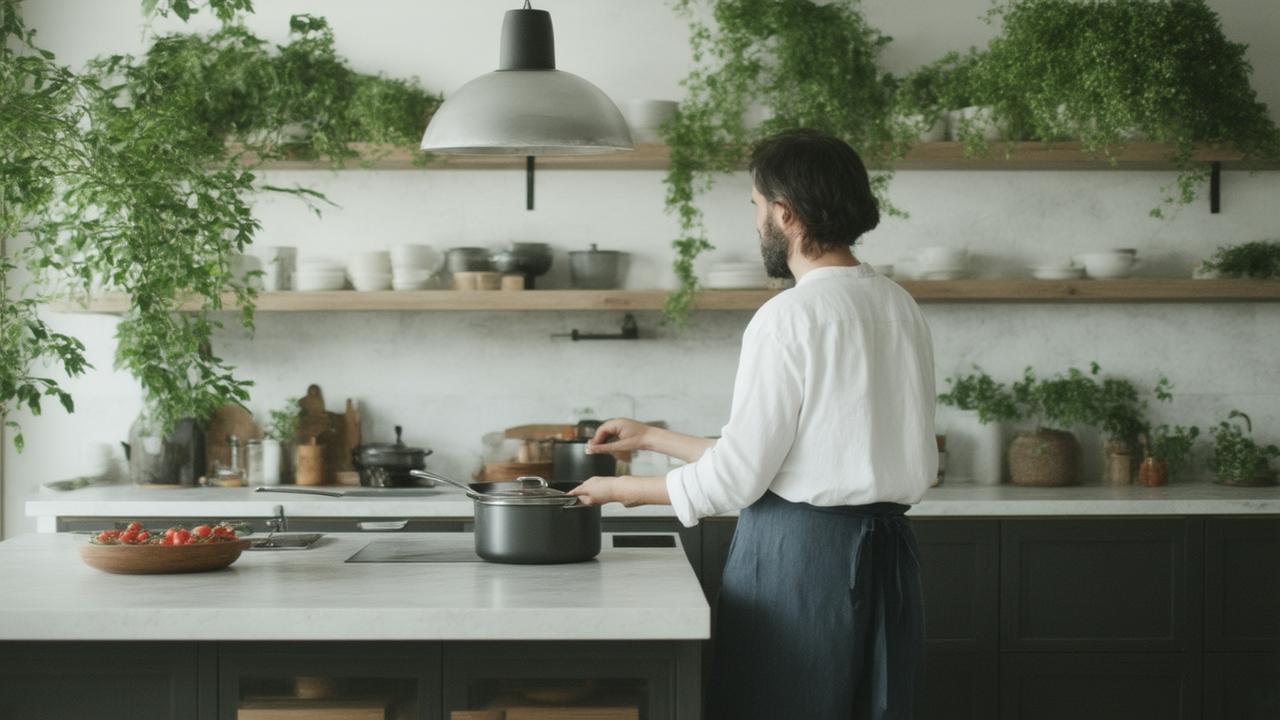
The first thing you notice when you walk into Mia and Leon’s kitchen isn’t the color of the cabinets or the curve of the faucet. It’s the sky. Or at least, that’s what it feels like. The walls stretch higher than you expect in such a small city apartment, unbroken by the hulking boxes we’ve all learned to accept as “normal” upper cabinets. Instead, light pours in and bounces freely. There are plants trailing from slim open shelves, a framed print leaning casually on a ledge, and the faint smell of toasted sourdough still hanging in the air.
“We didn’t realize how much those old cabinets weighed on the room,” Mia laughs, running her hand along the smooth surface of a deep drawer. “It felt like the walls were closing in on us. Now it just… breathes.”
The Quiet Revolution Happening Above Your Countertops
Across apartments, townhouses, and suburban homes, a quiet design revolution is taking place. Classic high kitchen cabinets—the tall, boxy storage that loomed above countertops for decades—are slowly disappearing. In their place: low, deep drawers, open shelves, and clever built-ins that hug the lower half of the room, leaving the upper walls open and light-filled.
This isn’t just a trend born for glossy design magazines and envy-inducing Instagram shots. It’s grounded in a surprisingly simple truth: most of us don’t use those sky-high cabinet spaces well, and many of us can’t comfortably reach them.
Think about your own kitchen. How many things are shoved into the top shelves “for later” and never seen again? How often have you teetered on the edge of a rickety step stool, fingertips grazing the bottom of a rarely used casserole dish? Over time, we’ve accepted inconvenience as standard—until now.
Why We’re Breaking Up with High Cabinets
For generations, high cabinets have been sold as the ultimate symbol of “more storage.” But more, we’re learning, isn’t always better—especially when much of that space is difficult to access and poorly organized. The shift away from tall uppers is driven by three deeply human desires: comfort, clarity, and calm.
First, comfort. As our understanding of ergonomics has filtered into everyday design, homeowners have started asking a simple question: Why do I need to reach, strain, or climb to get to basic items? Deep, full-extension drawers at waist height suddenly feel like a small luxury: you pull, you see everything at once, and you don’t have to stand on your tiptoes to do it.
Second, clarity. When upper cabinets are packed with items you rarely touch, they become a kind of storage graveyard. By focusing on easily reachable, right-sized storage, you’re gently forced to reconsider what really deserves a place in your kitchen. The result is often a more intentional, more visible arrangement of everyday tools and tableware.
And then there’s calm. Open walls and lower lines let light travel, soften visual noise, and make even small kitchens feel expansive. In a world that already feels crowded with screens, schedules, and notifications, the emotional sway of a calmer kitchen shouldn’t be underestimated.
The New Anatomy of a Comfortable Kitchen
Walk into a kitchen that’s said goodbye to classic high cabinets and you’ll likely notice a new layout logic. It’s not just about what’s missing; it’s about what’s been thoughtfully rearranged.
Below the countertop, wide drawers glide out effortlessly: plates stacked in tidy piles, pots nested without clanging, cutlery divided into slim wooden compartments. Everything is visible, everything at hand. Some drawers are double-deep, swallowing up tall items like blenders or big stockpots that once had to be wrestled out of a corner cabinet.
Above, instead of monolithic cupboards, you might see a few carefully placed open shelves. A row of everyday glasses, the mugs you actually love, a small stack of bowls, maybe a trailing pothos catching the morning light. The rest of the wall is just… wall. Maybe painted a deep, grounding color or left bright and pale to bounce light back into the room.
Pantries are evolving too. Rather than stuffing dry goods into a patchwork of upper and lower cabinets, more homes are carving out a specific vertical zone: a tall, narrow pantry with pull-out shelves, or a fully dedicated pantry closet. This brings the logic of a grocery store aisle home—everything vertical, visible, and accessible at once.
| Storage Approach | Classic High Cabinets | Low Drawers & Open Space |
|---|---|---|
| Accessibility | Requires reaching or a step stool for top shelves | Most-used items stored at waist or hip height |
| Visibility | Deep, dark corners where items get lost | Full-extension drawers show contents at a glance |
| Room Feel | Heavier, more enclosed, lower perceived ceiling | Lighter, more open, airier and taller-feeling |
| Decluttering Effect | Encourages “just in case” hoarding | Gently pressures you to own what you actually use |
| Aesthetic Impact | Traditional, sometimes bulky or boxy | Modern, minimal, emphasizes materials and light |
Designing for Real Life, Not Just for Show
The fear, of course, is always the same: “If I remove my high cabinets, where will everything go?” Hidden in that question is another, more revealing one: “Do I really need everything I’m storing now?”
Designers who champion low-storage layouts will tell you that the process starts not with demolition, but with editing. They’ll ask you to empty every cabinet, gather all your mugs in one place, stack your baking pans, line up your spice jars. It’s a confronting exercise. Suddenly you’re face-to-face with a lifetime of duplicates, well-meant gifts, and tools you used once five years ago.
From there, a more honest kitchen begins to emerge—one based on your real cooking habits. Do you bake every weekend? Then deep drawers for sheet pans and mixing bowls become non-negotiable. Are you more of a “one-pan dinner” cook? Then you might prioritize a tight, well-organized zone for your favorite skillet, oil, salt, and cutting board.
In many homes, this shift isn’t just about aesthetics. It’s about accessibility for aging parents, small children learning to help in the kitchen, or anyone with mobility limitations. A heavy dinner plate at shoulder height is an accident waiting to happen; the same plate at hip height can be lifted with ease and control.
Making Peace with Fewer Things
There’s another quiet, almost therapeutic side to this evolution: you come to terms with owning less. Without unlimited high-cabinet space, you’re nudged toward a more intentional collection of tools and tableware. One excellent chef’s knife instead of five mediocre ones. The three mixing bowls you actually use. The two vases that always make it to the table.
The absence of upper cabinets becomes an everyday reminder of sufficiency: there’s space for what you use, and not much more. That might sound restrictive, but many homeowners describe it as oddly freeing—like finally cleaning out a crowded closet and feeling your shoulders drop an inch in relief.
Light, Height, and the New Kitchen Mood
Where did we get the idea that every vertical inch in a kitchen must be filled? In smaller, older homes, the urge made sense: storage was a luxury. Over time, though, what began as necessity hardened into habit. Now, as more people work, eat, and socialize at home, the kitchen has become less of a closed-off workplace and more of a lived-in, shared space. Its mood matters.
Strip away the tall uppers and light begins to behave differently. Morning light can wash the entire wall, not just hover gloomily between cabinet frames. The ceiling feels higher, even if the measurements haven’t changed. Colors have room to breathe: a deep blue or earthy green doesn’t feel heavy when it’s not competing with long rows of boxes.
Even sound shifts. Without tall cabinets to bounce noise back at you, kitchens take on a softer acoustic texture. The clatter of dishes, the hiss of onions hitting hot oil, the quiet clink of a spoon in a mug of tea—these sounds settle into the space instead of ricocheting between hard surfaces.
➡️ Saudi Arabia quietly abandons its 100 mile desert megacity dream after burning billions and angry citizens demand to know who will answer for this colossal national embarrassment
➡️ Astronomers announce the official date of the century’s longest solar eclipse, promising an unprecedented day-to-night spectacle for observers
➡️ More and more people are wrapping their door handles in aluminum foil — and the reason behind this odd habit is surprisingly practical
➡️ By diverting entire rivers for over a decade, the Netherlands has quietly reshaped its coastline and reclaimed vast stretches of land from the sea
➡️ Day set to turn into night: the longest solar eclipse of the century is already scheduled : and its duration will be extraordinary
➡️ By dumping tonnes of sand into the ocean for more than a decade, China has managed to create entirely new islands from scratch
➡️ By pouring millions of tons of concrete into shallow waters year after year, China turned disputed reefs into permanent military outposts
From “Showpiece” Kitchen to Daily Sanctuary
In this new mood, the kitchen stops performing as a pristine showpiece and starts acting like a sanctuary for daily life. You’re more inclined to leave a book open on the counter, to let a bowl of fruit be the centerpiece instead of a styling prop, to hang a child’s drawing on that newly bare stretch of wall.
The absence of uppers doesn’t feel like something missing. It feels like you’ve finally given the room permission to exhale.
Making the Switch: Ideas You Can Actually Use
Not everyone is ready—or able—to strip out every high cabinet in one bold remodel. The good news is, this shift can be gradual and adaptable. It’s more of a conversation with your space than an all-or-nothing leap.
Start with a Single Wall
If a full renovation is off the table, try focusing on one section. Remove (or simply leave empty) the uppers on a single wall, patch and paint the surface, and install a couple of sturdy, narrow open shelves for your most-used dishes. Use the opportunity to re-home rarely used items into lower drawers or a nearby closet. Live with the change for a few weeks. Notice how it feels to have that one strip of visual quiet.
Rework the Low Storage You Already Have
Before blaming your upper cabinets for overcrowding, consider whether your lower ones are doing their fair share. Could a few deep drawers replace those awkward under-counter cupboards? Could you add pull-out trays, vertical dividers, or lazy Susans to make existing zones more usable? Sometimes, boosting the efficiency of lower storage is enough to free up the courage to empty the uppers.
Create a Dedicated Pantry Zone
Instead of scattering dry goods throughout three or four cabinets, carve out a single, intentional pantry area. This could be a narrow pull-out tower, a repurposed linen closet, or even a free-standing cabinet in an adjacent dining space. When you centralize food storage, the pressure on overhead cabinetry eases dramatically.
Use the Wall Thoughtfully—But Sparingly
Open shelves are often the first idea that comes to mind, but they’re not the only option. A simple rail with hooks for mugs or utensils, a magnetic strip for knives, or a slim ledge for spices can all live on the wall without visually closing it in. The key is restraint: leave stretches of blank wall so the eye can rest.
Plan for Tomorrow’s Body, Not Yesterday’s
When rethinking storage, imagine yourself ten or twenty years from now. Will climbing onto a stool feel as comfortable as it does today? Probably not. Designing with your future body in mind—fewer overhead lifts, more waist-level access—turns a design choice into a small act of long-term self-kindness.
FAQ
Will I lose storage space if I remove my high cabinets?
Not necessarily. Deep, well-organized lower drawers, a dedicated pantry, and a few strategic shelves often provide equal or better usable storage than poorly accessed high cabinets. You may own fewer items overall, but the ones you keep will be easier to reach and actually use.
Aren’t open walls and shelves harder to keep tidy?
They can be, if you overload them. The trick is to reserve open shelves for everyday items that move constantly—like glasses, bowls, and favorite mugs—and keep the rest tucked away in drawers or a pantry. When everything has a clear purpose and place, visual clutter stays under control.
Is this style only for modern or minimalist homes?
No. The idea of lowering storage and opening wall space works in many styles, from farmhouse to Scandinavian to classic European. Materials, colors, and hardware choices can lean traditional or contemporary while still embracing fewer high cabinets.
What if my kitchen is very small—don’t I need every inch of storage?
Small kitchens often benefit the most from this shift. Removing uppers on at least one wall can make a tight space feel twice as big. By focusing on smart lower storage, using vertical pantry solutions, and editing gadgets, you can maintain capacity without the boxed-in feeling.
Can I keep some high cabinets and still get the benefits?
Absolutely. This isn’t an all-or-nothing rule. Many people keep a short run of upper cabinets for items they truly use less often, while freeing up other walls. Even reducing uppers by half can noticeably improve light, airiness, and comfort in your kitchen.





