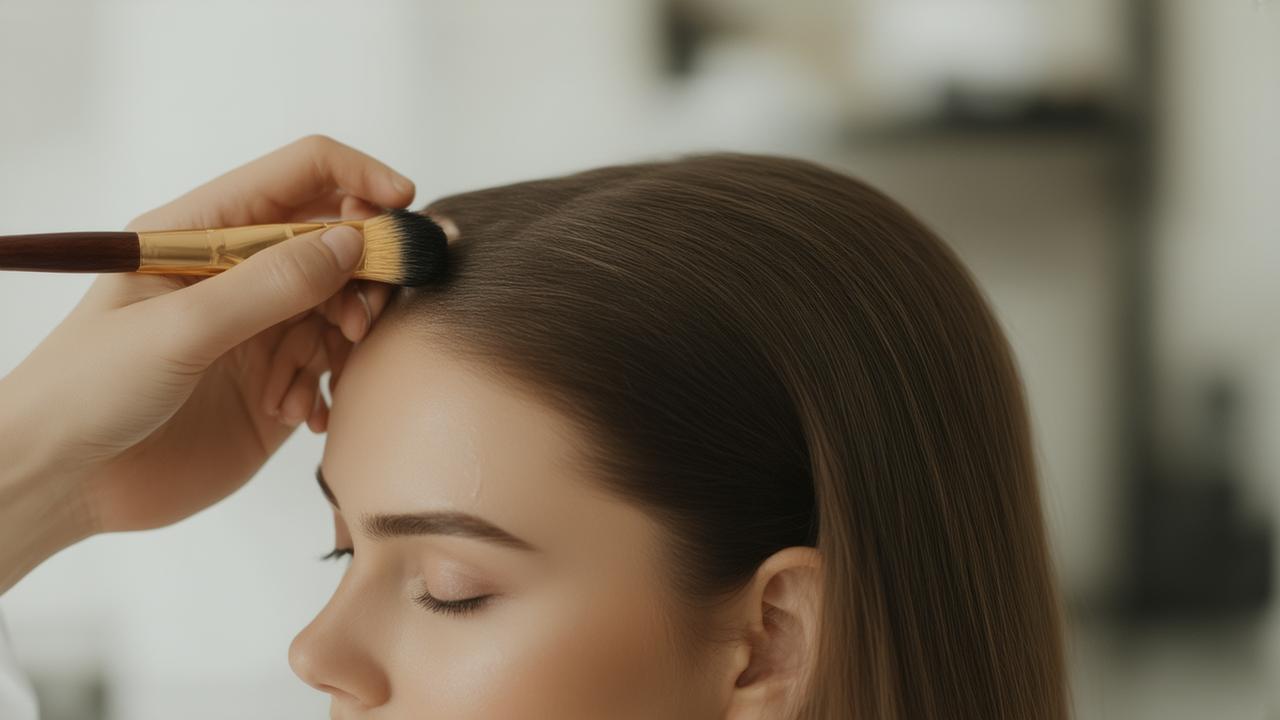
The sharp, chemical-sweet smell hits you before you even sit down. Foils crinkle like candy wrappers. Warm dye seeps against your scalp, and for a moment you feel it: that familiar sting followed by the thrill of transformation. Maybe you promise yourself, “This is the last time for a while.” But six weeks later, you’re back in the chair, chasing the same rush of new color, that polished, camera-ready version of yourself—while your scalp quietly begs for mercy.
The Secret Life of a Scalp
Under all that hair, your scalp is not just a blank canvas. It’s living tissue—thin, vascular, nervy, and surprisingly sensitive. When dye is brushed on, it’s not just coating hair. It’s soaking into that warm, fragile skin, swelling the cuticle of each strand, pushing pigments deep inside while your pores and follicles take a chemical hit.
Ask a stylist how often you can color your hair and you’ll usually hear some version of: “Every four to six weeks is fine.” Many are careful, conscientious professionals. They don’t want to hurt you. But they also live in a system where repeat appointments keep the lights on. Your root line, your split ends, your fading tone—these are not just beauty emergencies. They’re business models.
What you almost never hear is what the scalp feels like a year into that cycle. The creeping itch that doesn’t fully go away. The tightness after every wash. The soft, sandy sprinkle of tiny flakes you pretend is just “a bit of dry skin.” Or, more quietly still, the way the hairline itself can begin to thin—not suddenly, not dramatically, but like a shoreline eroding grain by grain.
When the Color Becomes a Craving
Hair dye addiction doesn’t look like an after-school special. It looks like calendar reminders for touch-ups. It looks like panicking when your natural color shows at the roots. It looks like never really seeing your own hair anymore—only the version that’s “fixed.”
In salons, you can watch the ritual unfold. A woman sits down, scrolling through photos of celebrities on her phone. “More ash, less warmth this time,” she says. She was here five weeks ago. The stylist hesitates, then mixes another bowl, reassuring her, “Your hair can handle it, don’t worry.” And technically, some hair can. The shaft might stay intact. The ends can be trimmed. A good conditioner can mask a lot of damage.
But the scalp? It doesn’t always shout. It whispers.
You feel the first whisper as a mild burn that you dismiss. Then maybe a red patch behind your ear. Maybe a little swelling around the hairline after a bold new shade. You chalk it up to “sensitivity” and carry on. After all, if it were truly dangerous, wouldn’t everyone be talking about it? Wouldn’t there be bright warning labels and stern lectures? But quiet harm rarely gets headlines.
The Sensation We Ignore
Imagine the scene: you’re leaning back at the rinse basin, warm water sluicing through your hair. The dye is washing away, and with it, the promise of a “new you” emerges. Your scalp tingles; the skin feels oddly tight, as if it’s been sunburned from the inside. There’s a faint metallic taste at the back of your throat from the fumes you’ve been breathing for the last hour. You notice all of this for a second, then bury it under the dopamine rush of transformation when you see yourself in the mirror.
And so you come back, again and again, each visit smoothing over the discomfort of the last. That’s how addiction works—not always loud and dramatic, but subtle and ritualized, masked by compliments: “Your hair always looks perfect.” “This color is so you.”
How Often Is Too Often, Really?
Ask five stylists how often hair can be safely dyed and you’ll likely get five slightly different, reassuring answers. But your scalp is not a brochure. It’s unique, moody, and very opinionated about what you put on it.
Here’s a simple way to think about timing from the scalp’s point of view:
| Coloring Habit | Typical Interval | Scalp Stress Level |
|---|---|---|
| Root touch-ups with permanent dye | Every 3–4 weeks | High (especially over 6+ months) |
| Full-head permanent dye | Every 6–8 weeks or more | Moderate to high |
| Bleaching/lightening | Every 8–12+ weeks | Very high, especially on scalp |
| Demi/semi-permanent (no ammonia) | Every 4–8 weeks | Lower, but not zero |
| Gloss/toner (acidic, low-peroxide) | Every 6–8 weeks | Lower to moderate |
Stylists often say “it’s safe” when what they really mean is “it’s common, and most people don’t have an immediate, dramatic reaction.” But “no emergency” is not the same as “no harm.” Chemical dyes—especially permanent ones—are designed to open the hair shaft and alter its pigment using strong agents like ammonia or ammonia substitutes and peroxide. Those same formulas inevitably touch your skin.
How often is too often? If your scalp had a voice, it might say: “Any schedule that doesn’t give me time to fully heal between applications is too often.” For many, that means spacing permanent dye sessions to at least 8 weeks, avoiding overlapping applications on already-colored hair, and treating bleaching as a special occasion rather than a standing monthly date.
Red Flags from Your Scalp
Your body is always sending clues. With hair dye, the scalp in particular has its own quiet language of distress:
- Persistent burning or stinging during application, not just a faint tingle
- Redness that lingers for hours or days afterward
- Flaky, rash-like patches or small blisters
- Areas of tenderness when you touch or comb your hair
- Increased hair shedding that feels different from your usual seasonal shed
These are not just “annoyances.” They are your skin’s version of an alarm bell. And yet, in salon chairs everywhere, people downplay them: “It always hurts a bit, I’m used to it,” they say, as if pain were part of the price of admission for beauty.
The Salon, the Science, and the Silence
Walk into a busy salon and there’s a kind of choreographed comfort. Mirrors glint. Blow dryers hum a white-noise lullaby. Bottles and jars line the shelves in soft, reassuring pastels. The language of the place is gentle: nourish, hydrate, protect, repair. It’s easy to forget that some of what’s being used is harsh by design.
Stylists are often taught that modern dyes are “much safer now” than they were decades ago—and that’s not entirely wrong. Formulas have evolved. Many of the worst offenders of the past have been removed or limited. Yet “safer” does not mean “risk-free,” especially for someone sitting in the chair every few weeks for years on end.
There is, too, the quiet pressure of the client-stylist relationship. You arrive with roots exposed like a confession. You apologize for not coming sooner. You wince and whisper, “It’s bad, isn’t it?” The stylist reassures. They fix. Their success is visible on your head as you leave, sleek and finished. Their failure—in the form of a sensitized scalp, in the slow burn of over-processing—doesn’t show up as clearly, or immediately. It accumulates at home, months or years down the line.
Why “Safe Enough” Isn’t the Same as Gentle
Chemical safety in cosmetics is a strange world of thresholds and averages. A product may be considered “safe” because, in controlled tests and typical use scenarios, it doesn’t cause acute harm for most people. But “most people” is a statistical comfort, not an individual guarantee.
If you are someone who colors every four weeks, year-round, for a decade, you are not the “average” user those assessments are based on. You are an edge case—living proof that “safe enough for most” can still be too much for one living scalp.
Learning to Live with Your Real Color (Sometimes)
There’s a reason hair dye sinks its hooks in so deeply. Color is identity. For many, gray hairs are not just pigment changes; they feel like betrayal. For others, bright tones or rich dark shades are a kind of armor—the version of themselves that feels most “true” happens to be chemically engineered.
The tricky part is finding a middle ground where you can enjoy that expression without turning your scalp into collateral damage. This usually means accepting a little more downtime between sessions, a little more of your real hair showing, and a little less control over the illusion of timeless, unchanging color.
➡️ Saudi Arabia quietly abandons its 100 mile desert megacity dream after burning billions and angry citizens demand to know who will answer for this colossal national embarrassment
➡️ Astronomers announce the official date of the century’s longest solar eclipse, promising an unprecedented day-to-night spectacle for observers
➡️ More and more people are wrapping their door handles in aluminum foil — and the reason behind this odd habit is surprisingly practical
➡️ By diverting entire rivers for over a decade, the Netherlands has quietly reshaped its coastline and reclaimed vast stretches of land from the sea
➡️ Day set to turn into night: the longest solar eclipse of the century is already scheduled : and its duration will be extraordinary
➡️ By dumping tonnes of sand into the ocean for more than a decade, China has managed to create entirely new islands from scratch
➡️ By pouring millions of tons of concrete into shallow waters year after year, China turned disputed reefs into permanent military outposts
Ways to Protect Your Scalp Without Giving Up Color
You don’t have to abandon dye to respect your scalp. You just have to renegotiate the relationship. Consider:
- Stretching your appointments by 1–2 weeks at a time instead of booking the earliest possible slot.
- Shifting from full-head permanent color to strategic techniques like balayage or highlights that leave more of your natural base untouched.
- Using demi- or semi-permanent dyes on lengths and reserving permanent dye only for stubborn roots.
- Requesting scalp protection such as barrier creams along the hairline and partings.
- Insisting on patch tests if you’ve had any past discomfort—not as a courtesy, but as a boundary.
There’s a quiet kind of bravery in letting your natural color peek through, even if just at the nape of your neck or at the underlayers. It’s a reminder to your brain: this is me, too. Not the version filtered through a chemical lens, but the one that grows out of my head without permission or polish.
Listening to the Skin Beneath the Style
Somewhere between the scent of developer and the glossy after-photos on your phone, it’s easy to forget that your hair story begins at the scalp. Every follicle is a tiny factory, fed by blood vessels you’ll never see, surrounded by skin that keeps showing up for you, even when you keep painting over it.
Hair dye addiction is rarely framed as addiction at all. It’s framed as upkeep, self-care, “looking put together.” But if the idea of going more than six weeks without coloring fills you with dread, if your calendar is organized around your next appointment for fear of anyone seeing your “real” roots, it might be time to ask: who is in control here, you or the bottle?
Stylists will likely keep saying it’s safe—because for many, in moderation, it can be. The missing question is not whether dye can be used safely, but whether you are using it gently enough for your scalp. Your skin already knows the answer. It speaks in tingles, burns, tightness, flakes, and shedding.
The next time you sit in that chair and feel the brush trace along your part, pause. Feel the coolness, then the slow bloom of warmth. Hear the rustle of foil, the low murmur of dryers, the chatter of others trading hours of their time and layers of their natural selves for color. Then quietly, maybe for the first time, ask your scalp what it wants.
You might find that “safe” isn’t a word on a label or a reassurance from a stylist. It’s a truce you make with your own biology: color when you must, rest when you can, and remember that the skin beneath the style is not a canvas—it’s you.
FAQ: Hair Dye, Scalp Health, and How Often Is Too Often
How often is it really safe to dye my hair?
For most people, spacing permanent dye sessions to at least every 8 weeks is gentler on the scalp, especially if the product touches the skin. Bleaching or high-lift color should be done even less frequently. Demi- and semi-permanent dyes may be used a bit more often, but your own scalp’s reactions should guide you.
Is it normal for my scalp to burn when dye is applied?
A mild tingle can happen, but burning, strong stinging, or pain is not “normal.” These are signs of irritation or a developing sensitivity. If you feel more than slight, brief discomfort, the product should be rinsed off and your stylist informed immediately.
Can frequent hair dye cause hair loss?
Repeated irritation and inflammation of the scalp can contribute to shedding and thinning over time. While dye alone isn’t always the main cause, over-processing combined with tight hairstyles, stress, or health conditions can create a perfect storm for hair loss.
Are “ammonia-free” or “natural” dyes completely safe?
“Ammonia-free” does not mean chemical-free, and “natural” does not always mean non-irritating. Many alternatives still use strong agents to change your hair color and can irritate sensitive scalps. Always patch test and pay attention to how your skin responds over multiple uses.
What are some signs I should take a break from coloring?
If you notice persistent itching, burning, redness, flaky patches, unusual shedding, or swelling around the hairline or ears, it’s a signal to pause. Give your scalp several weeks—or longer—without chemicals, use gentle care, and consult a dermatologist if symptoms continue.
How can I talk to my stylist about spacing out dye sessions?
Be direct and honest. Say something like, “My scalp has been feeling irritated, and I want to give it more time to recover between appointments. Can we plan a lower-maintenance color or technique that lets me come in less often?” A good stylist will respect your boundaries and help you adjust your routine.
Is there a way to keep coloring but reduce scalp exposure?
Yes. You can focus on techniques that keep dye off the scalp, like foils or balayage; use demi-permanent color on lengths while limiting permanent dye to minimal root areas; and apply barrier creams along the hairline. But even with these strategies, regular breaks and longer intervals are your scalp’s best friends.





