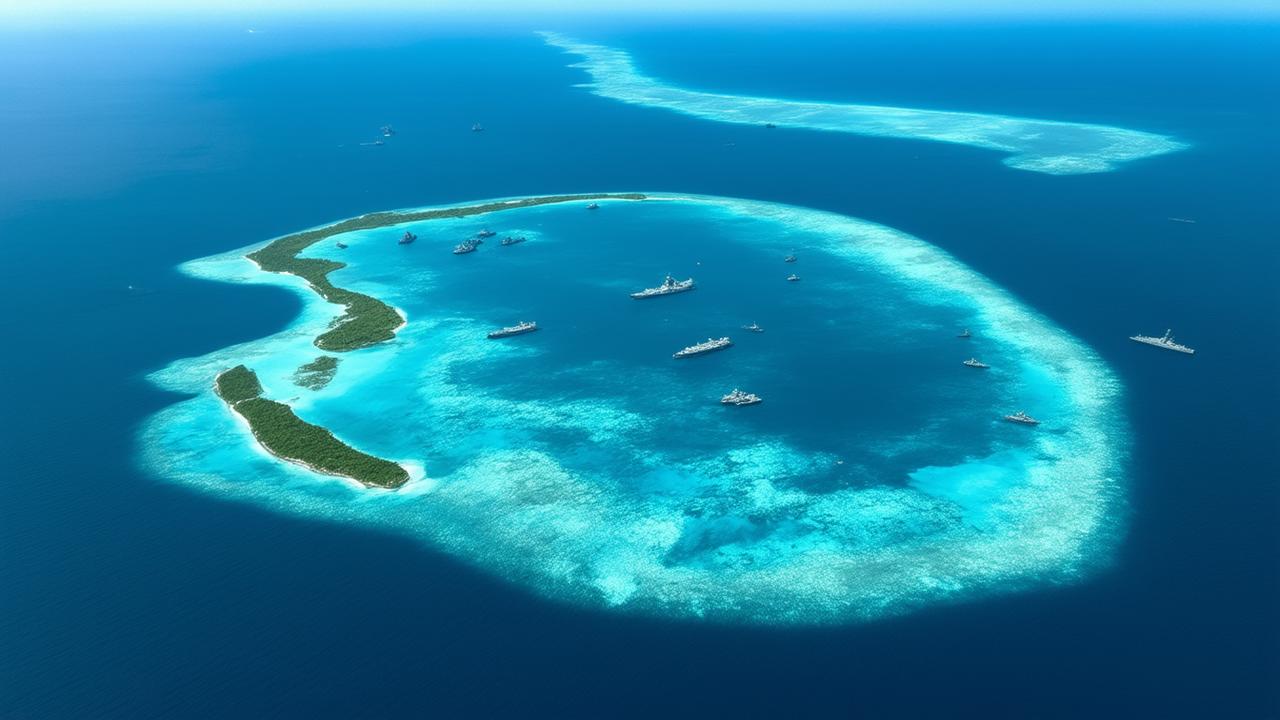
The reef is almost invisible at first—a pale green ghost under the wing of a passenger jet. From 30,000 feet, it looks like any other shimmer in the South China Sea: a ring of turquoise, a scatter of white where waves meet stone, and a quiet that seems eternal. But as the plane banks, the illusion breaks. A hard, geometric line cuts across the water. A runway glows in the sun. Radar domes sit like white blisters on a man-made island. Ships idle at immaculate piers that did not exist a decade ago. Here, in what was once just a scattered necklace of coral and surf, the sea has been turned to stone.
When the Ocean Started Turning to Concrete
Out on the water, you don’t hear politics first. You hear the engine thrum of a wooden fishing boat straining against the swell, the slap of waves on its hull, the rattle of plastic buckets rolling on deck. You smell diesel and salt and, faintly, mud stirred up from the seafloor. Yet every sound and smell now carries a new tension. Fishermen who once navigated by stars and currents now navigate by warning calls and radar shadows.
Not so long ago, the Spratly and Paracel Islands were, for the most part, hardly islands at all—just shoals and reefs, bare at low tide, swallowed again when the moon tugged the water higher. On nautical charts, they showed up as uneasy outlines and warnings: Dangerous Ground. Humans could visit, camp, set up temporary structures at best. Nature still held the upper hand.
Then the dredgers came—hulking, steel beasts that chew the ocean floor like mechanical whales. They arrived under cover of routine construction and scientific research, hooks sunk not into fish but into sand, clay, and coral rubble. Pump by pump, year after year, they swallowed the seabed and spat it onto the reefs in thick, wet plumes. Behind them followed concrete mixers and barges, cranes and prefabricated slabs, until what had been tidal whispers hardened into permanent silhouettes on the horizon.
By pouring millions of tons of concrete into shallow waters, China converted contested specks of geology into fortified platforms that no storm, and no tide, could easily erase. What were once shifting, living reefs became airstrips, ports, barracks, fuel depots, and radar stations—a vast, incremental act of cartographic alchemy: turn water into land, and land into leverage.
The Slow, Heavy Work of Making Land from Water
On an overcast morning, the sky the color of worn aluminum, imagine yourself on a survey vessel edging toward one of these transformed reefs. The water grows cloudy. The greens and blues that usually dance among the coral flatten into a dull, industrial gray. Nearer still, the sea loses even its scent of life, thinned by the chemical tang of fresh paint and machine oil carried on the wind.
Land reclamation sounds almost gentle—something associated with gardening, perhaps, or the patient drying of marshes. In practice, it is violence measured in cubic meters. Cutter-suction dredgers bite into the seabed, uprooting centuries-old coral skeletons, seagrass meadows, and the soft, shifting sediments that once provided nursery grounds for fish and crustaceans. The ocean around them turns thick and opaque, a tormented soup of sand and broken life.
The slurry is pumped onto the reef’s surface, where it spreads like a sluggish tan river across what used to be a mosaic of coral heads and tide pools. The sound of the pump is constant—like a jet taking off but never landing—while bulldozers growl back and forth, sculpting new shorelines as if the sea were just a stubborn pile of soil to be tamed.
Layer by layer, the elevation rises. Temporary seawalls of rock and sheet piles hold the new island in place. Then comes the concrete: poured into forms, woven with rebar, stacked into breakwaters and docks. It is poured into foundations for multi-story buildings, into pads for radar arrays, into towers where flags will fly and cameras will stare out over the horizon. What was once a reef just barely touching the surface now casts a clear, sharp shadow from orbit.
Where Sea Turtles Once Nested, Runways Now Gleam
It’s important to remember that, before it became a chessboard, this was a nursery. These shallows were where reef fish hid from predators, where clams anchored themselves to grow heavy and ancient, where sea turtles sometimes hauled out on rare scraps of sand to nest above the high-tide line. At night, under a full moon, the water used to shimmer with the phosphorescent glimmer of plankton and spawning coral.
Today, as aerial photos reveal, those same places bear razor-straight scars of human intent. One long arc of reclaimed land now hosts a full-length runway, flanked by hangars and storage facilities. Elsewhere, a once-ring-shaped atoll is choked by the square geometry of a harbor basin, its lagoon dredged deep enough to berth gray-painted warships. The coral gardens beneath have been buried or clouded beyond saving.
Consider the contrast that fits, uncomfortably, into a single frame: on one side, a clutch of reef fish flit nervously along the last living outcrop, dodging sediment clouds; on the other, farther above, a transport plane roars along a strip of concrete, carving the air over water shallow enough that you once could have waded across it at low tide.
The transformation is not subtle, and it is not slow anymore. Satellite images taken just months apart show the same reef swelling like a growing bruise, its edges squared off into something more like a fortress than a sandbar. Light that used to scatter in a thousand directions off the coral’s irregular surface now bounces off rooftops, cranes, and fuel tanks. At night, navigation lights blink where there used to be only the soft, organic glow of bioluminescence.
Concrete, Claim, and the Language of Power
Of course, the concrete is not poured only for the sake of infrastructure. It is poured as punctuation in an ongoing argument over maps and memory. Whose waters are these? Whose history? Whose future? In a region threaded by routes for global trade, rich with fish and rumored energy reserves, those questions are not academic.
For decades, claims to the South China Sea were scrawled in lines on paper—nine-dash maps, exclusive economic zones, historical routes whispered like family lore. But paper can be challenged. Lines can be redrawn. A reef covered at high tide, under international law, offers far fewer rights than an island that stands tall through any storm. And so, year after year, shovelful after shovelful, China has been rewriting geography with steel and stone, converting once-ambiguous features into permanent, garrisoned facts.
From afar, this strategy can be reduced to numbers: hectares reclaimed, runways completed, missile platforms detected. On the sea, it materializes in other ways. A Filipino captain, trying to reach a traditional fishing ground, is met by a radio voice demanding he turn back. A Vietnamese trawler finds itself facing a white-hulled coast guard vessel many times its size, floodlights blazing in the pre-dawn dark. A Malaysian crew watches as distant silhouettes—ships anchored near new artificial islands—never quite leave the edge of their radar screens.
Power, here, is no longer only about who can send the most ships in a crisis, but about who is physically present when the weather is bad, when the fish migrate, when a neighboring nation thinks twice about daring to appear. Concrete, rising in the surf, becomes a statement: We are here. We are not leaving.
Life, Loss, and the Quiet Things That Don’t Make Headlines
In the hushed language of environmental impact assessments, there is a phrase that sounds almost benign: “habitat alteration.” It does not conjure the dizzying image of a coral reef—home to thousands of species—suffocating under silt. It does not show the slow starve of giant clams deprived of light when the water around them turns permanently murky. It does not capture the way entire local food webs, built across millennia, can be gutted in a few construction seasons.
Concrete is permanent on a human timescale. Coral is not. When dredging begins, colonies that took centuries to grow are shattered in minutes. Fish that navigate by reef shape and current are suddenly homeless. Sea cucumbers, parrotfish, and small reef sharks retreat into fewer pockets of surviving habitat, packed tighter, more vulnerable to overfishing and stress. The reef’s ability to recover—a kind of biological memory—is erased with every load of fill dumped into the shallows.
Yet the loss is not only ecological. It is cultural, intimate. Fisherfolk in the Philippines, Vietnam, Malaysia, and elsewhere recall, with a kind of stunned nostalgia, reefs where they once camped on sandbars to dry their nets and gather shellfish. Those places are now behind exclusion zones, overlooked by watchtowers and patrolled by vessels that flash their lights like a warning heartbeat in the night.
➡️ Marine biologists warn of a troubling shift in orca interactions with vessels, as new research suggests learned aggression and humans refuse to change course
➡️ Psychology explains why overthinking at night is closely linked to the brain processing unresolved emotions
➡️ The forgotten kitchen liquid that leaves grimy cabinets smooth, clean, and shiny again with surprisingly little effort
➡️ “I’m a hairdresser, and this is the short haircut I recommend most to clients with fine hair after 50”
➡️ Drivers receive welcome news as new licence rules are set to benefit older motorists across the country
➡️ New spacecraft images expose interstellar comet 3I ATLAS with a level of detail scientists never expected
➡️ A retiree wins €71.5 million in the lottery, but loses all his winnings a week later because of an app
On a humid evening, in a coastal village that smells of grilled mackerel and woodsmoke, a fisherman might tell you how he used to read the color of the water to know which reef lay beneath his bow. Now, many of those colors are gone, replaced by a monotone smear from suspended sediments or the stark, reflective sheen of piers and seawalls. The names he gave each patch of sea—after a relative, a legendary catch, a near-miss with a storm—linger like ghosts with no place to haunt.
At a Glance: From Reef to Outpost
Viewed on a small screen, the scale of change can be hard to grasp. This simple overview offers a sense of how quickly and completely these reefs have been transformed:
| Feature | Before | After |
|---|---|---|
| Physical form | Low-tide reef, often submerged | Permanent island with raised platforms |
| Dominant material | Live coral, sand, seagrass | Concrete, steel, rock fill |
| Primary use | Fishing grounds, wildlife habitat | Military base, airstrip, harbor |
| Visibility | Barely visible from afar | Prominent structures, lights, radar |
| Legal status debate | Reef/low-tide elevation | Claimed as “island” with extended rights |
Is There a Way Back from All This Concrete?
Standing on the edge of one of these artificial shores—boots on concrete that did not exist when you were a child—you might wonder if any of it is reversible. The breeze still smells of salt. A few hardy terns still circle overhead, opportunistic as ever, waiting for discarded scraps from the mess hall or the galley of a patrol ship. Nature is not gone, only cornered into crevices and moments between patrol schedules.
Yet reefs, once buried, do not simply bounce back. You cannot unpour concrete. You can only stop adding more, and hope the surrounding ecosystems retain enough strength and diversity to knit new patterns of life in what space remains. Some scientists talk about restoration, about transplanting coral fragments and creating artificial structures where marine life might cling and rebuild. But such efforts are fragile, expensive, and no match for ongoing militarized construction.
So the question shifts. Less from Can we undo this? to What will we choose not to do next? Will more reefs become unmovable outposts? Or will the line be drawn somewhere, leaving at least pockets of the sea to continue their quiet, ancient labor of supporting life without runways and radars peering over their shoulders?
Far above, the jet you first imagined arcs away toward some distant city. Its passengers see, if they look carefully, a scattering of pale shapes below: islands that were not there not so long ago, each one a concrete syllable in a sentence still being written across the South China Sea. Down on the water, a fisherman adjusts his course by a few degrees, not because the currents have changed, but because the map in his mind now includes something new and immovable. And under the surface, the surviving fragments of reef carry on, filtering water, hosting larvae, tracing faint outlines of what used to be—waiting, in their slow, patient way, to see what kind of future the surface will allow.
Frequently Asked Questions
Why is China pouring concrete into shallow waters in the South China Sea?
China has been reclaiming land on reefs and shoals to create artificial islands that can support military facilities, airstrips, ports, and radar stations. Turning submerged or low-tide features into permanent outposts strengthens its physical presence and bolsters territorial claims in disputed waters.
How does this construction affect the marine environment?
Dredging and land reclamation damage or destroy coral reefs, seagrass beds, and critical nursery habitats for marine life. Sediment clouds smother nearby reefs, while the new concrete structures permanently alter local currents, light levels, and water quality, reducing biodiversity and ecosystem resilience.
Are artificial islands legally recognized as territory under international law?
Under the United Nations Convention on the Law of the Sea, artificial islands do not generate their own territorial sea or exclusive economic zones. Natural islands can, but low-tide elevations and submerged features generally cannot—regardless of later construction. This gap between legal principles and on-the-water realities is part of what makes the situation so contentious.
Who else is affected by these artificial islands?
Fisher communities and coastal nations around the South China Sea—including the Philippines, Vietnam, Malaysia, Brunei, and others—are directly affected. Traditional fishing grounds become harder or riskier to access, and the growing military presence raises tensions for all regional states.
Can the damaged reefs ever be restored?
Some limited restoration is possible—through coral gardening, artificial reef structures, and careful protection of remaining habitats—but fully recovering a complex, ancient reef that has been buried or heavily dredged is unlikely on human timescales. The most effective “restoration” is preventing further large-scale destruction.





