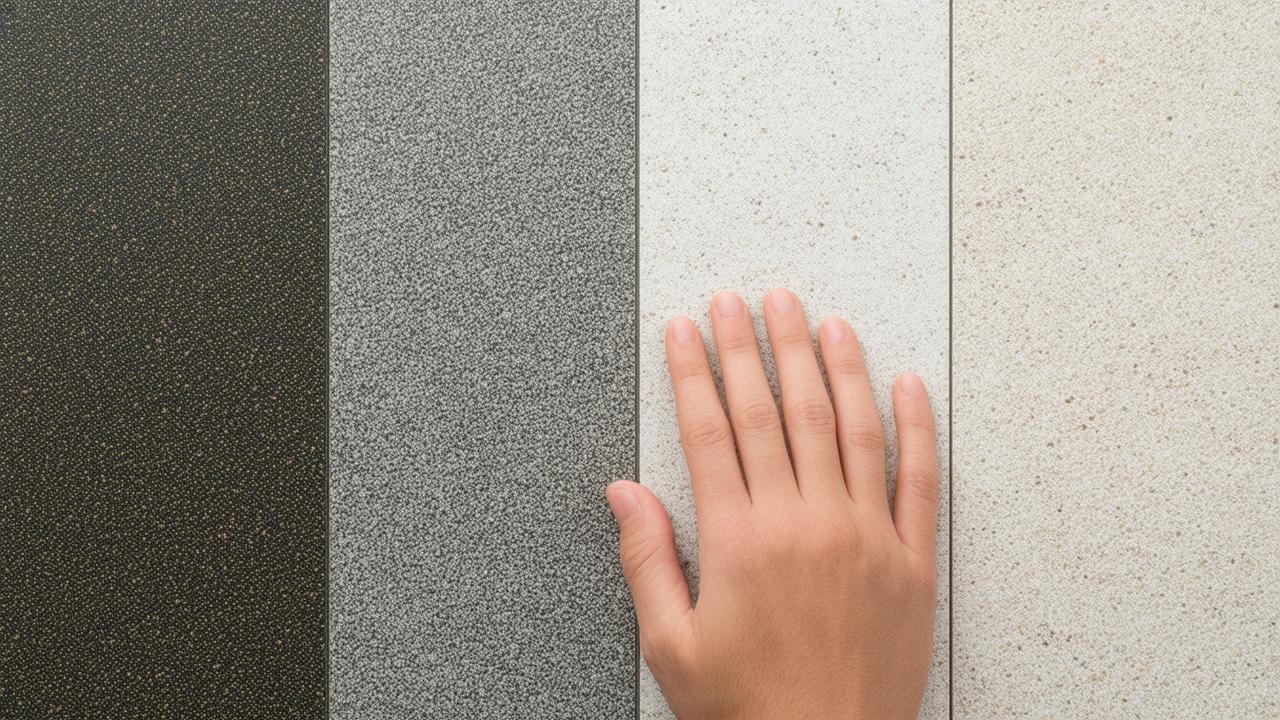
The first thing you notice is the quiet. Not the empty kind, but the softened kind—the way footsteps fall like a whisper across the floor instead of a hard echo. Sunlight drifts through the window and catches a surface that looks like poured stone, cool and continuous, but it feels… warmer than concrete has any right to feel. You press your palm against it again just to check. Not cold. Not plasticky. Just… right. This is not microcement; this is its successor—calmer, cleverer, and possibly the future of how our homes will feel beneath our hands and feet.
The Rise and Plateau of Microcement
For a few years, microcement felt like the answer to everything. Designers whispered about it like a secret: a thin, seamless coating that could go over tiles, wood, existing floors, walls, even countertops. Suddenly, bathrooms became smooth, slab-like sanctuaries. Kitchens looked like minimalist art galleries. No grout lines. No joints. Just one continuous, pale, stone-like skin.
It was easy to see the appeal. Microcement promised the industrial charm of concrete without the bulk, the weight, or the months-long install. It could be tinted into soft greys or warm beiges, stretched across curves and corners, and sold as “almost anything-proof.” Trend-conscious homeowners took notice. Influencers took photos. Hotels and cafes caught on.
But in the quiet corners—behind the styled shoots and the glowing captions—another story brewed. Microcement, it turned out, was a little more demanding than its dreamy images suggested. Surfaces cracked when the subfloor moved, stains proved stubborn, bathroom floors became unexpectedly slippery, and installation was an art form that not every contractor knew how to master. In the wrong hands, or in the wrong conditions, microcement aged badly.
By the time the aesthetic had peaked on social media, another shift had already begun: people wanted the same clean, continuous look, but with more forgiveness, more softness, more resilience. They wanted the feeling of nature, but with technology on their side. Out of that tension, a new material quietly stepped forward.
The New Surface: Mineral-Resin Seamless Flooring
This is where the story of microcement starts to fade, and a new character enters: mineral-resin seamless flooring and wall systems—known under different brand names, but sharing the same basic DNA. Think of them as the next evolution in “stone look” surfaces: part mineral, part resin, fully engineered for real living.
At a glance, it looks similar to microcement: smooth, matte, and continuous, with that modern, monolithic presence designers love. But run a bare foot across it and you feel the difference. The finish has a gentle give, a soft understep that microcement and poured concrete never had. It doesn’t feel as brutalist; it feels… inhabitable.
These systems blend finely ground minerals (often marble or quartz powders, and other natural aggregates) with advanced resins that add flexibility and strength. The result is a thin, highly durable coating that can go over existing substrates—yes, even old tiles—without building up heavy thickness. It remains breathable, resists cracking better than microcement, and offers more tailored textures: from silky to subtly grainy, depending on where it’s used.
In bathrooms, that means a floor you can step on with wet feet and not immediately brace for a slip. In kitchens, it means splashes, oil, and coffee reacting more like they would on a high-performance surface than on a raw, porous finish. In hallways, it means high traffic without developing that tired, patchy look as quickly.
A Material That Behaves More Like a Living Surface
What makes this shift so compelling isn’t just performance—it’s personality. Mineral-resin surfaces are not trying to look like copies of something else. They don’t attempt to perfectly mimic marble veining or oak grain. Instead, they embrace a calm, almost meditative visual language: soft clouding, gentle tonal changes, the kind of variation that echoes stone or clay plaster without pretending to be either.
Stand in a room finished with this new generation material and you don’t immediately think “trend.” You think space. Air. Light. The walls and floors step back, almost as if they know you’ll bring your own story into the room—with textiles, plants, art, and the mess of daily life. It’s quietly generous.
And because the resin component introduces controlled flexibility, the surface adapts better to the building beneath it. Wood subfloors expand, tiles shift microscopically, humidity rises and falls—and the coating moves just enough to avoid the hairline fractures that have become microcement’s unhappy signature.
Why Microcement Is Losing Its Crown
Trends don’t end overnight. Microcement will continue to live on in older renovations, in certain commercial spaces, in the feeds of stylistic purists. But if you pay attention to the homes being quietly reshaped now—the thoughtful renovations, the carefully paced builds—there’s a clear reason designers are shifting to mineral-resin and other new seamless systems.
Below is a simple comparison that captures how the two materials now stand side by side in real homes:
| Feature | Microcement | Mineral-Resin Seamless Surface |
|---|---|---|
| Thickness | Very thin, but rigid | Very thin, with slight flexibility |
| Crack Resistance | Prone to hairline cracks if substrate moves | Better at absorbing small movements |
| Moisture & Stains | Requires careful sealing, can stain or mark | Improved resistance, easier day-to-day care |
| Comfort Underfoot | Feels cool, hard, more like concrete | Slightly warmer, more forgiving |
| Slip Resistance | Can be slippery when wet, needs care in bathrooms | Can be formulated with subtle texture for better grip |
| Installer Skill | Very demanding; mistakes are hard to fix | Still specialist, but generally more forgiving |
None of this makes microcement a “bad” material. It simply reveals that it belongs to a specific moment—a step on the path toward something more nuanced. As our expectations change, materials that behave better, last longer, and ask a little less anxiety of us find their way to the front of the line.
Nature, Edited Gently
Perhaps the most intriguing thing about this new wave of seamless surfaces is how they reinterpret our longing for nature indoors. We want stone, earth, clay—but we also want easy cleaning, underfloor heating, and a toddler dropping spoons without leaving a lifetime scar.
Mineral-resin systems feel like a gentle edit of nature rather than a counterfeit. The mineral content—pulverised rock, ground earth—keeps the visual depth and subtlety that raw stone carries. The resin is the editor: refining, protecting, rounding the edges of reality just enough to fit a life full of pets, parties, and the occasional red wine spill.
There’s something psychologically soothing in that combination. The surface reads as natural, matte, and grounded, but behaves in a way that respects our modern mess. This is where we are now: craving the sensory calm of natural materials without wanting to live in a museum of fragile surfaces.
How It Changes the Feel of Home
Imagine walking into a small city apartment on a winter evening. Instead of fractured zones—tiles in the hallway, laminate in the living room, something else in the kitchen—one continuous, lightly textured surface runs from the doorway to the farthest corner. The space feels larger, tidier, almost as if someone quietly smoothed out the visual noise.
The walls in the bathroom rise from that same floor in a soft, chalky finish. No tile lines. No silicone edges blooming with age. Water beads, then glides away, leaving no drama behind. The room feels like a single, carved-out volume—cave-like in the calming sense, not dark, but enveloping.
These new materials don’t shout for attention. They let light have the starring role. Morning sun draws long, gentle gradients across them; evening lamplight turns them into a soft backdrop for everything else that lives in the room—furniture, books, a trailing plant splayed against the wall.
Over time, what changes isn’t just how your home looks, but how you move through it. You stop noticing where one room ends and another begins. Doors open not into different “zones” of flooring, but into different moods underlined by the same quiet continuity. The home stops feeling like an assembly of products and finishes, and more like one coherent, unfolding story.
Living with the Next Generation of Surfaces
Of course, no material is magic. Mineral-resin surfaces still need thought: a suitable substrate, skilled installation, respect for drying times. Heavy, sharp objects can still damage them. Strong chemicals can still dull them. Life leaves traces; that’s part of the beauty.
➡️ 6 old-school habits that people in their 60s and 70s refuse to drop and that make them happier than tech?obsessed youth
➡️ Bad news a 135 fine will apply to gardeners using rainwater without authorization starting February 18
➡️ A growing lifestyle trend among seniors: why more “cumulants” are choosing to work after retirement to make ends meet
➡️ Baking soda becomes the unexpected remedy for wrinkles and dark circles say beauty specialists
➡️ 3I/ATLAS: a strange radio signal was detected from the interstellar comet
➡️ Car experts share the winter tire-pressure rule most drivers forget
➡️ 10 dishes you should never order in restaurants, according to professional chefs
But the day-to-day reality becomes gentler. Spills wipe away without a panic search for the “right” cleaner. Joints and grout lines no longer hoard dirt in unseen crevices. Kids and dogs turn from threats into just… part of the equation. Maintenance becomes routine instead of ritual.
On a deeper level, there’s a subtle shift in attitude: from being a guardian of perfection to being a companion to patina. These new surfaces are built with a kind of flexible strength that accepts small scuffs and marks as part of the room’s story, not as a failure of the material. You’re less likely to tiptoe around your own home.
So, What Comes After Microcement?
In the end, saying “it’s the end of microcement” isn’t a criticism; it’s an acknowledgment that we’re stepping into a new chapter of how we shape our spaces. Microcement helped us discover what we loved: seamlessness, softness of colour, the erasure of visual clutter. It also taught us what we didn’t want to tolerate forever: brittle perfection, anxiety about cracks, and a finish that didn’t always bend with real life.
Mineral-resin seamless surfaces—and their close relatives in the new generation of thin, continuous finishes—are stepping in to answer that tension. They bring the mood of stone and earth indoors, refine it with modern science, and offer us homes that feel calmer and kinder without demanding constant vigilance.
We are moving toward materials that are less about making a statement and more about holding space. Surfaces that feel like a deep breath rather than a visual exclamation mark. Rooms that ask how you live and quietly adapt, instead of insisting you adjust to them.
One morning, years from now, you might look down at your floor—softly sunlit, unbothered by time—and try to remember when we thought grout lines were inevitable, when cracks were just “part of the look,” when every new finish felt like a gamble. And you’ll realise that the end of microcement was never a loss. It was a door quietly opening to a more forgiving, more grounded way of living with the materials that surround us every day.
FAQ
Is microcement still a good option for renovations?
Microcement can still work well in carefully managed projects with a stable substrate and highly skilled installers. However, many designers now prefer newer mineral-resin systems because they are more flexible, more forgiving, and better suited to everyday wear and moisture.
Can mineral-resin seamless surfaces go over my existing tiles?
In many cases, yes. As long as the existing tiles are sound, well-adhered, and properly prepared, these systems can be applied over them, reducing demolition waste and saving time. An assessment by a specialist installer is essential.
Are these new surfaces suitable for bathrooms and wet rooms?
They are particularly well-suited to bathrooms and wet rooms. When combined with proper waterproofing, they create a continuous, joint-free surface that’s easier to clean and can be finished with textures that improve slip resistance.
Do mineral-resin floors work with underfloor heating?
Yes. Their low thickness and mineral content allow heat to pass through efficiently. The slight flexibility of the resin component also helps accommodate thermal expansion, reducing the risk of cracks compared to more rigid systems.
How do you clean and maintain these new seamless finishes?
Maintenance is generally straightforward: regular vacuuming or sweeping, plus mopping with a mild, neutral cleaner. Harsh chemicals and abrasive pads should be avoided, but day-to-day care is usually easier than with porous or heavily jointed surfaces.
Will the surface look too “industrial” for a warm, cozy home?
Not necessarily. Modern mineral-resin systems come in warm neutrals, soft textures, and matte finishes that pair beautifully with timber, textiles, and plants. Instead of a harsh industrial look, they can create a calm, quietly natural backdrop.
Is this type of surface environmentally friendly?
Environmental impact varies by brand and formulation. Many systems use mineral components and low-VOC resins, and installing them over existing substrates can reduce demolition waste. If sustainability is a priority, ask specifically about VOC content, recyclability, and manufacturing practices when choosing a product.





