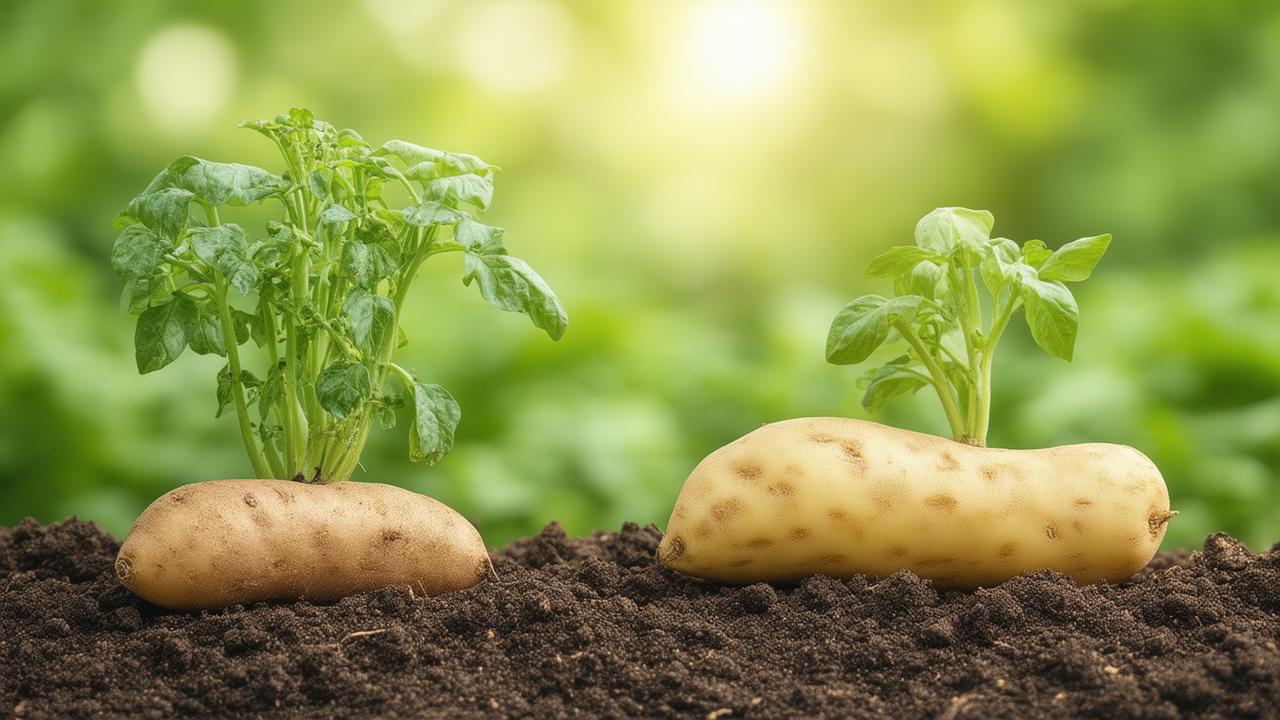
The knife slides through the orange flesh with a soft sigh, and for a moment the whole kitchen smells like autumn. You scoop the cubes of sweet potato into a bowl—bright as sunset—right beside a pile of pale, starchy regular potato pieces. Side by side, they look like cousins getting ready for the same family reunion: similar shape, shared destiny in the oven, a little olive oil and salt, maybe some rosemary if you’re feeling ambitious. Most of us never question it. One is just the colorful, sugary version of the other, right?
Not even close.
Hidden beneath the cutting board is a quiet botanical plot twist: sweet potatoes and regular potatoes are almost strangers in the plant world. They live in different families, have different evolutionary histories, and even make their own signature chemicals. The fact that they both ended up called “potato” is more of a historical accident than a scientific truth.
Once you know this, you start to notice the differences everywhere—on your plate, in the soil, even in the way they flower and defend themselves against hungry insects. The story of these two “potatoes” is less about how alike they are and much more about how two wildly different plants ended up filling a similar niche in our kitchens, our diets, and our imaginations.
How Two “Potatoes” Ended Up With the Same Name
To understand how this confusion started, you have to picture early European explorers sailing into new worlds with old vocabularies. They arrived in the Americas and met plants and foods they’d never seen before—underground treasures that sustained entire civilizations.
In the Andean highlands, they found Solanum tuberosum, the plant we know today as the regular potato. Above ground, it had small, starry flowers and green leaves; below ground, it produced plump tubers that could survive frosts and droughts, feed families for months, and even be dried into long-lasting stores. The local people already had names for it, of course. But as the plant crossed oceans, Europeans did what they often did with new discoveries: they bent unfamiliar words into familiar shapes. “Patata,” “batata,” “papa”—words from Indigenous and Spanish tongues mingled and eventually settled into “potato.”
Farther north and across other tropical regions, another plant grew: Ipomoea batatas, the sweet potato. Its vines sprawled, its leaves unfurled in lush, heart-shaped patterns, and its roots swelled with sweet, orange or cream-colored flesh. Once again, Europeans encountered a vital staple and folded it into their old language. This time, the Indigenous “batata” for the sweet potato collided with “papa” for the regular potato, and the linguistic tangle stuck. Both plants—so different in their biology—ended up sharing the same English word: potato, with a small patch, “sweet,” added to one of them like a name tag hastily pinned to a stranger.
Names have power. Say “potato,” and most of us picture something round, earthy, and starchy, maybe with a few eyes peeking through thin brown skin. We don’t usually picture winding vines with trumpet-like flowers, or a plant that’s more closely related to morning glories than to french fries. But that’s exactly what a sweet potato is.
The Botanical Plot Twist: Different Families, Different Stories
If you followed a sweet potato plant and a regular potato plant back through their family trees like a long, leafy genealogy, you’d eventually realize they don’t sit at the same table at all.
The regular potato belongs to the Solanaceae family—the nightshades. This is the same clan that includes tomatoes, eggplants, and peppers. It’s a dramatic family, full of edible superstars but also infamous for its more toxic members like deadly nightshade. Nightshades tend to produce particular alkaloid chemicals, some of which protect them from insects and animals. In high enough amounts, those compounds can be dangerous for humans too. That’s why we don’t eat potato leaves and why green-tinged potatoes make nutritionists nervy.
The sweet potato, meanwhile, lives in a very different neighborhood: the Convolvulaceae family, better known as the morning glory family. If you’ve ever seen morning glory vines climbing a fence, blooming with funnel-shaped flowers that open to the sunrise, you already know the sweet potato’s cousins. They’re twining, light-seeking plants, more often admired for their blossoms than harvested for their roots.
Here’s where it gets fascinating: sweet potatoes and regular potatoes do share some distant, ancient ancestry (all plants do, if you go back far enough), but in botanical terms they’re not close at all. They’ve traveled down separate evolutionary paths, refining different survival strategies, forming different chemicals, and adapting to different niches—yet still ending up as staple foods that humans tuck into stews, pies, and casseroles.
Underground Architecture: Tuber vs. Storage Root
From the kitchen counter, the differences look simple: one is orange (usually), the other pale. One tastes sweet, the other savory. But below ground, their bodies tell a deeper story.
The regular potato forms a tuber—a swollen portion of the stem that grows underground. Those little “eyes” are actually buds from which new shoots can grow. If you plant a chunk of potato with a few eyes, it can sprout an entirely new plant. The tuber is a kind of living pantry, stocked with starch to power future growth and survive rough seasons.
The sweet potato, by contrast, grows a storage root. It’s not a stem at all, but a root that’s thickened and loaded with energy—largely as complex carbohydrates that skew sweeter. The way it forms, the tissues involved, even the way it branches off inside the soil are different from a true tuber. Plant a chunk of sweet potato, and it won’t sprout the same way a regular potato does; instead, growers use “slips”—shoots grown from the root—to start new plants.
Same kitchen job, totally different anatomy. It’s like comparing a cellar carved under a house to an attached garage: both can store your supplies, but they’re built from different parts of the building for different reasons.
On the Tongue: Why They Taste So Different
Your senses already know something your brain might not have put into words: sweet potatoes and regular potatoes don’t feel the same in your mouth, don’t cook the same way, and don’t leave the same flavor echo after you swallow.
That difference starts in their chemistry. Regular potatoes lean heavily on starch—particularly amylopectin and amylose. These starches influence how fluffy a baked potato becomes, how crisp fries can get, and how well a mash will hold its shape. Bite into a boiled potato and you get that soft, mealy texture that seems to drink in butter and salt.
Sweet potatoes also contain starch, but they pack more natural sugars—like sucrose and maltose—and a slightly different balance of starch types. As they cook, some of those starches break down into sugars, concentrating that caramel-like sweetness and yielding a creamy, almost custard-like interior. Roast them slowly and they seem to turn into dessert right on the sheet pan.
Their nutrient profiles diverge too. Sweet potatoes are famous for their bright orange color, which comes from beta-carotene, a precursor to vitamin A. Regular potatoes, especially with their skins on, are more about potassium and vitamin C. To make the contrast easier to see, imagine them side by side in a simple table:
| Feature | Regular Potato | Sweet Potato |
|---|---|---|
| Plant family | Solanaceae (nightshade) | Convolvulaceae (morning glory) |
| Underground part | Stem tuber | Storage root |
| Typical flavor | Mild, starchy, savory | Sweet, earthy, caramel-like |
| Notable nutrients | Potassium, vitamin C, B vitamins | Beta-carotene (vitamin A), fiber |
| Above-ground look | Bushy plant, nightshade flowers | Trailing vine, morning-glory-like flowers |
What’s striking is that our taste buds, which judge food on flavor and texture, fooled us into lumping these two plants together. It’s only when you zoom out to the plant’s whole body—to its flowers, leaves, roots, and ancestry—that the illusion falls away.
Poison, Protection, and Plant Personalities
Every plant, whether growing in a garden bed or on a wild hillside, fights a quiet, daily battle: against insects, fungi, hungry mammals, and the stress of sun and drought. Over millions of years, they’ve evolved their own unique chemical defenses, and this is where the difference between sweet potatoes and regular potatoes gets especially vivid.
➡️ Eclipse of the century will plunge millions into six minutes of darkness scientists divided over health risks and religious groups prepare for chaos
➡️ Half a glass and a toilet bowl like new: smart ways to restore old sanitary ware
➡️ 9 things you should still be doing at 70 if you want people to one day say, “I hope I’m like that when I’m older”
➡️ A rare giant bluefin tuna is measured and confirmed by marine biologists using peer-reviewed protocols
➡️ A state pension cut is now approved with a monthly reduction of 140 pounds starting in February
➡️ A simple pantry powder rubbed on car plastics restores a deep factory sheen that even surprises seasoned mechanics
➡️ A father splits his will equally between his two daughters and son: but his wife says it’s unfair because of wealth inequality: “They’re all my kids”
Nightshades like the regular potato produce glycoalkaloids, such as solanine and chaconine. These compounds help deter pests, but they can be toxic to humans at high levels. That’s why we’re warned not to eat green or sprouted potatoes; the greenish tint often signals higher glycoalkaloid levels. Cooking helps, but can’t fully remove them. So we carefully peel, trim, and avoid the bitter, off-tasting bits almost by instinct.
Sweet potatoes, from their different family line, build a different chemical toolkit. They’re not burdened with the classic nightshade glycoalkaloids. Instead, they rely more on other compounds and a tough, fibrous structure to resist pests and disease. Their skins and pigments contain a variety of antioxidants; some varieties are deep purple, packed with anthocyanins that give them the same rich hues found in berries.
This divergence in chemistry doesn’t just shape how animals treat them; it shapes how we, as humans, learned to cook and trust them. People in potato-growing cultures developed folk knowledge—don’t eat that part, scrape off the green, store them in the dark—while sweet potato traditions evolved differently: cure them after harvest, let the sweetness deepen, roast them slow, treat them almost like a root dessert.
Different Histories, Shared Future on the Plate
Wander through markets across the world and you’ll see the story of these two almost-strangers laid out in crates and baskets. In the Andes, regular potatoes appear in dazzling diversity: knobbly, blue-skinned, fingerlike, long and twisted, each one tied to specific altitudes and microclimates. In parts of Africa and Asia, sweet potatoes wind their way through fields, their leaves sometimes harvested as greens while the roots fatten quietly below.
Despite their differences, both plants stepped into the same role in human history: as stay-alive foods, as comfort foods, as humble staples that could turn scarcity into survival. They share space on holiday tables and in school lunches, in street food stalls and home gardens. You could build an entire meal from one or the other, and many cultures have.
There’s a kind of poetic symmetry in that. Two plants, born from distinct evolutionary paths, ended up solving the same problem for us: how to store sunlight in a form that can carry us through winter, drought, or hard times. We call them both “potato,” but the name is a thin layer of paint over a much richer, deeper story.
Frequently Asked Questions
Are sweet potatoes and yams the same thing?
No. True yams belong to yet another plant family, Dioscoreaceae. They are typically starchier and less sweet than sweet potatoes and have a rough, bark-like skin. In many supermarkets, orange-fleshed sweet potatoes are labeled “yams,” but botanically they are still sweet potatoes.
Are sweet potatoes healthier than regular potatoes?
They’re just different. Sweet potatoes are richer in beta-carotene (vitamin A) and often have more fiber, while regular potatoes provide more potassium and vitamin C. Both can be part of a healthy diet, especially when baked, boiled, or roasted rather than fried.
Can people who avoid nightshades eat sweet potatoes?
Yes. Sweet potatoes are not nightshades; they belong to the morning glory family. People avoiding nightshades for health reasons typically can still eat sweet potatoes without issue, though individual sensitivities can vary.
Why do some potatoes turn green, and is that dangerous?
The green color in regular potatoes comes from chlorophyll produced when they’re exposed to light. While chlorophyll itself isn’t harmful, its presence often indicates increased levels of glycoalkaloids, which can be toxic in large amounts. It’s best to trim away green parts or discard very green potatoes.
Can you grow sweet potatoes and regular potatoes the same way?
Not exactly. Regular potatoes are usually grown from “seed potatoes”—pieces of tuber with eyes. Sweet potatoes are often grown from “slips,” which are shoots that sprout from the storage root. They also prefer slightly different conditions: sweet potatoes thrive in warmer, longer seasons, while many regular potato varieties tolerate cooler climates.
Why do sweet potatoes get sweeter when baked?
As sweet potatoes bake slowly, enzymes break some of their starches down into simple sugars. The heat concentrates moisture and caramelizes these sugars near the surface, intensifying their natural sweetness and creating that rich, almost dessert-like flavor.
Is it safe to eat sweet potato leaves?
Yes. Unlike regular potato leaves (which are from a nightshade and should not be eaten), sweet potato leaves are edible and commonly used as leafy greens in many cuisines. They’re usually sautéed, steamed, or added to soups and stir-fries.





