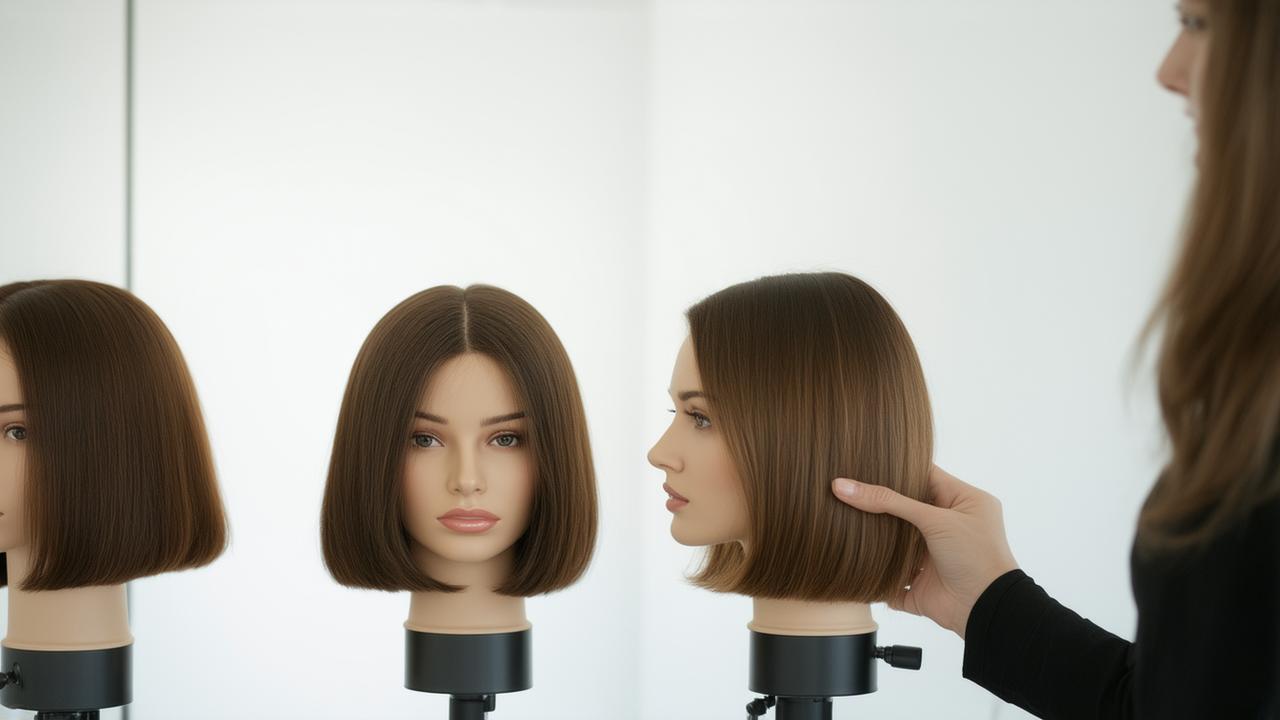
The salon smells faintly of eucalyptus and hot metal, that unmistakable mix of botanical spray and flat-iron heat. Outside, the city hums with weekday noise, but in this chair time has slowed to the rhythm of the scissors. You study yourself in the mirror—forty-something, a little wiser around the eyes, the kind of face that has seen some things and come out softer, not harder. You came in craving a change. Maybe a bob. Everyone on your feed seems to be chopping their hair. But as the cape settles around your shoulders, your stylist tilts their head and says, “Okay, but before we cut… let’s talk about the bobs that don’t do you any favors.”
When a Bob Stops Being Chic and Starts Being… Tired
We talk a lot about “flattering” haircuts as if it’s all about face shape and nothing else. But around forty, your hair starts whispering new truths: texture shifts, density dips, the hairline recedes in tiny, almost secret ways. It’s not betrayal; it’s simply evolution. Yet many of us are still bringing reference photos from our late twenties into the salon, expecting the same effect.
“What worked at 25 on freshly highlighted, unbothered hair,” a seasoned hairdresser will tell you, “can look harsh, droopy, or plain outdated at 45—especially with bobs.” A bob is deceptively simple. It’s a straight line, a curve of jaw, a bit of neck. But that minimalism leaves nowhere to hide. Every angle either lifts you up or drags you down.
So this professional hairdresser—let’s call her Mara, the kind of stylist who has cut the same clients through breakups, babies, promotions, and reinventions—has strong opinions. She rattles off the bob styles that she says tend to be the “least flattering” on many clients over forty. Not because they’re forbidden, not because there’s an age police, but because they often work against what your face, energy, and hair are doing now.
“Think of your haircut as the frame on your favorite painting,” Mara says, comb moving smoothly through your hair. “The painting changes a little with time. Your frame should, too.”
The Super-Blunt, One-Length Jaw Bob
The first on her list is the classic one-length, razor-straight bob that hits exactly at the jaw. It’s the cut you’ve seen on fashion editors in their twenties, paired with sharp cheekbones and minimal makeup. On a younger face, it’s graphic and intentional. On many faces over forty, though, Mara says it can turn from chic to severe in a heartbeat.
Here’s why: as we age, our lower face naturally softens. The jawline loses a touch of its clean angle, and skin can begin to loosen. A brutal, laser-straight line of hair slicing right at that point tends to highlight every tiny shift in contour. What once looked architectural can now accentuate jowls, deepen the impression of heaviness, and make the entire expression seem more tired than it really is.
You can almost feel it as she demonstrates with the comb, holding your hair rigidly across your jaw in the mirror. The line is merciless. Your eye goes straight to your jaw, nowhere else. “See?” she says gently. “It’s not that you can’t wear structure. It’s that we need the structure to collaborate with your face, not fight it.”
What works better, she explains, is the slightest bit of softness: an almost invisible graduation in the back, a soft undercut, or the faintest curve toward the face. A whisper of movement in the ends is often enough to turn harsh into harmonious.
| Bob Style | Why It Can Be Unflattering After 40 | What To Ask For Instead |
|---|---|---|
| Super-blunt jaw bob | Emphasizes jawline softening and any heaviness | Softly beveled bob with subtle movement in the ends |
| Boxy, chin-length bob | Adds weight at cheeks and jaw, can look “helmet-like” | Lightly layered bob that grazes collarbone |
| Severe A-line bob | Angle can drag the face down, highlights sagging | Gentle, soft angle with internal layers |
| Heavy, fringe-less bob | Flatters neither thinning hair nor fine lines | Light fringe or face-framing pieces |
| Ultra-precise “glass” bob | High-maintenance, exposes every texture change | Polished yet softly textured bob |
The Boxy, Chin-Length “Helmet” Bob
The second cut Mara gently steers many over-forty clients away from is what she calls the “helmet bob.” You know the one: chin length, uniform thickness from root to tip, often with no layers at all, hugging the head like a smooth, rigid shell. It’s technically tidy but rarely alive.
On fine or thinning hair, this shape collapses. Instead of floating, it sinks. The weight concentrates around the cheeks and jaw, adding visual bulk exactly where most people would prefer lift. The face can look wider, the features more compressed. When the wind blows, the whole shape moves as a single unit instead of in soft, flattering pieces.
“This kind of bob can lock your face in,” Mara says, tracing an invisible outline around your cheeks. “It’s like putting a frame that’s too small on a picture. Everything inside looks a bit crowded.”
Instead, she suggests air—literal and visual. Subtle internal layers that remove weight without thinning out the bottom. Maybe a length that just grazes the collarbone so the cut can breathe and swing. A few face-framing pieces that open up the area around the eyes. The difference in the mirror is almost shocking: same basic idea, but suddenly you look like you, on a good day, walking quickly toward something you’re excited about.
The Aggressive A-Line Bob with a Harsh Angle
An A-line bob—shorter at the back, longer at the front—can be striking at any age. The problem comes when the angle is too aggressive and the lines too hard. On younger faces, that bold geometry reads as fashion-forward. But on many faces past forty, it tends to pull the entire expression downward.
The eye naturally follows the line of hair. If the hair plunges sharply from nape to collarbone, the viewer’s gaze is pulled south, right along with it. That downward motion can accentuate things you may prefer to minimize: neck lines, softening skin under the chin, even slouchy posture. It’s not that your face has “fallen.” It’s that your haircut is literally pointing to the ground.
“Think of angles as energy arrows,” Mara says. “Do you want the energy to point up and out, or down?” When the front of the bob is several inches longer than the back and the line is razor-crisp, the arrow points firmly down.
A gentler, more forgiving A-line—just a small difference between back and front, with softened edges and maybe some invisible layering—creates a lifting effect instead. The hair still frames the jaw, but it does so with a kind of quiet support, like good lighting. You’re the main event; the bob just knows how to clap for you.
The Heavy, Fringe-Less Bob That Refuses to Move
There is a certain bob you might remember from offices in the early 2000s: sleek, weighty, parted dead-center, not a fringe in sight. On some women, it looked like confidence. On others, especially beyond forty, it reads as heavy—on the head and on the mood.
By this time in life, the skin around the eyes and forehead has often gathered a soft map of lines, tiny histories of every expression you’ve ever had. Completely exposing that canvas with a severe middle part and no softness around the face can feel a little unforgiving. Paired with a dense, blunt bob, it can make the upper face look more tired, even if you’re sleeping fine.
“I’m not anti-middle-part,” Mara smiles. “I’m anti-zero-softness.” She lifts sections near your temples and lets them fall again. “The trick is to let some hair flirt with your face.” That might be a long, wispy curtain fringe that splits near the center, or airy pieces that start at the cheekbone and skim the jaw.
These subtle additions do something almost magical. They distract the eye from any small asymmetries, soften expression lines, and create an illusion of lift at the cheekbones. The haircut goes from rigid helmet to living, breathing frame—the difference between staring at a portrait under fluorescent lights and seeing it in natural, golden afternoon sun.
The Ultra-Precise “Glass” Bob That Demands Perfection
Finally, there’s the hyper-polished, ultra-straight “glass” bob: every hair smoothed to submission, ends aligned like soldiers, the shine almost blinding. It’s beautiful, no doubt. But for many people over forty, this look becomes less of a style and more of a full-time job.
Hair texture subtly changes with hormones. Maybe you were pin-straight in your twenties, and now there’s a gentle wave, a mysterious kink at the nape, or a few rebellious frizz halos above the ears. A glass bob leaves no room for that. Every tiny bend shows. Any humidity turns the sleek façade into something patchy and uneven. The gap between “styled” and “not styled” becomes vast.
➡️ A legendary rock band announces its retirement after 50 years, leaving behind the hit everyone knows
➡️ A new kitchen device is poised to replace the microwave for good and experts say it’s far more efficient tested
➡️ A bay leaf under the pillow : the small night routine I once mocked, until it changed my sleep
➡️ Bad news a 135 fine will apply to gardeners using rainwater without authorization starting January 18
➡️ Birdwatchers say this one winter fruit keeps robins loyal to your garden
➡️ A basic household product washed down the pipes restored perfect flow leaving repair workers stunned
➡️ Boiling rosemary is the best home tip I learned from my grandmother: it transforms the atmosphere of your home
“If your haircut only looks good on the day you visit the salon, that’s the haircut failing you—not you failing the haircut,” Mara says. For an over-forty life that might include long work hours, kids, aging parents, or simply a desire not to live tethered to a flat iron, a style that demands daily perfection can start to feel punishing.
Instead, she urges, ask for a bob that respects your hair’s reality. Soft internal texture so the natural wave can live. A shape that looks intentional even when you let it air dry. Polished when you want it to be, forgiving when you don’t. It’s not about giving up on sleekness; it’s about claiming versatility.
So, What Makes a Bob Feel Right After 40?
At some point, you catch your own eyes in the mirror and realize this conversation isn’t really about age at all. It’s about honesty—with yourself, your schedule, your hair, your face as it is right now. The bobs that feel least flattering after forty, according to Mara, are usually the ones clinging to an old idea of you: the jawline you once had, the texture you once managed, the time you once devoted to styling.
“Your best bob,” she says, scissors flashing in quiet confidence, “will soften where life has softened you, and lift where gravity pulls. It should follow your movement, not force you into stillness.” She talks about adding lightness at the ends to prevent visual heaviness, placing length just above or just below the jaw instead of slicing right through it, letting a hint of fringe or layering protect rather than expose.
The cape rustles as she turns your chair for a final look. Your hair is shorter now, but somehow you look more like yourself, not less. The light catches on soft, piece-y ends. There is shape without severity, gloss without rigidity. When you run your fingers through it, it moves.
Outside, the city is still humming, but you walk a little differently toward it. You’re not wearing the bob you thought you needed at twenty-five. You’re wearing the one that understands you at forty-three.
FAQs About Bobs After 40
Is there a “best” bob length for women over 40?
There isn’t one universal length, but many over-forty clients look great with bobs that sit either slightly above the jaw or around the collarbone. Avoiding a harsh line exactly at the widest point of the jaw usually gives a more lifted effect.
Can I still wear a blunt bob after 40?
Yes, as long as the bluntness is softened with subtle beveling, texture, or gentle face-framing. Ask your stylist to keep the strong line but build in movement so it doesn’t feel rigid or heavy.
What if my hair is thinning—should I avoid bobs?
Not necessarily. A well-cut bob can actually make thinning hair look fuller. The key is avoiding boxy, one-length “helmets” and instead choosing soft layering and a length that doesn’t drag your hair flat.
Are bangs a good idea with a bob after 40?
Often, yes. Light, wispy bangs or long curtain fringes can soften lines on the forehead, draw attention to the eyes, and add freshness to the overall shape. Heavy, blunt bangs can be trickier, depending on your features and hair density.
How often should I trim a bob to keep it flattering?
Most bobs look their best with trims every 6–8 weeks. This keeps the shape clean, prevents the ends from getting bulky, and maintains the balance around your face as the hair grows out.
Can a bob work with naturally wavy or curly hair after 40?
Absolutely. In fact, waves and curls can give a bob incredible body and movement. The cut just needs to be tailored for your curl pattern, with layering and length chosen to avoid a triangular, bulky shape.
What should I tell my hairdresser to avoid an unflattering bob?
Explain that you’d like to avoid anything too boxy, too harshly angled, or too heavy around the jaw. Mention that you want movement, softness around the face, and a shape that still looks intentional even on low-maintenance days. Bringing photos of realistic, similar hair types can help your stylist guide you to the most flattering version.





