The sneakers were supposed to disappear—folded into the quiet anonymity of a donation bin behind a supermarket, bound for “somewhere else” and “someone who needs them more.” That’s usually where the story ends. You drop the bag, feel a spark of virtue, then drive away and never learn what happened on the other side of your good intention. But this time, the story didn’t end at the metal bin. It didn’t even really begin there. It began in a small apartment, with a man turning a worn pair of running shoes over in his hands, and an idea that felt equal parts childish experiment and quiet suspicion.
The idea that wouldn’t quite leave him alone
They’d been sitting by the door for months, those sneakers—scuffed white soles, mesh fraying at the sides, the faint, sour ghost of miles run in summer heat. Daniel had meant to donate them for weeks. Every time he passed the bin behind the grocery store, he’d think of them, still by the door, still waiting. And each time, some uneasy little thought bubbled up.
Where do they really go?
He’d read enough headlines: donation scams, warehouses full of “charity” clothes sold in bulk, entire markets in far-off cities piled high with someone else’s cast-offs. He didn’t exactly mistrust the blue metal bin with its earnest logo and promise of helping local families. But the doubt was there, subtle and persistent. Did the sneakers go to a shelter? A kid who needed them for gym class? Or did they get weighed, bought, and resold three times before landing in some stranger’s hands, price tags attached again?
On a rainy Tuesday, scrolling through his phone and half-listening to a podcast about e-waste, he saw an ad for the AirTag he’d bought months ago and never used. A tiny, white coin blinking from his “unused tech” drawer. The idea arrived slowly, then all at once: what if he tracked the shoes? Not as a crusade, not even as activism, but as a story he couldn’t shake. A way to follow the thread of his own belongings out into the world beyond his hallway.
Slipping a secret into the sole
AirTags are made to find lost keys, wayward backpacks, maybe the occasional runaway bike. They’re not advertised as tools for tracing the life cycle of donations. But the compact, smooth disc felt almost tailored for hiding. Daniel sat with the sneakers at his kitchen table that night, the apartment quiet except for the hum of the fridge.
He unlaced one shoe slowly, thumbs pressing into the foam insole, feeling for an opening. When he found the edge, he lifted it carefully—just enough to tuck the AirTag beneath, snug between the insole and the base of the shoe. It fit so perfectly it felt like it belonged there, like the sneaker had grown a tiny, secret heart.
He pressed the insole back down, smoothed it out, and slid his hand inside to make sure it still felt normal. No sharp edges. No strange bumps. Just the familiar give of a broken-in running shoe. He did the same with the other sneaker, even though only one held the device. Symmetry felt important, like keeping the balance of things.
On his phone, the AirTag sprang to life—“Sneaker Experiment,” he named it, grinning at the ridiculousness. There was a thrill in seeing the dot blink on the map, safe at home for the moment. It was a quiet type of excitement, the kind that comes from tugging on the curtain of an everyday ritual and glimpsing the gears behind it.
Into the metal mouth of the bin
The next morning, the sneakers went into a plastic grocery bag. The air was cool and bright, the kind of late-season sunlight that makes parking lots feel briefly cinematic—shimmering asphalt, shopping carts clinking, strangers brushing past one another in narrow spaces of shared routine.
The donation bin sat where it always did, against a cinderblock wall softened by years of weather. The painted logo promised support for local programs, warm clothes and household items for families “right here in our community.” Daniel hesitated, fingers tightening around the bag’s handles. Was this weird? Was he overthinking it? Was he, in some abstract way, spying on kindness?
He fed the bag into the metal slot. It scraped, hesitated, then vanished with a soft thud inside. The mouth of the bin clanged shut, and with that, the sneakers were gone. His shoes—and the little white disc hidden inside—belonged to the system now.
In the driver’s seat of his car, he opened the tracker app. The dot hovered where he knew it would for now, at the back of the lot, inside that unassuming blue box. He watched it for a moment, as if it might suddenly start moving like a character in some low-stakes thriller. It stayed still. Life called him back—work emails, a grocery list, an overdue phone call. He drove away.
The slow drift into somewhere else
For two days, nothing happened. Each time he checked, the little dot still lived in the charity bin, unbothered and unmoving. He pictured the interior: a jumble of anonymous clothes, chipped mugs, forgotten toys, his sneakers somewhere near the bottom. It was oddly comforting. Like they were waiting in a liminal space, belonging to no one and anyone at once.
On the third day, everything changed. The app pinged with a small notification: “Item moved.” He opened it immediately. The dot had drifted several miles across town, now pinned in an area he rarely visited—an industrial strip of warehouses and low, tin-roofed buildings.
He zoomed in. The location hovered over a long, rectangular building with a loading bay. No store name, no cheerful sign. Just a gray block on the satellite image.
He watched, fascinated. The dot stayed there for hours, shifting only slightly, as if traveling from one end of the structure to the other. He imagined a sorting line—bright overhead lights, the rustle of trash bags ripped open, the soft thumps of clothes tossed into bins labeled by type or quality. Maybe someone lifted his sneakers, checked the soles, tilted them in the light. Too worn for local donation? Good enough for resale?
The fourth day, the sneakers moved again. This time, the dot landed in a place that surprised him: not a storefront, not another warehouse, but a dense knot of streets and alleys pulsing with activity. When he switched to satellite view, his screen filled with a patchwork of awnings and umbrellas, tiny rectangles of color clustered tight together.
It was a market. Not a slick indoor shopping center, but one of those sprawling, semi-chaotic spaces that seem to grow from the ground itself—stalls, tarps, tables, and people, all layered into a breathing, shifting organism of trade.
Following a blinking dot to a real place
Daniel hadn’t planned on going further than the app. The idea had been to watch from a distance, collect a neat little story he could tell over dinner someday: “You know that donation bin behind the store? Guess what actually happens…”
But curiosity is rarely neat. The more he zoomed in on the map, the more the abstract questions became tangible. The sneakers weren’t just a dot—they were somewhere specific. On a table? In a pile? On somebody’s feet? The market was only a twenty-five-minute drive away.
On a Saturday morning, he gave in. The market’s parking lot was already half full when he arrived, a low rumble of music and conversation drifting from beyond the entrance. Stalls spilled into the walkways, stacked with secondhand clothes, phone cases, kitchen knives, cracked ceramic bowls, knockoff perfume. It smelled like grilled meat, fruit just at the edge of overripeness, diesel, and dust.
He checked the app. The dot pulsed a short walk ahead, somewhere among the maze of tarp-covered stands. As he walked, the world narrowed to a series of sounds and textures: the slap of flip-flops behind him, the murmur of bargaining, the metallic clink of a cash box closing. He felt oddly self-conscious, as if the AirTag wasn’t the only thing moving covertly through this place.
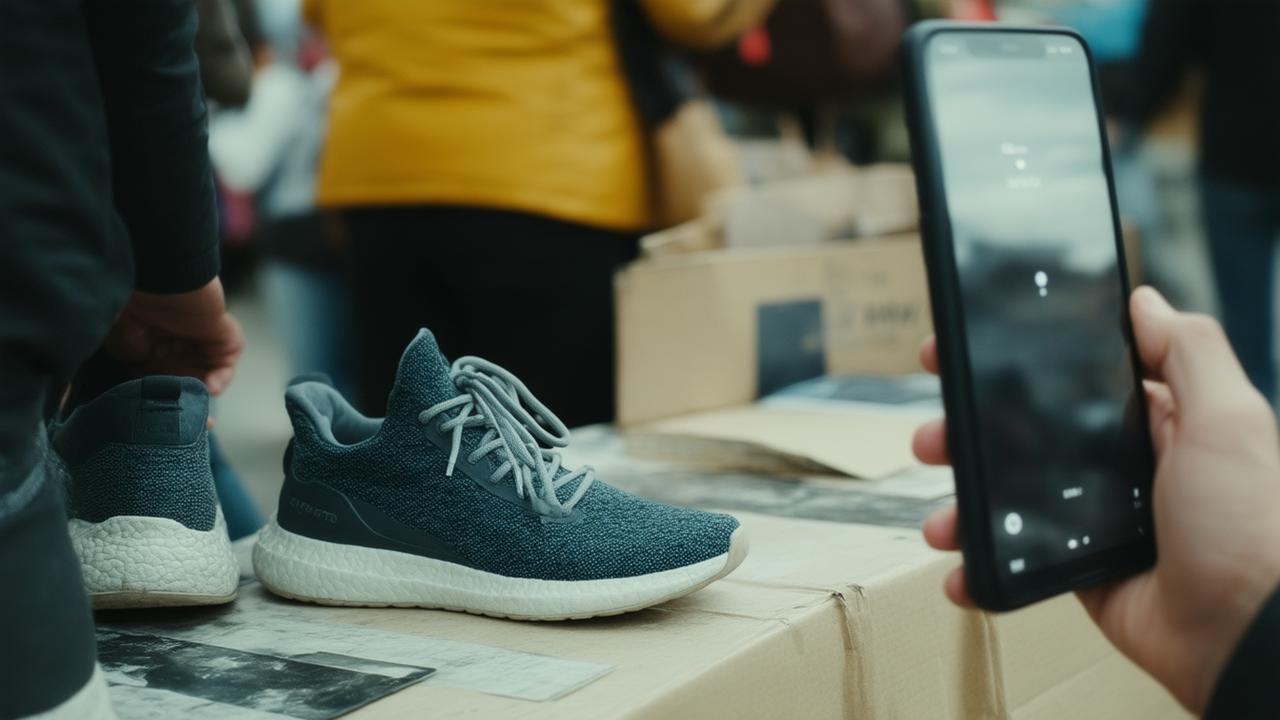
The closer he came, the more surreal it felt. The app insisted the sneakers were only meters away now, aligned with a narrow lane of stalls selling nothing but shoes—rows and rows of them, stacked in towers, tied together in mismatched pairs, lined in cardboard boxes on the ground.
| Step in the Journey | Approx. Location | What Likely Happened |
|---|---|---|
| Donation | Supermarket parking lot bin | Shoes dropped off with mixed items, waiting in collection bin. |
| Collection | Local warehouse district | Items sorted, graded, and separated for resale or export. |
| Distribution | Wholesale hub | Bulk lots likely sold to market traders by weight or bundle. |
| Resale | Open-air market stall | Shoes cleaned, priced individually, and displayed for customers. |
There they were, with a new price
He saw them before he believed they were real. Same gray mesh. Same faint creases along the toe. The laces had been retied into neat bows, and the soles looked like someone had at least half-heartedly scrubbed them. A handwritten cardboard sign perched above them: “BRANDED SHOES – GOOD COND – 350.”
He felt his phone buzz in his pocket. The app confirmed what his eyes were already shouting: “Sneaker Experiment – Nearby.” The familiarity of the notification in such an unfamiliar context made something inside him tilt slightly, like standing on a gently rocking boat.
The vendor, a man in a faded cap with laugh lines settled comfortably around his eyes, caught him looking.
“Good quality,” the man said, tapping the sneakers with the back of his hand. “Almost new. You want running shoe? These very light.”
Daniel picked them up, fingers slipping into the familiar grip of the heel, thumb brushing the spot beneath the insole where the AirTag lay hidden. For a heartbeat, he imagined peeling back the lining right there, showing the man the little device and saying, “I followed these from a donation bin.” But to what end?
➡️ A legendary rock band announces its retirement after 50 years, leaving behind the hit everyone knows
➡️ A new kitchen device is poised to replace the microwave for good and experts say it’s far more efficient tested
➡️ A bay leaf under the pillow : the small night routine I once mocked, until it changed my sleep
➡️ Bad news a 135 fine will apply to gardeners using rainwater without authorization starting January 18
➡️ Birdwatchers say this one winter fruit keeps robins loyal to your garden
➡️ A basic household product washed down the pipes restored perfect flow leaving repair workers stunned
➡️ Boiling rosemary is the best home tip I learned from my grandmother: it transforms the atmosphere of your home
Instead, he asked, “Where do you get them?” The question came out more casual than it felt.
The vendor shrugged, a small, practiced motion. “Big lot. Mixed clothes, shoes. We buy, we clean, we sell. Some good, some no good.” He smiled, open, matter-of-fact. “People throw away many good things.”
The ethics hiding under the insole
Later, sitting in his car with the sneakers on the passenger seat, Daniel scrolled through the app again. The dot that had once lived in his hallway now hovered over a parking lot, then his own home as he drove back. He’d bought the shoes back—not out of guilt, exactly, but out of a strange sense of responsibility. They felt less like property and more like witnesses now.
The experiment had given him answers, but not the tidy kind. He’d confirmed what so many investigative pieces had hinted at: that much of what we think of as “giving” is also a business, with links in a chain that pass through warehouses, wholesalers, and market stalls under patchwork tarps.
It wasn’t that the vendor was doing anything wrong. He was working inside a system that turned surplus into income, waste into an economy of second and third chances. In a way, those sneakers had lived more lives because of it—owned, donated, sorted, repriced, offered again. A small piece of textile reincarnation.
But the charity-branded bin hadn’t told this story. Its painted promise was about helping local families, not about the quiet logistics of resale and re-export, of middlemen and markets. It made him wonder how many of us would donate differently if we knew just how many hands our things passed through—and whose pockets they filled—before landing with someone who might actually need them.
The AirTag, in its unblinking neutrality, had done something human: it had forced him to look beyond the gesture and into the aftermath. It had turned “out of sight, out of mind” into “out of hand, still on the map.”
What we really give when we let go
That night, he pried up the insole at his kitchen table and plucked the AirTag from its hiding spot. The sneaker suddenly felt lighter, oddly emptier, as if the story had been removed along with the small white disc. They sat by his door again, this time with scuffed soles and an invisible history.
He didn’t donate them a second time. Not yet. Maybe he’d give them directly to someone he knew. Maybe he’d take them to a local shelter where the path between “here” and “there” felt shorter, more specific. Or maybe he’d keep them for a while, as a reminder that even ordinary, worn-out objects carry trajectories we rarely see.
Most of us will never hide a tracker in our donations. We won’t follow our shirts and shoes into warehouses and markets several neighborhoods—or continents—away. But the story of those sneakers and that AirTag lingers in the back of the mind the next time a bag of clothes softens the corner of a bedroom.
When we let go of something, we’re not just clearing space. We’re feeding a sprawling, complicated ecosystem that mixes generosity with commerce, need with opportunity, good intentions with opaque systems. Somewhere in the middle of all that, on a plastic table in a crowded market, a pair of sneakers waits for a new owner, tagged not with a tracker this time, but with a hand-scribbled price.
The AirTag is back in Daniel’s drawer now, blank on the map, quiet. But every time he passes the donation bin near the supermarket, the memory flickers: a tiny dot crossing town, slipping from a painted promise into a very real stall, under a canvas awning that flapped in the wind.
And it leaves a question hanging in the air, as soft and persistent as the scent of worn rubber and laundry detergent: when we give something away, how much do we really know about where our kindness goes—and who, in the end, it truly reaches?
Frequently Asked Questions
Is it legal to track donated items with an AirTag?
In many places, it’s not explicitly illegal to track an object you own, but once you donate it, you no longer own it. Continuing to track it may raise ethical and potential legal concerns, especially if it’s clearly associated with a specific person. Laws and policies vary by region, so it’s wise to check local regulations and respect privacy.
Do charities really sell donated clothes instead of giving them away?
Many charities do both. Some items go directly to people in need, while others are sold in thrift stores or in bulk to wholesalers. The revenue often supports programs, overhead, and logistics. However, this resale aspect is not always clearly communicated to donors.
Why do donated items end up in markets instead of shelters?
There is often more supply than local demand for certain items, like used clothing. Charities and recyclers may sell excess stock to wholesalers, who distribute them to markets. This creates income for organizations and traders, while still extending the life of the goods, though it may differ from donors’ expectations.
How can I donate in a way that more directly helps people?
You can ask local shelters, mutual aid groups, or community centers what they specifically need. Donating directly to individuals, community closets, or targeted drives (for example, coats in winter, school supplies in fall) often makes the path between giver and receiver shorter and more transparent.
Are AirTags and similar trackers ethical to use in everyday life?
They can be very useful—and ethical—when you use them to track your own belongings (like keys or luggage) and respect others’ privacy. Problems arise when they’re used to track people or items without consent. Transparency, consent, and purpose are key in deciding what’s ethical.





