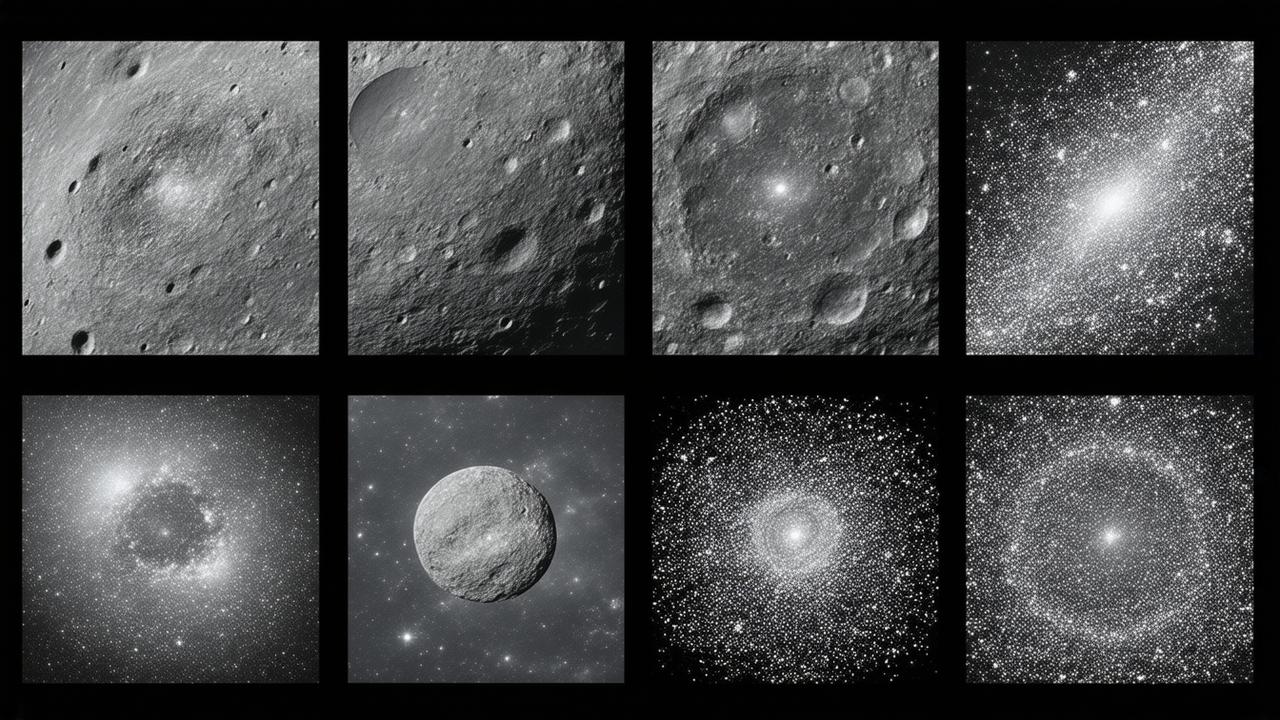
The comet looks wrong. That’s the first thing astronomers said quietly to one another when the new images came in—eight razor–sharp portraits of an interstellar visitor that does not belong here, captured with such unnerving clarity that even seasoned researchers leaned back from their screens. On the monitors, the object labelled 3I ATLAS is not the soft, romantic smear of light most of us imagine when we hear the word “comet.” It is something harsher, stranger, and unsettlingly precise: a shard of another star’s story, tumbling through our skies.
When the Sky Sends a Stranger
For most of human history, comets were omens—ragged streaks of light that arrived unannounced and slipped away without explanation. Then telescopes came, then digital detectors, then the enormous survey cameras that quietly patrol the sky every clear night. One of these, the ATLAS (Asteroid Terrestrial-impact Last Alert System) survey, first noticed the faint intruder and flagged it with the unromantic string of characters that is now whispered with a kind of awe: 3I ATLAS, the third confirmed interstellar object to cross our Solar System.
In the beginning, it was barely more than a mathematical rumor. Observers plotted its path and squinted at the numbers. The orbit didn’t close into an ellipse like that of a bound comet; instead it traced a hyperbola, the unmistakable signature of something not caught by our Sun, just passing through. That single geometric quirk meant this was no ordinary comet from the distant Oort Cloud. This was a migrant from another star, a body that had once circled a distant sun and been thrown into the dark, only to arrive ages later in our corner of the galaxy.
But it was still a smudge—until the images changed.
The Night the Pictures Sharpened
There’s a certain silence observatories share at night, an insulation from the everyday world. The hum of coolant pumps, the subdued rustle of fabric, the soft clicks of keyboards—these are the background sounds when something rare unfolds. On the night the new observational campaign locked onto 3I ATLAS, the atmosphere in control rooms across several facilities felt charged, as if every monitor glow carried a secret.
A new coordinated push had been organized: eight instruments, working across different wavelengths and resolutions, all focused on a single, receding comet. Some were perched on dry mountaintops above seas of cloud; others, space telescopes orbiting in the clean black vacuum above the blur of Earth’s atmosphere. Together, they formed a kind of improvised, global eye.
When the first combined frames appeared, the usual fog of interstellar distance dissolved. The coma—normally a soft blur of gas and dust—resolved into a textured veil. Jets, instead of appearing as vague flares, stood out like strokes from a surgeon’s scalpel: narrow, angled, asymmetric. There was structure here, violence here. The nucleus itself, usually beyond reach in such distant objects, hinted at contours—edges, brightness contrasts, the distant glitter of reflected starlight off a surface that hasn’t seen warmth in eons.
People did not cheer when they saw the first full composite. They went quiet.
What the Eight Images Tell Us
It helps to imagine the eight images not as a simple collage but as a conversation. Each one shows a different aspect of 3I ATLAS—infrared warmth, optical shimmer, the polarized dance of dust grains in reflected sunlight. When layered together, they sketch a biography written in ice and stone.
The comet’s tail, for one, does not behave the way familiar Solar System comets often do. Instead of a smooth fan, 3I ATLAS trails a fractured, almost braided plume. Density knots appear, compact clumps of dust and gas some distance away from the nucleus, as if pieces of the comet have been sloughed off and are falling behind like discarded memories. In some filters, those knots stand out like embers; in others, they practically vanish, suggesting they are made of very particular, perhaps exotic, grains.
The jets, too, are strange. Most comets have patterns that roughly align with their rotation, with gas and dust venting predictably as sunlight warms different regions. The high–precision imagery hints at jet orientations that do not neatly match a simple spinning body. Some researchers suspect that 3I ATLAS may be tumbling chaotically, a relic of the violent gravitational kick that flung it out of its home system. Others think the surface could be riddled with cliffs, fractures, and buried volatile pockets that ignite sporadically, producing angled flares.
Even the coma—the ghostly atmosphere around the nucleus—looks different. Its brightness profile decreases in a way that doesn’t perfectly follow the behavior of most comets studied closer to home. The dust grains appear to be of unusual sizes or compositions, scattering light in an oddly “hard” way, less diffuse, more directional. It’s as though the comet is made of slightly alien dust—which, in a very literal sense, it is.
The Numbers Behind the Awe
For all the poetry of this event, astronomers live and breathe numbers. The eight images have allowed them to pin down certain key properties of 3I ATLAS with higher confidence. The table below offers a simplified glimpse of what they are inferring, tailored for curious readers rather than technical papers:
| Property | Estimated Value / Description |
|---|---|
| Type | Interstellar comet (3rd known, after ‘Oumuamua and 2I/Borisov) |
| Trajectory | Hyperbolic orbit, not gravitationally bound to the Sun |
| Nucleus Size (approx.) | Likely a few kilometers across, irregular shape suggested |
| Tail Features | Fragmented, with dense clumps and complex dust structures |
| Coma Composition Clues | Mixture of ices and dust, with scattering behavior hinting at unusual grain sizes |
| Rotation Behavior | Evidence suggests complex spin or tumbling motion |
Each number, each faintly constrained estimate, is a fragment of a larger, still forming picture. But together they are enough to send theory papers into overdrive.
An Object Out of Place
There is something deeply uncomfortable about studying 3I ATLAS in such detail. Our own comets are ancient, yes, older than any fossils or mountains, but they are ours. They condensed from the same primordial cloud that built the Sun, the planets, and the dust that eventually became our bones. They belong to the long family history of this star system.
3I ATLAS does not. Its atoms may have formed near a star colder than our Sun, or perhaps one much hotter. It might have once circled in a thick disk of planet-building rubble around a young sun-like star; it might equally have been tossed around by migrating giant planets that turned its home system into a gravitational pinball machine. The violence that sent it here could have been the birth throes of planets, or the quiet, steady nudge of a distant stellar flyby millions of years ago.
Seeing it so clearly, in eight different views, makes its foreignness impossible to ignore. This is not a guess, not a speculative model on a whiteboard. This is a solid, crystal–sharp visitor carved into digital images: texture in the inner coma, the angled slash of a jet, the way its tail bends away from the combined pushes of sunlight and the solar wind. It is not just a point of light with unusual motion; it is a visible, active worldlet that once belonged elsewhere.
There’s an almost emotional dissonance in realizing how crisp those contours are. The better we see it, the more it feels like surveillance—like catching a traveler in a too–bright spotlight while they were hoping to slip through the crowd unnoticed, leaving only a faint footstep in our astronomical data.
Why This Clarity Is a Turning Point
Each interstellar object we’ve found so far has pushed astronomy into slightly new territory. ‘Oumuamua, the first, was a puzzle of shape and behavior; it was too small and faint to resolve into anything but a pinprick, leaving us arguing about its nature in the dark. 2I/Borisov finally gave us something that looked more like a “normal” comet, but still at the edge of what our best instruments could tease apart.
3I ATLAS, however, sits at a kind of sweet spot: bright enough, active enough, and—thanks to improved technology and a global observational effort—observed early enough in its passage to yield detail we once reserved only for long–studied Solar System guests. The unsettling precision of these new images does more than add another notch on the belt of discovery; it shifts our expectations.
➡️ 6 old-school habits that people in their 60s and 70s refuse to drop and that make them happier than tech?obsessed youth
➡️ Bad news a 135 fine will apply to gardeners using rainwater without authorization starting February 18
➡️ A growing lifestyle trend among seniors: why more “cumulants” are choosing to work after retirement to make ends meet
➡️ Baking soda becomes the unexpected remedy for wrinkles and dark circles say beauty specialists
➡️ 3I/ATLAS: a strange radio signal was detected from the interstellar comet
➡️ Car experts share the winter tire-pressure rule most drivers forget
➡️ 10 dishes you should never order in restaurants, according to professional chefs
Astronomers are not just cataloging this visitor; they are dissecting it—its spin, its outgassing behavior, the sizes of its dust grains, the way its ices respond to our Sun’s light. These data let us compare our own comets to an off–world cousin with a completely different family tree. Do the building blocks of far–off planetary systems resemble ours? Are their comets equally rich in ices, equally fragile, equally scarred by collisions?
The more precisely we see 3I ATLAS, the less isolated our Solar System feels. Planet formation, comet sculpting, chaotic ejections into deep space—these are no longer our private dramas. They’re part of a shared galactic language, and this visitor is one of the first translations we can read in high resolution.
Looking at the Galaxy Through a Frozen Keyhole
There is a paradox at the heart of our fascination with 3I ATLAS. On one hand, it is minuscule in the grand scheme of things—a tiny shard of rock and ice, smaller than many cities, already on its way out. On the other hand, it is an emissary, a physical sample of a place we may never see directly, carrying information scrawled in the chemistry of its dust and the physics of its motion.
By turning our instruments on this lone traveler, we are effectively peering through a keyhole into another planetary system. Those eight images are the narrow shaft of light coming through. In the fine granularity of the coma, we glimpse the temperature and composition of its birth environment. In the violence of its tail, we sense the trauma of its ejection. In the peculiarities of its jets, we see the scars of an ancient, alien history of sunlight, shadow, and frozen time.
And yet, it will leave. No matter how precisely we measure its orbit, the destination remains only a direction, not a known home. Long after it slips beyond the reach of our telescopes, it will continue on—crossing the faint magnetic boundaries of the heliosphere, gliding silently into the thin interstellar medium again. It will outlive our instruments, our current civilizations, perhaps even the future shapes of our continents.
But for this brief intersection of paths, our gaze meets it. Our cameras freeze its movement into frames. Our computers turn its fading light into numbers. Our minds, standing on one small planet around one ordinary star, reach outward and say: we see you. And in the sharp, unsettling detail of those eight images, the galaxy answers back with an icy whisper: you are not alone in how you are made.
Frequently Asked Questions
What does “3I ATLAS” actually mean?
The name “3I ATLAS” breaks down into two parts. “3I” means it is the third confirmed interstellar object (the “I”) discovered passing through our Solar System, after 1I/‘Oumuamua and 2I/Borisov. “ATLAS” refers to the survey system that helped discover it: the Asteroid Terrestrial-impact Last Alert System.
How do we know 3I ATLAS came from another star system?
Astronomers plot the object’s orbit using precise position measurements over time. For 3I ATLAS, the orbit is hyperbolic, meaning it is not bound to the Sun and is moving too fast to have originated in our own comet reservoirs like the Oort Cloud. Its incoming speed and direction strongly suggest it was wandering in interstellar space before entering our neighborhood.
Why are the new images of 3I ATLAS considered “unsettling”?
Most comets we observe, especially distant ones, appear as soft, fuzzy blobs. The new coordinated set of eight images reveals 3I ATLAS with unusual sharpness—showing jets, clumps in the tail, and subtle structure in the coma. Seeing an object from another star system in that much detail makes its foreignness feel very real, which many astronomers have described as eerie or unsettling.
Can 3I ATLAS pose any danger to Earth?
Based on current orbital calculations, 3I ATLAS is not on a collision course with Earth and poses no known risk. Its path takes it through the Solar System and then back out into interstellar space. For us, it is a scientific opportunity, not a threat.
Will we ever visit an interstellar comet with a spacecraft?
In principle, yes—but it is challenging. Interstellar objects travel very fast relative to the Sun, so any mission would need to be planned and launched quickly after discovery or use advanced propulsion to catch up. Several space agencies and research teams are now actively studying “rapid response” mission concepts, inspired by visitors like 3I ATLAS.





