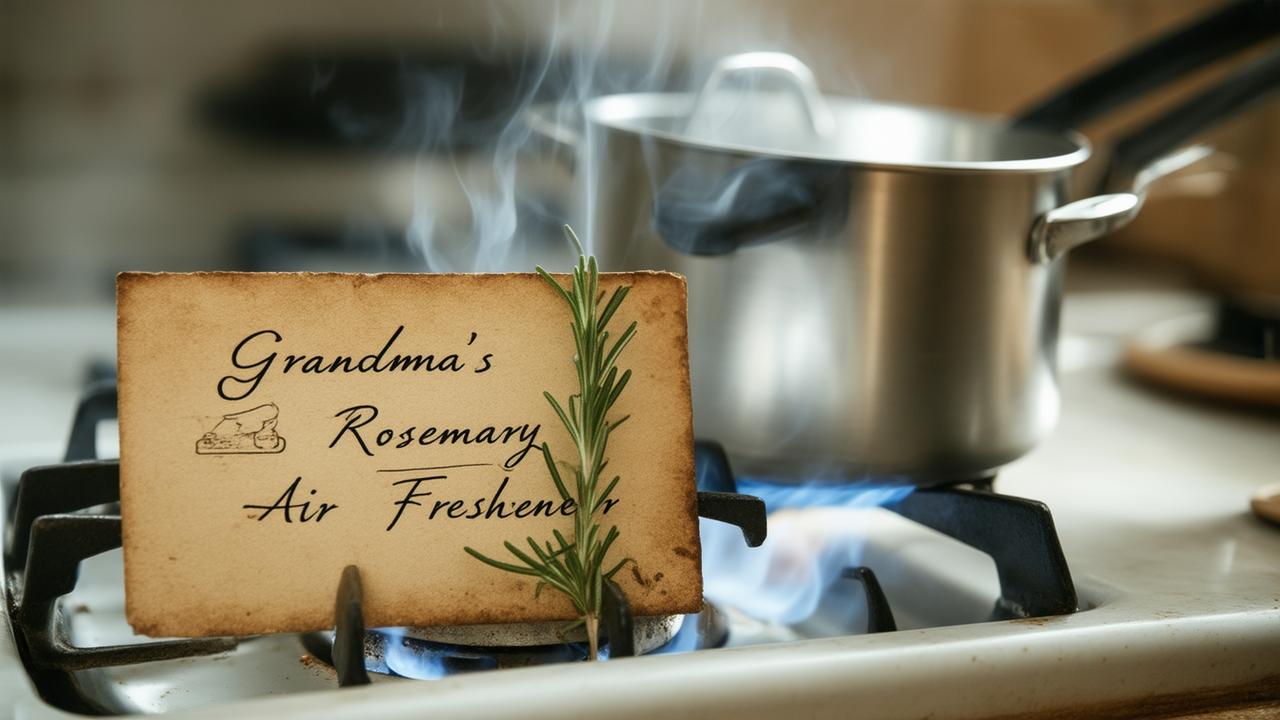
The first time I watched my grandmother make rosemary steam, I was eight years old and too impatient to care about anything that didn’t involve running, climbing, or getting filthy. She was standing by her small white enamel stove, the window cracked, a dented pot simmering with a handful of green sprigs bobbing gently in the water. I didn’t think much of it at first—just another one of her quiet rituals, like humming to the radio or polishing her wooden table until it glowed. But then the smell hit me: warm, resinous, slightly sharp, like pine needles after rain but somehow softer, more forgiving. It drifted through the house, curling into corners, wrapping itself around books, curtains, and the creaky hallway where the floor always groaned. The air felt different, as if the house had taken a slow, deep breath.
The Little Pot That Changed the Whole House
“Come here,” she said, lifting the lid just enough for a cloud of fragrant steam to rise. I stepped closer, and she cupped her hand, gently wafting the vapor toward my face. “Breathe in. Slowly.” I obeyed, not because I understood, but because her voice had that kind of gravity. The smell seeped into me: herbal and clean, but not sterile, like the memory of a forest pressed into hot water. My head cleared. The stubborn mood I’d brought in from outside began to loosen its grip.
“This,” she told me, tapping the pot with the back of her wooden spoon, “is how you remind a house to be kind again.” At the time, I thought she meant it as a joke. Houses, in my child-mind, were just backgrounds for the real story: people, arguments, the scraping of chairs on the floor, the late-night laughter. Only years later did I understand that the air around us is part of that story too. It carries moods. It holds onto what we don’t say out loud. And sometimes, it needs help letting go.
Today, in my own kitchen, far from that little enamel stove, I do the same thing she did: I boil rosemary. Whenever the air in my home feels heavy, or the day has piled up too thickly in my chest, I reach for a small pot and a fistful of green sprigs. And every single time, it feels like dialing her number, like calling in a quiet, familiar magic.
The Slow Ritual of Boiling Rosemary
Boiling rosemary is one of those deceptively simple rituals that, once you start, you wonder how you ever lived without it. It’s nothing complicated: just water, heat, and a handful of herb. But what actually happens in that pot is part chemistry, part memory, part mood alchemy.
I like to start by rinsing the rosemary under cool water. The stems are stiff but flexible, their needle-like leaves bristling with scent even before they touch the heat. As the water runs over them, they release a faint aroma that already hints at what’s coming—green and bright, with that slightly medicinal edge that makes you feel as if something inside you is straightening up and paying attention.
When I lay the sprigs into the pot, there’s always a moment where nothing happens. The water begins to tremble and whisper around the edges, making small shifting sounds against the metal. Then, almost imperceptibly, the first thin threads of scent rise with the early steam. It’s subtle at first, the way a thought forms before you find the words. Then the simmer starts, a gentle, steady bubbling, and the rosemary yields: its oils, its color, its essence. The kitchen fills up first, as if the house is being perfumed from the inside out.
Why the Air Feels Different
Step back for a moment as the steam curls upward. The rosemary doesn’t just smell good. It changes the quality of the air. The sharp, camphorous top notes wake you up, but underneath, there’s a softness, a woody sweetness that grounds everything. You might notice your shoulders dropping, your jaw unclenching. Somehow your home begins to feel less like a place you’re passing through and more like a place that’s holding you.
There’s a reason it feels almost medicinal. Rosemary has been used for centuries in different cultures for cleansing, focus, and memory. When it steams in your kitchen, it seems to gather stale smells—the remnants of last night’s dinner, the closed-window stuffiness, the faint, sour traces of tension after a difficult day—and gently push them out, replacing them with something clearer, more intentional.
A Small Domestic Transformation
If you watch closely, you’ll notice your whole home respond. Curtains catch the scent first, as if they’re tasting it. The warmth from the pot begins to spread, not in a dramatic way, but as a barely-there blanket of coziness. Footsteps sound softer. Even light seems to fall differently when the air is warmed and scented: it feels more golden, more complete.
On days when the weather is stubborn—when rain has been drumming for hours or cold has edged into every crack—boiling rosemary is like lighting a small ceremonial fire you can stand around. It pulls everyone in. Someone wanders into the kitchen, sniffing the air: “What are you cooking?” And you get to say “Just rosemary,” and watch their brow crease in brief surprise, then relax as the smell washes over them.
It’s such a forgiving ritual too. You don’t have to get it perfect. You can use fresh rosemary from the garden or from a grocery bundle, or even dried sprigs at the back of your cupboard. You can let it simmer for fifteen minutes or an hour, topping up the water when it drops too low. There’s no exact recipe, only a feel. That’s part of what makes it so deeply human: it asks you to pay attention, not to follow instructions.
How It Compares to Candles and Sprays
We live in a time when the shelves are crowded with scented candles, diffusers, plug-ins, and little bottles that promise “ocean breeze” or “mountain air” in a single spray. Many of them smell lovely, of course. But they can also feel like costumes for your house—something you put on, not something that grows naturally out of the space itself.
Boiling rosemary is different. It smells alive. It doesn’t try to imitate anything else. The fragrance changes as it simmers, starting sharper, then softening, then deepening as the water slowly extracts everything the leaves have to give. It’s a living, moving scent, not a static one trapped in wax or alcohol. And as it cools, it fades gently, never overbearing, never cloying.
| Method | What It Feels Like | Best For |
|---|---|---|
| Boiling Rosemary | Warm, herbal, alive; shifts with time | Cleansing the mood, cozy afternoons, quiet evenings |
| Scented Candles | Consistent, decorative, sometimes intense | Setting a theme, short rituals, visual ambience |
| Room Sprays | Instant, strong at first, then fades fast | Quick fixes, masking sudden odors |
The Gentle Science and Soft Magic of Rosemary Steam
If you lean over the pot as it simmers, you’re doing more than enjoying a pleasant smell. The warm steam carries tiny traces of rosemary’s essential oils into the air. Your lungs, your nose, your skin—everything participates in this quiet exchange between plant and person. It’s not about grand health claims or miracle cures, just a small, steady nudge toward feeling a little lighter, a little clearer.
My grandmother used to say rosemary “woke up the walls.” When I asked her what that meant, she shrugged. “You’ll see when you’re older.” I think now that she was talking about attention. When you deliberately put a pot on the stove solely to create a feeling—when you choose an herb, add water, wait for the boil—you’re telling your home: I am here with you. I’m tending to you. I’m not just rushing through.
This kind of mindful domestic ritual doesn’t demand a lot of time or money. It doesn’t involve complex tools. It just asks you to notice: the change in scent as the minutes pass, the soft hiss and bubble of water, the way your own breathing seems to synchronize with the gentle rhythm of the simmering pot.
Simple Ways to Make It Your Own
Once you’ve fallen in love with pure rosemary steam, you can start to play, the way my grandmother did when she thought no one was watching. Sometimes she’d toss in a strip of lemon peel for brightness, or a cinnamon stick in winter to deepen the warmth. I like to add a bay leaf now and then, or a slice of orange when the days are dark and I need a little borrowed sunlight.
Nothing about this has to be perfect or polished. You might boil rosemary while you clean, letting the aroma weave through the rooms as you move. Or maybe you set it on the back burner while you read, letting time thicken around you in a slow, fragrant curtain. Some evenings, I turn off all the lights except a small one near the stove, and let the pot bubble quietly in the dim, watching the steam turn golden in the warm glow. It always feels, in those moments, as if I’ve stepped into a softer version of reality.
An Inherited Secret for Heavy Days
There are days when the house feels clogged with things you can’t see. You know those days: arguments that leave a residue long after they’re done, bad news humming in the background like a low, persistent electrical buzz, restless nights that leave the rooms feeling as if they never fully slept. On those days, I reach automatically for the rosemary.
➡️ 6 old-school habits that people in their 60s and 70s refuse to drop and that make them happier than tech?obsessed youth
➡️ Bad news a 135 fine will apply to gardeners using rainwater without authorization starting February 18
➡️ A growing lifestyle trend among seniors: why more “cumulants” are choosing to work after retirement to make ends meet
➡️ Baking soda becomes the unexpected remedy for wrinkles and dark circles say beauty specialists
➡️ 3I/ATLAS: a strange radio signal was detected from the interstellar comet
➡️ Car experts share the winter tire-pressure rule most drivers forget
➡️ 10 dishes you should never order in restaurants, according to professional chefs
I don’t always think of my grandmother consciously when I do it. It’s more like muscle memory, a gesture written into me. But as soon as the scent rises, she’s there: her soft sweater, her deliberate movements, the way she moved through her small kitchen like it was a chapel. She wasn’t trying to impress anyone. There was no audience. It was just her and the house and the pot and the herb, and the quiet conviction that small acts can change how a place feels.
I’ve come to believe she was right. We look for transformation in big, dramatic gestures—new furniture, fresh paint, renovations. Those things can be beautiful, sure. But the atmosphere of a home often shifts in the tiniest of ways: a lamp moved closer to a chair, an open window in winter for ten sharp minutes, a bowl of lemons on a table, a pot of rosemary steaming on the stove. These are not upgrades. They’re conversations.
When you boil rosemary, you’re saying to your home and to yourself: I care how this feels. I care about the invisible things. I care about what we’re breathing, not only with our lungs but with our moods and our memories. You’re turning the ordinary into a kind of hospitality, both to the people who cross your threshold and to the parts of yourself that need somewhere gentle to land.
Bringing the Ritual Into Your Own Kitchen
If you’ve never tried it, the invitation is simple. Next time the day feels too sharp, or the house too stale, or your thoughts too loud, fill a small pot halfway with water. Add a few sprigs of rosemary—fresh if you have it, dried if you don’t. Set it over low to medium heat. Wait.
As the first wisps of steam rise, lean in. Close your eyes if you want. Let the scent meet you where you are. Maybe you’ll feel your own grandmother nearby, or maybe you’ll just feel a quiet sense of “enough”: enough warmth, enough calm, enough air. Let the pot simmer as long as it feels right. Walk through your rooms and notice how the atmosphere subtly shifts, how the walls seem to draw closer, not in a suffocating way, but in a protective one.
In a world that so often feels rushed and disjointed, this tiny practice is an anchor. No apps, no gadgets, no elaborate instructions. Just water, rosemary, and heat—three ordinary elements that, together, open a small door into something softer and more human. My grandmother might not have used words like “mindfulness” or “intentional living,” but she understood, innately, that the way your home smells and feels changes the way your heart moves through it.
So I keep her ritual alive. On the busiest weeks, on the longest nights, on the first cold morning of the year, I reach for that familiar herb and that waiting pot. Every time the steam rises, it feels like love made visible in the air. And every time, I’m reminded that the simplest home tip I ever learned is also the most profound: a handful of rosemary, a simmering pot, and the quiet power to transform not just a room, but the way you live inside it.
Frequently Asked Questions
How long should I boil rosemary to scent my home?
You can start smelling rosemary within a few minutes of simmering, but for a fuller, richer aroma, let it gently simmer for 20–40 minutes. Keep the heat low to medium and add more water if the level drops too much.
Can I use dried rosemary instead of fresh?
Yes. Fresh rosemary has a brighter, greener scent, but dried rosemary still works well. Use about one to two tablespoons of dried rosemary for a small pot of water and adjust based on how strong you want the fragrance.
Is it safe to leave the pot simmering unattended?
It’s better not to. Treat it like any cooking on the stove: stay nearby, or at least within hearing distance, and check the water level regularly. Never let the pot boil dry, and turn off the heat if you need to leave the house or get distracted.
Can I reuse the same rosemary more than once?
You can reuse the same sprigs once if they still have some color and scent left, but the fragrance will be weaker the second time. For the most effective aroma, use fresh rosemary or fresh dried herb each time you simmer.
Will boiling rosemary get rid of strong odors, like cooking smells?
It can help soften and replace lingering odors, especially after cooking, but it works best when combined with simple habits like opening a window for a few minutes or cleaning the source of the smell. Rosemary steam refreshes and lightens the air rather than completely masking very heavy odors.





