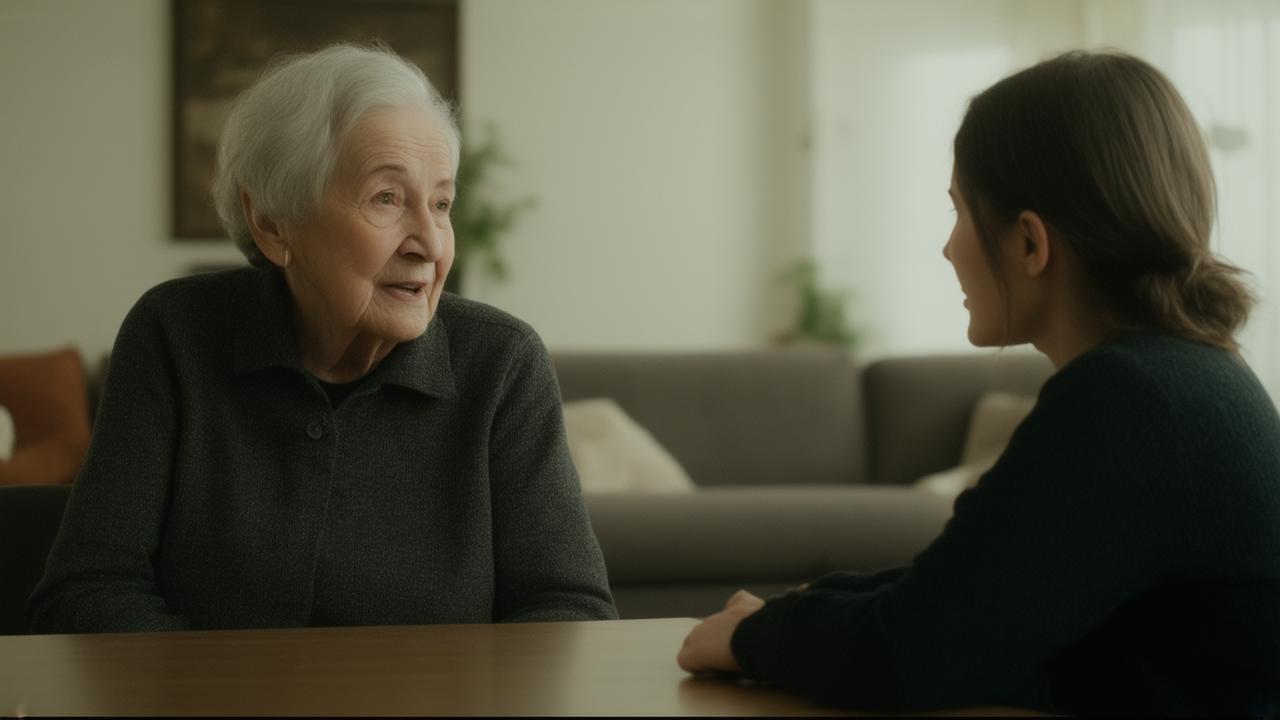
The first time I heard a teenager describe something as “low-key iconic,” I watched my sixty-eight-year-old neighbor, Lou, physically flinch. We were sitting on a park bench, watching dogs chase each other in loose, happy circles, when my young cousin tossed the phrase into the air like confetti. Lou blinked, tilted his head, and whispered to me, “Is that… good?” Moments later, my cousin’s phone buzzed and she sighed, “My screen time report is actually attacking me right now.” Lou looked at her, bewildered, as if she’d just announced that her calculator had filed for divorce. The gap between their languages felt like a canyon, wide and echoing.
It’s not that people over 65 can’t keep up. Many of them pay bills online, send GIFs, and know that TikTok isn’t a minty candy. But language is sticky; it holds on to the words we first used when the world felt new. For many older adults, phrases from the 60s, 70s, and 80s are caught in their vocabulary like pressed flowers in a book. They still pull them out, colorful and fragrant, not always realizing that to younger ears, these expressions sound like postcards from a time before Wi-Fi and wellness apps—sweet, but a little out of touch.
1. “Back in my day…”
It usually slips out with a sigh. At the kitchen table, over the clink of coffee cups. At the bus stop, when a teenager walks by in ripped jeans and headphones. “Back in my day…” It’s the first domino in a chain reaction of nostalgia. Suddenly, sidewalks were safer, kids were tougher, prices were lower, and everyone respected their elders—or so the story goes.
Older adults often use this phrase as a doorway into their memories. There’s a tenderness in it, a desire to compare eras like you’d compare old photographs: sepia versus filtered digital. But to younger people, “Back in my day” can feel like an accusation disguised as a memory. It sounds like a judgment on the present, a subtle declaration that everything now is lesser, lazier, somehow wrong.
Gen Z and younger Millennials have grown up in a world that feels like an endless emergency alert: climate headlines, rising costs, social feeds humming with anxiety. When they hear “Back in my day,” they don’t just hear someone reminiscing; they hear a refusal to acknowledge how different the terrain really is. They’re living on what feels like a new planet, and someone keeps insisting the old weather maps still apply.
2. “You kids have it so easy”
Picture a teenager hunched over a laptop, lit by the blue glow of a dozen open tabs: homework, a scholarship application, a side gig editing videos, and a half-finished text to a friend who’s struggling. An older relative drifts past, glances at the screen, and says, “You kids have it so easy. Everything’s done for you these days.”
The words hit like a cold draft. To the speaker, it’s an observation—a comparison to childhoods of paper routes, single televisions, and long walks without supervision. To the listener, it erases the invisible burdens of today: algorithmic pressure, job markets that feel like shrinking islands, the expectation to be reachable, responsive, and relentlessly productive at all hours.
The phrase stings because it suggests that convenience and ease are the same thing. Yes, there are apps for food, rides, dates, and directions. But there is no app that guarantees stability, mental health, or a future that feels livable. Young people hear “You have it so easy” and think, You have no idea what this costs me.
3. “Why don’t you just pick up the phone?”
For many over 65, the telephone is still a symbol of clarity. You dial. Someone answers. You talk. No mixed messages, no vanishing blue ticks, no ghosting. So when their younger relatives send carefully worded texts instead of calling, the response often comes: “Why don’t you just pick up the phone?”—sometimes with a hint of exasperation.
But the phone, for younger generations, is no longer a simple object. It’s a portal, a mirror, a stage, an office, and sometimes a threat. A ringing call can spike anxiety. A voicemail can feel like an ambush. Texting allows for boundaries, for breathing room, for shaping words instead of letting them tumble out unedited. And for many, it’s also an accessibility tool—especially for those with social anxiety or neurodivergence.
When older adults insist on phone calls as the “real” way to communicate, it can sound like a dismissal of those realities. What feels like intimacy to one generation can feel like intrusion to another. Both are craving connection; they’re just using different doorways.
4. “That’s not a real job”
Some phrases don’t just sound out of touch—they cut. “That’s not a real job” is one of them. It floats around family dinners and holiday gatherings, often directed at someone who works in social media, streaming, gaming, content creation, or freelance anything. The older speaker might not mean harm; to them, a “real job” is something with a clock-in time, a desk, and maybe a uniform.
Younger people inhabit a labor landscape that shapeshifts daily. They piece together incomes from online shops, editing gigs, brand partnerships, digital art, remote work, and jobs that didn’t exist when many older adults retired. The hustle is real, even if the office is a bedroom corner and the uniform is sweatpants.
When an older person says “That’s not a real job,” what young people often hear is: Your survival doesn’t look familiar, so I don’t respect it. Yet behind that phrase, there’s sometimes a quieter fear: a worry that this new, wobbly world of work won’t protect the people they love. Their concern is valid. It’s the packaging—dismissive, sharp—that makes it feel like an attack.
5. “Kids these days…”
If phrases had warning labels, this one would flash red. “Kids these days…” is almost always followed by a sweeping generalization: glued to their phones, no attention span, no respect, no work ethic. It’s a verbal shrug, a way of folding a whole generation into a single, unflattering snapshot.
What’s striking is how old this complaint really is. Ancient letters, Victorian editorials, mid-century radio rants—they all carry the same grumble about “kids these days.” Each generation forgets that someone once said the very same thing about them. The music was too loud, the fashion too wild, the politics too radical.
For young people now, “Kids these days” sounds less like concern and more like erasure. It overlooks the activism, the organizing, the care work, the mutual aid efforts quietly woven through their online and offline lives. They see friends marching, fundraising, sharing resources, and trying to reimagine a kinder future. To be reduced to a lazy trope stings, especially when everything already feels precarious.
How These Phrases Feel Across Generations
Put side by side, the gap becomes clearer—not just in words, but in emotion. The table below sketches how a few of these phrases land on each side of the generational divide.
| Phrase | What Older Adults Often Mean | What Young People Often Hear |
|---|---|---|
| “Back in my day…” | Here’s a story from a time I understand. | Your world doesn’t measure up to mine. |
| “You kids have it so easy” | Life used to be more physically demanding. | Your problems don’t count. |
| “Why don’t you just call?” | Talking voice-to-voice feels closer and clearer. | Your communication style is wrong. |
| “That’s not a real job” | I’m scared your work won’t be stable. | What you do has no value. |
| “Kids these days…” | I don’t understand this new behavior. | You’re all the same, and I disapprove. |
6. “You’re too sensitive”
Sometimes it happens after a quiet protest: a young person saying, “That joke makes me uncomfortable,” or asking for a different pronoun, or setting a boundary about topics they don’t want to discuss at dinner. The older adult, feeling criticized or confused, leans back and says, “You’re too sensitive.” The room cools by a few degrees.
For many over 65, stoicism was survival. You swallowed discomfort. You didn’t talk about mental health. You laughed off hurtful comments as “just how it is.” Sensitivity was framed as weakness, not awareness. Today’s younger generations have different tools, and in many places, more permission to name what hurts and ask for change.
When they hear “You’re too sensitive,” they often hear: Your feelings are a problem, not the thing that hurt you. The phrase can shut down conversation just when it’s getting honest. Yet tucked inside it, there’s sometimes an older voice whispering, I never got to be sensitive. I don’t know how.
7. “We didn’t have that, and we turned out fine”
It might be therapy, extra support at school, medication, safety policies, or even simply a day off. A younger person describes something they need or value, and the response comes like a stamp on a letter: “We didn’t have that, and we turned out fine.” It’s meant as reassurance, a testimonial from the past. Instead, it often lands like a door closing.
➡️ 6 old-school habits that people in their 60s and 70s refuse to drop and that make them happier than tech?obsessed youth
➡️ Bad news a 135 fine will apply to gardeners using rainwater without authorization starting February 18
➡️ A growing lifestyle trend among seniors: why more “cumulants” are choosing to work after retirement to make ends meet
➡️ Baking soda becomes the unexpected remedy for wrinkles and dark circles say beauty specialists
➡️ 3I/ATLAS: a strange radio signal was detected from the interstellar comet
➡️ Car experts share the winter tire-pressure rule most drivers forget
➡️ 10 dishes you should never order in restaurants, according to professional chefs
Young people live in a time where talking about trauma, burnout, and vulnerability is more common. They see patterns that went unnamed in older generations: untreated depression, unresolved grief, normalized abuse, quiet addictions. “We turned out fine” can sound, to them, like an invitation to ignore those scars—or worse, like denial that they exist at all.
This phrase can feel especially hollow when coming from someone who is visibly not fine: exhausted, bitter, isolated. To younger ears, it sounds less like evidence and more like a coping mechanism. They’re not asking for an easier life, just a different one—one where suffering isn’t a badge of honor but a signal to change something.
Why These Phrases Persist
Language ages the way landscapes do: slowly, then all at once. A phrase can feel timeless to one person and fossilized to another. Many of these expressions live at the crossroads of fear and affection. Older adults use them to try to pass along lessons, to make sense of a shifting world, to anchor themselves to the values that helped them survive. They don’t always realize that the ground beneath younger feet is shaped by different pressures—digital noise, financial instability, and a planet straining under human weight.
The conflict isn’t really about vocabulary. It’s about whose reality gets recognized. When an older person says “Back in my day,” they’re asking to be heard. When a younger person winces at “You kids have it so easy,” they’re asking for the same thing. Underneath the phrases, both sides are saying, in their own dialect: My experience matters. Please don’t dismiss it.
Finding New Words for Old Feelings
On another evening, that same park bench held Lou and my cousin again. This time, she showed him a video she’d edited for a small brand—clean cuts, gentle music, soft light. Lou watched in silence, then said, “In my day, we would have needed a whole team and a studio to do that. You’re doing it on a phone.” He paused, then added, “That’s… impressive.” No eye roll, no “real job” comment. Just a bridge, quietly laid down between eras.
He still tells his stories that begin with “Back in my day,” but now he follows them with a question: “What’s it like for you?” She still texts instead of calling, but sometimes she leaves a voice note, letting her laughter and breath carry the bits that words alone can’t. They’re still speaking different native tongues, but they’ve started learning each other’s phrases—gently, clumsily, like travelers in a new country.
The seven phrases older than 65 love to use aren’t villains. They’re artifacts. They carry the weight of wars, recessions, first loves, first paychecks, and the long slow work of becoming who you are. The trick isn’t to ban them, but to notice them—to ask what’s hiding underneath. To replace “Kids these days” with “Help me understand.” To swap “We turned out fine” for “We did what we could. Maybe you can do better.”
Language won’t solve the generation gap, but it can make the canyon shallower. It can turn flinches into curiosity, eye rolls into eye contact. Somewhere between “low-key iconic” and “back in my day,” there’s a shared vocabulary waiting to be written—one where everyone, young and old, gets to sound a little more understood, and a little less out of touch.
Frequently Asked Questions
Why do older people keep using these phrases even when they upset younger people?
Many older adults don’t realize how these phrases land. They’re repeating language they’ve heard their whole lives, often linked to memories and values that feel important. Unless someone gently explains the impact, they may never see a reason to change.
Should younger people correct or call out these phrases?
It depends on the relationship and the moment. Calm, specific feedback—like “When you say ‘You kids have it so easy,’ it makes me feel like my struggles don’t matter”—is usually more effective than arguing or mocking. The goal is understanding, not winning.
Are young people being too sensitive about harmless expressions?
Sensitivity is often just awareness. These phrases can carry dismissive or minimizing messages, even if unintentional. Acknowledging that impact doesn’t mean older generations are bad; it just means there’s room for more thoughtful language.
How can older adults show care without sounding out of touch?
Asking questions helps: “What’s that like for you?” or “Tell me more about your work” or “What would feel supportive right now?” Curiosity usually lands better than comparison. Sharing stories without judging the present is another powerful bridge.
Can generational language gaps ever really be closed?
They may never disappear, but they can shrink. When both sides listen for the feeling beneath the phrase—and are willing to adjust their words a little—the gap becomes less of a canyon and more of a conversation. That’s often enough.





