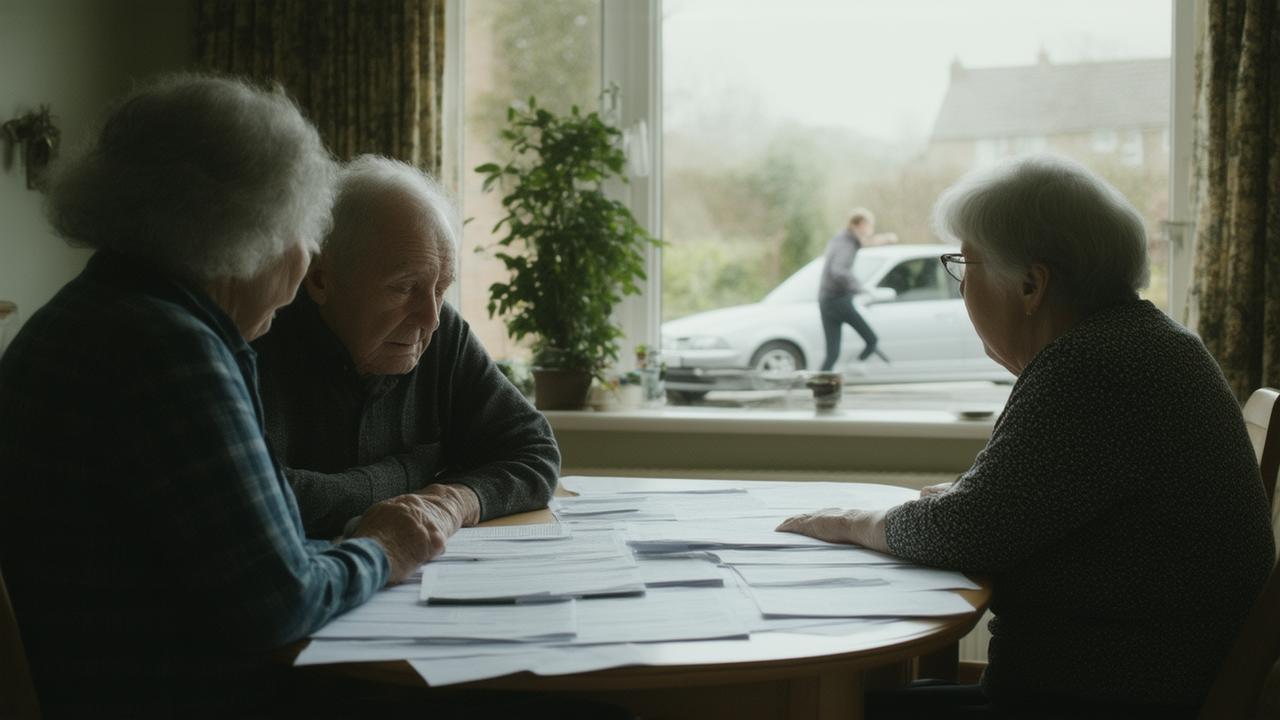
The kettle had just begun its soft rattle on the stove when the letter slipped through the brass mouth of the front door. It landed on the worn hallway rug with a sound that no one heard, though years later each family member would swear they remembered it clearly—a crisp, accusing thud. By the time the steam curled from the spout and the tea leaves colored the water, a line had been drawn through a family that once believed, perhaps naively, that love was thicker than ink and law.
The House That Held Their Childhood
From the street, the house did not look like a battlefield. It was an ordinary, slightly sagging, single-story brick place, the kind you drive past without a second glance. An oak tree leaned over it, as if listening. Hydrangeas, once proudly tended, now drooped in a kind of floral exhaustion. The paint on the front door—once a bright, impulse-buy blue—had faded to a weary pastel.
Inside, the air smelled faintly of boiled potatoes, laundry powder, and something else—an old scent of family life that never quite leaves: pencil shavings, school shoes, Sunday roasts, winter wet-dog, and the metallic tang of coins counted carefully at the kitchen table. Every corner of the house was padded with memory. Scratches on the hallway wall marked the children’s growing heights. A cracked tile by the stove, where a pan had once been dropped in a Christmas rush. A dent in the skirting board from a clumsy tricycle decades earlier.
To their neighbors, this was simply the home of an elderly couple who waved from the garden and talked about the weather. But to the parents, it was the sum of thirty-five years of early mornings and overtime shifts. For the siblings, it had been the stage of their entire childhood—the place where whispered secrets, small rebellions, first crushes, and slammed doors all unfolded.
It was the one place they all had in common, until money turned it into something far sharper and far less forgiving: an asset.
When Love Meets Legal Paper
The first sibling to say the unsayable was Daniel, the eldest. He didn’t do it in anger. At least, that’s what he told himself. He did it in a mild, almost practical tone one Sunday afternoon, as if they were sticking labels on moving boxes.
“We should talk about the house,” he said, fingers drumming on the kitchen table. The old wood buzzed under his nails like something alive and uncomfortable.
Their parents, Miriam and John, exchanged a glance over their cold tea. Their youngest, Chloe, pretended to scroll on her phone, but her thumb hovered idly, not really moving. Liam, the middle child, stared at the window, watching a sparrow hop along the fence.
“What about the house?” Miriam asked carefully.
Daniel shrugged, but his voice had an edge. “Well, it’s our inheritance, isn’t it? We should have things in writing. Make sure it’s divided fairly.”
“Fairly,” in this case, did not take into account the fact that Miriam and John were still alive, still paying council rates, still bleeding a bit each month to keep the lights on and the kettle hot. The mortgage had been paid off only five years earlier, closing a long, heavy chapter of sacrifice. None of the children had ever paid toward those decades of bills. They had contributed mess, noise, heartbreak, and joy—but not money.
Still, Daniel had done the quiet math of adulthood. He’d looked at his own rent, his own debt, the unachievable glint of a first home in the distance, and his mind had turned, helplessly, toward the house he’d once fled for independence. It seemed, now, like a solution. A right. A thing he was owed.
Conversations, in families, have a way of becoming stories. That Sunday afternoon in the kitchen became a story Danielle told his wife later, shaking his head. It became a story Liam muttered in the pub, anger frosting his words. It became a story Chloe typed to a friend in the shimmering blue light of her phone screen: They’re not listening. They don’t get it. It’s ours too.
The Drift from Conversation to Court
Law, for most people, exists like some distant thunder—over there, on the horizon. You hear about it in the news, in other people’s tragedies, in quickly scrolled headlines. The idea that it could stride into your living room and rearrange your life feels surreal, until it happens.
When the siblings visited a solicitor, they did not think of themselves as aggressors. The room smelled of photocopy toner and carpet cleaner, the desk stacked with very calm folders. The solicitor’s voice was smooth and measured, the kind of tone that suggests this is all quite routine, nothing personal, just a matter of paperwork and precedent.
“If the property is in your parents’ names,” the solicitor explained, “you will need to establish your claim legally. If there was an understanding or promise that you would receive a share, we can explore that. It’s not easy—but not impossible.”
Words like “claim,” “share,” and “entitlement” slid between the siblings and hardened into a plan. If conversation failed, there was, after all, a system. A process. A way to make things fair. They framed it in the language of justice, not greed. They talked about housing prices, about how impossible it was to own anything now, about how their parents had bought the home in a different era, when wages and property hadn’t drifted into different galaxies.
What none of them fully pictured was the moment their parents would stand on their own doormat holding an official envelope that said, in effect: Your children are suing you for the roof over your heads.
The day the paperwork arrived, John’s hands trembled. Not with age, but with something that felt like betrayal and disbelief twisted together. Miriam read the first lines once, twice, her eyes blurring, the legal phrasing turning their children into “plaintiffs” and themselves into “defendants.” Suddenly, this home with its dented skirting boards and faded door was not a sanctuary. It was evidence.
What a House Really Holds
In the weeks that followed, the house grew quieter and louder, all at once. Footsteps seemed to echo more. The clock in the hallway ticked with almost theatrical insistence. The television murmured on low volume, more out of habit than interest. Each ring of the phone sent a small, sharp jolt down Miriam’s spine.
At night, John lay awake and mentally walked through the rooms. The bedroom where the boys had once whispered about comic books. The tiny room where Chloe had taped glow-in-the-dark stars to the ceiling. The kitchen where they’d celebrated scraped-through exam results with cheap cake. Was every memory now going to be dragged into a courtroom, twisted into evidence of a so-called “understanding” about future inheritance?
The case triggered conversations among neighbors and relatives, spoken in hushed tones over hedges and at funerals, at barbecues, and in online comment threads. Some said the children were heartless, spoiled, rotten by a culture of entitlement. Others, often younger, said that the housing crisis had changed the rules; that parents who sat in fully paid homes while their children floundered in precarious rentals were sitting on a power imbalance no one wanted to name.
Somewhere between those two views lay a quieter truth: a house is never just bricks. It’s a knot of stories, debts, fears, ambitions, and unspoken expectations. When that knot is pulled too hard, something snaps.
A Tangle of Expectations
For years, the siblings had assumed—without ever asking directly—that the family home would one day be split between them. It was an invisible promise, the kind that hangs in the air of many families: One day, this will all be yours. Their parents, meanwhile, had carried a different, equally unspoken assumption: that the house would remain theirs until they no longer needed it, or that they’d sell it to fund care in their later years.
No one had ever sat down at that scarred kitchen table and said the raw, specific words: “Here is what will happen to the house, and here is why.” Silence had done what silence often does—it left a blank space, and everyone filled it with their own private version of fairness.
By the time the dispute walked into a courtroom, fairness had become something abstract and icy. Lawyers translated family tension into clauses, exhibits, and precedents. Photographs of childhood birthday parties and Christmas dinners, once treasured, were now potential evidence of a shared life that might have implied an unwritten promise.
When the Numbers Don’t Tell the Whole Story
In court, the house was distilled into numbers: market value, outstanding costs, potential equity. These figures glowed crisply on printed pages, neat and unruffled, as if they had nothing whatsoever to do with the human mess from which they were born.
Yet even here, where emotions are supposed to be tamed by procedure, they leaked out—in the tremor in Miriam’s voice, in the way Daniel’s jaw clenched as he testified, in how Liam stared at his shoes while the judge asked him direct questions.
Outside of this single family, similar dramas were playing out in quieter forms. In cities and towns, adult children sat with calculators open, trying to balance their parents’ aging with their own financial survival. Elderly parents worried about being forced to sell the only place that still felt stable. Solicitors, mediators, and financial advisors saw the same pattern again and again—love colliding with scarcity.
➡️ “I didn’t expect one decision to save me $750 in just three months”
➡️ Psychology says people who grew up without air conditioning developed these 7 mental resilience traits that are nearly impossible to build today
➡️ Heated dispute over effortless patio cleaning: the ‘miracle’ method for blackened slabs that some call genius and others call irresponsible
➡️ This forgotten feature in your car improves visibility during bad weather
➡️ Food experts explain why this cooking shortcut often backfires
➡️ The simple reason some rooms echo more than others
➡️ The exact reason your phone battery drains faster at night even when you are not using it
Consider the uneasy arithmetic that so many families find themselves doing:
| Family Reality | Emotional Impact |
|---|---|
| Parents own a mortgage‑free home but live on a modest pension | Fear of losing security in old age, anxiety about care costs |
| Adult children struggle with high rents and low savings | Resentment, panic about the future, a sense of being left behind |
| No clear will or written plan for the family home | Rumors, assumptions, and unspoken expectations |
| One child provides more practical or emotional support to parents | Tension over what is “fair,” guilt, rivalry between siblings |
| Family turns to legal action instead of mediation | Deep fractures, long‑term estrangement, grief that has no funeral |
On paper, the siblings’ lawsuit was about property rights. In reality, it was about fear: fear of never owning anything, fear of being left out, fear of growing old with nothing to show but rent receipts and regrets. For the parents, it was a different fear—the terror of being treated like a problem to be “resolved,” rather than people whose lives still had unfolding pages.
Lines That Can’t Be Uncrossed
No verdict could restore them to the people they’d been before the lawsuit. Whether the court sided with the parents’ right to keep their home intact, or with the siblings’ argument for a share, something fundamental had already shifted.
At Christmas the following year, there was no full family gathering in the blue-doored house. Instead, there were smaller, fractured celebrations—one sibling here, another there, parents somewhere else, everyone making do with thinner, quieter versions of the day. Phone calls went unanswered. Text messages stayed in drafts. The oak tree in the front yard stood over it all, unbothered, collecting another season’s leaves.
Neighbors noticed the absence of noise more than anything—the lack of overlapping voices, of a car door slamming, of someone laughing too loudly in the driveway. The silence felt like a verdict of its own.
What Could Have Been Different
The story of this family is not unique; it is simply one of the louder, more visible examples of a tension that lives in many homes. But inside that ache, there are insights that other families still have time to use.
Speaking the Unspeakable, Sooner
Imagine, for a moment, if years earlier they had gathered at that kitchen table not to fight, but to plan. If Miriam and John had said: “We want to stay here as long as we can. After we’re gone, this is what we hope will happen with the house. This is why.” If the children had been able to say, without shame, “We’re worried we’ll never own anything. How can we be honest about that without hurting you?”
These conversations are awkward, yes. They expose vulnerabilities on both sides. But silence doesn’t avoid conflict; it simply delays it and hands it to the future, where it tends to explode at exactly the worst possible time.
Beyond Bricks and Bloodlines
In the end, a family home is not a birthright guaranteed by biology alone. It is the product of effort—of shifts worked, meals skipped, risks taken. For some parents, the house is the one solid achievement in a life of compromise. For some children, it looks like the only lifeline in sight.
Between those realities lies a fragile bridge: understanding. Not the sentimental kind, but the practical, humble, sometimes brutally honest variety. It’s built from clear wills, honest conversations, written agreements when needed, and a willingness to see the other side’s fear as real, not as an attack.
This family’s story is heavy, but it is not purely a warning; it is also a mirror. It asks anyone who hears it to pause at their own front door and consider what unspoken expectations hover, ghost-like, in the crack between the hinges.
Maybe the most radical act a family can undertake is not to promise that everything will be “fair,” but to sit down, before lawyers and letters enter the scene, and admit how complicated “fair” has become. To remember that a house can be sold, rebuilt, or lost—but that the quiet, day-to-day work of staying a family is the rarest kind of inheritance, and the hardest to win back once it’s gone.
Frequently Asked Questions
Why would children sue their parents over a house?
Adult children sometimes turn to legal action when they feel insecure about their financial future or believe they were promised a share of the family home. Rising housing costs and unclear expectations around inheritance can amplify that fear, turning it into a legal dispute rather than a conversation.
Is it legally possible to claim a share of a home you never paid for?
In some situations, yes—but it is usually difficult. Courts may consider whether there were explicit promises, contributions in other forms, or reliance on an understanding that caused someone loss. Each case is highly specific, and outcomes are never guaranteed.
How can families avoid conflicts over the family home?
Clear communication and early planning help. Written wills, open discussions about parents’ needs in old age, and realistic conversations about what children can and cannot expect can prevent misunderstandings that later explode into legal battles.
What if parents want to protect their home and still help their children?
Parents can explore options like downsizing, gifting carefully, or setting up formal agreements, but they should consider their own long-term care and financial security first. Professional legal and financial advice can help them find a balance that feels fair and sustainable.
Can broken family relationships be repaired after a lawsuit?
It’s possible, but not easy. Trust is damaged when a private disagreement becomes a public legal conflict. Rebuilding often requires time, sincere apologies, and sometimes outside help, such as family therapy or mediation. Some families eventually find a new, more cautious peace; others remain permanently estranged.





