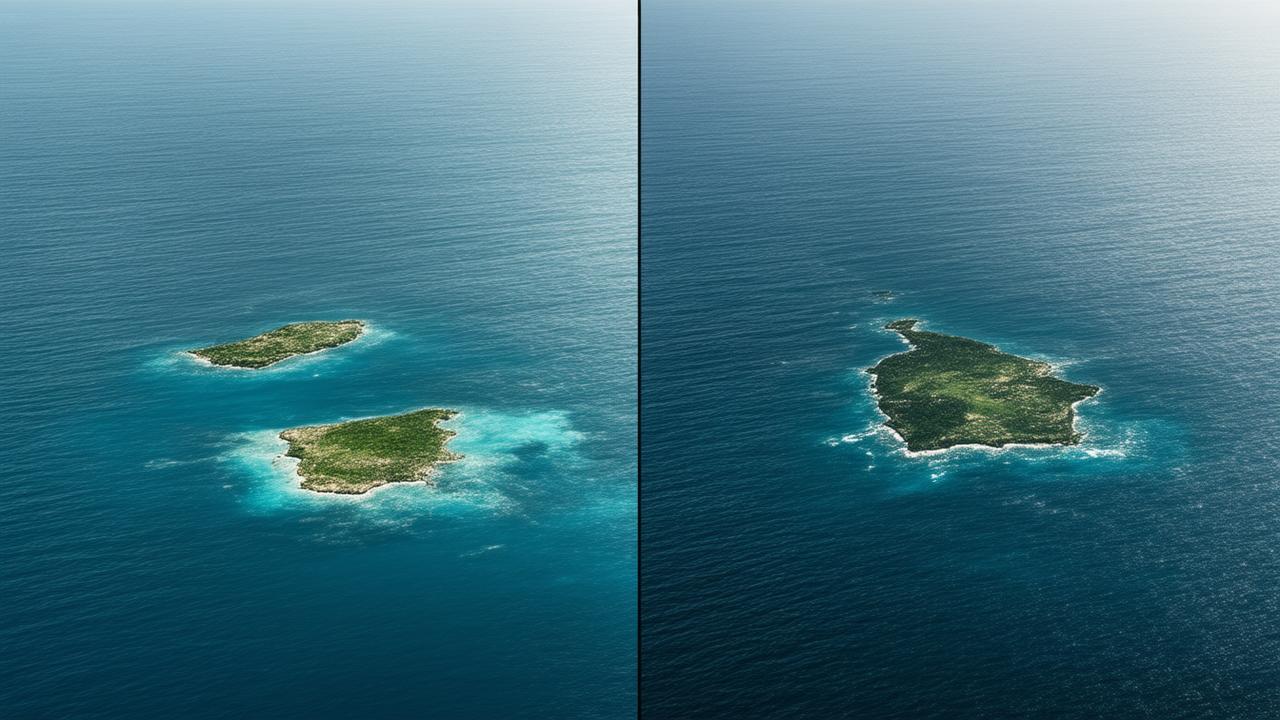
The first time you see one of China’s man-made islands from the air, it doesn’t look real. The water below, a vast sweep of the South China Sea, glows an impossible turquoise. Then, almost like a mirage, a shape hardens out of the blue: a pale ring of sand, a strip of runway as straight as a dropped matchstick, the hard angles of buildings and radar domes rising where, not so long ago, there was only open ocean. From that high window, you are watching a new geography being written in real time—one barge of sand at a time.
What It Looks Like To Build An Island From Nothing
Imagine the sound first. Out on the water, before dawn, the air is thick and heavy, smelling of salt and warm metal. The low thrum of diesel engines never really stops; it just grows louder and softer as ships shift position. Great, lumbering dredgers hover over the sea like steel insects, their massive suction arms plunging below the surface, drinking in the seafloor.
Below them, coral reefs that took millennia to grow are scraped, chewed, and broken into slurry—sand, mud, shell, and shattered living architecture all blended into something that can be pumped. On deck, thick pipes shudder as that slurry rushes through, roaring and hissing, pushed by pumps the size of small houses. At the outlet, the ocean becomes a kind of construction site: sand explodes into the shallows in plumes, piling up, oozing into shape, slowly rising toward the light.
This is how China has been remaking the map of the South China Sea. Not with volcanic fire or slow tectonic lift, but with machines and planning documents and an unblinking sense of purpose. For more than a decade, fleets of dredgers and support vessels have been dispatched to lonely reefs and half-submerged rocks. The mission: transform them into permanent, controllable land—military outposts, runways, small cities—built entirely on foundations the ocean never meant to hold them.
The Quiet Decade of Sand
The story really begins in the early 2010s, though the ambitions echo further back. The South China Sea has long been a crowded chart: overlapping lines of claim, disputed rocks, fishing grounds jealously guarded and quietly raided. But the tools changed. Where once power was marked by ships and flags, suddenly there was something more physical, more literal, and more permanent: the creation of land itself.
To the casual observer, nothing appeared to change at first. Ships came and went; the horizon remained the horizon. Far from major cities, out on remote atolls with names most people could not find on a globe, the work went on in the background hum of global attention. Busy news cycles turned elsewhere. But the barges kept moving, the pipes kept pumping.
By the middle of the decade, satellite images began to tell a different story. Tiny dots on the map—reefs, shoals, pinpricks of rock—had swollen into shapes that looked suspiciously like airfields, harbors, and compounds. What had been specks barely visible at low tide were now sprawling man-made platforms, edged with breakwaters, topped with gray concrete.
| Feature | Before Sand Dumping | After Island Construction |
|---|---|---|
| Land Area | Tiny reefs, often submerged at high tide | Hundreds of hectares of solid ground |
| Infrastructure | None or small outposts on stilts | Runways, docks, radar domes, barracks |
| Ecosystem | Living coral reefs and diverse marine life | Buried reefs, altered currents, stressed habitats |
| Legal Status | Often low-tide elevations with limited legal weight | Contested “islands” used to project maritime claims |
The raw numbers tell one story—thousands of acres of new land added in a matter of years—but the experience of it is something else. It is a reminder that modern power can literally rearrange the edges of the sea, trading coral for concrete, fish for runways.
How To Make Land That Was Never Meant To Be
On paper, the process of building an island is deceptively straightforward. Dredge. Dump. Shape. Stabilize. But the realities, especially in a restless tropical sea, are anything but simple.
First, engineers choose their target: a reef or shoal that breaks the surface at low tide, or comes close—a place shallow enough that it offers a natural platform, but remote enough to matter in geopolitical terms. Massive dredgers then sweep in, their cutters tearing at the seabed. They vacuum up sediment and coral rubble, then pump that mixture through floating pipes to the chosen reef.
There, the slurry fans out, clouding the water into a milky green. Over time, storm after storm, tide after tide, the sand settles, packing down into a rough, unstable hill. The early stages look almost fragile—just a pale smear in the sea, waves still cutting channels through the new ground. But the dredgers keep feeding it, layer after layer, like building a sandcastle in reverse: not from the top with hands, but from below with machinery.
Once the new island rises above the highest tides, the shape becomes more deliberate. Bulldozers and excavators, brought in on barges, growl across the bare surface, sculpting edges, carving flat runways and roadbeds. Retaining walls of rock and concrete line the perimeter, trying to hold the sand in against waves and typhoons. Eventually, an island that never existed begins to look like it’s always been there: crisp edges, gridded roads, sharp shadows from neat rows of buildings.
From the sea, though, you can still feel the strangeness. If you were to sail close enough—dodging patrol boats and warnings on the radio—you would see the water change color abruptly around the new land, shifting from deep blue to a cloudy, shallow green. Sediment still drifts off in slow, pale curtains, a kind of underwater dust that never fully settles.
What The Ocean Loses When Sand Becomes Strategy
To turn a thriving reef into an airfield is to make a trade, even if no one on deck uses that word. Under the rumble of engines and the shout of orders, another sound disappears: the crackle of coral, the muted clicks and calls of reef life, the invisible symphony of a complex ecosystem.
Before the dredgers arrive, many of these reefs are crowded underwater cities. Branching corals, brain corals, staghorns and fan corals stack and twist into wild architecture. Fish flash between them in bright scales of yellow, blue, and silver. Sea cucumbers graze along the bottom. Turtles might pass through, snipping off soft sponges, while sharks patrol the edges, shadows sliding just beyond easy sight.
When the first slurry hits, it is like a slow underwater storm. Fine sediment coats coral surfaces, clogging the microscopic mouths that feed them. Light is choked out by cloudy water. Some corals bleach; others simply suffocate. Creatures that can swim away sometimes do. Those that can’t—small invertebrates, anchored organisms, eggs and larvae—are buried or starved.
It doesn’t end with the initial construction. Even after the island feels solid, the ocean keeps tugging at the edges, rearranging grains of sand, eroding here, piling there. To keep the island in place, to keep the airstrip flat and the harbor deep, maintenance dredging and reinforcement continue. Each new round kicks up more sediment, shifting the life of the surrounding sea a little further off balance.
It’s hard to measure a lost reef in simple numbers. You can count species, log temperature changes, track fish populations. But you can’t easily quantify the quiet erasure of places that once glowed with color and motion and now lie entombed beneath straight lines and concrete.
Sand, Sovereignty, And The Shape Of A Map
These artificial islands are not just engineering projects; they are political sentences written in sand and steel. In a crowded, contested waterway, being able to say “This is land” carries weight. Land, in the language of maritime law, can be used to argue for territorial seas, economic zones, and rights to the resources hidden beneath waves: oil, gas, fish, shipping lanes.
From a distance—say, from another capital city—the islands appear as points in broader strategies, nodes in a network of influence stretching across sea and sky. Airstrips mean aircraft can land, refuel, and patrol further. Deepwater harbors can host larger ships. Radar and communication arrays extend the invisible reach of surveillance over a wider arc of ocean.
But stand on the imagined shoreline of one of these newborn islands, and the geopolitics compress into something more visceral. The horizon is a clean, hard line. The wind tastes of salt and hot dust. The rumble of generators fills in for birdsong. Behind you rise watchtowers and antennae; ahead, the sea glints, indifferent to the arguments held in conference rooms thousands of miles away.
There are questions that drift through every discussion of these islands: Can land made of dumped sand carry the same weight as land raised by geology? Does an airfield on a drowned reef change the moral equation of who belongs where? When a new island appears, is it an extension of a country, or a kind of floating statement that could, someday, be swallowed again?
Living With Islands That Shouldn’t Exist
For fishers from neighboring coasts, the islands are both obstacle and omen. Many remember when those same reefs were just dots that only appeared at low tide, known mostly by experience and rumor. They navigated by swell and stars, the sea a shared, if uneasy, commons. Now, they look out across waters they’ve worked for generations and see warning lights, radar masts, and patrol boat silhouettes.
➡️ “I feel like I’m always bracing for something”: psychology explains anticipation mode
➡️ “No one explained how to do it”: their firewood stored for months was actually unusable
➡️ “This slow cooker meal is what I start in the morning when I know the day will be long”
➡️ A quick and natural way to make any room smell fresh, without using sprays or scented candles
➡️ A Nobel Prize winning physicist says Elon Musk and Bill Gates are right about the future, with far more free time but fewer traditional jobs
➡️ 8 phrases deeply selfish people often say without realising it
➡️ Another once-ignored “poor people’s fish” is becoming a sought-after staple as Brazilians rediscover its safety, low cost and impressive nutritional benefits
Some keep their distance, pushed out by patrols or nervous of getting too close to such tightly held new borders. Others skirt the edges, still following old currents, eyes flicking nervously toward gray hulls on the horizon. The invisible lines of claim, once theoretical, have become concrete—literally.
Out beyond the debates and press conferences, storms continue to sweep in each year, testing the new islands with waves that crash and claw at their engineered shorelines. The buildings stand, for now. The runways glisten wet beneath driving rain. But there is always an undercurrent of uncertainty. Sand is stubborn but also fickle. It shifts, compresses, settles. Engineers race not just against politics, but against the patient, grinding persistence of the sea.
To live with these islands is to live with a new kind of coastline: one that can appear within a single political generation, yet must be constantly defended from the very water it tries to command.
What These Islands Say About Us
In the end, China’s decade of sand in the South China Sea is a story about more than any one nation. It reveals something about the age we live in, where human ambition no longer stops at quiet borders drawn on old maps, and where technology gives us the power to tilt the physical world closer to our desires.
There is awe in that: the sheer capability to decide, “Here there will be land,” and then make it so. But awe walks hand in hand with unease. Each artificial island is a kind of mirror, reflecting our comfort with bending ecosystems and coastlines to political will, and our habit of assuming that the nonhuman world exists chiefly as a surface to be rearranged.
Somewhere beneath those runways, beneath the buried layers of sand and cement, lie the ghost outlines of reefs that once blossomed with life. Somewhere overhead, planes lift off from a place that used to be waves and open sky. When we talk about dumping sand into the ocean, it’s easy to picture piles and machinery. Harder, but perhaps more honest, is to picture the before and after stitched together in a single frame: coral gardens trading places with radar dishes, parrotfish with patrol craft.
The sea will remember, in its own way. It will keep tugging, reshaping, clouding the shallows. It will test each new edge with storms. Maybe, far in the future, when engines are silent and claims have shifted again, some of these islands will sag back toward the water, eroded and forgotten. Or maybe they will endure, layered over and built upon, becoming accepted parts of a coastline that was once blue on every map.
For now, as planes pass overhead and ships trace their routes below, the new islands sit where there was once only depth. They stand as proof that, for better or worse, we have entered an era where even the sea floor is no longer beyond our reach—and where the act of dumping sand into the ocean can redraw not just charts, but the possibilities of power, nature, and place.
Frequently Asked Questions
Are China’s artificial islands natural in any way?
No. While they are built on or around existing reefs and rocks, the bulk of their land area is entirely artificial, created by dredging and dumping sand and sediment onto shallow parts of the sea.
How long does it take to build one of these islands?
Initial land reclamation can happen surprisingly quickly—sometimes in a matter of months. However, full development with infrastructure, stabilization, and ongoing maintenance can take years and requires constant attention to erosion and storm damage.
Do these islands count as “real” territory under international law?
This is heavily disputed. Many legal experts argue that artificial islands do not have the same status as naturally formed land and cannot generate full territorial seas or exclusive economic zones. Different countries interpret and challenge these claims in various ways.
What is the environmental impact on coral reefs?
The impact is severe. Dredging and sand dumping can destroy coral structures, smother marine life, increase sediment in surrounding waters, and alter currents. Recovery, if it happens at all, can take decades.
Can the ocean eventually reclaim these man-made islands?
It’s possible. Without continuous reinforcement, waves, storms, and subsidence can erode artificial islands. Governments can slow this with engineering and constant maintenance, but the sea will always push back against land that was never meant to be there.





