The first cold evening always comes with a kind of ceremony. The light drains out of the sky earlier than you think it should, your breath becomes visible in the air, and somewhere in the house an old instinct wakes up: it’s time for a fire. That was exactly the feeling that wrapped around Mia and Jonas as they stepped out onto their porch that November, cheeks stung pink by the wind, hearts quietly pleased with themselves. Behind them, the living room waited—fireplace swept, kindling basket ready, a heavy kettle of water already on the stove. Outside, under the eaves, stood their pride and joy: a neatly stacked wall of split wood they’d been seasoning for months. Their first winter with their own firewood. Their first winter, they’d decided, of “doing it right.”
When the Perfect Stack Refuses to Burn
They had followed all the obvious steps, or so they thought. Back in early spring, they’d ordered a full load from a local guy with a rusty pickup and an easy smile. He’d dropped the pile at the far end of their gravel drive—oak and maple, mostly, with some birch mixed in—and waved away their anxious questions. “You’ll be fine,” he’d assured them. “Just stack it under cover and you’re good.”
They spent a full weekend on it. Tools clanged; wheelbarrows squeaked. They learned the weight of a log in the hand, the sound of one piece knocking against another, the pleasure of a clean split that rang like a bell. They built a handsome stack along the back wall of their garage, pleased with how it transformed chaos into order: tight rows, ends flush, everything tucked safely out of the rain. All summer, they’d glance at that wall of wood and feel quietly competent—as if they were becoming a little more rooted, a little more rural, a little more prepared.
Then came that first cold night. The ritual unfolded exactly as they’d imagined: the crumple of newspaper, the teepee of kindling, the larger logs laid in place. A single match flared sulfur-yellow, then orange. For a moment, the world felt like it was tilting toward everything warm and good.
Only the fire didn’t catch. The kindling sputtered, smoked, and coughed out. The logs hissed as though offended. Flame licked their sides, then gave up, leaving behind nothing but a sour smell and a stubborn smear of black on the rough grain. They tried again. And again. More newspaper, more kindling, more frustration. Each failure left another thin string of smoke crawling up the cold chimney, the room smelling faintly like a damp campfire long after the rain.
Mia finally sat back on her heels, streaked with ash and disappointment. “Why won’t it burn?” she asked the room, as if the old bricks of the fireplace were withholding a secret.
“No One Explained How to Do It”
What they didn’t know then—and what many first-time wood-burners learn the hard way—is that firewood isn’t just “wood you burn.” It’s a material whose readiness can’t be seen in a quick glance, and whose whole personality changes with water and time. They had stored it carefully, yes. But they had stored it in the worst possible place.
Against the inner garage wall, the stack looked clean and safe, hidden from weather and theft and the casual chaos of the yard. Yet it sat directly on concrete, pressed up snugly against a wall, the air around it cool and still. On humid summer days, the garage smelled faintly of earth and bark and something else—something Jonas once joked was “forest breath.” They shrugged it off. Wood smells like wood, right?
By autumn, the pieces felt reassuringly heavy in the hand. They assumed that meant good, dense heat. In truth, that weight was water. The logs had never had a chance to properly dry. No one had told them that firewood needs wind more than it needs a roof—that air is as essential as shelter. No one had explained that moisture doesn’t just leave on its own, not when it’s trapped against a wall, stacked too tight, sitting on a slab that sweats in the heat and chills in the cold.
So they did what many of us do when something simple turns stubbornly difficult: they blamed themselves, then the fireplace, then the wood seller. It was only later, with a cheap moisture meter in hand and a few evenings of reading, that they finally learned the truth. Their carefully guarded treasure was, for this winter at least, almost useless.
The Sound, Smell, and Feel of Wood That Will Never Catch
Unseasoned wood doesn’t exactly stand there holding a sign. Instead, it tells on itself in hints and half-whispers—clues they’d missed, clues you might be looking at in your own stack right now.
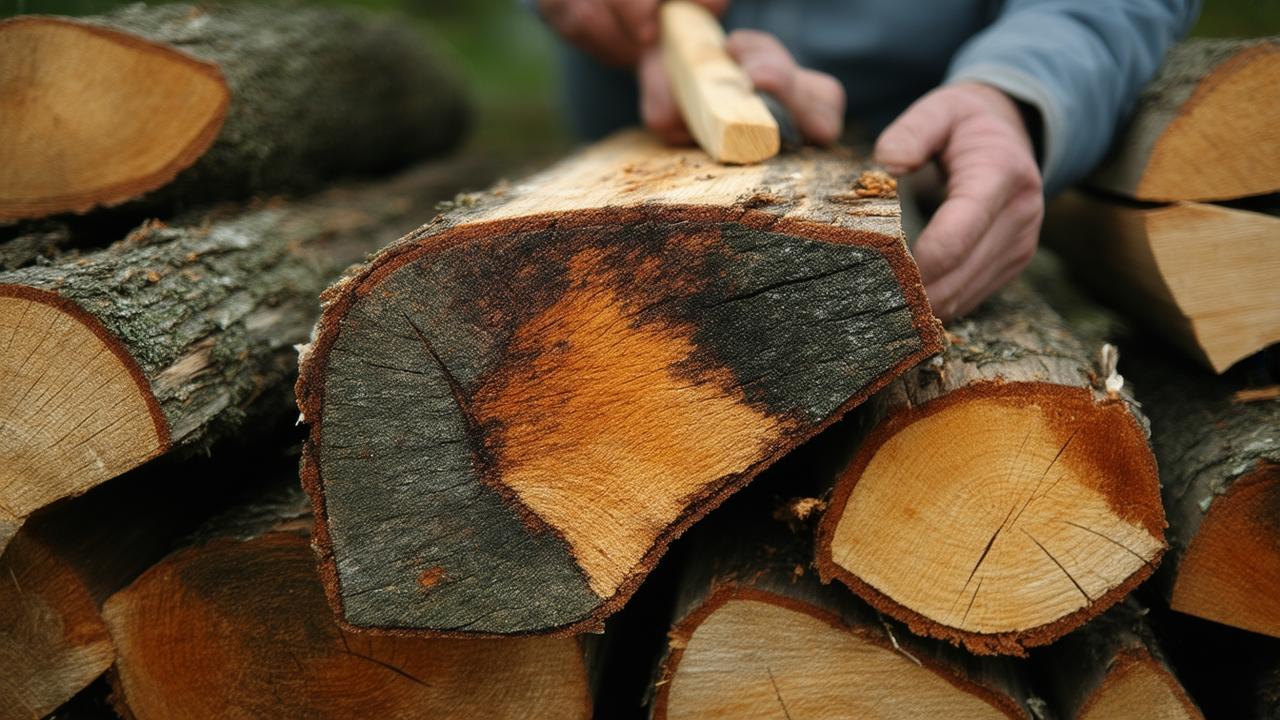
On a damp afternoon a week later, Jonas stepped back from the garage and really looked. The logs still had a faint sheen where the bark had peeled away. Some ends were dark, with tight grain and no cracks. He pried apart two pieces near the bottom of the pile and found a line of pale mold along their touching faces, like a ghostly signature.
He picked up a split and slapped it against another. Instead of the crisp “clack” he remembered from that spring, the sound now was dull, more like two wet books bumping together. When he brought a fresh log to his nose, there was a sharp, earthy tang—more sap than smoke, the lingering memory of a living tree rather than the dry, clean scent he’d imagined.
That night, he and Mia sat at the kitchen table with a notepad between them, frustration slowly giving way to curiosity. They began listing what they were learning, turning their small failure into a kind of field guide.
| Sign | Wet / Unseasoned Wood | Dry / Ready Wood |
|---|---|---|
| Weight | Feels heavy, dense with hidden moisture | Noticeably lighter for its size |
| Sound when struck | Dull thud, no ring | Clear, sharp “clack” or ring |
| Appearance of ends | Smooth, dark, few or no cracks | Cracked, lighter color, checking visible |
| Burn behavior | Hisses, smokes, struggles to catch | Ignites easily, burns with bright flame |
| Moisture content | Often 30–50% or higher | Ideally below 20% |
They underlined that last line. “Below 20%” became their new north star. Unlike the romance of rustic living, moisture content was specific, measurable, almost comforting in its exactness. At the hardware store, tucked between bags of screws and rows of paint samples, they found a small digital moisture meter for less than the cost of a single takeout dinner. Back home, they pressed its prongs into split faces of wood from different parts of the stack.
Thirty-two percent. Thirty-eight. Forty-one.
The numbers told a story: the wood hadn’t been delivered dry. And their careful, airtight storage had quietly sealed its fate.
The Quiet Art of Stacking Wood So It Actually Dries
In the days that followed, their backyard turned into a kind of open-air workshop. The original stack came down piece by piece, each log carried out into the pale autumn sun. There was something humbling and oddly soothing about undoing their mistake in slow motion, about allowing air to flow where it had been blocked.
“No one explained how to do it,” Mia said again as they worked, not as accusation this time, but as observation. They had absorbed the image of a neat stack from photographs and movies, from woodstove catalogs and nostalgia-drenched social media posts. But the physics behind those images—the invisible dance of moisture and wind—had never entered the conversation.
They laid pallets on the ground to lift the new rows up and away from damp soil and dew-laden grass. Where they didn’t have pallets, they used straight scrap boards on cinder blocks, anything to let air move underneath. They pulled the stack a few inches away from the fence and garage wall instead of pressing it flush. In the narrow space between wood and structure, the wind could now slip through like a quiet river.
Each row was stacked a little looser this time. They left small gaps instead of hunting for a perfect Tetris fit. Thick ends alternated, odd-shaped pieces tucked where they wouldn’t seal off the flow. At the top, they angled a few old pieces of galvanized roofing to shed rain, leaving the long sides exposed. It looked a bit messy compared to the Instagram-perfect wall they’d had before. But as breezes threaded the new stack, they could feel the logic of it, the rightness.
Here, finally, the wood could breathe.
What Firewood Really Needs (That Nobody Mentions)
As the weeks passed, they kept learning. Each small discovery chipped away at the shame of “doing it wrong” and replaced it with the soft satisfaction of understanding.
They learned that “seasoned” is often a marketing word, not a guarantee. Any seller can say it; only a meter or experience can confirm it. They learned that the type of wood mattered—how dense oak takes longer to dry than birch, how a log split in April behaves differently than one split in October. They realized that covering the entire stack in a tight plastic shroud kept out rain but also locked in every bit of escaping moisture, turning the pile into a kind of low, slow sauna.
Most of all, they realized fire doesn’t just happen at the hearth. It begins months or even years earlier, with small, practical decisions: where to stack, how to orient the rows to catch prevailing winds, how to keep the bottom layer from wicking up ground moisture.
➡️ “I feel like I’m always bracing for something”: psychology explains anticipation mode
➡️ By dumping sand into the ocean for more than a decade, China has managed to create entirely new islands from scratch
➡️ “This slow cooker meal is what I start in the morning when I know the day will be long”
➡️ A quick and natural way to make any room smell fresh, without using sprays or scented candles
➡️ A Nobel Prize winning physicist says Elon Musk and Bill Gates are right about the future, with far more free time but fewer traditional jobs
➡️ 8 phrases deeply selfish people often say without realising it
➡️ Another once-ignored “poor people’s fish” is becoming a sought-after staple as Brazilians rediscover its safety, low cost and impressive nutritional benefits
Their next load of wood arrived earlier the following spring, the truck driver puzzled when they pulled out the moisture meter and tested several pieces before paying. “Below twenty?” Jonas asked.
The man laughed, half-amused, half-impressed. “You’ve done your homework,” he said. “Most folks just look at it and hope.”
They smiled in a way they couldn’t have the year before—not smug, but quietly grounded. They knew now that hope doesn’t dry wood; time and air and attention do.
When the Flame Finally Finds Its Way
By their second winter, the ritual of the first fire felt different. The matches were the same, the bricks of the fireplace unchanged. But the logs in their hands had a new language. They felt lighter, almost hollowed of their past life as living trees. The ends were split with fine, star-shaped cracks. When knocked together, they sang a bright note instead of groaning.
This time, the kindling caught quickly, flames racing up the dry twigs with a kind of greedy joy. The larger splits began to glow at the edges, then leaned into the flame as if they’d been waiting for this moment. There was no hissing, no sullen smoke curling stubbornly across the glass. Only steady, bright combustion, the air above the fire trembling with heat.
They sat back on the old sofa, socks thawing, windows fogging slightly at the corners. The whole room smelled not of damp and frustration, but of that deep, almost sweet scent that only properly seasoned wood can release—a smell of sap remembered rather than sap trapped.
Between crackles, they thought about that first winter and the stack that seemed perfect until the match was struck. They thought about how many people must be standing right now in front of a nervous little pile of kindling, wondering what they did wrong, breathing in too much smoke and too much self-doubt.
Because that’s the deeper truth hiding in their misadventure: this isn’t just about firewood. It’s about all the basic skills we quietly assume we should already know. The world is full of things that look simple from the outside—starting a fire, growing tomatoes, sharpening a knife, tuning a bike—and yet come with their own invisible grammar. We carry the weight of “I should know this by now” until a stubborn log, or a failed recipe, or a stuttering chainsaw finally forces us to admit: no one ever explained how to do it.
And from that admission, if we let it, a different kind of warmth can start. The warmth of curiosity instead of embarrassment. The warmth of asking neighbors, searching for real answers instead of shrugging and hoping. The warmth of starting small, starting clumsy, but starting anyway.
Outside, a faint wind slipped between the rows of next year’s wood, whispering through the loose stack, drying what would someday burn. Inside, the flames answered, steady and sure. Between them lay months of patient learning, and the quiet, practical knowledge that this time, the firewood waiting in the dark would be ready when the cold returned.
Frequently Asked Questions
How long does firewood need to dry before it’s ready to burn?
Most firewood needs at least 6–12 months of proper air drying after being split. Dense hardwoods like oak often need 12–24 months. Softwoods can be ready sooner, sometimes in 6–9 months, if they’re cut, split, and stacked correctly.
What moisture level is best for burning firewood?
Firewood should be below about 20% moisture content to burn cleanly and efficiently. A simple moisture meter lets you check this by pressing the probes into a freshly split face of the log.
Is it okay to store firewood in a garage or basement?
Only in small amounts and only if it’s already well seasoned. Garages and basements are usually too still and sometimes damp, so they slow drying dramatically and can encourage mold. Most of your wood should be stacked outdoors where wind can move freely.
What’s the best way to stack firewood so it actually dries?
Keep the stack off the ground with pallets or blocks, leave space between rows, avoid pressing it tight against walls or fences, and cover only the top to shed rain. The sides should stay open to the air so wind can move through.
How can I tell if my “seasoned” wood from a seller is really dry?
Look for cracks on the ends, a lighter feel in the hand, and a clear ringing sound when two pieces are knocked together. For certainty, bring or borrow a moisture meter and test a few split pieces from the center of the load. If they’re over 20–25%, the wood still needs more time to season.





