The room was quiet enough that Margaret could hear the refrigerator hum. It was 4:17 p.m., that strange hour after lunch and before evening when the house seemed to pause and listen to its own emptiness. Her book lay open on her lap. The TV murmured in the other room to no one in particular. She stared at the half-knitted scarf in her basket and wondered when the days had started to feel this long.
Loneliness doesn’t arrive with a grand announcement. It slips in at the edges: when friends move away, when adult children get busy, when health changes your routines. Psychologists now talk about loneliness as an epidemic, especially among older adults. It’s not just an emotional ache; research links chronic loneliness to higher risks of depression, memory decline, heart disease, and even early mortality.
But tucked inside that sobering truth is something hopeful: we are not powerless. Over the last decade, psychologists and gerontologists have been quietly mapping the kinds of activities that protect against loneliness in later life. The pattern is clear. Certain hobbies don’t just fill time; they create connection, meaning, and a sense of being woven into the world instead of sitting apart from it.
Imagine, instead of staring at the walls at 4:17 p.m., you’re learning to watercolor with a group in the park, or tending tomatoes in a community garden, or rehearsing a folk song with voices that crack and blend and laugh. The clock still moves at the same speed. Your age hasn’t changed. But psychology suggests your future health and happiness might have.
Why Hobbies Matter More Than We Think
In psychology, loneliness is defined not as being alone, but as the painful gap between the social connection you have and the connection you want. That’s why someone in a crowded retirement complex can feel desperately lonely, while another person living alone may feel deeply content and connected.
Hobbies help close that gap in several ways that researchers pay attention to:
- They create structured social contact: Regular, predictable gatherings lower the barrier to connection. You don’t have to “make plans”; the plan already exists.
- They support identity and purpose: Being a “gardener,” “singer,” or “mentor” gives you a role beyond patient, widow, or retiree.
- They engage the brain: Novelty and learning build cognitive reserve, which is linked to slower cognitive decline and better mood.
- They activate flow: When you’re absorbed in something challenging but manageable, worries and ruminations fade, at least for a while.
Not all hobbies work the same way. Psychology points toward certain ingredients that are especially powerful in aging: social interaction, physical movement, mental challenge, and a sense of contribution. The best hobbies for preventing loneliness usually combine at least two of these.
1. Group Walking and Nature Clubs
There is something quietly medicinal about walking beside another person, step matching step, conversation rising and falling with your breath. Studies show that even light physical activity like walking is linked to lower levels of depression and better cognitive function in older adults. But when you walk with others, you add the protective layer of social connection.
Nature amplifies this effect. Environmental psychologists talk about “soft fascination” — the way rustling leaves, water, and birdsong gently captivate our attention, giving the mind a break from worry. Joining a walking club, birdwatching group, or casual “stroll and chat” circle turns the outdoors into a weekly anchor point, something that pulls you back into the stream of other people’s lives.
You don’t have to hike mountains. A loop around the neighborhood, a city park, or a mall (for those with mobility challenges or icy winters) can still deliver what matters: shared movement, repeated faces, and stories that slowly unfold over months and years.
2. Community Gardening and Plant Care
Some hobbies let you watch time. Gardening lets you grow it. Soil under the fingernails, the damp green smell of tomato vines, the small thrill of a seedling finally pushing through — these are not just poetic moments. They are deeply regulating for the nervous system.
Research in eco-psychology shows that tending plants is associated with reduced stress, improved mood, and stronger feelings of connection. Community gardens add a powerful social dimension: shared tools, traded seeds, advice swapped over the lettuce beds. Even balcony pots or indoor plants can be social if they connect you to a local gardening club, online plant group, or neighborhood exchange.
What makes gardening particularly valuable in older age is the quiet sense of being needed. The beans will not water themselves; the roses rely on you. For someone who has spent a lifetime caring for others, this small, manageable responsibility can restore a sense of usefulness that retirement sometimes dissolves.
3. Group Music: Choirs, Drumming, and Jam Sessions
Imagine a circle of people in a sunlit hall, a piano’s first chord ringing out, voices layering imperfectly but earnestly. Group music-making is one of the most consistently recommended activities in psychological research on aging and connection. Singing in a choir, joining a community band, or even a casual drumming circle does several things at once.
First, it synchronizes. When we sing or play in time with others, our breathing and heart rates tend to align, a phenomenon associated with bonding and trust. Second, it demands presence. You can’t worry about your medical bills and watch the conductor at the same time, at least not very well. Third, music taps directly into emotional memory, reaching back to songs from youth and embedding new experiences in a rich, emotional context.
Studies have found that older adults in choirs report less loneliness, better mood, and even improvements in perceived physical health. You don’t need prior musical training. Many community groups welcome beginners, and the laughter over missed notes may be the best part.
4. Creative Making: Art, Craft, and Story
Loneliness often whispers, “You no longer matter.” Creative hobbies answer back, “You can still make beauty, still shape the world.” Whether it’s drawing, quilting, pottery, woodworking, or creative writing, making something with your hands (or words) lights up neural networks involved in pleasure, problem-solving, and self-expression.
Psychologists talk about “meaning-making” — the process of weaving your experiences into a coherent story. Creative hobbies are a playground for that process. A memoir-writing circle gives you a place to share pieces of your past with an audience that listens. A quilting group stitches memory into fabric, each block a fragment of personal or family story.
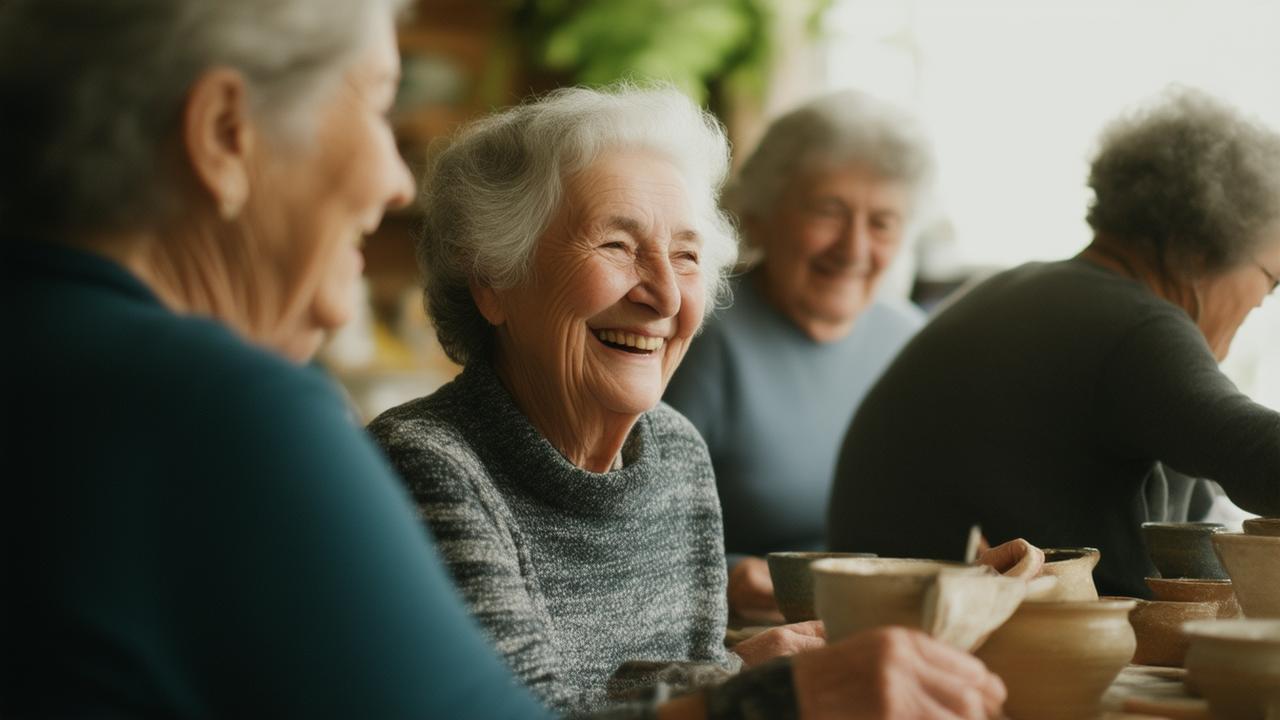
Programs that bring older adults into shared studios or writing groups repeatedly show reductions in reported loneliness and increases in life satisfaction. The key is less about artistic skill and more about shared process: showing up, struggling with the paint or the clay, laughing at mistakes, and slowly seeing something take shape under your hands.
5. Learning and Teaching: Classes, Clubs, and Mentoring
The stereotype of aging is one of decline, of shrinking horizons. Psychology tells a different story: the human brain remains capable of learning, changing, and even forming new neural connections well into late life. When older adults continue to learn, especially in social settings, they protect not only their minds but their sense of belonging.
Book clubs, language classes, history courses, technology workshops for seniors — all provide fresh material for conversation and the quiet satisfaction of mastery. Intergenerational programs, where older adults mentor younger people in skills or life experience, add another layer: the feeling of mattering to someone outside your immediate family.
Mentoring, in particular, is linked to what psychologists call “generativity” — the desire to contribute to the next generation. High generativity is associated with lower levels of loneliness and depression. Teaching a teenager how to cook a family recipe, guiding a younger colleague in your former profession, or volunteering as a reading buddy at a local school all turn accumulated life experience into a bridge instead of a wall.
10 Loneliness-Buffering Hobbies at a Glance
Here is a quick overview of 10 hobbies that research and clinical practice suggest are especially powerful in preventing loneliness in later life:
➡️ “I didn’t expect one decision to save me $750 in just three months”
➡️ Psychology says people who grew up without air conditioning developed these 7 mental resilience traits that are nearly impossible to build today
➡️ Heated dispute over effortless patio cleaning: the ‘miracle’ method for blackened slabs that some call genius and others call irresponsible
➡️ This forgotten feature in your car improves visibility during bad weather
➡️ Food experts explain why this cooking shortcut often backfires
➡️ The simple reason some rooms echo more than others
➡️ The exact reason your phone battery drains faster at night even when you are not using it
| Hobby | Main Benefit | Psychological Impact |
|---|---|---|
| Group walking / nature clubs | Light exercise + outdoor time | Boosts mood, fosters casual social bonds |
| Community gardening / plant care | Nurturing living things | Reduces stress, increases sense of purpose |
| Choirs, drumming, group music | Shared creative expression | Strengthens belonging, emotional expression |
| Art, craft, and creative writing | Hands-on making | Supports meaning-making, self-esteem |
| Book clubs and discussion groups | Shared ideas and reflection | Encourages connection and mental stimulation |
| Lifelong learning classes | New skills and knowledge | Builds cognitive reserve, confidence |
| Volunteer work | Helping others | Increases meaning, social integration |
| Mentoring / intergenerational programs | Sharing wisdom | Enhances generativity, reduces isolation |
| Gentle group sports (bowling, tai chi, dance) | Movement with others | Combines physical health with camaraderie |
| Clubs based on interests (chess, knitting, photography) | Shared passions | Creates identity and regular contact |
Bringing These Hobbies into a Real Life
It is one thing to nod along to a list. It is another to step out the door. Many older adults say the hardest part is not the hobby itself; it is overcoming the first wave of hesitation: What if I’m the oldest one there? What if I can’t keep up? What if no one talks to me?
Psychologists suggest starting with “low-friction” steps. Instead of announcing to yourself, “I’m joining a choir,” you might start by visiting one rehearsal just to listen, or by taking a short walk at the same time a local walking group meets, letting yourself observe before you commit. Small exposures can gradually disarm the anxiety that often travels with loneliness.
Another helpful approach is to recruit an ally — a neighbor, a family member, an old friend — to attend the first meeting or class with you. Shared novelty is less intimidating, and you’re more likely to return if someone else knows you planned to be there.
Perhaps most important is giving yourself permission to be a beginner again. Many older adults carry decades of competence in their former jobs, and stepping into a room where you know nothing can feel unsettling. But from a psychological perspective, this “beginner’s mind” is exactly what keeps us curious, adaptive, and less brittle in the face of life’s changes.
Letting Hobbies Stitch You Back into the World
Imagine Margaret again, months after that silent afternoon. It’s Thursday now, and she’s tying the laces of her walking shoes. A small group waits by the park entrance: the man with the wide-brimmed hat who always knows the bird names, the woman who cracks jokes about her arthritic knees, the retired teacher who brings thermos coffee for anyone who forgot.
Margaret still has quiet afternoons. Grief has not left; her worries have not vanished. But every week, her world now has these small, bright stitches: the walk, the community garden plot she shares with a neighbor, the Wednesday evening choir where she stands in the back row, eyes on the lyrics, feeling her voice join something larger than herself.
Loneliness in old age is not a character flaw or a personal failure; it’s often the result of structural changes — retirement, bereavement, mobility issues, cultural ageism. Hobbies will not fix everything. Yet, according to psychology, they are some of the most practical tools we have for resisting the slow drift toward isolation.
We cannot always control who stays or leaves our lives. But we can choose, again and again, to place ourselves in the paths where connection is more likely: a table of people with sketchbooks open, a semi-circle of chairs facing a music stand, a row of garden beds after rain. Hobbies, in the end, are not just ways to pass time. They are ways of saying, “I am still here, still learning, still interested in the world and its people.”
Frequently Asked Questions
Do hobbies really make a difference against loneliness, or do they just distract me?
Psychological research suggests that the right kinds of hobbies do more than distract. Activities that involve regular contact with others, mental engagement, and a sense of purpose can actually reduce perceived loneliness, improve mood, and even support physical health over time.
What if I’m introverted or shy around new people?
Many introverted people find structured hobbies easier than unstructured socializing. A book club, art class, or gardening group gives you a shared focus so you don’t have to carry the conversation. You can participate at your own pace and let relationships grow gradually.
How many hobbies do I need to see benefits?
You do not need a dozen activities. Even one or two regular, meaningful hobbies can help. The key is consistency: something you return to weekly or monthly, where people begin to know your name and expect you.
What if I have health or mobility limitations?
There are many adaptable hobbies: seated exercise or chair yoga groups, online classes, phone-based discussion groups, low-impact crafts, or small indoor gardening projects. The psychological benefits come from engagement and connection, not intensity.
Is it too late to start if I’m already feeling very lonely?
It is never too late. Studies include participants in their 70s, 80s, and beyond who still gained social and emotional benefits from new hobbies. Feeling lonely can make starting harder, but each small step — one visit, one class, one conversation — increases the chances that tomorrow will feel a little less empty.





