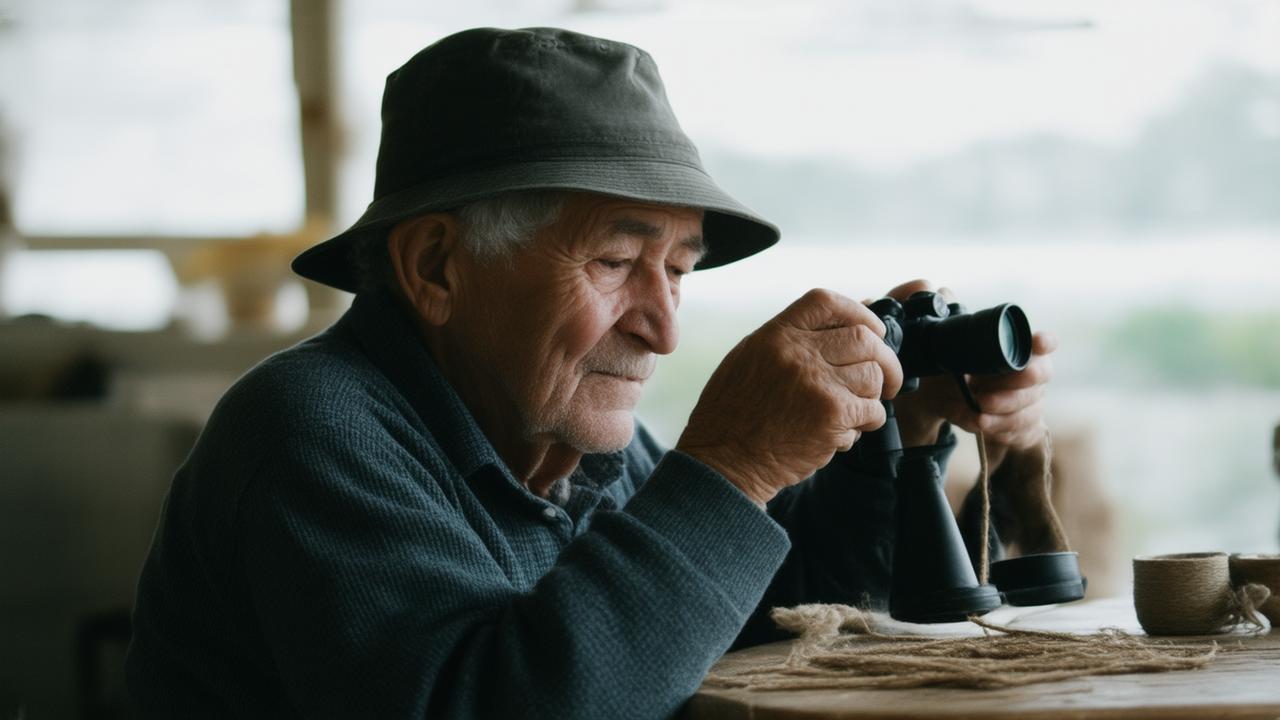
The first time I noticed it, I was sitting in a crowded café, watching two worlds share the same tiny room. At the big table by the window, a group of college kids stared silently at their phones, thumbs flying, headphones on, faces illuminated by cold blue light. In the corner, near the plants, a gray-haired woman in a blue cardigan slowly unfolded a newspaper, smoothing the creases with both hands. She wasn’t multitasking, wasn’t checking notifications, wasn’t half-watching something else. She read. She underlined a word with her finger. She paused to look out the window, then took a long, deliberate sip of coffee. Her whole morning seemed to move in one unbroken, peaceful line. And in that moment, between the tap-tap-tap of screens and the soft rustle of paper, the contrast felt deafening.
The Quiet Power of Doing One Thing at a Time
Ask many people in their 60s or 70s what they miss about “the old days,” and you’ll hear a surprising answer: not the fashion, not the prices, not even the music. They miss the feeling of doing one thing at a time—and only that thing.
Picture an older man in his garden, trimming roses. His phone is probably inside on the kitchen table, if he carries one at all. There are no podcasts playing in his ears, no texts blinking on-screen. Just sunlight, soil under his nails, the faint snap of thorns, the thickness of the air around him. To younger eyes, it can look quaint or even inefficient. But he’s not being slow; he’s being present.
Many older adults grew up in a world where attention wasn’t yet a currency, where you weren’t expected to split yourself in ten different directions every hour. They learned to sit in the front row of their own lives. When they read, they read. When they talk, they talk. When they walk, they walk—eyes up, feet grounded, mind following the rhythm of each step.
Psychologists now have a term for what a lot of them do instinctively: “single-tasking.” It lowers stress levels, sharpens memory, and increases overall satisfaction. Yet for someone who came of age before smartphones, it’s not a “strategy.” It’s just how life works—you give yourself fully to the moment in front of you, and in return, that moment gives something back.
Handwritten Notes and the Intimacy of Ink
The Letters That Outlast Notifications
In a box tucked into countless closets and attics, you can still find proof that the slow way has its own kind of magic: letters. Paper, envelopes, faded ink, looping cursive that leans just a little to the right. Many in their 60s and 70s still write birthday cards by hand, still send thank-you notes with real stamps, still keep small notepads near the phone or by the bed for things they don’t trust to vanish into a digital cloud.
Writing by hand is an old habit that refuses to die quietly, and maybe that’s because it does something that no instant message can touch. It demands time. It asks your hand to move as fast as your thoughts, and sometimes slower. The scratch of pen on paper creates a physical trail of care—you can feel the slight pressure of the hand that wrote it, see where they paused, where they pressed too hard in a rush of emotion.
Studies show that handwriting helps people remember what they write. But beyond the science, there’s a feeling that comes from steadying your hand to write a name at the top of a letter. You’re not just sending words; you’re sending a piece of your attention, preserved like a pressed leaf.
Compare that to a text that appears with a soft buzz among a dozen other alerts and is gone, lost in a scroll of group chats and unread messages. No wonder older adults cling to their pens: the slowness isn’t a bug—it’s the whole point.
Face-to-Face Conversations in a World of Half-Listening
The Radical Act of Showing Up Fully
There’s a certain kind of conversation that people who grew up before the internet still specialize in—the kind where no one is halfway out the door before the sentence is finished. You can see it when two older friends meet on a park bench. They don’t talk while checking their phones because their phones are often buried in a bag or left at home. Their eyes stay on each other. Their bodies lean in. Silence is allowed to exist between sentences like a shared breath rather than a void to be filled with quick jokes or TikTok references.
This old-school habit of full-body listening is more than etiquette; it’s medicine. People in their 60s and 70s came of age when the main social network was the front porch, the bowling league, the church hall, the union meeting, the local café. You wanted company? You walked to it. You showed up. You stayed a while.
That kind of presence leaves traces. When you’ve spent decades reading emotions off of real faces instead of emojis, you develop a fluency in human nuance. Older adults often catch the tremor in a friend’s voice, the slight tightening of the jaw, the sigh that hides behind a joke—and they respond with something no app can send: a hand on the arm, an invitation to stay for tea, a willingness to sit in companionable silence.
It’s not that younger people don’t want connection; many are starving for it. But constant digital contact can paradoxically make real connection feel rare and fragile. Meanwhile, seniors who’ve kept their old habits continue to practice the art of unhurried presence—the kind of attention that says, “I’m here, and I’m not going anywhere.”
Analog Rituals: Newspapers, Cookbooks, and the Texture of Time
When Information Arrives Slowly on Purpose
In an era of infinite scrolling, there is something almost rebellious about unfolding a newspaper or opening a thick, butter-splattered cookbook. Yet for many in their 60s and 70s, these rituals are stitched into the fabric of their days.
The morning might begin with the weight of a paper on the table, its smell of ink and fiber mixing with the aroma of coffee. Headlines are not algorithmically tailored; they arrive in a curated spread, equal in size on the page. You don’t tap to open one; you physically turn to it. You might stumble across an article you’d never have clicked on, guided not by a machine but by your own curiosity and the layout chosen by an editor.
Later in the day, dinner doesn’t start with “Hey, what’s trending on recipe apps?” It starts with reaching for a favorite cookbook whose spine is cracked from years of use. A handwritten note in the margin—“Add more lemon” or “Mom’s favorite”—connects the present meal to decades of past ones. The pages curl slightly, spotted with old sauce stains, like a map of family history you can touch.
These analog rituals slow time down just enough for it to become visible. When you wait for water to boil instead of microwaving everything, when you flip pages instead of refreshing feeds, your day stops feeling like a blur. It has a beginning, middle, and end—anchored by small, familiar acts that quietly tell your body and mind: you are here, and this day is real.
Moving the Body the Old-Fashioned Way
Walks, Chores, and the Everyday Workout
While younger generations download fitness apps and buy smart watches to count their steps, many older adults are still getting their exercise the same way they always have: by living. Walking to the store. Tending the garden. Sweeping the porch. Hanging laundry on a line, reaching up and out, up and out, like a slow, practical yoga.
For them, movement was never something you had to schedule; it was built into the architecture of the day. You walked more because cars were fewer or money was tighter. You carried groceries, pushed lawn mowers, climbed stairs repeatedly without checking if your watch awarded you a little digital badge.
That legacy of natural movement lingers. Many in their 60s and 70s still go for “a walk around the block” without calling it cardio. They stretch in the morning because their bodies ask for it, not because a fitness influencer told them to. They dig their hands into the earth, rake leaves, scrub floors, and in the doing, stay more physically and emotionally grounded than a day spent hunched over a laptop could ever provide.
There is happiness in this unmeasured movement. When you’re not tracking every calorie burned, your body becomes less of a data project and more of a trusted companion. You can hear its cues more clearly: rest now, move now, breathe deeper, feel the sun. The “workout” is just another way of participating in the world.
Community as a Daily Practice, Not a Follow Count
The Old Habit of Showing Up for Each Other
If you ask older adults what kept them going through hard decades—wars, recessions, family crises—you’ll hear a word that doesn’t show up often in app stores: neighbors. Not in the abstract sense, but the literal person two doors down who lent sugar without keeping score, who watched your kids, who showed up unasked when someone was ill.
Those who grew up in the 1950s, 60s, and 70s remember a time when community wasn’t a concept; it was the natural by-product of proximity and habit. You talked on the sidewalk. You attended community meetings. You knew the names of the people at the post office, the library, the corner store. Church basements and union halls, community gardens and school gyms—these were the original social networks.
➡️ Bad news a 135 fine will apply to gardeners using rainwater without authorization starting February 18
➡️ A growing lifestyle trend among seniors: why more “cumulants” are choosing to work after retirement to make ends meet
➡️ Baking soda becomes the unexpected remedy for wrinkles and dark circles say beauty specialists
➡️ 3I/ATLAS: a strange radio signal was detected from the interstellar comet
➡️ Car experts share the winter tire-pressure rule most drivers forget
➡️ 10 dishes you should never order in restaurants, according to professional chefs
➡️ 10 hobbies to adopt that help prevent loneliness in old age, according to psychology
Many seniors still practice those habits, even as the culture around them shifts online. They volunteer. They join clubs not for networking but for companionship. They remember birthdays without needing calendar alerts. They cook extra portions “just in case someone stops by,” a phrase that carries a whole philosophy: leave room for other people in your life.
Younger generations often have more “connections” than any human nervous system was built to handle, yet report record levels of loneliness. Meanwhile, those older adults who still walk the same streets, attend the same groups, and knock on actual doors have fewer followers but more people who would show up if their car broke down at midnight. That difference is not an accident; it’s the result of thousands of small, old-fashioned choices to prioritize real presence over virtual appearance.
Six Old-School Habits That Quietly Outperform Tech
When you look closely, the supposedly “old-fashioned” ways add up to a powerful daily toolkit for happiness. Here are six habits that many people in their 60s and 70s hold onto—and why they might be emotionally richer than anything a screen can offer.
| Old-School Habit | What It Looks Like | Why It Often Feels Better Than Tech |
|---|---|---|
| Single-tasking | Reading a book without checking a phone, cooking without streaming, gardening without earbuds. | Reduces stress, deepens satisfaction, and helps the brain fully process experiences. |
| Handwritten communication | Letters, cards, notes on the fridge, recipes on index cards. | Creates tangible memories, feels more personal, and encourages reflection. |
| Face-to-face conversations | Long talks at the kitchen table, chats on porches, visits without an agenda. | Builds empathy, reduces loneliness, and offers emotional nuance no text can match. |
| Analog rituals | Reading newspapers, using cookbooks, listening to the radio at set times. | Adds structure to the day, limits overwhelm, and invites discovery without endless scrolling. |
| Everyday physical movement | Walking, gardening, housework, fixing things by hand. | Keeps the body active naturally, lifts mood, and grounds attention in the present. |
| Community participation | Clubs, volunteering, neighborly visits, shared meals, local events. | Builds reliable support networks, gives a sense of purpose, and counters isolation. |
These habits don’t require logins, chargers, or updates. They do, however, require something rare: a willingness to give your time and attention in whole, unbroken pieces.
Borrowing a Little Old-School Happiness
None of this is an argument against technology. For many older adults, video calls mean seeing grandchildren’s faces across oceans; medical portals mean easier care; digital photos mean family moments are always at hand. Tech isn’t the enemy. Distraction is. Disconnection is. The constant, low-level hum of “not enough” that seeps in when every spare second is colonized by someone else’s content.
People in their 60s and 70s who hold onto old-school habits aren’t stuck in the past. Many are weaving the old and the new together with quiet wisdom—using phones when they’re useful, putting them away when they’re not. They know, often without being able to explain it, that happiness has less to do with what glows in your hand and more to do with what glows in the room: the presence of another person, the warmth of a ritual, the feel of your own body doing something simple and real.
If you’re younger, you don’t have to wait decades to taste that kind of contentment. You can borrow it right now. Write one letter. Take one walk without your phone. Invite one neighbor over for coffee. Read one article start to finish without toggling to another tab.
Somewhere, an older woman in a blue cardigan is still smoothing the creases of her newspaper, still looking up between paragraphs to watch the light change on the street outside. She’s not behind the times; she’s deep inside them, living them fully. And maybe, just maybe, that’s the real cutting edge.
FAQ
Why do many people in their 60s and 70s seem happier without so much technology?
They grew up with habits that naturally protect their attention: single-tasking, in-person conversations, and slower rituals. These create a sense of control, connection, and meaning that constant digital stimulation often erodes.
Are older adults completely against modern technology?
Usually not. Many use smartphones, video calls, and social media—but they tend to see tech as a tool, not a lifestyle. They’re more likely to put it down when it interferes with real-world relationships or routines they value.
Can younger people realistically adopt these old-school habits?
Yes, even in a digital world. You don’t have to abandon technology; you can add intentional analog moments—like handwritten notes, device-free walks, or regular dinners with friends—to balance your day.
Do these habits actually improve mental health?
Research supports key elements behind them: focused attention reduces stress, face-to-face connection lowers loneliness, physical movement boosts mood, and strong community ties protect against depression and anxiety.
Where should I start if I’m constantly on my phone?
Start small and specific. Choose one daily activity—like meals, walks, or your morning routine—and make it device-free. Over time, you can build more of these pockets of undistracted living into your day.





