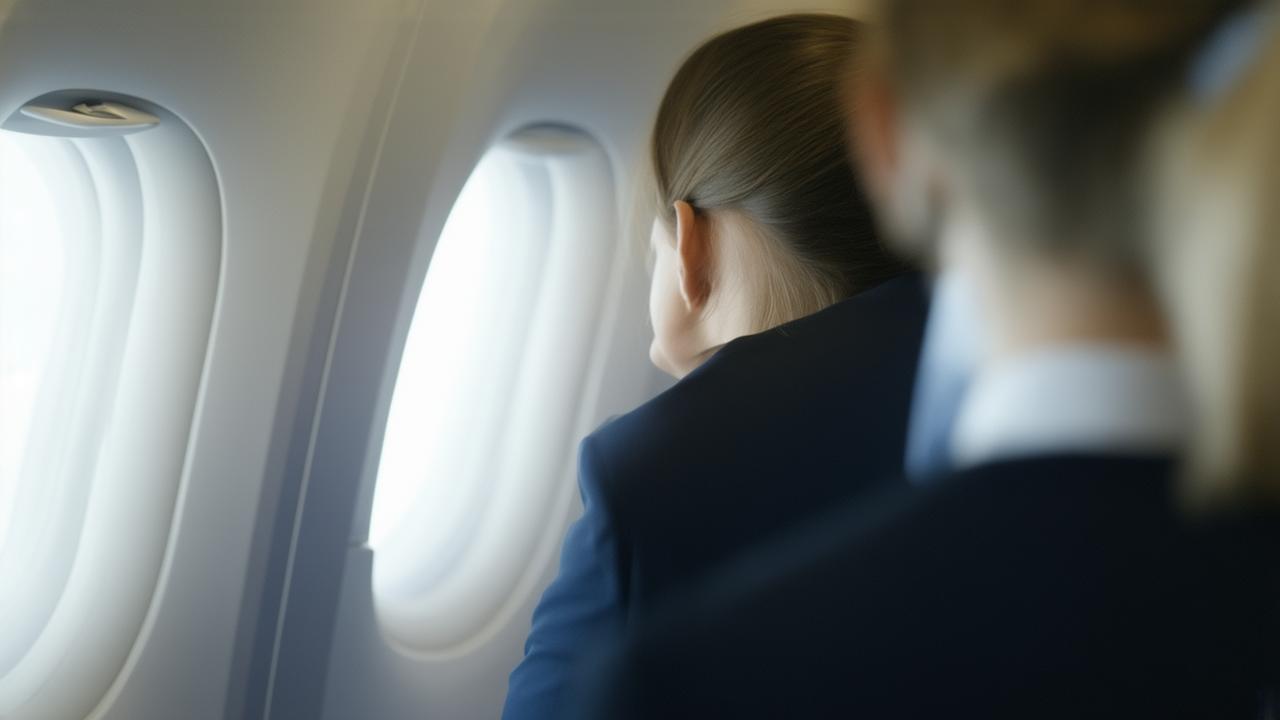
The jet bridge has a particular smell if you notice it—the faint rubber of tired wheels, recycled air tinged with coffee, a whisper of cold metal waiting just beyond the door. You shuffle forward with your carry-on, maybe a little sleepy, maybe a little late, maybe already counting the hours until landing. Ahead, the aircraft door yawns open like a lit stage, and there, framed in white fuselage and soft yellow light, stand the flight attendants. They smile, they welcome, they nod you past. It all feels routine. But in those first five seconds, they have already noticed more about you than you might guess.
The first glance: posture, pace, and the weather you carry in
By the time your foot crosses the threshold from jet bridge to cabin, a flight attendant has already read the weather of your day. Not through magic, but through practice—the way you walk down that narrow passage says almost everything.
Your posture steps in before you do. Shoulders high and tight around your ears? Jaw clenched? That tells a story of rushing, maybe a close connection, maybe a bad morning at security. They note it quietly, because tense passengers often need a softer touch later—a slower explanation, a second offer of water, a little extra calm when turbulence turns the cabin into a rattle.
Your pace is a clue too. Some people move with a quick, staccato urgency, scanning for their seat like it’s a lifeboat. Others drift in, earbuds already in, moving with that practiced familiarity of someone who’s done this route a hundred times. The attendants clock that difference instantly. Frequent flyers often need less guidance but can be less patient when things go wrong. First-timers might look braver than they feel.
Then there’s the invisible weather: the mood that clings to you. Are you walking in with a smile ready, eyes open and curious? Or are you already somewhere else—on the meeting you’re dreading, the argument you left unresolved, the fear you’re trying not to name? Nothing is said, but your energy has weight. They feel who’s going to joke with them, who’s going to flinch at every bump, who might escalate if the flight gets delayed on the tarmac.
Hands full, heart full: what you carry tells on you
Before you even say hello, every object in your hands has already made an introduction. Flight attendants track bags the way birders track movement in the sky—careful, practiced, always predicting the next landing.
Oversized carry-on, stuffed to its seams? They see the overhead bin battle before you do. That backpack plus roller plus shopping bag combo? They know they may have to gently intervene: “We might need to check one of those, okay?” They’re not judging the new luggage or the old scuffs—what they’re really tracking is friction. How many tiny conflicts might spark in the aisle before takeoff?
Then there are the small, telling details in your hands. The stiff grip on a passport, pinched white at the fingertips—that might be anxiety. The crumpled boarding pass, half-folded, pulled from a pocket without looking might say: frequent traveler, probably knows the drill. A child’s hand clasped in your own says responsibility and maybe exhaustion. A bouquet box or a garment bag hints at weddings, funerals, milestones unfolding several time zones away.
They also notice who boards prepared. The person with a water bottle already full, a book or downloaded show ready, noise-canceling headphones resting around their neck—that’s someone who probably won’t ring the call bell every thirty minutes. Someone who boards juggling a hot coffee, a phone, a bag, and a jacket is more likely to need help stashing things before the boarding line clogs behind them.
The seat dance and the unspoken hierarchy
Most of us think seat numbers are just rows and letters, but flight attendants see a small social map. They notice if your eyes dart upward to scan the numbers because you’re nervous about holding up the line. They notice if you breeze past your row without checking your ticket at all—often a sign you’re used to the front of the plane, not the back.
There’s an unspoken choreography they watch unfold: who steps aside to let someone pass, who blocks the aisle rearranging a bag while twenty people stand behind them, who offers to swap seats so a family can sit together. Those little gestures tell them where kindness lives in the cabin and where friction might crop up later.
Faces like open books: tension, fear, and tiny joys
By the time you turn your head to offer that reflexive boarding smile, a flight attendant has already traced the outlines of your day across your face. They are, in many ways, quiet experts in micro-expressions—the small flares of emotion that flash across mouths and eyes and then disappear as if they never existed.
There’s the tight half-smile of the anxious flyer: mouth attempting politeness, eyes locked on the windows the way someone might watch a storm brewing. They notice that immediately. That’s the person they check on after takeoff, the one they might offer an extra reassurance about turbulence: “It’s normal; we’re just passing through a rough patch of air.”
Then there’s the glazed stare of the exhausted business traveler, skin dulled by too many time zones, tie slightly askew, laptop bag pulling one shoulder down. For them, kindness might look like efficiency—no chatter, just water, just quiet. A soft recognition that what they need most is rest, not small talk.
Sometimes joy is the loudest thing in the aisle. The person whose smile is huge and unguarded, whose eyes are shining all the way to the exit row—maybe it’s their first flight, maybe they’re finally going home. You can see it in the way they touch everything: the seatback, the window, the safety card as if it’s an artifact. Flight attendants clock this too. They know who to treat like a guest of honor when the moment allows.
What you wear: comfort, culture, and quiet stories
Clothing on an airplane is more than fashion; it’s a subtle manifesto about how you move through discomfort. Flight attendants notice your shoes first—not because they’re stylish or not, but because shoes are the secret to how emergencies unfold and how quickly you can get where you need to go.
High heels and fragile sandals stand out—stylish but impractical in an evacuation. Thick, sturdy sneakers or flats suggest someone ready to move briskly if needed. Bare ankles in flimsy slides might mean someone who’s never thought about walking through a cold, wet jet bridge in the rain, or standing in a long customs line on the other end.
Then there’s the rest: the hoodie worn like armor, hood up before the plane even pushes back; the business suit that hasn’t yet wrinkled but will; the cultural garments that tell entire migration stories in a single glance. A sari, a thobe, a kente cloth wrap—threads that speak of other geographies, other skies.
They notice practical details too: loose clothing that will be comfortable on a long-haul, layers that can adapt to the air that always seems a bit too cold or too warm. The person boarding in shorts on a winter evening with no jacket suggests inexperience or optimism—or maybe both.
The smell of stories: scent, sobriety, and subtle warnings
Smell is often the first and most intimate thing that greets a flight attendant. It’s unavoidable in the narrow aisle, and it’s part of the sensory calculus they do without comment.
Perfume that arrives a full second before you do can be a red flag—they’re picturing a closed cabin, recycled air, and the nearby passenger with allergies or a migraine waiting to happen. A strong cloud of alcohol on the breath gets logged too, not as judgment but as risk management. Someone who has already been drinking heavily before takeoff might become a safety issue at 38,000 feet.
But there are softer stories in scent: the lingering trail of airport food clinging to a hoodie; the faint hint of baby lotion on a parent’s clothes; the sterile brightness of hand sanitizer on a nurse’s hands heading to or from a shift. All small markers of who you are off the plane, following you quietly into the cabin.
Eyes that wander: curiosity, confusion, and quiet needs
Your eyes, perhaps more than anything, give you away. A flight attendant watches where they land, where they hesitate, what they search for in those first seconds.
➡️ “I didn’t expect one decision to save me $750 in just three months”
➡️ Psychology says people who grew up without air conditioning developed these 7 mental resilience traits that are nearly impossible to build today
➡️ Heated dispute over effortless patio cleaning: the ‘miracle’ method for blackened slabs that some call genius and others call irresponsible
➡️ This forgotten feature in your car improves visibility during bad weather
➡️ Food experts explain why this cooking shortcut often backfires
➡️ The simple reason some rooms echo more than others
➡️ The exact reason your phone battery drains faster at night even when you are not using it
Eyes that flick from exit sign to exit sign, that trace the line of the wing, that glance quickly at the safety card before it’s even mentioned—these often belong to people who have studied this environment before. Maybe they’re anxious, maybe they’re safety-minded, maybe both. Those passengers may be the ones who quietly listen most closely to the safety demonstration.
On the other end, eyes that dart around, overwhelmed, scanning the layout like it’s a puzzle with no edges—those often belong to first-time flyers or travelers in a language that isn’t their own. Flight attendants clock that quickly. They gesture more, speak more slowly, point to seat numbers, to overhead bins, to call buttons. They become a moving translation of the aircraft itself.
Sometimes your eyes are simply tired, skimming seats, looking for a number and a place to land. Sometimes they are vibrant and wide, drinking in every detail: the curve of the wings, the tiny vents overhead, the pattern in the carpet that runs like a river through the aisle. Curiosity is its own kind of companionship in the sky, and they see that too.
Table of subtle signals
All of this noticing happens in seconds. Below is a simple overview of a few things flight attendants often register immediately—and why they matter once the doors close.
| What They Notice | What It Often Signals | How It Shapes Their Response |
|---|---|---|
| Posture and pace | Stress level, patience, confidence with flying | Offer extra calm, clearer instructions, gentler tone |
| Type and number of bags | Experience with air travel, potential bin issues | Proactive help with storage, early conflict prevention |
| Facial expressions | Anxiety, exhaustion, excitement, irritability | Who to reassure, who to leave in peace, who to monitor |
| Clothing and shoes | Comfort level, preparedness, evacuation mobility | Extra guidance in emergencies, subtle safety reminders |
| Smell of alcohol or strong perfume | Possible intoxication, potential passenger conflicts | Closer monitoring, careful drink service decisions |
The quiet calculations you never see
All of these details, all of this noticing—it isn’t about judgment. It’s about safety, about harmony, about moving hundreds of bodies and stories across the sky in a metal tube with grace instead of chaos.
When you walk onto a plane, you may think you’re just a seat number, a boarding group, a rectangle of paper or a barcode on a screen. But the crew sees you as a person entering a shared space where strangers will sleep inches apart and breathe the same air for hours.
They notice who might need help with a bag before the person behind them grows impatient. They notice who might panic at the first shudder of turbulence and quietly pre-empt it with a reassuring smile. They notice the parent whose arms are already full before the wheels have left the ground, and the teenager sitting alone who hasn’t yet learned how to ask for what they need.
Those “12 things” aren’t really a checklist as much as they are instincts trained over thousands of flights: your posture, your bags, your face, your eyes, your shoes, your scent, your voice, your pace, your interaction with others, your seat behavior, your tech readiness, your level of sobriety and self-control. Each one is a thread they quickly weave into a picture of how this flight might feel—for you, for them, for everyone sealed into this shared skyward experiment.
So the next time you step over that slim metal threshold, take a breath. Feel the change in air, the way the cabin hums like a beehive just coming to life. When the attendant at the door meets your eyes and says, “Welcome aboard,” know that in that tiny exchange, they’ve already begun to look out for you in ways you’ll probably never fully notice. You are seen, more than you think, somewhere high between departure and destination.
FAQ
Do flight attendants really judge how I look when I board?
They notice how you look, but the goal isn’t judgment—it’s assessment. They’re trained to read body language, clothing, and behavior to anticipate safety needs and potential issues, not to rate your appearance.
Why do they care how many bags I have?
The number and size of your bags affect boarding speed, overhead bin space, and aisle congestion. Noticing this early helps them manage storage and avoid arguments between passengers.
Can flight attendants tell if I’m afraid of flying?
Often, yes. Tense posture, tight grip on the armrest or boarding pass, wide or darting eyes, and nervous chatter are common tells. They use this information to offer extra reassurance and check in during the flight.
Do they really notice if I’ve been drinking before the flight?
Strong alcohol smell, slurred speech, and unsteady movement are hard to miss in a narrow aisle. If they suspect you’re already intoxicated, they’ll monitor you carefully and may limit or refuse more alcohol for safety.
Is there anything I can do to make boarding easier for everyone?
Yes: have your boarding pass ready, know your seat number, keep your essentials in a small bag you can access quickly, stow larger bags efficiently, and be aware of people behind you in the aisle. A simple smile and brief greeting also set a kinder tone for the whole flight.





