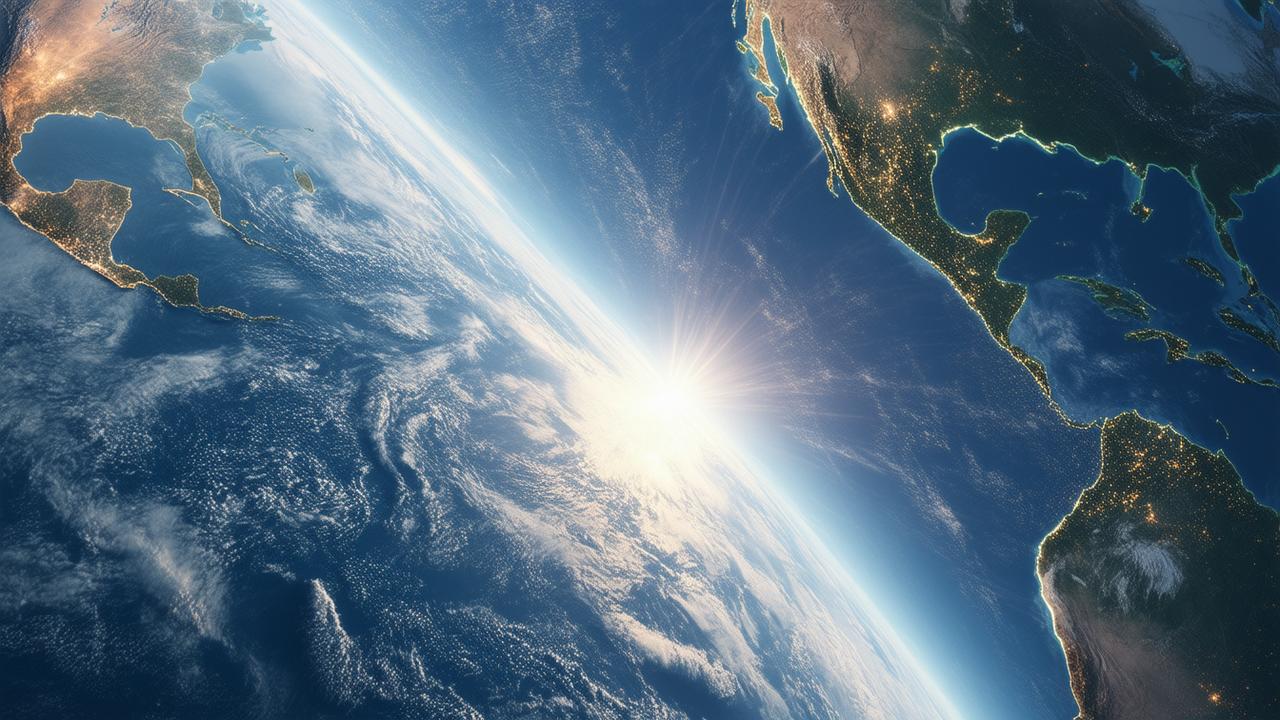
The first sign is not darkness, but a strange kind of light. Colors go flat, as if the world has slipped through a dimmer switch designed by someone who loves drama. Shadows sharpen into razor edges. Birds stop mid-song. And on this particular day, somewhere on Earth, the sun itself will seem to hesitate—then slowly, impossibly, wink out. Day will turn to night as the longest total solar eclipse of the century sweeps across parts of the globe, and for a few breathless minutes, millions of people will stand under a sky that has forgotten what time it is.
A Moving Shadow Across a Breathing Planet
Think of the eclipse not as an event, but as a traveler. High above you, the moon’s shadow is not still; it races. A dark oval, roughly the size of a small country, skims across oceans and continents at thousands of kilometers per hour, painting a narrow path of night through the daylit world. This path—called the path of totality—is the only place where the sun will be completely covered, where the world will look and feel like someone pressed pause on the afternoon.
Outside that path, people will see a partial eclipse. The sun will look bitten into, crescent-shaped, maybe like a glowing smile breaking apart. But within the path of totality, the transformation is absolute. Temperatures drop. Wind patterns shift. The horizon glows in a ghostly 360-degree sunset, while directly overhead, stars and planets prick the sky. It feels less like a weather event and more like a glitch in reality.
This coming eclipse is special not only for its path, but for its duration. For a few select spots on Earth, the moon will cover the sun for a staggeringly long stretch—longer than any total eclipse in this century. We measure that rare fullness in minutes and seconds, but the experience itself lives in eye-blinks, in gasps, in the sound of a crowd going suddenly, utterly quiet.
What Makes This Eclipse the Longest of the Century?
Total solar eclipses happen somewhere on Earth roughly every 18 months, but most are fleeting. Two minutes here. Three minutes there. You barely have time to process the darkness before it hangs a question mark over your skin and then slips away.
This one will be different. At its peak, totality will stretch to an extraordinary length—more than enough time to let your senses catch up, to explore the strange twilight the eclipse pulls across the land, to stare up and feel very small and very lucky.
Several things must line up for such a long eclipse:
- The moon must be near perigee – its closest point to Earth, making its apparent size slightly larger in the sky.
- The Earth must be near aphelion – the point in its orbit farthest from the sun, making the sun appear a little smaller.
- The alignment must be nearly perfect – the moon must cross directly in front of the sun’s center, not skimming the edge.
- The path must cross near the equator – where the rotational speed of the planet helps stretch the duration of totality.
When these conditions align, the moon’s darkened disc doesn’t just cross the sun, it lingers. The result is not just an eclipse, but an extended immersion in another kind of daylight—one that looks like early night but feels like the universe holding its breath.
The Sound of the Sky Going Dark
Before you see the sun fully vanish, you will feel the eclipse.
It begins with the light. Colors shift toward a muted, metallic palette, as if someone has gently drained the warmth from the world. Greens of trees flatten. Human faces take on a theater-like pallor. The familiar cues your body uses to tell time dissolve.
Then comes the temperature. On a warm day, you might notice a swift, uncanny coolness wash over you. The ground, which just moments ago radiated heat, suddenly feels like it has stepped back from summer. A faint breeze may rise, not because the wind has changed its mind, but because the rapid cooling air rearranges itself above the land.
The animals react too. Birds fall silent or begin strange, confused calls. Crickets sometimes start their nightly chorus in the middle of what—the clock insists—is still afternoon. Bees that had been busily crossing clover fields may retreat to their hives. Pets may look up, pace, or simply grow still beside you.
And then, almost without warning, the final sliver of sunlight slips away.
The Moment of Totality
If you’re in the path of totality, there is a point when it becomes safe to look up without eye protection, and the change is so dramatic, so otherworldly, that people often gasp, or cry, or simply stand slack-jawed beneath the sky.
Where the sun used to blaze, there is now a black disc—a hole punched through the sky. Around it arcs the sun’s corona, a delicate crown of white fire, stretching and flowing out into space. This is the sun as you never see it, because its fierce glare usually erases its own edges. Now its atmosphere hangs visible, a ghostly halo you can feel in your chest as much as you see with your eyes.
Planets like Venus or Jupiter may emerge near the eclipse, bright and steady. Fainter stars reveal themselves. The horizon in all directions glows with the rusty colors of sunrise and sunset at once—a ring of distant daylight persisting at the edges of the moon’s sweeping shadow.
In those minutes, time behaves strangely. You are looking at the mechanics of the solar system laid bare: three bodies in elegant alignment. The geometry you may have studied in school is no longer abstract; it is above you, moving in real time.
Where on Earth Will Night Fall at Noon?
The path of totality for this eclipse will carve across the planet like a narrow, wandering river of darkness. Within that slender band—typically around 100 to 200 kilometers wide—viewers will experience the full shock of midday night. Just outside of it, millions more will witness a partial eclipse, the sun shaved into crescents and arcs.
While exact geographic details belong to astronomical charts and local observatories, the pattern is always similar: the shadow first touches one edge of the Earth, often over open ocean, then sweeps across landmasses, islands, and cities before racing off again into the sea. For some, it will pass overhead in the early morning, turning breakfast into a cosmic spectacle. For others, the eclipse will crown the afternoon, rewriting what “midday” can look like.
If you’re curious how different locations experience this kind of event, consider a simple comparison like this:
| Viewing Location Type | What You See | Experience of Daylight |
|---|---|---|
| Within Path of Totality | Complete coverage of the sun; corona visible; stars and planets appear. | Day turns to deep twilight or night for several minutes. |
| Near Edge of Totality | Very thin crescent sun; may just miss full totality. | Light becomes eerie and dim, but not fully dark. |
| Partial Eclipse Zone | Sun appears bitten or crescent-shaped through proper filters. | Noticeable dimming; odd shadows, but no true darkness. |
| Outside Eclipse Path | No visible change in the sun. | Regular daylight; the event is happening, but far beyond your horizon. |
Wherever you stand, the eclipse traces a line between those who will experience a universe-shaking few minutes of totality and those who will feel only its faint echo. Yet even that echo—the soft dimming, the strange shadows—is a reminder that we live beneath moving orbits, not a static sky.
Preparing to Meet the Shadow
There is a quiet ritual to eclipse-watching, even in bustling cities. People gather in parks, on rooftops, along lonely roads, and in fields. Some drive or fly thousands of kilometers just to stand beneath a sky that will go dark on schedule.
To be ready for this eclipse, you do not need elaborate equipment, but you do need respect—for both your eyes and the celestial mechanics playing out above you.
Basic preparation means:
- Safe viewing tools – Certified eclipse glasses or handheld solar viewers that meet international safety standards. Ordinary sunglasses are never enough.
- Simple projection methods – A pinhole projector, or even sunlight passing through tree leaves, to create dozens of crescent suns on the ground during the partial phases.
- A clear line of sight – A place with a wide, open view of the sky and, if possible, away from bright city lights to enjoy the emerging stars during totality.
- Time – Arrive early. Eclipses do not wait, and traffic, crowds, or clouds may try your patience.
But preparation is not just about gear. It’s also about intention. Ask yourself what you want to notice: The sound of the world in those fading minutes? The feel of the air on your skin? The expressions on the faces around you as the last bead of sunlight—the so-called “diamond ring”—flickers, then disappears?
➡️ “I didn’t expect one decision to save me $750 in just three months”
➡️ Psychology says people who grew up without air conditioning developed these 7 mental resilience traits that are nearly impossible to build today
➡️ Heated dispute over effortless patio cleaning: the ‘miracle’ method for blackened slabs that some call genius and others call irresponsible
➡️ This forgotten feature in your car improves visibility during bad weather
➡️ Food experts explain why this cooking shortcut often backfires
➡️ The simple reason some rooms echo more than others
➡️ The exact reason your phone battery drains faster at night even when you are not using it
Science in the Shadow of the Moon
While many of us will be watching with awe, scientists will be watching with purpose. For centuries, total solar eclipses have offered rare windows into the hidden behavior of our star and our atmosphere.
During totality, researchers may train instruments on the sun’s corona to study its tangled magnetic fields and the origins of the solar wind. Others will use the sudden switch from light to dark as a kind of natural experiment, tracking how animals react, how temperatures shift near the ground, how the upper layers of Earth’s atmosphere respond.
Long eclipses like this one are especially valuable. The extended darkness gives more time for precise measurements, for high-resolution images, for repeated observations that are impossible during shorter events. In some ways, every total eclipse is both a spectacle and a scientific gift—an alignment that turns the entire Earth into a laboratory for a few fleeting minutes.
A Human Story Written in Shadow and Light
If you step back from the math and the physics, what remains is something profoundly human: the shared experience of wonder. Ancient cultures carved stories into stone and myth when the sun vanished unexpectedly. Today, we map the timing of eclipses centuries into the future, yet the feeling beneath the darkened sky has not really changed.
People still gather in hushed clusters, or in jubilant crowds, faces turned upward. Strangers pass around eclipse glasses, or huddle around a single small telescope. Children either squeal with delight or cling to a familiar hand. Some people cheer when totality hits; others can’t seem to find any sound at all.
And later, after the last sliver of moon slips away and the sun returns in a blaze of ordinary daylight, there is that odd, giddy aftertaste—like waking from a vivid dream you shared with thousands of others standing nearby.
When Day Becomes Night—and Then Something Else
This eclipse, the longest total solar eclipse of the century, will be remembered in photographs, in notebooks, in scientific journals. But mostly it will live in the small, personal details: the chill on your arms, the way the streetlights flickered on, the sudden quiet of a park that only moments before had buzzed with midday life.
Day will turn to night, yes—but not the night you know. It is a thinner darkness, full of edges and echoes, framed by a halo of starfire around the moon. In that brief interval, the ordinary rules step aside. You see not just the sun hidden, but yourself revealed: tiny, temporary, deeply and beautifully aware of standing on a spinning world in a well-timed alignment of worlds.
When the light returns, as it always does, you may find that something in you has shifted just a little. Perhaps you trust the sky more, or perhaps you understand its strangeness better. Either way, you will have stood in the path of a shadow that began long before it reached you and will continue long after it passes—a traveling darkness that, for a few minutes, made your own corner of the Earth feel like the center of the universe.
Frequently Asked Questions
Is it safe to look at a total solar eclipse with the naked eye?
It is only safe to look with the naked eye during the brief period of totality, when the sun is completely covered by the moon and no direct sunlight is visible. At all other times, including the early and late partial phases, you must use proper eclipse glasses or approved solar filters.
Why does the temperature drop during a total solar eclipse?
As the moon blocks the sun’s light, the ground and lower atmosphere receive far less solar energy. This sudden reduction in heating causes the local air temperature to fall, sometimes by several degrees within minutes, creating a noticeable and sometimes startling chill.
How often do total solar eclipses happen?
A total solar eclipse occurs somewhere on Earth approximately every 18 months. However, any given location may wait many decades, or even centuries, between total eclipses passing directly overhead.
What makes this eclipse the “longest of the century”?
Its maximum duration of totality is longer than that of any other total solar eclipse in this century, thanks to a near-perfect alignment of factors: the moon’s distance, the Earth’s position in its orbit, the geometry of the shadow, and the path it traces across the equatorial regions.
Can animals really sense and react to an eclipse?
Yes. Many animals respond to the sudden change in light and temperature. Birds may roost, insects like crickets may begin their evening sounds, and daytime creatures can behave as if night has fallen, revealing just how much living things rely on the sun’s regular rhythms.





