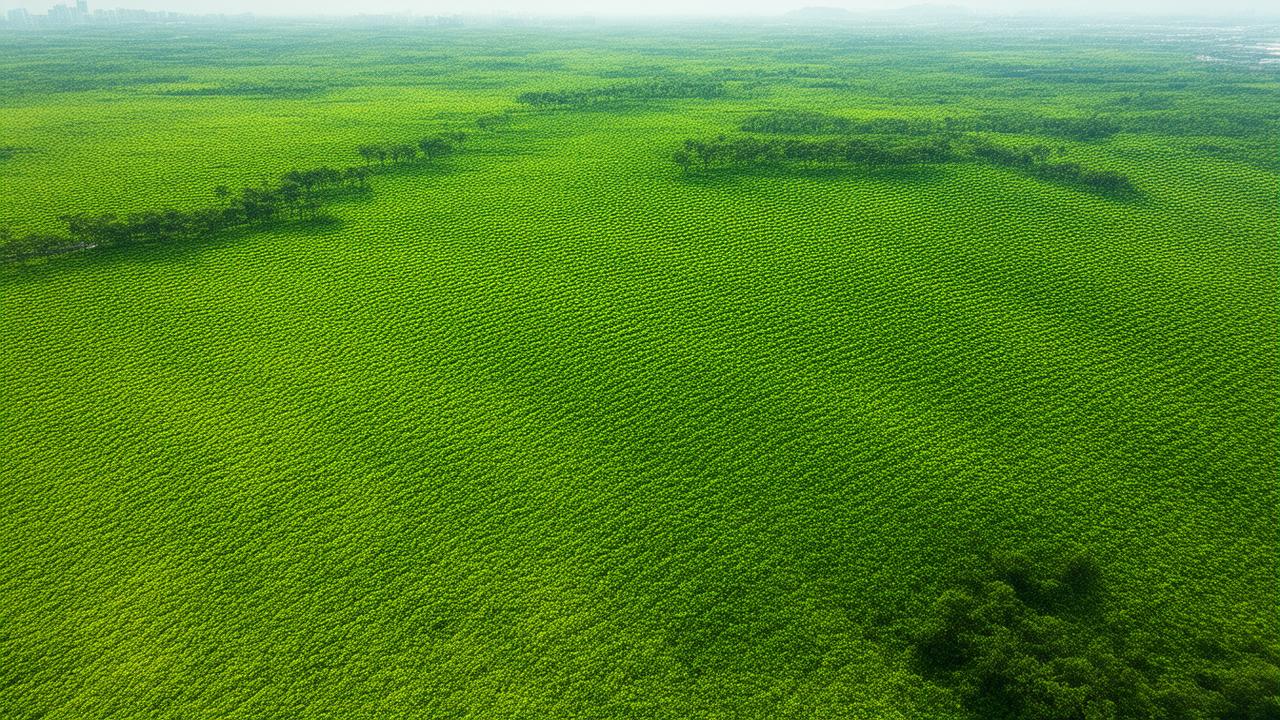
The wind reaches you first—a dry, sand-laden breath that tastes like dust and sun-baked stone. You are standing on the edge of what used to be moving desert, a place where dunes once crept forward each year, swallowing fields, villages, and roads. But now, as far as you can see, there is a strange new forest: endless rows of trees, their thin trunks rising from gritty soil, leaves trembling under a blanching sky. They are survivors, but also strangers here. This is the frontier of China’s billion-tree project, a living wall built to hold back the sands—and a vast, unfolding experiment whose final outcome no one can yet fully see.
The Great Green Wall That Wasn’t Built Overnight
In the late twentieth century, northern China faced a slow-moving catastrophe. Deserts like the Gobi were expanding, chewing into grasslands, drying rivers, clouding city skies with choking dust storms that could reach as far as Beijing, Seoul, and even across oceans. Farmland turned barren, villages emptied, and the wind seemed to be winning.
In response, Chinese planners reached for an audacious idea: if sand could move, perhaps trees could stand in its way. Thus began one of the largest ecological engineering efforts in human history—the Three-North Shelterbelt Program, often called China’s “Great Green Wall.” Launched in 1978, it aimed to plant billions of trees across a swath of the country roughly the size of Western Europe, stretching across the arid and semi-arid north.
Decades later, satellites now show swaths of new greenery where there was once bare ground. Dust storms have lessened in some regions. In certain communities, farmers talk about how their children now see more clouds than dust in spring. On paper, it sounds like a triumph—a story of ambition, persistence, and the healing power of human effort.
But if you step into those meticulously planted forests, listen more closely, and dig your fingers into the soil, the story becomes more complicated. The trees are standing, yes. But what else has changed—quietly, invisibly—beneath their shade?
The Sound of Water Leaving
Walk into one of these plantation forests at midday, and you notice something unexpectedly comforting at first. The rough wind softens between the trunks. The temperature drops a degree or two; your skin finally finds respite from the relentless sun. The young poplars and pines rise in regimented lines, their shadows creating a sort of artificial cool that feels, for a moment, like mercy.
But watch the ground. The soil underfoot is a muted gray-brown, threaded with a few grasses, but otherwise bare. No forest floor mosaic of shrubs and wildflowers, no delicate undergrowth weaving a tapestry of life. Instead, this is a tree army, and the rest of the ecosystem has been mostly dismissed from service.
These trees, many of them non-native or poorly matched to the local climate, are thirsty. In areas where average rainfall is already low—sometimes less than 400 millimeters per year—they reach deep with roots and drink what’s there. Locals in some regions of Inner Mongolia and Ningxia have watched shallow wells go dry and seasonal streams become intermittent. The trees, introduced as saviors, are competing not just with the desert, but with the water that once sustained native grasses and shrubs.
It’s here that scientists raise a quiet but insistent alarm. In ecosystems on the edge of aridity, every drop of water is already spoken for. Add dense belts of trees, and you tilt the balance. Evapotranspiration—the combined loss of water from soil and leaves—rises. Groundwater drops. Native vegetation, already hardened against drought, finds itself pushed further to the margins.
From above, satellite images may see “greening.” On the ground, ecologists see something more fragile: a system stretched like a rope pulled tight, one more dry year away from snapping.
When Greening Isn’t the Same as Healing
For many policymakers, it’s tempting to measure success in simple numbers. How many trees planted? How many hectares covered? How many satellites show more green pixels than before? The answers here are impressive: China’s tree programs have increased forest cover noticeably in several provinces, and they are often cited as a global example of large-scale reforestation.
But “green” on a map does not always mean “healthy” on the ground. A desert ecosystem is not simply empty land waiting to be upgraded to forest. It is home to grasses with roots like braided wire, shrubs that sleep through heat like monks in meditation, lichens that pull life from passing mist and dew. There are beetles, larks, saxaul trees, foxes, and insects too small to name, each adapted to a landscape of extremes.
When single-species plantations are introduced on a massive scale, this intricate web is often broken. Diversity drops. Sand-binding shrubs and native grasses lose territory to the straight lines of poplars or pines. Some plantations become vulnerable to pests and disease, because where there is uniformity, there is also weakness. If one tree species falls ill, the entire planted forest can wither.
Researchers walking these areas sometimes compare them to mirages. From afar, they promise a new ecosystem; up close, they are more like scaffolding—structures that might hold back sand, but do not always nurture the complexity of life that true ecosystems need.
The Trade-offs Beneath the Canopy
This conflict between numbers and nuance becomes clearer when you look at how different land covers respond to drought. Natural grasslands, with a mix of species and deep-rooted perennials, can go brown on the surface while still holding soil in place. They can bounce back with the next rains. They conserve water and spread risk.
By contrast, thirsty, fast-growing trees might offer rapid shade and immediate visual “green,” but lock the landscape into a more precarious pattern. They link ecosystem health to constant access to water—a resource these regions simply do not have in abundance.
Scientists tracking soil moisture and groundwater in some of China’s newly forested areas report an unsettling pattern: decreasing water availability over time, even as rainfall stays roughly the same. In other words, the system is getting drier on the inside, despite looking greener on the outside.
Deserts, too, have their own kind of resilience. They are not empty failures, but mature responses to a long history of scarcity. When we plant trees where nature did not intend forests to stand, the question becomes not just “Can they grow?” but “At what cost—and for how long?”
Lives Along the Edge of the Sand
For people living along the desert’s reach, the costs and benefits of this grand experiment are anything but abstract. Imagine a village in northern China thirty years ago: spring arrives not with blossoms, but with dust. Grains of sand in your teeth, dust in your lungs, laundry stained beige by the wind. Parents worry about their children’s coughs. Farming becomes a game of chance.
Then the trees came. Villagers, students, soldiers, and volunteers planted them in long lines—sapling after sapling pressed into sandy soil with awkward shovels and calloused hands. Over years, the wind softened. Dust storms did, in some places, decline. The project brought jobs, subsidies, a feeling of national pride. People could point at the new forests and say, “We did that.”
Yet, as time passed, different worries emerged. Farmers noticed the soil drying more quickly. Grassland herders saw pastures shrink and native shrubs disappear. Some locals began to refer to “green deserts”—places that looked like forests but had little ecological or economic life. Old springs ran less strongly. Wells that had served families for generations now needed to be drilled deeper.
This is the human face of ecological engineering: gains in one dimension, losses in another. In conversations with residents, you hear both gratitude and unease. Fewer dust storms, yes. But also, a question asked softly: What happens if the water runs out?
Balancing Policy, Pride, and Ecology
Chinese authorities are not blind to these concerns. In recent years, policies have shifted away from simply planting as many trees as fast as possible. There is growing emphasis on restoring native vegetation, using drought-resistant shrubs, and allowing some areas to recover as grasslands rather than forcing them into forests.
Scientists are increasingly involved in guiding decisions, advocating for “the right tree in the right place”—or, sometimes, no trees at all, but carefully managed natural vegetation. The language is changing from “greening” to “ecological restoration,” from “cover” to “function.”
Still, the momentum of a decades-long campaign, the political symbolism of China’s “Green Great Wall,” and the global hunger for climate success stories all exert pressure. It is difficult to slow a story that the world has already begun to celebrate.
➡️ Car experts share the dashboard setting that clears fog twice as fast
➡️ Neither swimming nor Pilates: experts reveal the best activity for people suffering from knee pain
➡️ I do this every Sunday”: my bathroom stays clean all week with almost no effort
➡️ Goodbye to classic high kitchen cabinets as more households switch to a space-saving, more comfortable alternative
➡️ Hair dye addiction is quietly ruining scalps everywhere but stylists still say it is safe how often is too often
➡️ Day will turn slowly to night during the longest total solar eclipse of the century occurring across several regions
➡️ Mark Zuckerberg’s AI announcement shakes the global scientific community
Lessons from a Billion Trees
China’s billion-tree story is not a simple tale of success or failure, but something more instructive: a reminder that big environmental solutions are rarely as straightforward as they appear. The project has reduced dust storms in some regions and captured carbon in trunks and branches. It has also, in places, dried soils, simplified ecosystems, and put stress on already scarce water.
In this tension lies a wider lesson for a world racing to plant trees as a climate fix. Forests are powerful allies in the fight against global warming, but they are not universal tools. Planting trees where they don’t belong—on grasslands, savannas, or fragile drylands—can break more than it mends. True restoration means working with the grain of existing ecosystems, not simply overlaying them with uniform lines of green.
As you leave the edge of China’s tree line and walk back toward the older, rougher landscape—where shrubs crouch low and grasses hug the ground—you may notice something that the plantation forest lacks: sound. Here, you hear insect wings, the quick flit of small birds, the padding of a distant animal across sand. The diversity of life is quieter than the visual drama of a billion planted trees, but it is sturdier too.
Nature’s resilience does not always look like a straight, tall trunk. Often, it looks like many small forms woven together, each adapted to a narrow niche. Sophisticated restoration respects that pattern. It asks, repeatedly: Are we healing what was broken, or replacing it with something more fragile that merely looks like progress?
A Future Written in Roots and Rain
The fate of China’s Great Green Wall will be decided not in headlines, but in slow, patient measurements: groundwater levels, species counts, soil organic matter, the number of dust storms that still surge over city skylines. It will be written in whether these planted forests survive once initial funding and political focus move elsewhere, and in whether native ecosystems are allowed to return alongside them.
For now, the trees stand—lean, persistent silhouettes against a bright, hard sky. They hold the sand a little more firmly. They make life marginally easier for millions of people downwind. They also cast long shadows over fragile ecosystems that never asked for their company.
Somewhere in the shade of those trees, a scientist kneels to press a moisture probe into the soil. Somewhere nearby, a herder studies the shrinking patchwork of native grass. Somewhere in a distant city, a planner redraws a map, trying to decide where the next line of green should go, and where restraint might be the wiser choice.
A billion trees can change the landscape. The harder question is whether they can heal it—and whether we know the difference between the two.
Key Trade-offs in China’s Billion-Tree Project
| Aspect | Positive Outcome | Potential Hidden Cost |
|---|---|---|
| Dust Storms | Reduced frequency and intensity in some regions | Local benefits may mask degradation of distant source ecosystems |
| Forest Cover | Significant increase in tree cover visible by satellite | Monoculture plantations with low biodiversity and weak resilience |
| Water Resources | Short-term soil stabilization and microclimate cooling | Declining groundwater and soil moisture in arid and semi-arid zones |
| Local Livelihoods | Planting jobs, subsidies, reduced dust for downwind communities | Shrinking native rangeland and changing access to grazing and water |
| Climate Impact | Carbon stored in new tree biomass | Risk of future die-off releasing carbon if plantations fail under drought stress |
Frequently Asked Questions
Is China’s billion-tree project considered a success?
It is a partial success. The project has reduced dust storms in some areas and increased tree cover, but many scientists caution that ecological health is mixed. In some regions, plantations are water-stressed, low in biodiversity, and may not be sustainable in the long term.
How is the project affecting water resources?
In dry and semi-dry regions, dense tree plantations can use more water than the ecosystem naturally supports. Studies have documented declining groundwater levels and drier soils beneath some of these forests, which can stress both native vegetation and local communities.
Why do scientists worry about biodiversity loss?
Large-scale monoculture plantations often replace diverse native grasslands and shrublands. While they increase tree cover, they simplify the habitat, reducing the number and variety of plants, insects, birds, and other wildlife that can live there.
Are all the trees non-native species?
Not all, but many early phases of the project relied on fast-growing or poorly adapted species. More recent efforts have begun using more native and drought-resistant plants, including shrubs and grasses, but legacy plantations still dominate many landscapes.
What changes are being made to improve the project?
Policy has gradually shifted from simple tree-planting targets toward broader ecological restoration. This includes reducing planting density, favoring native and drought-tolerant species, restoring grasslands where appropriate, and paying closer attention to long-term water balance.
Does the project help fight climate change?
Yes, to a degree. Trees store carbon as they grow. However, if plantations fail due to drought or disease, much of that carbon can be released again. Scientists argue that climate benefits are strongest when restoration prioritizes ecosystem health and resilience, not just tree numbers.
What is the main lesson for other countries planning large tree campaigns?
The key lesson is that planting trees is not automatically good for nature. Successful restoration depends on matching species to local conditions, respecting existing ecosystems like grasslands and savannas, and planning for water limits and long-term resilience rather than short-term visual “greening.”





