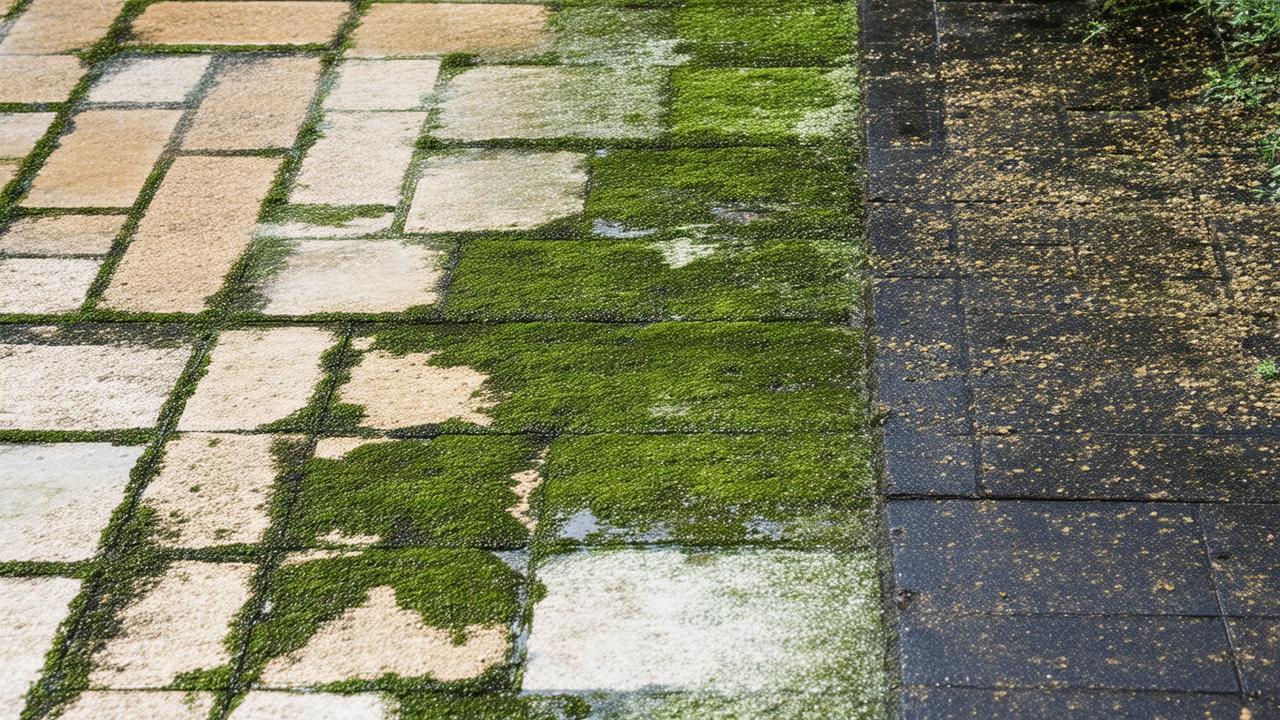
The first time I saw the video, I was sitting at my kitchen table, half‑listening to the kettle and half‑scrolling through my phone. A hose. A bottle of something from under the sink. A patio so blackened with algae and grime it looked almost furry. And then, as if summoned by some suburban spell, the slabs transformed—pale, bright, almost new—while a stranger’s hand casually swept the liquid across the stone. “No scrubbing. No pressure washer. Just this miracle mix,” the caption promised. In the comments, hearts and flame emojis flared. But buried among them were other voices, sharper, angrier. “Irresponsible!” one wrote. “You’re poisoning the soil.” Another: “This should be illegal.” Somewhere between the sparkling slabs and the furious replies, a quiet, unsettling question emerged: what price are we willing to pay for a clean patio?
The patio that started a fight
A week later, I’m standing in a back garden that looks almost exactly like the one from the video. The air is damp, carrying the faint metallic tang of winter rain and the earthier smell of soaked soil. The patio slabs are streaked in green and brown, a cloudy patina of algae, lichen, and forgotten summers. Fallen leaves cling to the edges like wet confetti. It’s the kind of scene most of us have in some corner of our lives, quietly accumulating in the margins until the first warm day of spring makes us see it again with fresh eyes—and mild embarrassment.
“You should’ve seen it last month,” laughs Jake, the homeowner, pulling his jacket tighter. He’s the sort of person who talks fast, always on the verge of the next idea. “Slippery as ice. My mother nearly went down on it at Christmas. That’s when I started Googling ‘quick patio fix.’” He looks down at the ground, then back at me. “Honestly? I just wanted it done.”
Jake is exactly the kind of person those miracle‑cleaning videos are made for: time‑poor, house‑proud, suspicious of long afternoons spent scrubbing. When he discovered the method—usually some combination of household chemicals, bleach, or strong biocides poured or sprayed on the slabs and left to work “like magic”—he felt, in his words, “saved.” A few hours later, he had a brighter patio and a triumphant photo to text around. It felt like a small domestic victory.
Then his neighbor saw what he used.
The ‘miracle’ method everyone’s arguing about
The method itself is rarely presented with much nuance online. A short video. A list of ingredients. Quick results. Swipe to see “before and after.” The recipes vary, but the pattern is the same: something strong, something cheap, something easy to pour. Bleach in different forms is the star ingredient in many of these concoctions, sometimes joined by washing up liquid, sometimes by patio cleaners sold in big jerrycans with vague promises like “kills algae” printed on the label. The promise is seductive: no kneeling, no scrubbing, no roaring pressure washer. Just a bottle and a hose—and, if the caption is to be believed, a guilt‑free conscience.
Not everyone is buying that last part.
Jake’s neighbor, Anna, is a wildlife gardener, the type who lets clover bloom in the lawn and knows the names of the spiders that spin their webs between the fence posts. She saw the sudsy runoff sliding towards the drain and felt something twist in her stomach. “It looked like a chemical cocktail,” she tells me later, standing in a coat flecked with soil. “We’ve spent years trying to make this garden a refuge for insects and birds. And then suddenly there’s this slick of white foam drifting past the flowerbeds. All for some shiny slabs?”
It’s the clash of two very modern impulses: the urge for convenience and the growing awareness that our smallest choices can ripple outwards into rivers, soil, insects, and beyond. Online, that clash has turned into a heated, almost tribal dispute. One side posts videos titled “Game‑changing patio hack!” The other responds with images of dead plants and screenshots of product safety sheets.
What lives in the cracks between the slabs?
You don’t notice them at first. The patio seems like a solid, inert thing: stone, mortar, a human attempt to keep nature at bay. But if you crouch down and let your eyes adjust, you see the quiet city that lives in the hairline gaps. Slender blades of grass. Tiny beetles that vanish when the shadow of your hand crosses them. Ants navigating their own highway system below your garden furniture. Moss that holds water like a sponge and glows a deep, lush green after rain.
Algae, lichen, and moss—those “unsightly” patches that miracle methods promise to erase—are often the first to colonize man‑made surfaces. To some, they’re a sign of neglect. To others, they’re proof that even our hardest edges can be softened by life. Birds pick through them for insects. Solitary bees sometimes shelter in the fine cracks. Spiders set traplines along the edges, patient and still.
When strong chemicals hit this micro‑habitat, they don’t negotiate. They sterilize. Bleach and certain biocides are designed to kill living matter: algae and fungi, yes, but also the microscopic life that quietly supports the rest. The rinse water doesn’t simply vanish; it runs towards drains, seeps into soil, or slips under fences. On a still day, you might smell it long after the slabs have dried—an invisible presence stretching beyond the stone.
For people like Anna, that’s the hidden cost of the miracle: a cleaned surface bought with the lives of the smallest, least visible residents of the garden. “It’s not just about one patio,” she says. “It’s about hundreds of them, in every neighborhood, every spring. It builds up.”
Genius time‑saver or quiet pollution?
Online, the debate often collapses into two caricatures. On one side, the “lazy homeowner” who’d do anything to avoid lifting a brush. On the other, the “overly sensitive eco‑warrior” who wants everyone to live in a mossy ruin. Reality, as usual, is stickier.
Plenty of people who use miracle methods care about the environment; they just feel crushed by the sheer volume of things they’re supposed to worry about. Climate change. Plastics. Energy. Food waste. “And now I’m a villain because I cleaned my patio?” Jake says, half‑joking, half‑wounded. “I recycle. I buy less meat. I take the train when I can. I honestly didn’t think this was a big deal.”
And then there are those who’ve watched one too many summers disappear into chores. They grew up hearing that technology should make life easier, that the point of all this progress was to give us back our time. A bottle that turns black slabs into pale stone feels like the payoff of that promise. No one in the glossy videos mentions risk, runoff, or safety data. It’s all sparkling surfaces and satisfied sighs.
But the environmental voices are not simply scolding. They’re pointing to a quieter pattern: the way individual conveniences add up. Detergents in waterways. Weed killers drifting into hedgerows. Patio chemicals leaching into soil. None of it looks catastrophic on its own. Together, it becomes a steady, background thinning of life.
This, perhaps, is why the dispute burns so fiercely. It’s not really about slabs. It’s about what we think we’re entitled to demand from the world around us, and what we’re willing to look away from to get it.
Is there such a thing as a “clean enough” patio?
Walk around any older neighborhood and you’ll see patios that seem to have made peace with time: stones mottled with lichen, pale maps of old spills, moss at the edges like a soft border. They’re not untouched—they’ve clearly been swept, maybe gently brushed—but they haven’t been returned to showroom perfection. Standing on them feels a bit like being in an old, comfortable jumper: lived in, softened, shaped by years.
Not everyone wants that look, of course. But some people are quietly drifting towards the idea that “clean enough” might be better than “pristine at any cost.” The lure of the miracle method grows weaker when you decide your slabs don’t need to look like they were laid yesterday to be worthy of guests and barbecues.
There are also slower, more physical ways to keep a patio safe and pleasant: a stiff broom and hot water; a scrub brush and a mild, biodegradable soap; a pressure washer used sparingly and thoughtfully, directed by someone who understands that blasting off the top layer of stone is not a long‑term solution. These approaches ask more of your muscles and your time. They also recruit your senses in a different way.
The rhythm of sweeping. The soft hiss of hot water meeting cold stone. The gradual revelation of color under the grime, not in a sudden, chemical shock, but in a slow, almost meditative unveiling. It’s less of a hack and more of a seasonal ritual, like turning the compost or oiling wooden garden tools. You remember that the patio is part of the garden, not a sterile platform hovering above it.
➡️ “I feel like I’m always bracing for something”: psychology explains anticipation mode
➡️ By dumping sand into the ocean for more than a decade, China has managed to create entirely new islands from scratch
➡️ “No one explained how to do it”: their firewood stored for months was actually unusable
➡️ “This slow cooker meal is what I start in the morning when I know the day will be long”
➡️ A quick and natural way to make any room smell fresh, without using sprays or scented candles
➡️ A Nobel Prize winning physicist says Elon Musk and Bill Gates are right about the future, with far more free time but fewer traditional jobs
➡️ 8 phrases deeply selfish people often say without realising it
| Approach | Effort | Environmental impact | Effect on wildlife |
|---|---|---|---|
| Strong chemical “miracle” mix | Very low physical effort | High: potential soil and water contamination | Harsh: kills algae, moss, and many small organisms |
| Pressure washing | Moderate; machine‑based | Medium: water use, noise, possible erosion | Disruptive: can strip habitats in cracks |
| Brushing with hot water and mild soap | Higher physical effort | Lower: fewer harmful residues | Gentler: some micro‑habitat remains |
| Accepting partial moss/lichen | Very low; occasional safety checks | Very low: minimal intervention | Supportive: more shelter for insects and spiders |
Rethinking what “effortless” should mean
Maybe the real friction in this argument isn’t about cleaning at all. It’s about our relationship with effort. So much of modern life is sold to us through the lens of effortlessness: effortless beauty, effortless cooking, effortless homes. And under that shimmer, a quieter story plays out—one where the effort we avoid is often simply exported elsewhere.
The bottle that promises effortless cleaning didn’t spring fully formed from nowhere. It carries the invisible work of factories, transport, packaging, and eventually, treatment plants trying to cope with what we pour away. The chemicals that save your back from bending might ask something, later, from the river, the soil, or the creatures that live a few inches below the surface of your slabs.
What if effortless, in the context of a patio, meant something different? Not zero effort, but effort that feels proportionate, honest, and contained. The kind of chore that leaves you pleasantly tired rather than vaguely uneasy. The kind of cleaning where, afterwards, you can stand back and breathe deeply without the faint sting of bleach in your nose.
When I ask Jake if he’d use the miracle method again, he pauses longer than I expect. “I don’t know,” he says finally. “It felt amazing at the time. But now, after the argument with Anna… I can’t pretend I don’t know there’s a downside.” He glances at the slabs, then at the flowerbed where a robin is hopping, head tilted. “Maybe next time I’ll just… take a Saturday and do it the slow way.” He laughs softly. “Don’t tell the internet.”
Choosing your side of the argument
For now, the heated dispute over effortless patio cleaning isn’t going anywhere. Every spring, as the light sharpens and we start looking critically at our outdoor spaces again, those videos will surface. There will be new products, new hacks, new bottles bearing words like “eco,” “green,” or “biodegradable,” hoping to soothe the friction between our conscience and our craving for instant results.
But beyond the comment‑section battles, a quieter, more personal decision waits for each of us. When you stand at the edge of your own blackened slabs, hose in one hand and phone in the other, it won’t be the influencers or the angry strangers who live with the consequences—it will be you, your soil, your drains, your frogs, your neighbor’s flowers, the spiders in the cracks.
Maybe you’ll still reach for the strong stuff. Maybe you’ll store the pressure washer in the shed and decide that, this year, you’d rather spend elbow grease than pour something harsh into the ground. Maybe you’ll look at the green haze on the stone and feel, for a brief moment, not disgust, but recognition: nature, gently trying to come back.
The miracle, in the end, might not be a bottle that makes your slabs gleam. It might be the moment you realize you can live with a patio that bears its seasons honestly, a little stained, a little softened, but still safely walkable and quietly alive.
Frequently Asked Questions
Is using strong chemical patio cleaners always harmful?
Not always, but they carry risks. Used rarely, in small amounts, and kept away from drains, beds, and ponds, their impact is smaller. Frequent or careless use, especially with runoff into soil and waterways, increases the potential harm to plants, insects, and aquatic life.
Are there safer options that still work on blackened slabs?
Yes. Hot water, a stiff brush, and a mild, biodegradable soap can remove much of the grime, especially if done regularly. Some specialized cleaners are formulated to be less harmful when used as directed, though it’s wise to read labels carefully and avoid overuse.
Is pressure washing better than chemical “miracle” mixes?
It can be better for water quality, since it avoids many harsh chemicals, but it isn’t impact‑free. Pressure washing uses a lot of water, can erode stone and grout, and can strip away small habitats in cracks. Used gently and sparingly, it may be a reasonable middle ground.
Is it unsafe to leave moss or algae on my patio?
Heavy growth can be slippery, especially in wet or shaded areas, so paths and main walkways may need more attention. However, light moss or lichen at the edges or in less‑used corners is often manageable and can provide micro‑habitats for small creatures.
How can I balance a tidy patio with caring for wildlife?
You can focus cleaning efforts on high‑traffic, safety‑critical areas and be more relaxed about the edges. Use gentler methods where possible, avoid directing runoff into drains or beds, and accept that a little imperfection—some moss, some lichen—can be part of a richer, more alive garden.





