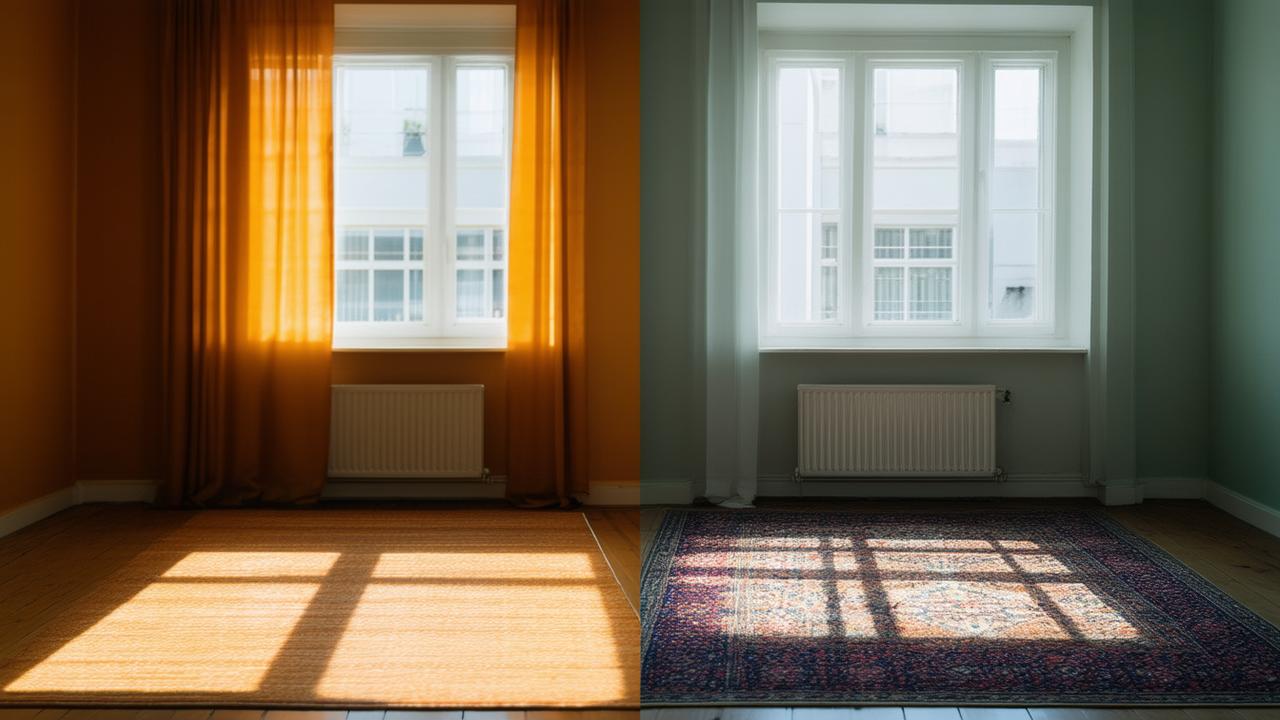
The first thing you notice isn’t the view. It’s the sound. You clap your hands in the middle of the empty living room and the noise doesn’t just stop—it ricochets, snapping off the walls, ceiling, and bare floor, lingering in the air like a ghost that doesn’t know it’s supposed to leave. A single laugh turns sharp and metallic. Your footsteps feel too loud, like you’re walking inside a drum. Later that day, you step into a tiny study lined with overstuffed bookshelves and a soft rug, and suddenly the air changes. Your voice drops, the room feels closer, warmer, quieter—as if the walls are listening and absorbing everything you say. Same you, same voice. Completely different experience. Why?
The Invisible Weather of Sound
We’re used to noticing light. A bright room versus a dim one is obvious. But sound has its own kind of weather, drifting through space in waves, bouncing, softening, or shattering depending on what it meets. The echo you hear—or don’t hear—isn’t a mysterious property of “big rooms” or “empty spaces.” It’s the product of a simple dance between sound and surfaces.
Imagine your voice as a burst of tiny, energetic travelers: sound waves. The moment you speak, they hurry outward in every direction, racing toward walls, floors, ceilings, windows, furniture, even your own body. Every time they hit something, one of three things happens: they bounce off, they get absorbed, or they slip through.
The reason some rooms echo and others don’t mostly comes down to how much bouncing versus absorbing is going on. Rooms with many hard, flat surfaces act like acoustic trampolines. Rooms full of soft, irregular, textured things behave more like thick forests, catching the waves and slowly swallowing them. You don’t need a physics degree to feel the difference; your body senses it instantly.
Why Certain Rooms Sound Like Caves
Hard, Flat, and Bare: The Perfect Echo Recipe
Think about the last time you walked into an unfurnished apartment. Bare walls. Shiny floors. Wide, uninterrupted surfaces. There’s almost nothing there to “catch” your sound. When you speak, those waves slam into plaster, glass, concrete, or tile and bounce back nearly as strong as they left you. That bouncing is what your ears interpret as echo or reverberation.
Reverberation is like a crowd of faint copies of your voice arriving a fraction of a second after the original. They’re slightly blurred, overlapping, but close enough in time that your brain merges them into one smeared sound. If the room is big enough or reflective enough, you start to clearly hear those delayed returns as distinct echoes. A stairwell. A cathedral. A school gym. Those spaces aren’t just big; they’re smooth, rigid, and mostly empty.
Size Matters—But Not How You Think
It’s tempting to say, “Big rooms echo; small rooms don’t.” But you can prove that wrong in a second by stepping into a tiled bathroom. Bathrooms are usually tiny. Yet sing a note while the shower is off, and the sound blooms and hangs in the air like steam. It’s not the size that’s doing the heavy lifting there; it’s the tile on the walls and floor, the glass of the mirror, the hard tub, the naked ceiling.
Size changes the timing of the echo—how long it takes for the sound to come back to you and how many times it can bounce around before dying away. But the real villain (or hero, depending on your taste) is still the surfaces. A big room filled with sound‑absorbing materials can feel hushed and intimate. A small room built like a ceramic box can feel sharp and loud.
How Everyday Objects Quiet a Room
The Secret Life of Sofas, Curtains, and Rugs
Walk back into that echoey empty living room in your imagination. Now, start furnishing it. Lay down a thick rug. Drag in a heavy sofa. Stack some books on a shelf. Add curtains over the windows. Toss a throw blanket on a chair. Without even thinking about it, you’re engineering the acoustics.
Soft, porous materials like fabrics, cushions, carpets, and even plants act like tiny mazes for sound waves. When waves travel into these materials, they don’t bounce back cleanly. Instead, they wiggle through fibers, twist into tiny pockets of air, and lose energy as they go. That lost energy becomes a little bit of heat—far too small to notice, but enough that your voice doesn’t return with its former power.
From your perspective, it feels like the room is leaning in closer. Conversations become easier. You don’t have to raise your voice to be heard. There’s less of that tinny aftertaste on every word. Nothing magical happened. You simply added things that are good at turning echo into silence.
Even Messiness Has a Sound
Clutter has a bad reputation in design magazines, but acoustically, it’s a bit of a hero. A wall lined with mismatched books, a coat rack full of jackets, a stack of boxes in the corner—they all break up flat surfaces and scatter sound in different directions. Instead of a clean, “ping‑pong ball” reflection straight back at your ears, the waves get split, diffused, and weakened.
That’s why a study crammed with novels and notebooks feels softer and more intimate than a sleek, minimalist office with glossy walls and a spotless floor. Modern minimalism is beautiful to the eye but often brutal on the ear.
Below is a simple look at how common materials in a room behave when sound hits them:
| Surface / Object | Typical Material | Effect on Sound |
|---|---|---|
| Bare wall | Plaster, drywall, concrete | Strong reflection; increases echo |
| Floor | Tile, wood, laminate | Reflective; can make rooms sound “hard” |
| Rug or carpet | Woven fibers, padding | Good absorption; reduces echo and footstep noise |
| Curtains | Fabric (light to heavy) | Moderate absorption; softens reflections from windows |
| Bookshelves | Wood + books | Scatter and partially absorb sound; reduce sharp echoes |
| Upholstered furniture | Foam, fabric | Strong absorption; make speech feel warmer and clearer |
| Glass windows | Glass pane | Highly reflective; can create bright, ringing sound |
The Shape of Space and the Journey of a Voice
Angles, Corners, and Little Acoustic Traps
Rooms are rarely perfect boxes, and those quirks matter. A vaulted ceiling in a living room can send your voice soaring upward, bouncing around overhead before returning, like birds wheeling under a roof. Narrow hallways funnel sound, making even small noises seem focused and intense. Big, empty corners can act like gathering spots for particular frequencies, making some notes or tones feel strangely louder.
Even something as simple as a slanted ceiling above a bed can tilt the path of reflection, causing your voice to return at odd angles. That’s why certain spots in a room sound different from others. You might notice that clapping near a corner sounds harsher than clapping in the center. The room hasn’t changed—your position in its little acoustic landscape has.
Distance and Delay
There’s another simple reason a cavern, church, or gym feels more echoey: distance. When sound has farther to travel, the delay between your voice and its returning reflections is longer. Your brain is surprisingly sensitive to those tiny gaps in time. If the reflections come back too quickly, you just hear a fuller, richer sound. If they come back a little later, your brain starts to separate them as distinct echoes.
In a small, soft room, sound doesn’t get the chance to make that grand journey. It gets caught and tamed quickly, absorbed by the very things that make the room comfortable. The echoes still exist in a technical sense—but they’re so faint and short‑lived that your brain lets them slip under the threshold of awareness.
Listening With Your Whole Body
Why Echo Changes How a Room Feels
The way a room sounds doesn’t just matter to your ears. It changes how your whole body experiences the space. An echoey room often feels cooler, emptier, more emotionally distant, like walking through an art gallery after hours. Your voice feels less rooted, less grounded, as if it belongs more to the room than to you.
In a quieter, more absorbent room, you often feel physically closer to other people. Conversations feel more private, even if the space is the same size. You don’t need to push your voice. You don’t feel the subtle fatigue that creeps in after hours of talking against a waterfall of reflected sound.
➡️ “I didn’t expect one decision to save me $750 in just three months”
➡️ Psychology says people who grew up without air conditioning developed these 7 mental resilience traits that are nearly impossible to build today
➡️ Heated dispute over effortless patio cleaning: the ‘miracle’ method for blackened slabs that some call genius and others call irresponsible
➡️ This forgotten feature in your car improves visibility during bad weather
➡️ Food experts explain why this cooking shortcut often backfires
➡️ The exact reason your phone battery drains faster at night even when you are not using it
➡️ The hidden link between eye contact and trust perception
That’s one reason restaurants that prioritize decor over acoustics can feel exhausting, even if the food is spectacular. The clatter of plates on hard tables, voices ricocheting off glass and concrete, background music trying to compete—it all adds up to a blur. You leave not quite sure why you’re so tired; your ears, and the rest of your nervous system, have been working overtime.
Bringing It Back to the Simple Reason
So what’s the simple reason some rooms echo more than others? Strip away the jargon, and it comes down to this:
Echo lives where sound can bounce, and it dies where sound can sink.
Rooms full of hard, flat, empty surfaces give sound a playground of mirrors. It reflects again and again, layering over itself until you hear that bright, ringing, lingering quality. Rooms filled with soft, textured, uneven things give sound places to rest. Each cushion, curtain, rug, and book quietly steals a bit of that energy until there’s not much left to come back.
The next time you walk into a space and instinctively whisper or raise your voice, pause for a moment and really look. Notice the floor: tile or carpet? Feel the walls: bare or covered? Glance up: is the ceiling high and smooth or broken by beams and fixtures? Listen for your footsteps, for the way a cough hangs in the air or disappears into it.
You don’t need special equipment to understand a room’s acoustics. You are the equipment. Your clap, your hum, your casual hello at the doorway—these are small experiments, sending sound into the room and listening to how the room sends it back. In that simple exchange, between your breath and the walls around you, lives the secret of why some rooms echo and others hold their silence.
FAQ
Why does my empty room echo so much more than when it’s furnished?
An empty room usually has mostly hard, flat surfaces, which reflect sound strongly. When you furnish it with rugs, curtains, sofas, and books, those softer, textured materials absorb and scatter sound, so less of it bounces back as echo.
Do high ceilings always mean more echo?
Not always, but they often increase echo because they give sound more space to travel and bounce around. However, if a high‑ceilinged room has plenty of sound‑absorbing materials, it can still feel surprisingly quiet and intimate.
Why do bathrooms sound so good for singing?
Bathrooms are usually covered in tiles, glass, and other hard materials that reflect sound very efficiently. The strong reflections add natural reverb, making your voice sound fuller and more resonant—like a tiny concert hall.
Can small rooms echo too?
Yes. A small room with hard floors, bare walls, and no soft furnishings can still sound sharp and echoey. Size affects how long sound lingers, but the materials in the room have more influence over how strong the echo feels.
How can I quickly reduce echo in a noisy room at home?
Add soft, porous items: a large rug, thick curtains, cushions, wall hangings, and bookshelves filled with books. Even a few fabric‑covered panels or a tall plant can help break up reflections and make the room sound more comfortable.





