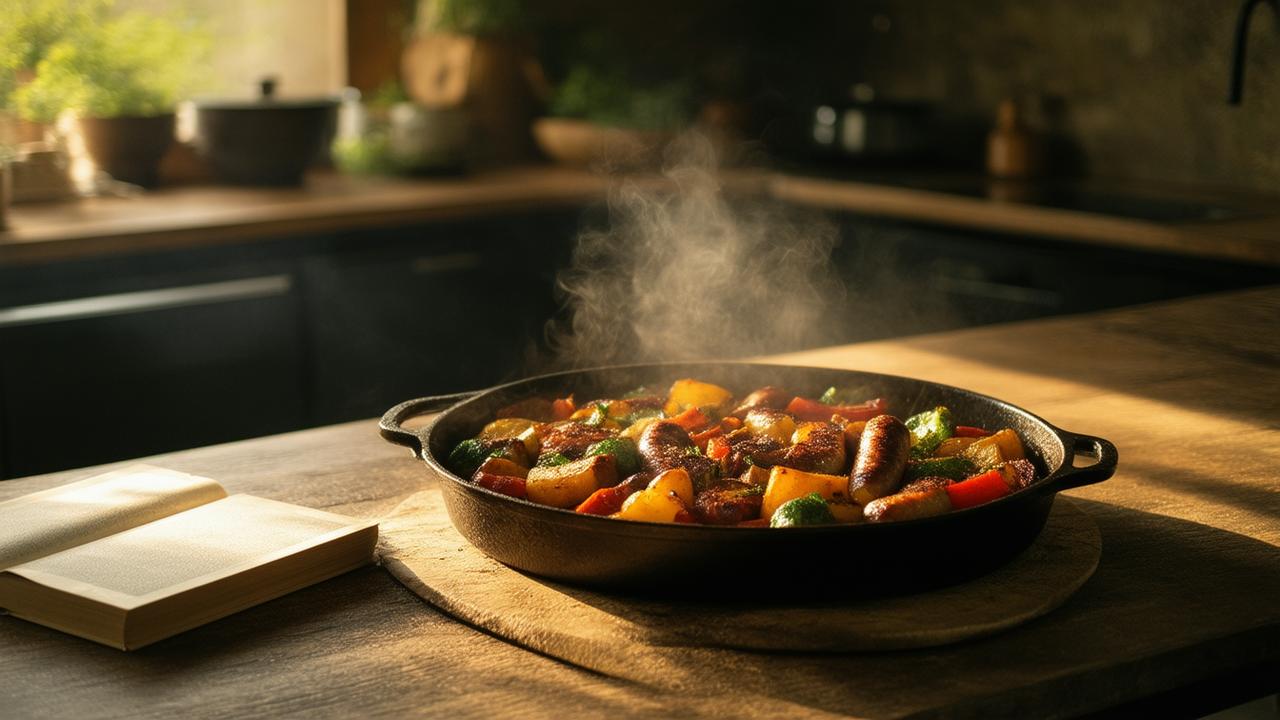
The evening always begins the same way: I turn off the television, flip my phone face down on the counter, and stand in the quiet glow of the kitchen light, listening to the soft hum of the oven as it wakes up. Outside, the sky is folding itself into blue-gray, neighbors are closing curtains, and the house feels like it’s holding its breath. This is when I make the one baked meal that asks nothing of me except that I be here, now, with my hands in the ingredients and my mind nowhere else. It’s not fancy. It will never gather likes on a screen. But it has a quiet kind of gravity—the kind that pulls you out of the noise of the day and back into your own body.
The Ritual of Turning Everything Else Off
There’s something almost old-fashioned about cooking with the intention of not being distracted. It feels rebellious, in a way, to decide that for the next hour, no one will reach you. I set the oven to 190°C (about 375°F), and that ritual—turn, click, whoosh—is like the opening chord of a favorite song.
This meal starts with vegetables that can take the heat without complaining: thick coins of carrot, half-moons of onion, wedges of potato, and whatever else the crisper drawer has managed to keep alive—zucchini, perhaps, or a worn but still determined bell pepper. I rinse them under cool water; droplets cling to their skins like tiny beads of glass. The knife makes that gentle, satisfying thud against the wooden board, a rhythm I can feel more than hear.
There is no hurry. The world can scroll on without me. Right now, my entire radius of concern is the width of my cutting board. There is relief in that.
The Baked Dish That Waits, Never Demands
This particular meal is a kind of baked everything-in-one-pan: vegetables, a protein, and a blanket of flavors that deepen and mingle in the oven. Sometimes it’s chicken thighs, skin-on for that crackle of crisped fat. Sometimes it’s chickpeas, straight from the can, rinsed and rolled between my fingers, their pale bodies soft and sturdy. Whichever I choose, it all ends up in the same wide, chipped ceramic dish that has seen years of weeknight dinners and quiet Sundays.
I drizzle olive oil over the piled vegetables, a lazy golden thread that catches the light. Salt follows—enough to make the flavors speak up, not shout. Cracked black pepper; a pinch of dried thyme or rosemary, whichever jar my hand touches first; maybe some smoked paprika if the air outside feels particularly cold. I rub everything together with my hands, not a spoon. There’s something about the oil slicking across my palms, the roughness of potato edges, the cool give of onion layers, that insists I be present.
The protein—chicken or chickpeas—settles on top of this vegetable bed like someone dropping into a well-worn couch. If it’s chicken, I nestle each piece skin-side up so the fat can melt down into the vegetables, basting them while no one’s watching. If it’s chickpeas, I scatter them across and in between the vegetables like punctuation marks, knowing they will wrinkle and crisp at the edges, small golden comets threaded through the pan.
Why This Meal Refuses to Be Background Noise
There are meals that keep you scrolling as you eat, your attention grazing rather than grazing your plate. This isn’t one of them. Even in the making, this baked dish demands just enough of your senses to push everything else to the far edge of your mind. You listen for the tiny roar of the oven turning on, you smell the first hint of rosemary rising as the heat builds, you feel the tacky grip of starch on your fingertips.
It’s not complex, but it is complete. It doesn’t ask you to plate it beautifully or find the perfect angle. It just asks you to show up, to sit down when it’s ready, and to taste what happens when three or four honest ingredients share the same heat and time.
The Slow Transformation in the Oven
When the dish slides into the oven, there is a small exhale. The hardest part—if you can call any of this hard—is done. The oven door closes with a soft thump, and the quiet of the kitchen deepens. Now there is only the waiting, and even that becomes its own kind of meditation.
At first, the air changes slowly. A faint scent of onion and oil, then the sharper note of thyme waking up, stretching in the warmth. After 20 minutes, there’s a soft crackling from inside, a sound you almost have to lean into to hear, like eavesdropping on a secret conversation between pan and flame. The edges of the potatoes begin to brown, the onion slumps into sweetness, and the chicken skin, if you’re using it, tightens and blisters to the color of late autumn leaves.
I might tidy the counter while it bakes, line up the spice jars again, rinse the knife. But I don’t leave the kitchen. I don’t pick up my phone “just for a second.” Instead, I wander to the window, watch the slight sway of trees, the gradient of darkening sky, the passing of headlights like distant ships. The oven timer is enough digital intrusion for one night.
A Pan That Feeds More Than Hunger
By the time I open the oven, the kitchen is its own small weather system. Warm, fragrant, a little fogged near the glass. I pull the dish out, and everything is both exactly as expected and somehow better. The vegetables have shrunk into themselves, concentrating their flavors. A fork slides easily into a carrot; the potato interior is creamy, its edges browned and crisp. The chicken, if I’ve made it that way, has rendered its fat down into the pan, where it has kissed every vegetable with flavor. If I’ve gone the chickpea route, they are mottled and toasty, some split, some intact, all humming with spice.
This pan will absolutely feed a few people if it needs to. But most of the time, it’s just me. I scoop a generous heap into a shallow bowl, making sure I dig all the way to the bottom to catch the caramelized bits stuck to the dish. Those are always the pieces that taste like they’ve been touched by fire and memory at the same time.
The Quiet Pleasure of Eating Without a Screen
I take my bowl to the table—never the couch for this meal—and sit down with nothing else. No show, no podcast, no open laptop whispering unfinished tasks. Just the gentle clink of cutlery and the low, almost imperceptible sound of food cooling in the bowl.
The first bite is always hotter than I expect. Steam brushes against my face. A wedge of potato collapses in my mouth, soft and salted, carrying hints of rosemary and whatever pan drippings have seeped in. A piece of carrot follows, sweet and earthy, still with enough bite to remind me it once grew in soil. If there is chicken, its skin breaks with a quiet crackle, giving way to meat that tastes like it has been listening to the company of vegetables for the last hour. If it’s chickpeas, they offer that faint, satisfying snap, then a buttery interior wrapped in spice.
Without a screen in front of me, details show up that I usually miss: the way the olive oil pools in tiny golden lakes at the bottom of the bowl; how the thyme leaves have darkened but still hold their shape; how a stray onion strand has twisted into an accidental spiral. I chew slower. Time seems to stretch, then pause—a held breath between days.
The Subtle Texture of Solitude
Eating alone, without distraction, can feel like a lost art. It’s easy to believe that we should always be multitasking, feeding our bodies and our attention at the same time. But this simple baked meal thrums with a soft insistence: be here.
There’s room for every sensation. The rough grain of the ceramic bowl under my thumb. The warmth seeping through to my hands. The muted scrape of fork against dish. The way flavors layer: salt on tongue, sweetness of roasted carrot rising a second later, the final whisper of herbs and oil lingering at the back of the throat.
Halfway through the bowl, I usually realize how tired I actually am. Not the frantic kind of tired that pushes you to scroll for escape, but a gentle fatigue that simply wants rest and something warm. This meal doesn’t fight that feeling; it welcomes it. It says: finish this, then you can let the day go.
➡️ Why Australian psychologists are studying loneliness as a measurable public health risk
➡️ The surprising role of Australian wetlands in buffering floods and storing carbon
➡️ How Australia’s migration story is influencing modern identity and everyday language
➡️ Australia’s renewed interest in nuclear submarines is reshaping Indo Pacific strategic planning
➡️ What Australian historians now believe about the early contact period along the northern coast
➡️ How Australian supermarkets are quietly changing portion sizes without changing prices
➡️ Why Australian scientists are watching Antarctic ice shelves with growing urgency
A Simple Guide to the “No-Distraction” Baked Meal
It helps to think of this dish not as a recipe, but as a framework. Once you understand the bones of it, you don’t need to measure or consult anything. You can move through it almost by instinct, which is exactly the point.
| Element | Options | Notes |
|---|---|---|
| Base Vegetables | Potatoes, carrots, onions, sweet potatoes | Choose firm veggies that roast well and soften inside. |
| Extra Vegetables | Zucchini, bell peppers, mushrooms, fennel | Add color and variety; cut in larger chunks so they don’t burn. |
| Protein | Chicken thighs, firm tofu, chickpeas, sausage | Choose something that can share the same roasting time as the veggies. |
| Fat | Olive oil, butter (dotted on top), ghee | Don’t be shy; fat carries flavor and helps everything brown. |
| Flavor | Salt, pepper, thyme, rosemary, smoked paprika, garlic | Keep it simple but intentional; two or three spices are enough. |
Once everything is cut and gathered, it’s just this: toss vegetables with oil, salt, and spices. Spread them in a single layer in a baking dish. Top with your chosen protein. Roast at around 190–200°C (375–400°F) for 35–50 minutes, depending on the size of your pieces and the stubbornness of your oven. Stir once if you feel like it. Don’t, if you don’t. Both ways work.
The Gentle Boundaries Around This Meal
The most important ingredient here is not in the table above: it’s the boundary you draw around this time. Choose to leave your phone in another room. Let the oven’s timer be the only notification you answer. If you live with others, you can invite them into this quiet, or let them know that for this one meal, you’re stepping into a slower space.
The point is not perfection. Some nights the potatoes will brown a little too deeply; some nights the carrots will be softer than you like. But each time you make it, your body will remember the motions more easily. The calm will come faster. Eventually, just preheating the oven for this dish may be enough to signal to your brain: we’re clocking out of the noise now.
What This Meal Teaches in the Silence
There’s a temptation, when life feels fast and scattered, to search for grand solutions. Weekends away. New habits tracked by apps. Big, sweeping changes. But often, it’s something as ordinary as a roasting pan that quietly reorients us.
This baked meal reminds me that slowness doesn’t always require more time; sometimes it just requires more attention. The same 45 minutes could be filled with mindless scrolling while a takeout app tracks my order. Or it could be filled with the steady, grounding series of small acts: washing, chopping, seasoning, waiting, tasting. Both deliver food. Only one delivers me back to myself.
When the pan is empty and the dishes are drying on the rack, there’s a lightness that wasn’t there at the start of the evening. The day still happened. The emails were still sent or not sent, the deadlines still loom or have passed. But in the middle of all of it, there was also this: a small, warm island of undistracted presence. A single meal that asked me to sit with my hunger, my senses, and my own company—and found that, for tonight at least, they were enough.
Frequently Asked Questions
Can I prepare this meal in advance?
Yes. You can chop the vegetables and toss them with oil and seasonings a few hours ahead. Keep them covered in the fridge, then add your protein and bake when you’re ready. Just know that some vegetables, like potatoes, may darken slightly if left too long before baking, though this doesn’t affect the taste much.
How do I adapt this for a vegetarian or vegan version?
Use chickpeas, firm tofu, or plant-based sausage as your protein. Increase the olive oil slightly to ensure richness, and lean on herbs, garlic, and smoked paprika for depth. Everything else about the process stays the same.
What if my vegetables don’t brown well?
Make sure they’re in a single layer with a bit of space between pieces so they roast rather than steam. Use a hot oven (at least 190°C / 375°F), and don’t be afraid to give them an extra 10 minutes if they’re still pale. A light drizzle of oil before the last stretch of baking can also help them take on color.
Can I use frozen vegetables?
You can, but the texture will be softer and there may be more moisture in the pan. If using frozen vegetables, spread them out well and consider increasing the oven temperature slightly so excess water can evaporate and some edges can still crisp.
How do I stay truly undistracted while the meal bakes?
Decide on one simple, phone-free activity to keep you company: reading a physical book, journaling at the table, stretching, or simply sitting by a window. Let the oven timer be your signal, and treat these minutes as a quiet pause rather than more time to get things done online.





