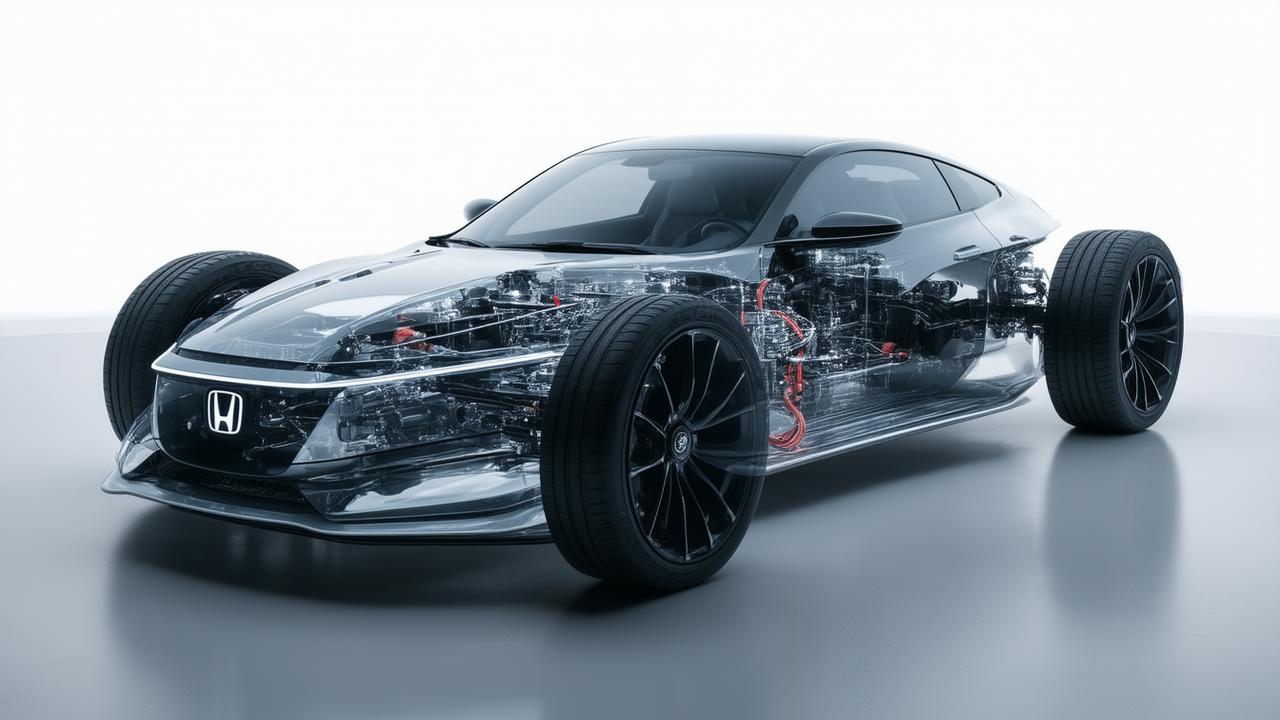
The first time you hear it, you almost don’t believe it. A family hatchback whispering through a misty backroad, climbing steadily, the cool air beading on its windscreen. No grumbling engine drama. No strained, high-rev panic. Just a smooth surge of power, the muted hum of electronics, and a strange sense that something familiar has quietly, decisively changed. This is Honda’s new hybrid platform at work—90 kilograms shaved away, performance sharpened, and fuel efficiency pushed to the kind of numbers that used to belong in lab reports, not everyday life. It doesn’t shout. It doesn’t grandstand. It simply moves, smart and silent, rewriting what a hybrid can be while pretending it’s the most normal thing in the world.
The Moment Hybrids Stopped Feeling Like a Compromise
If you’ve ever driven an older hybrid, you probably know the feeling. You climb in, press the start button, and are greeted by an eerie quiet. You roll away on electric power, impressed for a moment—until the petrol engine jumps in with an anxious growl the first time you ask for more than gentle, Sunday-afternoon acceleration. There’s a subtle message: This is good for the planet, but don’t expect too much fun.
Honda has decided that era needs to end. Their radical new hybrid platform isn’t just a clever upgrade; it feels like a deep, philosophical reset. Engineers began by attacking weight—those 90 kilograms gone are not just an abstract number, they’re a thousand tiny decisions: thinner yet stronger materials, more compact components, fewer compromises in packaging. The result is immediate and visceral. Lighter cars react faster. They stop shorter. They feel more awake under your hands.
That lightness pairs with a powertrain that has been rethought so thoroughly it feels like a different species to the hybrids you might remember. Electric motors step in with more authority. The petrol engine doesn’t sound like it’s reluctantly helping out; it feels like it’s part of a coordinated team. The whole car gives off the impression of having shed not only weight, but a kind of mechanical hesitation.
Inside the New Heart of Honda’s Hybrid Revolution
A Smaller, Smarter, Stronger Powertrain
Under the skin, there’s an intricate ballet of engineering decisions that all lean toward one idea: do more with less. The new platform uses a more compact hybrid drive unit—motor, generator, and power electronics packed tighter together, with less waste heat and fewer heavy casings. Think of it as going from a bulky stereo stack to a sleek soundbar that somehow sounds better than the old tower of boxes.
The battery pack has been redesigned as well. It’s slimmer and denser, allowing it to tuck neatly into the car’s structure without stealing cabin or boot space. The chemistry has been fine-tuned not just for range, but for the way power is delivered—short, strong bursts for overtakes, steady flows for gliding through town, silent creeping in traffic. Every cell is part of a plan to make electric assistance feel natural, not like a separate mode you dip into occasionally.
The control software—the invisible brain of the whole system—has undergone its own quiet revolution. It predicts rather than merely reacts: reading your throttle inputs, learning your habits, watching road gradients and traffic conditions through its sensors. Engine and motors swap roles so seamlessly that, after a while, you stop noticing which one is doing the work. You just notice that the car seems to be in the right gear, with the right power, at the right time—without constantly shuffling or surging.
How 90 Kilograms Changes Everything on the Road
The Feel of Less Weight Beneath Your Hands
Numbers are helpful, but they don’t tell you what happens when a winding road throws a surprise tightening bend at you. That’s where the 90-kilogram cut becomes something you feel through the steering wheel and the seat of your pants.
Turn in, and the car answers more quickly. There’s less mass leaning on the front tyres, less inertia trying to push you straight on, more willingness to follow the line you picture in your head. The suspension can be tuned to be both supple and composed, because it doesn’t have to wrestle with as much bulk. Over a broken country lane, the car floats and settles instead of clattering and skipping. The electric motors fill in torque smoothly out of corners, and the lighter body means they don’t have to work as hard to create that push you feel in your back.
Braking is where hybrids traditionally reveal their quirks. Regenerative systems can feel grabby or vague, like the pedal is speaking two languages at once: friction and electricity. With this new platform, the lighter weight and a more sophisticated blending of regen and mechanical braking make things clearer and calmer. You press, the car slows—firm, predictable, confident. There’s physics at play here: less mass to slow down, so less drama in doing it.
Performance Without the Guilt, Efficiency Without the Boredom
Strong Acceleration, Whisper-Quiet Cruising
One of the most surprising aspects of Honda’s radical platform is how it handles those everyday moments when you need a bit of extra muscle. Joining a fast-moving motorway, swinging out to pass a truck on a narrow B-road, climbing a long uphill stretch: these are the places where older hybrids sometimes felt winded.
With the new system, electric torque arrives right now, not after a polite pause. The petrol engine, freed from the burden of dragging unnecessary kilos, doesn’t have to scream to deliver. It drops into a more natural, confident note—audible but not intrusive, a background singer instead of a lead vocalist trying to steal the show. That harmony between electric and combustion power makes acceleration feel effortless rather than stressful.
Once you’re at a steady cruise, the car seems to disappear under you. Wind noise is hushed thanks to more efficient aerodynamics, a by-product of rethinking how components are packaged and cooled. The hybrid system slips into its most efficient rhythm: coasting on electric where it can, sipping fuel where it must. On a long highway run, you watch the fuel gauge settle into a barely-moving calm that would have been unthinkable for a car with this level of performance a decade ago.
Where the Kilograms Went and What They Gave Back
Designing a Lighter Future Piece by Piece
To understand the scope of Honda’s achievement, it helps to zoom in on the small details. That 90-kilogram loss wasn’t magic; it was the work of designers poring over every bracket, casing, and bolt.
The chassis makes wider use of high-tensile steels and strategic reinforcements, enabling thinner panels in some areas without sacrificing safety. Suspension components, often overlooked as weight sources, have been carefully reconsidered—aluminium here, revised geometry there, smarter integration of bushings and arms. Even the steering system contributes: more compact hardware with lighter housings reduces not only mass but also the effort needed to turn the wheels.
Inside, weight trimming doesn’t mean austerity. Instead, materials do double duty: structural seat frames that are both lighter and more supportive; door panels that blend sound insulation and rigidity in a single layer; wiring looms shortened and simplified by placing major components closer together. The result is a cabin that feels quietly premium, not stripped. It’s efficiency expressed in millimetres and grams, invisible yet tangible every time you drive.
The Numbers Behind the Feeling
Performance, Economy and the New Hybrid Benchmark
For all the talk of sensations and impressions, hard figures still matter. They tell us where this new platform stands in the broader story of automotive progress. While exact values vary by model and market, the pattern is unmistakable: more performance from less fuel, wrapped in a more responsive driving experience.
➡️ Sheets shouldn’t be changed monthly or every two weeks: an expert gives the exact frequency
➡️ Social Security 2026 new monthly payment figures, payment boost for confirmed : new monthly amounts for retirees, spouses, survivors, and disabled beneficiaries explained
➡️ Scientists confirm the discovery of an exceptionally large African python during a certified field expedition
➡️ Seniors behind the wheel: will licenses be pulled automatically after 70 from ?
➡️ The breakthrough cooling device that outperforms traditional air conditioning while using far less energy
➡️ The grandmother’s old mix that makes floors shine the easy method proven over decades
➡️ Psychology explains that overthinking at night is closely linked to how the brain processes unresolved emotions
| Key Metric | Previous Generation Hybrid | New Honda Hybrid Platform* |
|---|---|---|
| Vehicle Weight | ~1,450 kg | ~1,360 kg (−90 kg) |
| System Power Output | Moderate, efficiency-focused | Higher, performance-optimised |
| 0–100 km/h Acceleration | Acceptable, but leisurely | Noticeably quicker, more linear |
| Fuel Efficiency (Combined) | Already respectable | Record-setting for its class |
| Electric-Only Operation | Limited, often interrupted | Longer, smoother, more frequent |
*Representative comparison; exact specifications vary by model and region.
These numbers tell a story of incremental advances stacking into a breakthrough. Shed 90 kilograms, and you don’t just save fuel; you transform how the car accelerates, brakes, and flows along a road. Improve the power electronics and thermal management, and you don’t just reduce energy losses; you make silence and effortlessness part of everyday driving.
From Niche to New Normal
Why This Platform Matters Beyond Honda
Step back from the technical detail and something bigger comes into focus. Hybrids once occupied an awkward middle ground—neither full electric nor traditional combustion, often seen as a stopgap. But this new Honda platform suggests a different narrative: hybrids as a refined, enduring answer for drivers who want meaningful efficiency without changing their routines overnight.
In many parts of the world, charging infrastructure remains patchy. Long commutes, cold winters, and apartment living can make full electric ownership complicated. A hybrid that feels this smooth, this responsive, and this frugal starts to look less like compromise and more like a quietly brilliant solution. You fill up as usual, you drive as usual—but your fuel stops spread farther apart, your tailpipe emissions fall, and your everyday journeys feel calmer and more composed.
It also sends a message to the wider industry. Lightweighting isn’t optional any more; it’s an art form. Efficiency isn’t just a number on a sticker; it’s something you can taste on a winding road and feel in the way your shoulders drop on a long drive home. Honda’s radical new hybrid platform is more than another entry on a spec sheet. It’s a sign that the era of “good enough” hybrids is over. The next generation won’t ask you to choose between joy and responsibility—they’ll quietly, confidently offer you both.
FAQ
What makes Honda’s new hybrid platform different from older hybrids?
It combines a major 90 kg weight reduction with a more compact, powerful hybrid system and smarter control software. The result is stronger performance, more natural driving feel, and noticeably better fuel efficiency, without sacrificing comfort or practicality.
How does the 90 kg weight reduction affect everyday driving?
Less weight means quicker responses to steering input, shorter stopping distances, smoother ride quality, and easier acceleration for both the engine and electric motors. Overall, the car feels more agile, stable, and relaxed in normal use.
Is this new hybrid platform only about efficiency?
No. Efficiency improves significantly, but Honda has also focused on making the car more engaging to drive. Acceleration is stronger and more linear, handling feels sharper, and the transition between electric and petrol power is far smoother than in older systems.
Will cabin space or comfort be reduced because of the weight savings?
No. The weight reduction comes from smarter engineering and materials, not from stripping out comfort. The battery pack and hybrid components are more compact and better integrated, so interior and boot space remain practical and comfortable.
Is this platform a replacement for fully electric vehicles?
It isn’t a replacement, but an alternative. For drivers who can’t easily charge at home or who regularly make long trips, this advanced hybrid offers much lower fuel use and emissions than a conventional car, while fitting seamlessly into existing fueling habits.





