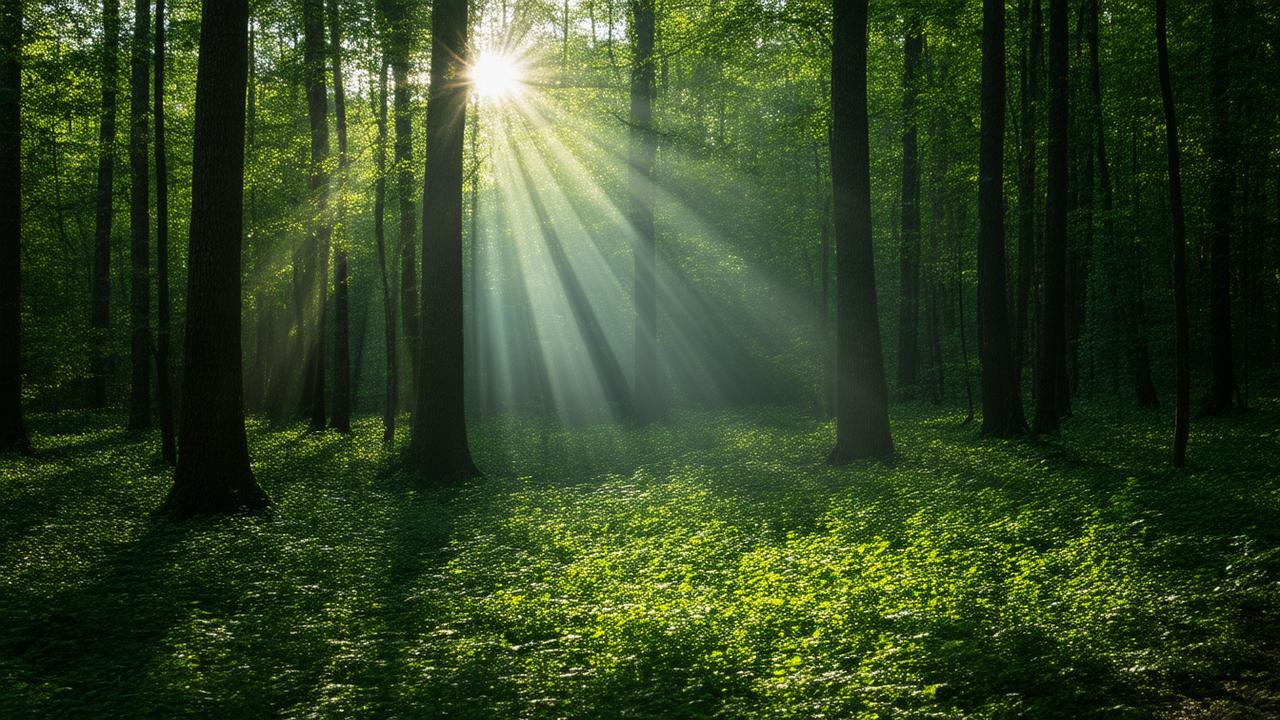
The first thing you notice is the sound. Not of chainsaws, or trucks, or the dry, hollow wind that once scraped across this place like a dull blade—but birds. An entire spectrum of birdsong floats through the morning air, layered over the soft rustle of leaves. The ground under your boots is springy with humus where, not long ago, it was cracked and powder-dry. Sunlight moves in slow, broken shafts through a young canopy of green. If someone had shown you a photograph of this valley 25 years ago, you would not have believed it was the same place.
The Memory of a Barren Land
Old photos still circulate in the nearby town. In them, the landscape looks like a faded postcard from a harsher planet. Hills shaved bald. Dust clouds marching across the horizon. Isolated stumps jutting up like broken teeth. People remember the way the wind used to howl, picking up loose soil and flinging it against houses, stinging skin and eyes. Children walked longer distances for firewood each year, hauling heavier bundles from farther away, as the ring of emptiness spread out from the villages.
There was a certain quiet to that treeless land, but it wasn’t peace. It was the quiet of exhaustion. Springs that had flowed even in the hard years began to fail. Cattle stumbled through gullies, hooves grinding up what little topsoil remained. Without roots to hold the slopes, the first strong rains after a long dry season would arrive like a punishment, stripping gullies deeper, carrying what was left of fertility downstream.
When the idea of reforestation was first proposed, more than a few people laughed. Trees? Here? Again? To many, it was like being told that a desert could simply decide not to be a desert anymore. Besides, it wasn’t only the land that was tired. The people were, too.
How 25 Years of Patience Change the Air Itself
The transformation didn’t begin with grand speeches or satellite images. It began with small, stubborn acts. A handful of farmers agreed to fence off the most eroded sections of their land. Volunteers came on weekends, hands blistering and backs aching, to plant rows of fragile saplings into soil that felt more like crushed brick than earth.
In the early years, survival rates were terrible. Young trees baked under unfiltered sun or disappeared in the mouths of goats. So plans changed. Instead of forcing foreign species into an unforgiving landscape, local communities started studying the survivors—the shrubs and pioneer trees that clung to ravines and rocky outcrops. These became the teachers.
Gradually, the approach shifted from “tree planting” to “forest growing.” People stopped pushing against the land and started listening to it. They protected natural regeneration, shaded seedlings with temporary structures, and learned which native species paired well together, sharing shade and nutrients. They adjusted the timing of planting to match subtle changes in rainfall. It was less like engineering and more like tending a slow, living fire.
By the tenth year, the hills looked less skeletal. By the fifteenth, photos from the same vantage point began to seem like they belonged to two different worlds. And with that new green came something invisible, yet immense: a steady drawdown of carbon dioxide from the sky.
From Dust to Carbon Sinks
Today, those once-barren landscapes function as vast, living carbon sponges. Each trunk, each branch, each root is a piece of atmospheric CO₂ turned into solid matter—locked away not in vaults or mechanical tanks, but in the architecture of life itself.
Forests don’t capture carbon in a single dramatic burst; they do it in millions of quiet, patient gestures. A leaf opens. Sunlight strikes chlorophyll. Molecules rearrange. Carbon from the air becomes sugar, then wood, then soil. Multiply that simple reaction by millions of trees over decades, and the numbers climb fast.
In this region alone, scientists now estimate that the recovering forest and surrounding restored woodlands absorb millions of tons of CO₂ each year. Not once. Every year. The same slopes that used to radiate heat now cool the air. Where dust storms once rolled, mist sometimes gathers.
What the Numbers Feel Like on the Ground
Numbers can be cold and distant; the forest is anything but. Yet the scale of change is easier to grasp when both are held side by side—what the data say, and what your body feels when you step beneath these trees.
On a hot afternoon, you walk from the bare roadside into the shade of the recovering forest. The air temperature drops. Your skin, sticky with sweat, suddenly meets a softer, cooler breeze. Underfoot, the crunch of dry gravel gives way to the muted give of leaf litter. That sensation is not just comfort. It’s climate regulation in real time.
To understand the arc of change, imagine a simple comparison of what this landscape was, and what it has become.
| Aspect | 25 Years Ago | Today |
|---|---|---|
| Tree Cover | Scattered shrubs, almost no canopy | Continuous young forest with mixed species |
| Soil Condition | Hard-crusted, low organic matter | Deepening topsoil, rich with roots and fungi |
| Wildlife | Few birds, small pockets of biodiversity | Abundant birds, insects, returning mammals |
| CO₂ Balance | Net source of CO₂ (degrading soils, burning) | Net sink: millions of tons of CO₂ absorbed annually |
| Local Climate | Hotter, drier, frequent dust storms | Cooler under canopy, improved moisture and rainfall patterns |
Stand here long enough, and the numbers stop being abstract. You can smell the difference in the soil—a kind of deep, loamy breath. You can hear the difference in the insect chorus. You can feel the difference when a sudden gust runs through the canopy, turning individual leaves into a collective, whispering body.
The Hidden Machinery of Forest Carbon
From a distance, a forest looks like a single organism. Up close, it is an intricate negotiation: roots trading nutrients with fungi, trees sharing sugars through mycorrhizal networks, fallen leaves decomposing into the next generation of growth. And threaded through it all is carbon, being continuously captured, transformed, and stored.
The tall, straight trunks store carbon in visible, obvious ways. But in these recovering forests, much of the magic is underground. As roots penetrate deeper, they pull carbon into the soil. Microbes break down organic matter, and some of that carbon becomes stable soil carbon—locked away for decades, sometimes centuries, if left undisturbed.
Over 25 years, this regeneration hasn’t just produced lush green cover; it has rewired the carbon accounting of an entire region. What used to be a landscape that released carbon whenever trees were cut or fields burned has become a landscape that quietly offsets emissions from surrounding towns, vehicles, small industries. It doesn’t excuse those emissions, but it cushions them, buying precious time in a heating world.
People Who Grew a Forest
No forest plants itself in a human-dominated landscape without a story of people behind it. Here, that story is written in calloused hands, patient arguments, and slow, steady compromises.
There were the elders who remembered what the land looked like when they were children and insisted it could be green again. The young people who formed patrols to keep out illegal loggers and stray cattle. The women who organized seed-collecting walks, learning to recognize which pods rattled with promise. Schoolchildren who planted the first sapling they ever touched, then came back years later to lean their backs against a grown trunk and feel its rough solidity.
Reforestation changed more than the view. It shifted daily routines. Fuel-efficient stoves reduced the need for firewood. Agroforestry plots—where crops grow under the partial shade of nitrogen-fixing trees—began to deliver both food and income. Honey production, wild herbs, fruits, and small-scale timber from managed plots spread risk and improved livelihoods.
➡️ This small adjustment helps reduce the feeling of bodily overload
➡️ What it means psychologically when you avoid talking about yourself, even when asked
➡️ I noticed my stress dropped once my cleaning goals became realistic
➡️ This is how to show interest without forcing enthusiasm
➡️ The one breathing mistake most people make daily without realizing it affects their stress levels
➡️ Why doing one task at a time is healthier than multitasking
➡️ I realized my cleaning system was built for a life I don’t live
Perhaps the most subtle change was psychological. A community that had grown used to decline—less water, less soil, fewer options—began to see an opposite trend. More shade, more birds, more rain. The sight of saplings surviving through successive dry seasons became a quiet lesson: the future can be shaped, not only endured.
A Forest That Talks to the Sky
Walk to a clearing and look up. The canopy doesn’t stand still; it shivers with every breeze, drinks in every photon. Each day, it draws CO₂ from the air and exhales oxygen, but it also influences things you can’t quite see—how clouds form, how moisture cycles, how heat lingers or escapes.
Evapotranspiration—the combined release of water vapor from soil and plants—acts like a natural air conditioner. As trees pull up water and release it through their leaves, they cool the local environment. The rising moisture can seed clouds, which in turn may bring rain. In this way, the recovering forest is not just a backdrop to the climate story; it is an active character, negotiating with the sky.
When scientists say these restored landscapes now absorb millions of tons of CO₂ annually, they’re describing one dimension of a much deeper relationship. The forest is not only sequestering carbon; it’s recalibrating the conversation between land and atmosphere, rough ground and moving air.
What These Forests Mean for the Rest of Us
You might never visit this particular valley, or the other reforested regions like it around the world. But the air mixing above its treetops is the same air that will eventually cross your own roofline. We share that atmosphere, for better or worse.
These 25-year-old forests tell us something profoundly important about time and possibility. A human life can span the entire arc—from the day the first saplings went into dead earth to the afternoon when their crowns finally overlap. It means that within a single generation, landscapes can go from amplifying climate change to resisting it.
That doesn’t make reforestation a silver bullet. Forests can burn. Policies can reverse. Mismanaged planting can strip water or displace people. And a tree planted today cannot instantly offset a ton of CO₂ emitted from a jet engine tomorrow. But the lesson still stands: when we commit to the long work of caring for a place, that place can begin to care for the climate we all inhabit.
Somewhere in the world right now, another hillside is being planted. Another degraded pasture is being fenced off to let natural regeneration begin its slow, green climb. Decades from now, someone else will walk there, listening for the shift from wind over bare ground to wind through leaves—and breathing slightly easier, in every sense of the word.
Frequently Asked Questions
How do reforested areas absorb millions of tons of CO₂?
Trees absorb CO₂ during photosynthesis, turning carbon into biomass—trunks, branches, leaves, roots—and adding organic matter to soils. When large areas are restored and allowed to grow for decades, this continuous uptake adds up to millions of tons of CO₂ removed from the atmosphere.
Does any kind of tree planting help fight climate change?
Not always. Monoculture plantations of fast-growing, non-native trees can harm biodiversity, water supplies, and soils. Effective climate mitigation comes from restoring diverse, mostly native forests and allowing natural regeneration, not just planting as many trees as possible.
Why does it take 25 years to see big climate benefits?
Young forests take time to establish roots, develop canopy, and build soil carbon. Over 10–30 years, growth rates and carbon storage increase dramatically. The 25-year mark often represents a turning point where landscapes transition from degraded and emitting carbon to robust and strongly absorbing it.
Can reforestation alone solve climate change?
No. Reforestation is a powerful tool, but it must complement rapid reductions in fossil fuel use and other emissions. Forests can buy time, buffer impacts, and restore ecosystems, but they cannot offset unlimited ongoing pollution.
What can individuals do to support this kind of restoration?
People can support credible local and regional restoration projects, advocate for policies that protect existing forests, reduce personal land and resource footprints, and help plant and care for trees in ecologically appropriate ways within their own communities.





