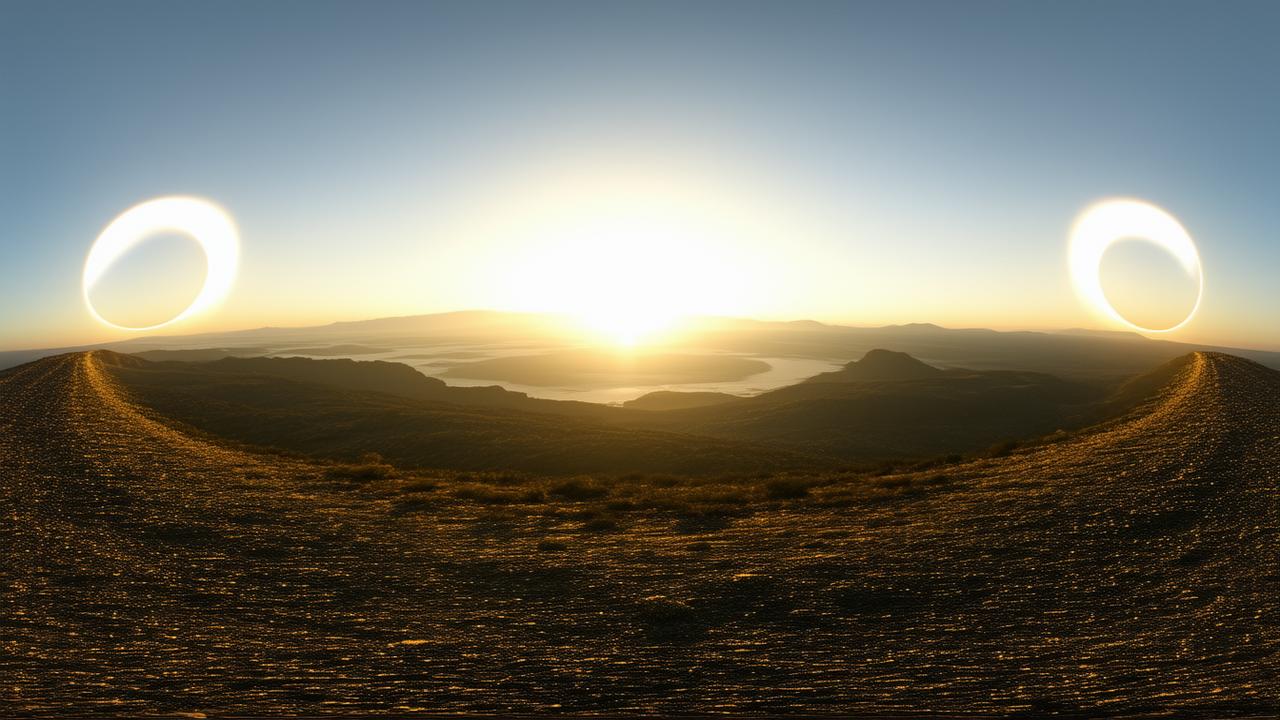
The first shadow arrives almost shyly. A strange dimming, a soft cooling of the air, as if someone has turned the world’s brightness down a single notch. You might glance up from your phone, from your book, from the dishes in the sink, and think: the light feels…different. Not darker exactly—just quieter. On this day, as the longest total solar eclipse of the century begins its slow journey across our skies, millions of people will notice that subtle shift. Some will already be waiting with protective glasses in hand, some will stumble into the moment by accident, but all will stand under the same impossible, ancient dance of shadow and light.
The Day the Sun Learns to Whisper
Long before the sky goes truly dark, the world begins to change in ways that are easy to miss if you’re not looking closely. Birds fall silent or grow restless. Shadows sharpen, stretching across pavements and fields in unnaturally crisp lines. The temperature drops—just a degree or two at first—and the heat that’s been pressing on your skin all afternoon seems to loosen its grip.
As the Moon’s shadow starts to move across the face of the Sun, the day doesn’t simply dim like an evening; it shifts in texture. Colors lose their usual warmth. Greens turn metallic, blues deepen, and your own hands look slightly foreign against the light. Scientists call this transition the partial phase, but if you’re standing in its path, it feels more like a long-held breath. Time acquires a new density. People keep glancing up, then back down, then up again, as if the sky has become a live screen they can’t ignore.
In this eclipse, the Moon will linger in perfect alignment longer than any other in this century. In some regions, totality will last several minutes—long enough for conversations to stop mid-sentence, for traffic to slow, for lives to collect around a single shared horizon. There is something humbling about knowing that on every balcony, beach, mountaintop, and city street along the path, someone else is shielding their eyes and feeling the same uneasy awe.
When the Light Breaks Apart
In the final minutes before totality, the world begins to tilt toward the surreal. If you stand under a leafy tree, each tiny gap between the leaves becomes a pinhole projector, casting hundreds of crescent-shaped suns onto the ground. Children may chase the shapes, trying to cup them in their palms. Adults, still pretending to be composed, will start to murmur and point. The Sun, viewed through eclipse glasses or a viewer, looks like a slowly narrowing bite from a cosmic apple.
This is the moment scientists love: the rapid, high drama stage where aviation engineers, atmospheric physicists, and solar researchers scramble to capture data they’ve been planning for years. High-altitude balloons drift into the path of darkness, loaded with cameras and sensors. Telescopes turn, their mechanical movements almost reverent. Spectrometers wait to parse the Sun’s delicate outer layers, normally washed out by the brutal glare of daylight.
But for everyone else—the families on picnic blankets, the workers stepping outside for “just five minutes,” the elders leaning on walking sticks to scan the sky—this is the edge of something deeply personal. The light now looks wrong in a way your body understands before your brain does. Instinct, older than language, begins to stir: day is not supposed to behave like this.
The Shadow’s Slow River Across the Earth
The Moon’s umbra—the darkest heart of its shadow—will sweep across the planet like a silent river of night, racing faster than a jet, yet unfolding slowly enough for millions to drink it in. Different places will experience different versions of the same story. Others will stand inside the path of totality, where the Sun will be fully covered and day will slide into a brief, raw twilight.
| Region | Approx. Local Time of Totality | Estimated Duration of Totality |
|---|---|---|
| Western Region | Late Morning | 3–4 minutes |
| Central Corridor | Midday to Early Afternoon | 4–6 minutes (longest) |
| Eastern Region | Late Afternoon | 2–4 minutes |
The specifics—minutes, seconds, exact coordinates—are the language of astronomers, and they have calculated them with exquisite precision. But in human terms, what matters more is how those minutes feel. For some, totality will arrive in the middle of a bustling workday, turning office windows into sudden theaters. In rural towns, it may pass across open fields and farm roads, where people park on dusty shoulders and stand in groups, sharing glasses and gasps.
The shadow makes no sound as it approaches, yet many people will swear they felt it coming. The wind may shift, the horizon may look bruised and strange, as if storm clouds are gathering from every direction at once. You look around and realize: the world is preparing for a kind of night that doesn’t belong here.
Those Few Impossible Minutes of Night
Then it happens. The last sliver of the Sun fractures into dazzling beads—Baily’s beads, flickering through the Moon’s rugged edges—then vanishes. A bright burst, the diamond ring effect, flashes and fades. And suddenly the day is not day anymore.
Totality is nothing like sunset. It is as if someone has lifted a transparent dome off the sky and replaced it with another universe. Overhead, where the Sun should blaze, a black disk hangs: the Moon, now visible not as a gentle, familiar companion, but as a hard-edged void. Around it unfurls the Sun’s corona, a pale, silken aura that stretches in streamer-like tendrils across the darkened sky.
The corona is usually invisible, lost in the Sun’s fierce brightness. During a total eclipse, it becomes a ghostly crown, delicate yet vast. Scientists train cameras on it to study its structure, to understand why the Sun’s outer atmosphere burns millions of degrees hotter than its surface. But no photograph, no livestream, no high-resolution image has quite the same effect as seeing it with your own eyes. You do not just look; you feel watched back by something immeasurably larger than you.
All around, the horizon glows in a 360-degree band of twilight. It is like standing in the center of a bowl painted with late evening. Stars and bright planets may appear. Venus often steps forward first, a small, defiant gleam. Animals react in their own ways: crickets may start their evening chorus, cows might wander toward barns, city lights flicker on as automatic sensors misread the sudden dusk.
Science in the Dark
While onlookers tilt their faces to the sky, research teams are racing the clock. Totality is their sudden window into realms usually shielded by daylight. Telescopes tuned to different wavelengths dissect the Sun’s outer layers, peeling back secrets of magnetic storms and solar winds that can one day disturb our satellites and power grids. On the ground, instruments log how temperature, humidity, and wind respond to this abrupt, wandering night.
High above, aircraft chase the shadow at high speeds, extending their time in darkness to gather more data. In classrooms far from the path of totality, students watch live broadcasts, learning that this theatrical sky-show is more than spectacle: it’s an opportunity to refine our understanding of stellar physics, Earth’s atmosphere, and even how ecosystems respond to sudden environmental shifts.
Yet, speak to many scientists after a total eclipse and they’ll admit: there is always a moment when they lower their instruments, take off their glasses, and simply look. Data is precious; awe is irreplaceable.
The Human Heart Under a Temporary Night
Ask people who have seen a total solar eclipse to describe it, and their voices often soften. Words pile up—eerie, otherworldly, sacred, impossible—and still fall short. For many, the eclipse becomes a kind of personal timestamp: a memory around which other memories cling. “Before the eclipse” and “after the eclipse” suddenly belong to different emotional geographies.
There is something profoundly communal about this experience. Strangers who might never exchange more than a polite nod in an elevator now stand shoulder to shoulder in open fields, on rooftops, in parking lots, counting down aloud, passing spare glasses to whoever needs them. Children point out details adults missed; grandparents tell stories of eclipses long past, of watching the sky go dark decades ago and feeling the same astonishment.
For a brief interval, the noise of timelines and to-do lists falls away. The cosmos reclaims our attention. The Sun, which we mostly ignore despite the fact that it powers our every breath and bite of food, becomes impossible to overlook precisely because it is gone. We are reminded that our lives unfold on a small, turning world in a finely tuned dance with its lone Moon and radiant star.
➡️ These zodiac signs are destined for major prosperity in 2026, according to astrological forecasts
➡️ The RSPCA urges anyone with robins in their garden to put out this simple kitchen staple to help birds cope right now
➡️ The RSPCA urges anyone with robins in their garden to put out this simple kitchen staple today
➡️ What you see is not a ship : at 385 metres long, Havfarm is the world’s largest offshore salmon farm
➡️ “I used to multitask constantly,” this habit helped me stop without effort
➡️ Workers in this role often earn more by becoming specialists rather than managers
➡️ If you want a happier life after 60 be honest with yourself and erase these 6 habits
Preparing to Witness the Century’s Longest Eclipse
Experiencing this eclipse begins long before the shadow arrives. It starts with preparation: finding where you’ll stand, how you’ll watch, and who you’ll share it with. Astronomers and public safety officials stress one thing above all: never look directly at the Sun without proper protection except during the brief moments of totality, when the Sun is completely covered.
Certified eclipse glasses or solar viewers are essential. Ordinary sunglasses, no matter how dark, are not safe. Many communities along the eclipse path will host viewing events, offering shared equipment, explanations, and safe setups such as pinhole projectors and filtered telescopes. Families may turn the day into a kind of sky picnic, packing blankets, snacks, and an extra layer for that eerie eclipse chill.
Some will travel hundreds of kilometers to reach the path of totality, chasing clear skies. Others will simply step outside their front doors. However you witness it, consider keeping a small notebook, drawing what you see, or recording the sounds around you when darkness falls: the birds, the gasps, the silence that follows.
When the Light Returns
Just as abruptly as it left, the Sun begins to return. A bead of light flares at the edge of the dark disk, the diamond ring sparkles once more, and the crowd’s collective exhale turns into scattered applause, laughter, even a few tears. Daylight rushes back like a tide coming in, colors warming as if the world has remembered itself.
The temperature rises. Crickets quiet. Birds test the air with hesitant calls. For a moment, the ordinary feels extravagant: the familiar blue of the sky, the easy confidence of shadows, the unremarkable certainty of the Sun shining where it belongs. The extraordinary has receded, leaving behind a sharper awareness of the everyday miracle we live inside.
In the days and weeks that follow, scientists will sift through their data, extracting patterns and secrets from that short-lived darkness. People will scroll through their photos, trying to match the chill that ran through them to the images on their screens. But somewhere, lodged just beneath language, will remain a memory that belongs as much to the body as to the mind: the feeling of standing in daylight that wasn’t day, under a Sun that learned, for a few exquisite minutes, how to whisper.
Frequently Asked Questions
Is it safe to look at a total solar eclipse?
It is only safe to look at the eclipse with your naked eyes during the brief phase of totality, when the Sun is completely covered by the Moon. At all other times, you must use certified eclipse glasses or a solar viewer to protect your eyes.
How long will this eclipse last?
The entire event, from first contact to last, can take a couple of hours. The period of totality—when the Sun is fully covered—will be the longest of this century in some regions, lasting several minutes at peak. The exact duration depends on your location along the eclipse path.
Why is this eclipse called the longest of the century?
Because of the precise alignment and distances between the Earth, Moon, and Sun on this date, the Moon’s shadow will linger over certain areas longer than in any other total solar eclipse this century. Astronomers calculate these durations far in advance using orbital mechanics.
Do animals really behave differently during an eclipse?
Yes. Many animals respond to the sudden darkness as if night has arrived. Birds may roost or fall silent, insects might start their evening chorus, and some mammals adjust their behavior as if it were dusk. These changes are brief but often noticeable.
What is the best way to experience the eclipse?
The most powerful experience is usually within the path of totality, where the Sun is completely covered. Go to a safe viewing location, bring proper eye protection, and if possible, share the moment with others. Take time not just to photograph the eclipse but to pause, breathe, and let yourself truly feel the sky changing above you.





