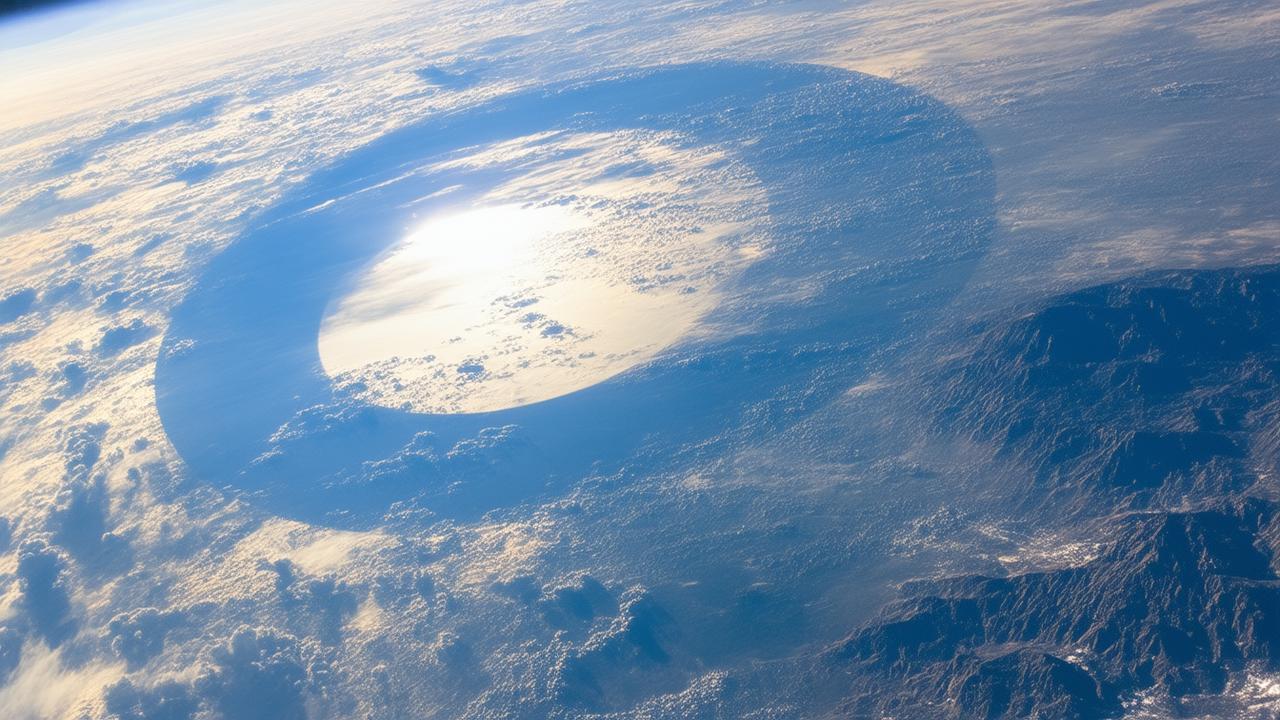
The news arrived first as a whisper: day will turn to night. Not in some distant future, not in a science fiction novel, but on a very real day, under very real skies, when the longest total solar eclipse of the century draws a dark ribbon across our planet. You might be standing in line for coffee, or helping a child with homework, or scrolling through your phone when it happens—when the world’s brightest constant, the Sun, suddenly surrenders to the Moon and midday feels strangely, thrillingly wrong.
The Slow Approach of a Shadow
Long before the sky darkens, the eclipse begins as a feeling. The air changes first, though you might not notice right away. The warmth that usually pools on your skin at midday will thin, like someone has quietly turned down a cosmic dimmer switch. Birds will shuffle uneasily in the trees, their calls sharpening and then softening, as though the soundtrack of the day can’t decide what time it is.
A total solar eclipse is, in simple terms, perfect celestial alignment: Sun, Moon, and Earth falling into a straight line, the Moon sliding in front of the Sun from our point of view and casting its narrow, racing shadow on the Earth below. But no photograph and no scientific diagram quite prepares you for the way it feels. You’re not just watching something happen in the sky; you’re standing inside the event itself, inside the shadow, inside a moving geometry of light and dark that has mesmerized humans for as long as we’ve had eyes to look up.
This particular eclipse has astronomers and skywatchers buzzing for a reason. It’s not just total—it’s long. The track of totality, that slender path where the Moon covers the Sun completely, will grant some locations several astonishing minutes of midday night. In the world of eclipses, those extra seconds and minutes are pure gold. They stretch the experience from a gasp into a long, held breath.
The World Holds Its Breath
On the day of the eclipse, the world will not go dark all at once. It will be a slow turning of a cosmic dial. In the early phases, a tiny nibble appears on the Sun’s edge—just a bite taken neatly out of its perfect circle. Through safe solar glasses or a pinhole projector, you’ll see the Sun begin to resemble a luminous cookie with a missing piece. It’s subtle, almost playful at first.
The change in light creeps in quietly. Shadows sharpen, becoming unnervingly crisp. Colors wash out, as if someone has drained the saturation from the day. The temperature slips down a few degrees, and the wind shifts, taking on a strange coolness not typical of the hour. People step outside offices, cafés, schools. Conversations start in fragments: “Is it happening yet?” “Look at the light on the pavement.” “It feels weird, doesn’t it?”
As the Moon covers more and more of the Sun, the world enters a soft twilight that makes your inner clock stumble. Streetlights may flicker on. Flowers that open by day begin to close, while some that wait for dusk start to unfurl. The sky deepens into a blue you don’t usually see in daylight—richer, more solemn. This is the prelude, the universe clearing its throat before speaking in total darkness.
Inside the Shadow: Totality
Then it happens quickly, faster than your emotions can process. The last sliver of Sun thins to a trembling arc, sprouting brilliant beads of light along the Moon’s rugged edge—“Baily’s beads”—as sunlight streams through lunar valleys. A final, diamond-bright flare—“the diamond ring”—winks out. And just like that, day loses its grip.
Totality begins.
The Sun, the ceaseless ruler of the sky, vanishes. In its place hangs a black disc, so dark it seems to cut a hole right through reality. Around it spills the solar corona, the Sun’s ethereal outer atmosphere: white, feathery, and ghostlike, flowing in delicate streamers and plumes. It looks impossibly soft, like the glow of breath in cold air, stretched across space.
The horizon all around you burns with a 360-degree sunset glow—orange, pink, violet—while above you the sky turns deep indigo. Bright stars and planets pop into view, as if night has been fast-forwarded. Venus might blaze to one side, Jupiter to another, glittering companions suddenly made bold by the Sun’s retreat.
For several long, surreal minutes, the world feels suspended. People shout, or cry, or fall quiet. Some laugh out of sheer disbelief. The animals grow confused—crickets begin their evening chorus, nocturnal insects stir, birds head to roost. You can look at the eclipsed Sun now with your naked eyes, safely, and it is hard to look away. The corona pulses with intricate detail, shaping itself around the hidden Sun and the unseen dance of its magnetic fields. For once, humans, scattered along a narrow path on a turning planet, are united in collective astonishment.
Where the Shadow Will Fall
The path of totality for this eclipse will be a narrow swath, only about a couple of hundred kilometers wide, arcing across parts of the globe like a dark brushstroke. On either side of this path, from thousands of kilometers away, millions more will see a partial eclipse: the Moon taking a bite from the Sun but never swallowing it whole.
Depending on your location, totality may last from just under two minutes to over six precious minutes—an eternity, in eclipse terms. Outside that path, the Sun will remain partly visible, and while the event is still beautiful and strange, it lacks the full, heart-stopping plunge into darkness. The difference between 99% and 100% coverage is not 1%. It is everything.
| Eclipse Experience | What You See | Approximate Duration |
|---|---|---|
| Totality (Path of Total Eclipse) | Complete coverage of the Sun, visible corona, sudden darkness, stars and planets. | Up to several minutes of totality, with hours including partial phases. |
| Deep Partial Eclipse (Near Path) | Most of the Sun covered; dramatic dimming, unusual shadows, but no full darkness. | 1–3 hours of changing coverage, no true night effect. |
| Moderate Partial Eclipse | Noticeable “bite” out of the Sun; light feels odd but day remains bright. | 1–2 hours, with the maximum phase lasting only minutes. |
How to Watch Without Looking Away From Safety
There is a paradox at the heart of every solar eclipse: the more astonishing it becomes, the more tempted you are to stare directly at it, and the more careful you must be. Except during the brief phase of totality—when the Sun is completely covered—it is not safe to look at the Sun without proper protection.
That means certified eclipse glasses or handheld solar viewers with filters that meet international safety standards. Ordinary sunglasses, even very dark ones, are not enough. Through safe filters, the Sun will appear as a calm, orange or white disc against a dark sky, allowing you to trace the Moon’s slow advance without harming your eyes.
If you don’t have solar glasses, the eclipse is still yours to witness. A simple pinhole projector—just a small hole in a piece of cardboard, projecting the Sun’s image onto another surface—turns the event into a private, tiny cinema of light. Strangely, even the spaces between leaves become pinhole cameras; during the deeper phases of the eclipse, the ground beneath trees can fill with hundreds of crescent-shaped Suns dancing on the pavement.
When totality finally arrives (if you are lucky enough to be on its path), that is the one moment you can safely remove your eclipse glasses and look with naked eyes. The instant the smallest bead of sunlight reappears, though, you must turn away or shield your eyes again. The Sun, even mostly hidden, is still fierce enough to scar your vision.
The Human Story Written in Shadow
We are far from the first people to stand in wonder under an eclipsed Sun. Ancient communities watched day turn to night and layered the sky with stories: hungry dragons devouring the Sun, gods in conflict, omens of change and upheaval. For many, the eclipse was frightening, destabilizing—a sign that the firm rules of day and night could be broken.
Today, we understand the physics with exquisite precision. We can tell you exactly when the shadow will touch the ocean, cross mountains, graze cities, and fade back into open sky. We can time totality to the second. Yet for all our charts and equations, something older and wilder still stirs when the shadow comes.
During these rare minutes, the boundary between science and emotion softens. Astronomers set up telescopes to study the corona, chasing faint details that can’t be seen any other time. Photographers plan exposures and angles fastidiously, knowing the moment will be over almost as soon as it begins. Families spread blankets on hillsides, sharing eclipse glasses and snacks, children asking questions that span from orbital mechanics to myth.
The eclipse collapses distance. Along the path of totality, in countries and cultures scattered across continents, people raise their heads in the same direction, at the same moment, for the same reason. The shared gasp that rises as the Sun goes dark is a quiet kind of global chorus.
➡️ The streak-free window-cleaning method that still works flawlessly even in freezing temperatures
➡️ The quick and effective method to restore your TV screen to like-new condition
➡️ Thousands of passengers stranded in USA as Delta, American, JetBlue, Spirit and others cancel 470 and delay 4,946 flights, disrupting Atlanta, Chicago, New York, Los Angeles, Dallas, Miami, Orlando, Boston, Detroit, Fort Lauderdale and more
➡️ The sleep pattern that predicts alzheimer’s risk 15 years before symptoms
➡️ These zodiac signs are destined for major prosperity in 2026, according to astrological forecasts
➡️ The RSPCA urges anyone with robins in their garden to put out this simple kitchen staple to help birds cope right now
➡️ The RSPCA urges anyone with robins in their garden to put out this simple kitchen staple today
Preparing for a Once-in-a-Century Shadow
Because this is the longest total solar eclipse of the century, it’s worth treating the day almost like a pilgrimage, even if you only have to travel to your neighbor’s backyard. Think of what you’ll need not just to witness it, but to truly remember it.
- Certified eclipse glasses or a safe solar viewer for every person.
- A simple pinhole projector or colander (for watching the crescents on the ground).
- A comfortable place to sit or lie down—blanket, chair, or patch of grass.
- A light layer of clothing for the temperature drop during totality.
- A camera or phone if you wish, though some choose to leave them aside and just look.
Most importantly, bring time. The magic of an eclipse isn’t only in those central minutes of darkness; it’s in watching the slow arc of the Moon’s journey, the subtle changes before and after, the way the world responds. Arrive early, settle in, and watch the day carefully even before anything seems to be happening. Pay attention to how birds behave, how insects sound, how your own body feels as the light shifts.
Years from now, you may not recall every scientific detail, but you will remember the hush, the odd chill, the color of the sky when the Sun’s steady blaze gave way to a pale, otherworldly crown. You’ll remember standing within the shadow of the Moon, realizing that the ordinary clockwork of your days is part of an immense, graceful machinery that rarely reveals itself so boldly.
When Day Learns the Language of Night
When the Sun finally reemerges—first as that blinding diamond ring, then as a growing crescent, then as a full disc once more—the world feels like it’s been gently returned to you. Birds resume their confident daytime songs. The colors return to the trees and buildings. Conversations slowly shift back to work, school, errands. But something has been rearranged, even if just slightly, inside the people who watched.
For a few minutes, you will have lived in a world where noon behaves like midnight, where stars blaze in the middle of the day, and where our planet’s dance with its small companion writes a moving band of darkness across continents. You will have felt the thinness of the line between day and night, between the familiar and the uncanny.
The longest total solar eclipse of the century will sweep across parts of the globe and then be gone, its shadow racing off into the distance, leaving no trace on the ground. But in human memory—in stories told over dinners, in photos passed from phone to phone, in the quiet certainty that you once watched the Sun disappear—its mark will endure.
When day turns to night, it is not the end of anything. It is a rare reminder that we live in a universe still capable of surprising us, even with motions that are as old as time itself. All you have to do is look up, safely, and let the darkness speak.
Frequently Asked Questions
Is it safe to look at a total solar eclipse?
It is only safe to look at the Sun with the naked eye during the brief period of totality, when the Sun is completely covered by the Moon. Before and after totality, and during any partial eclipse, you must use proper eclipse glasses or certified solar filters. Never look directly at the uneclipsed or partially eclipsed Sun without protection.
Do I need special equipment to enjoy the eclipse?
You don’t need a telescope or camera to appreciate the eclipse. The most important item is a pair of certified eclipse glasses or a handheld solar viewer. Simple tools like a pinhole projector or a colander can help you safely view the changing shape of the Sun’s image on the ground.
What makes this eclipse the longest of the century?
“Longest” refers to the maximum duration of totality at a specific point along the eclipse path. This depends on the precise distances between the Earth, Moon, and Sun, and the geometry of their alignment. In this case, conditions align so that the Moon’s shadow lingers slightly longer over parts of the Earth than in any other total eclipse this century.
What will I see if I’m not on the path of totality?
If you’re outside the path of totality, you’ll see a partial solar eclipse. The Moon will cover only part of the Sun, creating a noticeable “bite” or crescent shape. The sky may dim subtly, but you won’t experience full darkness or see the Sun’s corona. You must keep eye protection on at all times while viewing.
How often do total solar eclipses happen?
Total solar eclipses occur somewhere on Earth roughly every 18 months, but any given location on the planet experiences totality much less frequently—on average, only once every few hundred years. That rarity is part of what makes standing in the path of the Moon’s shadow feel so extraordinary.





