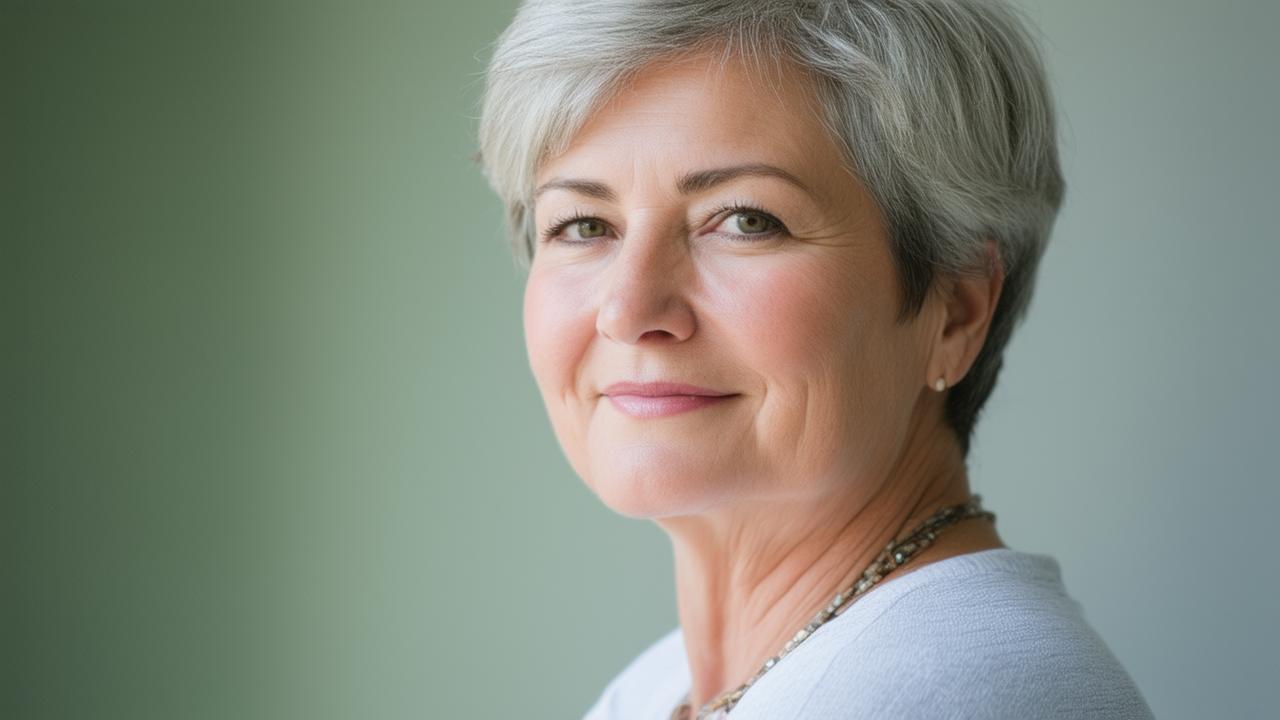
The scissors paused half an inch from Helen’s jawline. The salon was hushed except for the slow hum of hairdryers and the faint hiss of a kettle somewhere in the back room. Outside, late afternoon light slanted through steamed-up windows, catching the scatter of silver strands that framed her face. “Be honest with me,” she said, staring at herself in the mirror. “Will cutting it short make me look… old?”
The Question Every Stylist Hears but No One Wants to Ask
Her hairdresser, Ana, had heard this question so many times she could almost lip-read it before the words landed. Women over 50, sitting under the cape with a nervous half-smile, asking for “a fresh look” or “something lighter, more modern,” but really asking the same silent thing: Will this cut betray my age or reclaim it?
The air in the salon smelled faintly of hairspray, coffee, and that metallic tang of wet hair. On the radio, someone murmured about the weather—another rainy week ahead. Life, as usual. But at that mirror, everything felt heightened, like a scene waiting for a punchline or a confession.
Helen’s fingers fidgeted with the edge of the cape. She had grown her hair long as a kind of armor, a curtain she could still tuck behind her ears like she had at twenty-five. She wasn’t sure who she would be without it. “Everyone keeps telling me women my age should go short,” she added. “It’s supposed to be more flattering, right? More… appropriate.”
Ana rested the comb against Helen’s shoulder and met her eyes in the mirror. And then, in that small, hair-sprayed bubble of truth, she said the thing that many stylists think but rarely say out loud.
“Short hair won’t save you,” she said softly. “And it won’t ruin you either.”
The Hard Truth: Short Hair Is Not a Magic Youth Filter
This is the hard truth many women over 50 don’t want to hear: cutting your hair short will not automatically make you look younger, fresher, slimmer, or more stylish. It will not erase the last three decades of your life—or the last three months of bad sleep. It’s not a visual reset button.
The myth of the “over 50 short cut” has lived in magazines and salon chatter for generations. Somewhere along the way, it became an unwritten rule: once you hit a certain age, the acceptable thing to do is to crop your hair, soften the color, play it safe. Long hair is for the young, short hair for the sensible. That’s the script.
But hair, like age, refuses to follow a tidy rulebook.
Short hair can, in fact, make someone look older—if the cut is harsh, the color flat, or the style fights rather than flows with their features. A too-severe pixie can highlight deep lines and hollow cheeks; a poorly shaped bob can drag the face downward instead of lifting it. Equally, long hair can look dated, heavy, and tired if it’s not cared for—or it can look luminous and powerful.
The real, uncomfortable truth is this: your hair will only look as youthful, vibrant, or “you” as the thought and care you put into choosing a style that actually suits your specific face, texture, lifestyle, and spirit. Not your age bracket. Not the rules. You.
Short Hair Demands More Than You Think
Another truth that often goes unsaid: the shorter you go, the less you can hide. With long hair, you can twist it, pin it, sweep it into a low chignon on tired days, let it fall in soft waves that blur the edges of your jawline. Short hair puts everything on display—neck, ears, jaw, the way your hair naturally grows or sticks up or thins.
That doesn’t mean it’s a bad idea. It means short hair is about intention, not escape. It’s not a shortcut; it’s a commitment.
Many women believe: “I’ll cut it short so I don’t have to do anything with it.” Yet a well-cut short style usually needs more frequent trims, more product, and more styling than a loose shoulder-length cut. Especially when hair starts to change in texture with age—getting finer, coarser, wavier, or more fragile—those half-inch differences matter.
What changes isn’t whether short hair is “allowed,” but how much honesty you’re willing to bring to the mirror. And that, ironically, might be the most liberating part.
Age Is in the Edges, Not the Length
What actually makes hair feel ageless or “old” has much less to do with how long it is, and far more to do with details: the edges, the movement, the color placement, and the way it fits the person wearing it.
A blunt, heavy bob with no layers can look severe on a face where the skin has softened. But that same length, given gentle texture around the cheeks and subtle movement near the collarbone, can create lift and energy. A pixie cut with soft, feathery edges and light around the face can look bright and elegant. A long, layered cut with natural silver highlights can look more modern than any box-dyed, one-tone brown.
It’s not the length that dates you. It’s the stiffness. The flatness. The refusal to evolve.
When you look at women who seem effortlessly stylish in their fifties, sixties, and beyond, notice what stands out. Their hair, whether cropped close or flowing long, rarely looks like it’s clinging to an outdated idea of who they used to be. It looks like it belongs to who they are today.
The Emotional Weight of the Cut
For many women, hair is a story they’ve been writing for decades. The long braid from their twenties, the power blowout from their career peak, the messy bun years of children and exhaustion. At fifty, sixty, seventy, cutting your hair isn’t just about style. It’s a confrontation with time.
Women often arrive in the salon carrying more than split ends. They bring in grief, change, divorce, new love, retirement, illness, or simply the soft ache of realizing their reflection no longer matches the mental image they’ve been quietly holding onto. The suggestion to “go short” can feel, in that tender moment, like an instruction to surrender, to step into some pre-defined “older woman” category.
But what if short hair, instead of being a sign of giving up, could be an act of editing? Not erasing your story, but underlining the parts you like best. What if long hair, instead of being a clinging to the past, could be a bold choice to carry your softness, your drama, your romance forward?
The cut isn’t the point. The alignment is.
The Salon Mirror Doesn’t Lie, But It Can Mislead
Back in the chair, Helen bit her lip as she listened to Ana’s quiet, unvarnished truth. “So, should I cut it or not?” she asked.
Ana didn’t answer right away. Instead, she started asking questions: How much time do you really want to spend styling your hair in the morning? What parts of your face do you love? (It took Helen a minute to answer that one.) Do you wear glasses usually? What kind of clothes make you feel most like yourself?
This is where many women over 50 are let down: the decision gets rushed. A photo pulled from a magazine, a quick “let’s freshen it up,” a vague hope that losing length will somehow also lose years. But if you don’t understand why you’re cutting, the mirror can turn on you very quickly.
The mirror will show you everything—the lines, the softness, the sharpness of bone, the curve of the neck. It’s impartial. But the context you bring to it—that is where you have power.
To make that power easier to see, imagine your options this way:
| Style Direction | Better for You If… | Watch Out For |
|---|---|---|
| Short & Cropped | You like structure, don’t mind styling, and want your face to be the focus. | Too severe lines, flat color, skipping regular trims. |
| Short & Soft | You want ease with gentle texture and a natural, airy feel. | Over-layering fine hair, making it look thin instead of light. |
| Mid-Length (Shoulder-ish) | You want versatility: up, down, waved, or straight, with some softness. | Heavy ends that drag the face down, outdated fringe. |
| Long & Layered | You love movement and don’t mind a bit more maintenance. | Split ends, lack of shape, “curtain” effect that hides your features. |
| Natural Silver/Gray Focus | You’re ready to embrace your color and highlight shine and texture. | Yellowing tones, dullness without gloss or conditioning. |
Notice what’s missing from the table: any rule that says, “If you’re over 50, you must…” You won’t find it, because it doesn’t exist.
➡️ Just six minutes of darkness: get ready for the longest eclipse of the century set to briefly turn day into night
➡️ Hang it by the shower: the clever bathroom hack that eliminates moisture and keeps your space fresh
➡️ If your dog gives you its paw, it’s not to play or say hello : animal experts explain the real reasons
➡️ If you remember these 10 moments from decades ago, your memory is sharper than most in their 70s
➡️ Helping restaurant servers clear your table is not kindness it is a disturbing sign of your real personality
➡️ Eclipse of the century: six full minutes of darkness when it will happen and the best places to watch the event
➡️ Just half a glass is enough: smart tricks to make old toilet bowls and sanitary ware look like new again
What Stylists Wish More Women Over 50 Knew
When hairdressers speak honestly among themselves, between mixing bowls and appointment books, certain themes keep surfacing. If they could sit every woman over 50 down with a cup of tea and offer a few truths without fear of offending, it might sound like this:
1. Your Hair Has Changed—So Must the Strategy
Hormones, health, stress, and time all alter your hair’s behavior. What worked at 35 might fall flat at 55. That doesn’t mean you’ve “lost” your good hair; it means your hair is asking you to adapt. Shorter layers, better products, different tools, or embracing your natural texture can make more difference than simply chopping it all off.
2. Light and Movement Beat Length Every Time
Whether your hair dusts your ears or brushes your ribs, the most rejuvenating element is lightness—soft edges, subtle layers, and dimension in color. A stiff helmet of short hair can age you more than a softly layered longer cut. The goal is to create the impression of lift and air, not to hit an arbitrary number on the ruler.
3. Color Can Age You Faster Than the Cut
A single, flat blanket of dark dye clinging to the same shade you wore twenty years ago often looks harsher than any wrinkle. Gentle variations, softer tones around the face, or artfully blended natural silver can bring more freshness than losing three inches of length ever could.
4. Confidence Is Visible
Hair that matches the rest of you—your clothes, your posture, your life—always reads as more “youthful” than hair that feels like a costume. A woman with a sharp crop who strides into a room like she chose it on purpose will outshine someone hiding behind hair that no longer feels like her own, no matter the age gap.
5. You’re Allowed to Want to Look Beautiful, Not Just “Age Appropriate”
The phrase “age appropriate” has quietly bullied countless women into haircuts they never really wanted. You are allowed to ask for beauty, sensuality, drama, softness, or edge, at 50, 60, 70 and beyond. The right stylist will help you translate that into shape and texture—not shame you into compliance.
Back in the Chair: Choosing Truth Over Rules
In the end, Helen didn’t go for the dramatic crop she thought she “should” get. After talking it through, she and Ana carved out a different route: they lifted the length to just above her shoulders, softened the layers around her jawline, and lightened the color near her face to pick up the sparkle in her eyes. Some of her silver was left alone, woven quietly into the result.
When the hairdryer went off and the mirror came into full, quiet focus, she didn’t look younger exactly. She looked more present. Like herself, but clearer.
“You know,” she said slowly, turning her head from side to side, watching the way the hair moved, “I thought I needed to chop it all off to prove I wasn’t clinging to the past.”
Ana smiled. “You don’t need a short cut to prove you’ve grown up. You just need a cut that doesn’t pretend you’re someone else.”
That is the hard truth about short hair for women over 50: it’s not a rule to obey or a cure to chase. It is one option in a wide, beautiful spectrum. The real work isn’t deciding how much to cut; it’s deciding how much of yourself you’re willing to honor.
FAQ: Short Hair and Women Over 50
Does short hair really make women over 50 look younger?
Not automatically. Some short cuts can lift and brighten the face; others can look severe and aging. The effect depends on the shape, texture, color, and how well the style suits your features and lifestyle—not simply the length.
Is there an age when women “should” cut their hair short?
No. There is no universal age rule. The right time to go shorter is when it aligns with your preferences, hair texture changes, maintenance needs, or a shift in how you want to express yourself—not a birthday.
Can long hair still look good after 50?
Absolutely. Long hair can look elegant and modern at any age if it’s healthy, shaped well, and suited to your features. Regular trims, thoughtful layering, and appropriate products are key.
Is short hair really lower maintenance?
Sometimes, but not always. Short styles often need more frequent trims and regular styling to look intentional. A slightly longer, well-shaped cut can actually be easier for some women to manage day-to-day.
How do I know if short hair will suit me?
Consider your face shape, hair texture, neck and jawline, and how much styling you’re willing to do. Bring photos to a stylist you trust, but stay open to adjustments based on your specific features rather than copying a look exactly.
What if I regret cutting my hair short?
Hair grows, and most short cuts can be softened or reshaped during the grow-out phase. If you’re unsure, start with a mid-length style and work gradually shorter over a few appointments instead of making an extreme change all at once.
Should I embrace my gray before going short?
Not necessarily, but planning color and cut together gives the best result. Some women find that a shorter cut makes the transition to gray or silver more stylish and deliberate; others prefer to keep some color dimension. Your comfort and taste should guide that choice.





