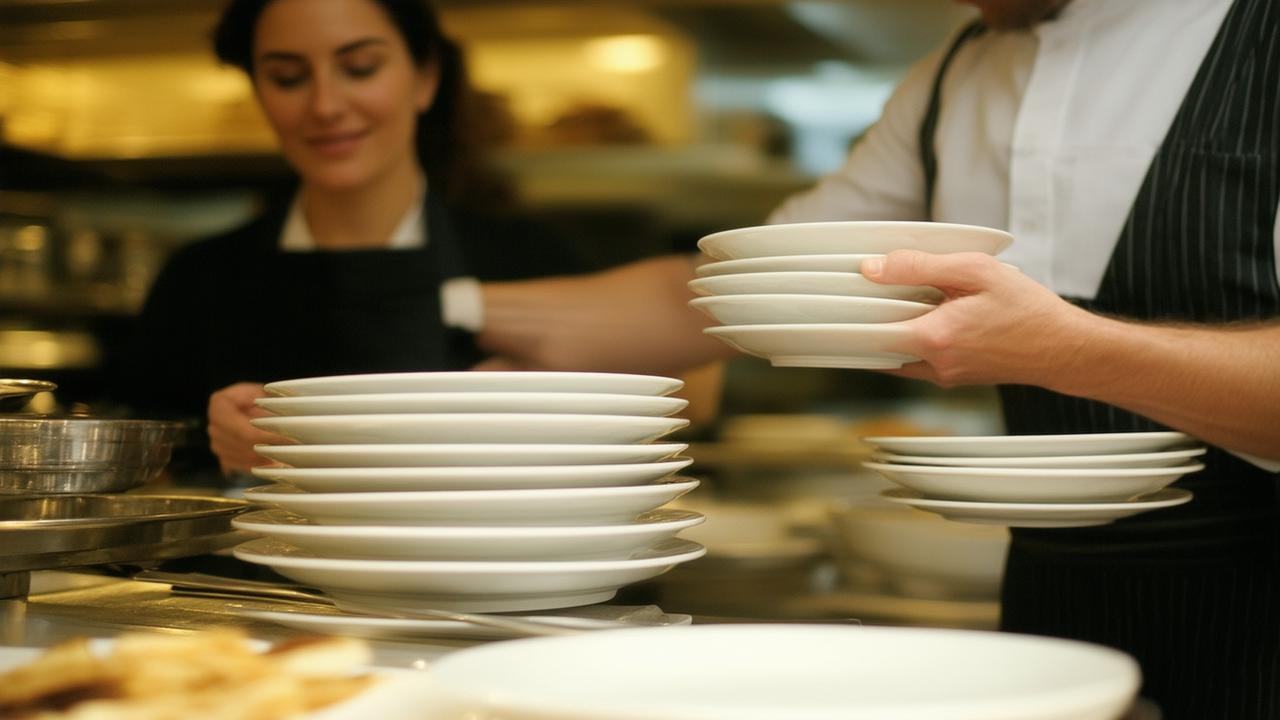
The plate is still warm when your hand reaches for it. You’re not even thinking—just stacking dishes, gathering cutlery, corralling crumpled napkins into a neat little graveyard at the edge of the table. The server appears at your elbow with a practiced smile, that tiny flash of tension in their eyes quickly shuttered. “Oh, you don’t have to do that,” they say. You offer a breezy, “Just helping!” and feel a small glow of virtue. It feels like kindness, like being the good one in a sea of rude customers. But the server’s smile doesn’t quite reach their eyes. Something about the moment hangs in the air, fragile and off-key, as if you’ve stepped somewhere you don’t quite belong.
The Quiet Theater of Eating Out
Walk into any restaurant and your senses are immediately recruited: the soft clatter of dishes, the sizzle from the kitchen, the dense braided smells of garlic, butter, charred meat, citrus and wine. You slide into a chair, feel the texture of the table under your fingertips—wood grain, cool stone, or the faint tackiness of laminated veneer washed a hundred times. A glass of water appears. A menu is placed just so. A pen hovers over a small pad like a conductor’s baton waiting for the downbeat.
Eating out isn’t just about food; it’s a quiet piece of theater. The server is center stage and backstage crew at once: they read the room, track orders, dodge trays, remember who wanted dressing on the side and who’s allergic to nuts. Their role is choreographed: approach, retreat, refill, remove. The whole experience works because everyone sticks to their parts.
But culturally, we’ve started to blur those lines. We call it “helping” when we stack our plates, push everything to the side, or hand things directly to the server as they approach. It’s easy to believe you’re making their life easier. Yet, if you pause and watch their body language—the slight hesitation, the way their hands adjust mid‑reach, the microsecond of recalculation—you can see something else. You’ve changed the script on them without asking.
And that shift, that small act that you label as kindness, often says more about your need to feel helpful and in control than it does about any real desire to respect their work.
“Just Trying to Help”: When Politeness Crosses a Line
You’ve probably heard someone say it: “I always stack my plates. I’m helping the server.” It rolls off the tongue with the easy moral certainty of a person who’s sure they’re on the right side of decency. The narrative is clean and flattering: you see yourself as aware, considerate, not like those customers who leave chaos in their wake.
But step behind the scenes for a moment. Servers are trained—explicitly or through hard experience—how to clear a table efficiently and safely. Where you see a messy but manageable battlefield, they see a carefully sequenced puzzle: which plate can be balanced on which, how the weight will shift, which fork is slick with sauce that might slide, which glass is close enough to be knocked. They know the angles and timing that keep the whole stack from tumbling to the floor.
Now imagine inserting your own improvisation into that routine: forks jammed under plates, slippery knives stacked together, glasses exiled to a precarious corner, sauces pooled under the bottom dish. You’ve “helped” them into a more complicated and riskier job. They can’t tell at a glance what’s sticky, what’s heavy, or what’s hiding under that little tower of good intentions.
This isn’t just theoretical. Many servers will quietly agree—often in break rooms and group chats—that guests stacking dishes is more hindrance than help. They’ll also tell you they feel pressured to accept it as kindness because correcting you might risk their tip or trigger defensiveness. The imbalance of power in that moment is real. Your need to feel like a good person sits on top of their need to keep their job and pay their rent.
Control, Image, and the “Good Customer” Costume
There’s a strange intimacy in being served. Someone brings you food, refills your drink, tidies your space while you talk, scroll, laugh, or sulk. For some people, that dynamic is quietly uncomfortable. It pokes at the edges of privilege, class, and entitlement. Helping clear the table becomes a way to signal, “I’m not that kind of person. I’m not above you.”
But the need to demonstrate that you’re not “that kind of person” is itself revealing. Instead of simply respecting the boundaries of the role—letting professionals do the job they know how to do—you insert yourself into their work to manage your own discomfort.
There’s another layer too: control. Some personalities simply can’t tolerate sitting in a space and not managing it. The stray napkin bothers them. The unfinished plate feels like an unresolved task. So they move, rearrange, stack. It looks like tidiness; beneath it, there may be anxiety or a deep-seated belief that if they’re not controlling the situation, they’re somehow failing.
And underneath the surface of “I’m helping” can lurk quieter beliefs:
- that you know better than the worker how to do their job,
- that your preferences about neatness should override their workflow,
- that your visible helpfulness proves your character to anyone watching.
In this way, the act becomes a performance of humility rather than the real thing. Real humility would sound more like: “They probably understand their job better than I do. I’ll trust their process.”
The Unseen Risks: Safety, Systems, and Spills
Restaurants function on thin margins and thinner walkways. Servers weave through narrow passages balancing more weight than you’d comfortably carry with two hands. They move as if the floor were mapped in their head: where the uneven tile is, which corner hides a rogue chair leg, where the kitchen door bursts open without warning. What looks simple from your chair is a constant dance with gravity and momentum.
When you stack dishes or hand them mid‑stride, you tamper with the physics of their job. A precarious tower of plates you’ve arranged might shift unexpectedly when they lift it. A fork hidden under a napkin might slide and send sauce flying onto their shirt or, worse, onto another guest. A glass you’re holding out could bump their overloaded tray, causing a domino of disaster.
Consider how their work actually plays out in motion:
| What You Think Helps | What the Server Experiences |
|---|---|
| Stacking plates and bowls into a tower | Unstable, unknown weight distribution that can tip or slide when lifted |
| Hiding cutlery under plates or napkins | Hidden sharp edges and slippery, sauce‑coated utensils that can fall or cause spills |
| Handing dishes directly to the server | Unexpected movement disrupting their balance and tray stacking technique |
| Pushing everything to one crowded corner | Awkward angles that force twisting, reaching, and higher risk of drops or strain |
| Placing glasses right at the table’s edge | Easily knocked over by a sleeve, tray, or passing guest |
Many servers also follow specific clearing systems: some remove from the right, others from the left; some always take glassware last, others first, depending on how crowded the table is and what they’re carrying. When you pre‑clear the table, you’re essentially scrambling their mental map.
The irony is sharp: the more you try to “help,” the less safe and efficient their work can become.
Respect Over Performance: What Real Kindness Looks Like
So if picking up plates and tidying like a volunteer busser isn’t kindness, what is? Kindness in restaurants is surprisingly simple and wonderfully quiet. It doesn’t require a performance or visible effort. It looks like:
- Making eye contact and saying “thank you” like you mean it.
- Speaking to servers as professionals, not personal assistants.
- Being patient when the dining room is clearly overwhelmed.
- Not interrupting them when they’re balancing a heavy tray.
- Tipping fairly, especially when you can tell the shift is hard.
It also looks like trusting that they know what they’re doing. If a server says, “You don’t have to do that,” take them at their word. Smiling, easing back into your chair, and letting them handle the plates can be kinder than insisting on your help. It’s an act of faith in their expertise.
Real kindness respects boundaries. It doesn’t need to be seen, praised, or turned into a personal anecdote about how considerate you are. It focuses not on how you appear but on what actually makes someone else’s day easier.
The Uncomfortable Mirror: What Your “Help” Reveals
This is where things get uncomfortable. Because when you insist on helping clear the table—even when asked not to—you’re sending a message, whether you mean to or not: “My way of doing this matters more than yours.” That’s not kindness; it’s a small act of dominance dressed up in good manners.
➡️ Lidl is set to launch a Martin Lewis–approved gadget next week, arriving just in time to help households get through winter
➡️ Inheritance law shake-up confirmed: a new reform arriving in February will significantly change the rules for heirs
➡️ Just six minutes of darkness: get ready for the longest eclipse of the century set to briefly turn day into night
➡️ Hang it by the shower: the clever bathroom hack that eliminates moisture and keeps your space fresh
➡️ If your dog gives you its paw, it’s not to play or say hello : animal experts explain the real reasons
➡️ Hairdresser reveals hard truth about short hair for women over 50 that many won’t want to hear
➡️ If you remember these 10 moments from decades ago, your memory is sharper than most in their 70s
Behavior like this can hint at deeper patterns:
- A habit of ignoring professional boundaries when you think you “know better.”
- A need to control situations, even those that aren’t yours to control.
- A tendency to center your feelings—your need to be helpful, to be seen as good—over the actual needs of others.
Most people don’t like to see themselves this way. It’s far more comfortable to believe you’re just thoughtful, tidy, conscientious. But growth often starts at the edge of discomfort. If a tiny, everyday habit—like grabbing plates at a restaurant—can reveal so much about how you move through the world, maybe it’s worth examining.
Ask yourself: if I wasn’t allowed to perform helpfulness physically, how else could I show respect? Could I be okay with simply being a guest, with letting others do their jobs without interference? Can I handle the mild discomfort of being served without needing to demonstrate that I’m a “good” person?
There’s a quiet power in recognizing that not every space needs your intervention. Some spaces ask instead for your trust, your patience, your presence.
Learning to Sit Still and Let People Work
The next time you’re at a restaurant and your plate is empty, notice what happens in your body. Do your hands itch to gather the dishes? Does the sight of a messy table feel like an accusation? Are you reaching for the plate before you even notice what you’re doing?
Try something different. Place your fork down. Rest your hands in your lap or around your glass. Look around the room: the hum of conversation, the glow of phones, the arc of a server’s path as they carry five plates effortlessly. When they approach, let them decide what goes where, which dish to pick up first, how to carry it.
If they pause and say, “I’ll take care of that,” believe them. A simple, “Thank you, we really appreciate it,” does more good than a dozen stacked plates.
Helping isn’t wrong. But helping without listening—helping without awareness of power, training, and context—isn’t really help. It’s self‑soothing. It’s image management. It’s a way of writing yourself as the hero of a story that was never about you in the first place.
The world doesn’t need more people who perform kindness at every turn. It needs more people who can sit with their own discomfort, respect professional boundaries, and trust that sometimes the kindest thing you can do is nothing at all.
Frequently Asked Questions
Is it ever okay to stack plates at a restaurant?
It can be okay if the server clearly invites you to, or if you ask, “Does it help if I stack these?” and they say yes. The key is letting them lead. Don’t assume your version of help is actually helpful.
What can I do instead of stacking dishes to be considerate?
Basic courtesies go a long way: keep your belongings off the walkway, avoid placing bags where servers need to stand, respond when they check in, and be ready to let them access the table easily when they approach.
Is pushing my plate to the edge of the table helpful?
Often it isn’t. Plates balanced on the edge are easier to knock over and can disrupt how the server plans to clear. It’s usually better to leave your plate where it was placed and let them reach for it.
Do servers actually dislike when customers help?
Many do, especially when that “help” complicates their workflow or creates safety risks. Some won’t say anything because they depend on tips and want to avoid conflict. Listening when they say, “I’ve got it,” is an important way to respect them.
How can I teach my kids to be respectful in restaurants?
Model calm, patient behavior. Encourage them to use “please” and “thank you,” keep their space reasonably tidy without rearranging dishes, and explain that the servers are professionals whose job is to handle the food and dishes. Show them that respect doesn’t always look like helping—it often looks like listening.





