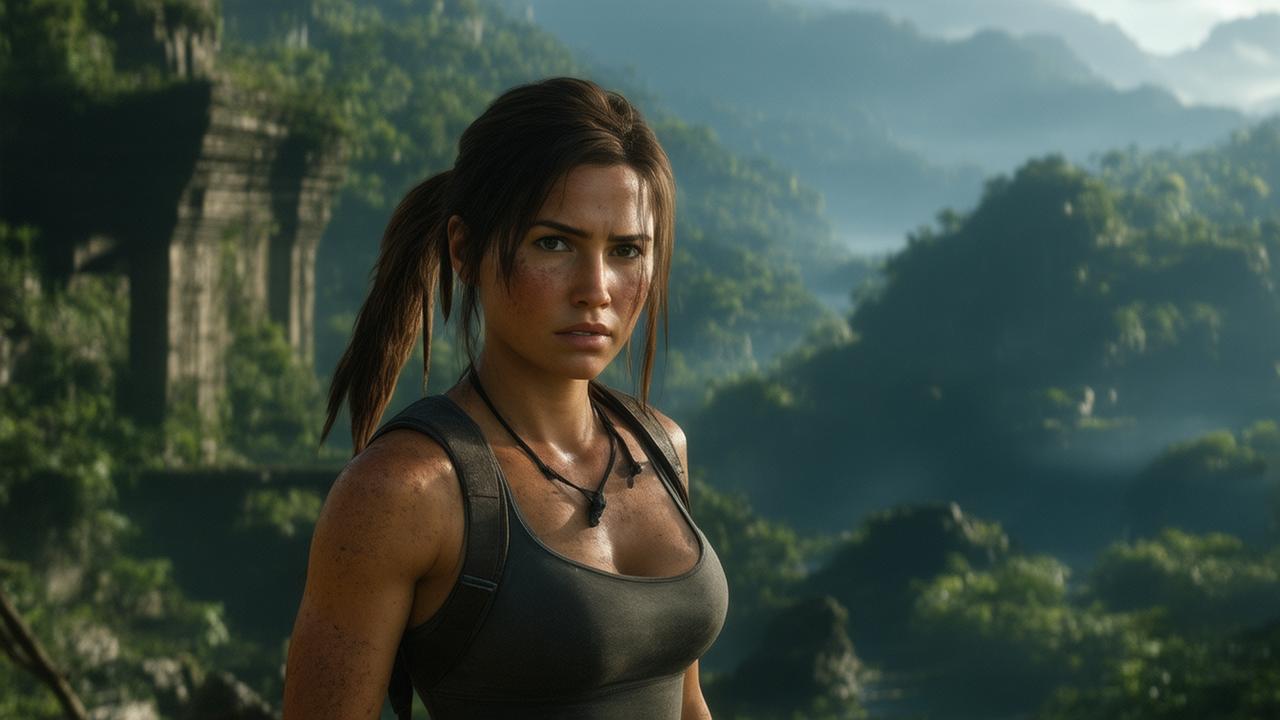
The first thing you notice isn’t her pistols. It isn’t even the ruins, or the way the jungle folds itself around the crumbling stones like a secret. It’s her eyes. They’re older now—more observant, less reckless, carrying the kind of focus that only comes from having survived too many close calls and too many collapsing tombs. Lara Croft is back, not in one, but in two new Tomb Raider games on the horizon. And while the familiar heartbeat of adventure still pulses underneath, something fundamental has shifted. This isn’t just about raiding tombs anymore; it’s about raiding the past, the present, and the myth of Lara herself.
The Return of a Legend, Heard Before It’s Seen
Close your eyes and imagine that sound: the soft crunch of boots on gravel, the metallic click of a harness buckle, the distant drip of water inside a cavern that hasn’t seen sunlight in centuries. Tomb Raider has always been an audio-visual ritual as much as an action game—torches flaring, stone doors grinding open, that small intake of breath right before a leap.
In these upcoming entries—one a continuation teased as the next big “unified” adventure, the other a portable experience reimagining classic designs—you can almost feel the series taking a deep breath. The tech is more advanced, the visuals sharper and richer, but under all that polish is a quieter transformation. Lara is no longer just an acrobatic silhouette framed against lost cities. She has become a bridge between eras: classic and modern, cartoonishly invincible and believably vulnerable, power fantasy and introspective journey.
That may sound lofty for a franchise once known mostly for dual pistols and impossible somersaults. But walk with her a little way into these new games—into shadowy corridors and sun-scorched plateaus—and you’ll notice the difference in how she moves, how she talks, how the game invites you to inhabit her world.
The Major Shift: Lara Isn’t Just Being Rebooted—She’s Being Reconciled
For years, Tomb Raider has lived in two parallel timelines. There was the original Lara of the late ’90s and early 2000s: angular, confident, wry, almost superhuman in her poise. Then came the reboot trilogy: a younger Lara, softer around the edges, pushed to her limits, covered in mud and fear and guilt as much as in glory. Two different heroes wearing the same name and climbing roughly the same cliffs.
What’s changing now is that the new games are not trying to erase one version in favor of the other. They are, instead, trying to thread them together. The major shift is this: Lara isn’t being reinvented to fit a new mold; she’s being allowed to grow into a complete person who remembers where she came from.
In narrative teases and design hints, you can sense an older Lara, one who has already survived the origin stories and is now standing somewhere between legend and human being. She’s not a rookie scrambling for survival in every scene, but she’s not the untouchable action figure from the early polygon days, either. Her confidence feels earned rather than assumed. Her vulnerability isn’t the entire point, but it’s never fully hidden from view.
Lara’s New Center of Gravity
The biggest transformation isn’t in the weapons she carries or the puzzles she solves—it’s in perspective. The games are slowly shifting away from the question, “How far can we push her?” to “Who has she become because of what she’s endured?” Adventure remains the canvas, but identity is now the ink.
That deepens everything: how she notices ancient carvings not just as “clues” but as pieces of other people’s lives; how she reacts when an excavation feels more like desecration; how she treats the spaces she moves through, not as playgrounds, but as contested territories with histories of their own.
Two Games, Two Mirrors: Classic Echoes and Modern Weight
Look closely and you’ll see that the decision to bring Lara back in two different games at once is not just a marketing push—it’s a statement. One title leans into the expansive, cinematic, big-budget experience, the kind of adventure you sink into for dozens of hours, chasing weather systems across jungle canopies and listening to ancient structures groan under your weight. The other nods more directly to the Lara that many players grew up with: tighter levels, snappier traversal, a distilled dose of platforming, puzzle-solving, and exploration.
It’s as if Lara is standing between two mirrors: in one reflection, you see the angular PS1 icon leaping across impossible gaps; in the other, the mud-streaked survivor carefully weighing each decision. The new games seem determined to let those reflections face each other instead of keeping them separated by years and generational divides.
For players, that means something unusual: your nostalgia and your present-day expectations can finally sit at the same campfire. You can crave the blocky precision of classic tomb puzzles and the nuanced performances of a more emotionally layered Lara—and the franchise is, at last, saying, “Yes, you can have both.”
Sensory Storytelling Across Platforms
Even in the more streamlined experience, you can expect rich sensory detail: dust motes swirling in the beam of Lara’s flashlight, the echo of her footsteps in a flooded chamber, the thick, humid stillness of underground jungles. The larger-scale game will likely indulge in wide-angle panoramas, letting you stand at the lip of a valley and feel—almost in your gut—the distance between one crumbling spire and the next.
What links these two is not just the name on the box, but the feeling they chase: that electric tingle of stepping somewhere you were never meant to stand, guided by a character who has never quite belonged to any one era.
From Looting to Listening: Tombs as Living Places
Here’s where the new direction becomes clearest. Tomb Raider used to be about taking things: artifacts, treasures, secrets. The tombs were majestic backdrops to Lara’s acrobatics—beautiful, yes, but mostly inert. Over the past decade, they’ve slowly become more alive: home to cultures, ecosystems, and stories that challenge Lara’s presence.
In the upcoming games, that evolution seems ready to complete a full arc. The ruins are no longer just obstacles; they’re characters in their own right. You can almost feel the air shift as Lara enters a chamber heavy with history, the sound dampening under stone arches, her flashlight catching the faint shimmer of centuries-old pigment in the carvings.
As players, we’re being quietly encouraged to move from looting to listening. To consider not just what an artifact can do for our upgrade tree, but what it meant to the people who made it. Lara is being recast as an explorer who wrestles with the ethics of her own actions—still driven by curiosity, still drawn to danger, but more critically aware of the footprints she leaves behind.
New Stakes, Beyond Survival
Earlier games in the reboot trilogy leaned heavily on survival as a theme: cold nights, makeshift shelters, the brutal scramble just to stay alive. The new adventures, while still dangerous, are shifting the stakes. It’s less, “Will Lara survive this?” and more, “What does survival cost—and to whom?”
That subtle change infuses every decision: Do you trigger that mechanism, knowing it might permanently alter the site? Do you accept that some mysteries might be better left unsolved? Tomb Raider is slowly morphing from a story about conquering the unknown into a story about coexisting with it.
How Players Fit into This New Era
For longtime fans, this next chapter is an invitation. Not just to return, but to participate in the reconciliation of Lara’s many selves. If you’ve held onto memories of those crisp, grid-based jumps in the early games, you’ll find echoes of that design discipline. If you were drawn in by the emotional turbulence and cinematic storytelling of the reboots, you’ll recognize the same heartbeat—just steadier now, less panicked, more reflective.
New players will meet a Lara who arrives with history already etched into her. They won’t need to choose between “classic” and “reboot” versions; they’ll encounter someone who carries both inside her. She might crack a dry joke as she dusts off an ancient relief, then fall into a quiet pause, realizing she’s the first person in a thousand years to see it. Those are the moments that define this new era: not just the explosions, but the silences between them.
Lara’s Evolving Relationship With You
There’s an unspoken bond between player and protagonist in long-running series. With Lara, that bond is especially personal. Many players grew up alongside her—through the awkward polygons, the wild spin-offs, the gritty reinventions. These new games seem aware of that shared history. When she glances over a ledge or mutters a half-amused, half-exasperated line at yet another crumbling bridge, it feels like she’s in on the long-running joke: “We’ve been here before, haven’t we?”
➡️ The streak-free window-cleaning method that still works flawlessly even in freezing temperatures
➡️ The quick and effective method to restore your TV screen to like-new condition
➡️ Thousands of passengers stranded in USA as Delta, American, JetBlue, Spirit and others cancel 470 and delay 4,946 flights, disrupting Atlanta, Chicago, New York, Los Angeles, Dallas, Miami, Orlando, Boston, Detroit, Fort Lauderdale and more
➡️ The sleep pattern that predicts alzheimer’s risk 15 years before symptoms
➡️ These zodiac signs are destined for major prosperity in 2026, according to astrological forecasts
➡️ The RSPCA urges anyone with robins in their garden to put out this simple kitchen staple to help birds cope right now
➡️ The RSPCA urges anyone with robins in their garden to put out this simple kitchen staple today
That awareness makes every leap feel different. You’re not just guiding an avatar; you’re traveling with an old acquaintance who has seen as many console generations as you have. She’s no longer a blank slate onto which we project power fantasies; she’s a character whose scars, skills, and regrets we’ve helped shape across decades.
A Look at What’s Changing—and What’s Not
To get a sense of how this new phase reframes the familiar, it helps to see the contrast laid out clearly. Think of it as a snapshot of Lara’s journey—from icon to human, from isolated adventurer to a figure in dialogue with her own legacy.
| Aspect | Earlier Tomb Raider | New Direction |
|---|---|---|
| Lara’s Personality | Either hyper-confident icon or fragile newcomer | A balanced, seasoned explorer with layered emotions |
| Core Focus | Treasure, spectacle, survival | Heritage, responsibility, coexistence with the past |
| Tomb Design | Mainly puzzle arenas and obstacle courses | Living spaces with cultural and ethical context |
| Tone | Either campy action or relentless grit | Adventure with introspection and earned confidence |
| Player Role | Controller of an action hero | Companion to a fully realized character |
Notice that what’s sacred hasn’t been abandoned: the thrill of a leap that just barely lands, the satisfaction of a puzzle finally slotting into place, the joy of stepping into spaces the real world has forgotten. Those things remain. What’s changed is the lens through which you experience them. Lara is no longer the distant figure sprinting across your TV; she’s someone whose history you can feel in every decision, every bruise, every whispered “Almost didn’t make that one.”
Where Lara Goes from Here
So, yes: Lara Croft is back with two new games. But the more important truth is that she’s coming back different. Not unrecognizable, not broken down and rebuilt from scratch, but matured—like a story that has finally caught up with its own legend.
Somewhere out there, beyond the glow of your screen, there’s a valley wrapped in mist, a temple swallowed by roots and sediment, a door that hasn’t opened in a thousand years. Lara stands before it, palms flat on the stone, feeling the chill seep through her gloves. She has opened countless doors like this, in countless places, across decades of games and consoles. Yet this one is new, because she is new.
The lock clicks. The door shudders. Dust spills from the ancient seam. She doesn’t quip, not right away. She just listens—for the sigh of the past, for the stories waiting in the dark, for the echo of all the versions of herself that have brought her to this threshold.
Then she steps through. And this time, we’re not just following a legend into the unknown.
We’re following a person.
FAQ
How are the new Tomb Raider games different from the previous ones?
The new games aim to reconcile classic and reboot-era Lara, giving us a more mature, unified version of the character. The focus shifts from pure survival and spectacle toward responsibility, heritage, and the emotional consequences of Lara’s adventures, while still preserving exploration, puzzles, and action.
Are the two upcoming games connected to each other?
They share the same overarching vision of a more complete Lara Croft, but they emphasize different aspects of the series. One leans into big-budget cinematic storytelling, while the other channels the tighter, more classic tomb-focused design. Together, they reflect different sides of the same character rather than telling identical stories.
Will the new games still feel like “classic” Tomb Raider?
Yes, especially in terms of exploration and puzzle-solving. The design draws inspiration from the precision and structure of older games, but layers in the emotional depth and cinematic flair of the modern titles. You’ll recognize the core DNA, even as the tone and character work have evolved.
Is Lara still the main playable character?
Lara Croft remains the central protagonist. What’s changing is her portrayal: she’s no longer defined solely as a young survivor or an untouchable icon, but as a seasoned explorer shaped by everything she’s experienced across the franchise’s history.
What is the “major change” in simple terms?
The biggest shift is that Lara is being treated as a single, continuous character whose different eras are finally being woven together. The new games don’t reboot her; they reconcile her, blending the confidence of classic Lara with the vulnerability and nuance of the reboot trilogy into one, more human adventurer.





