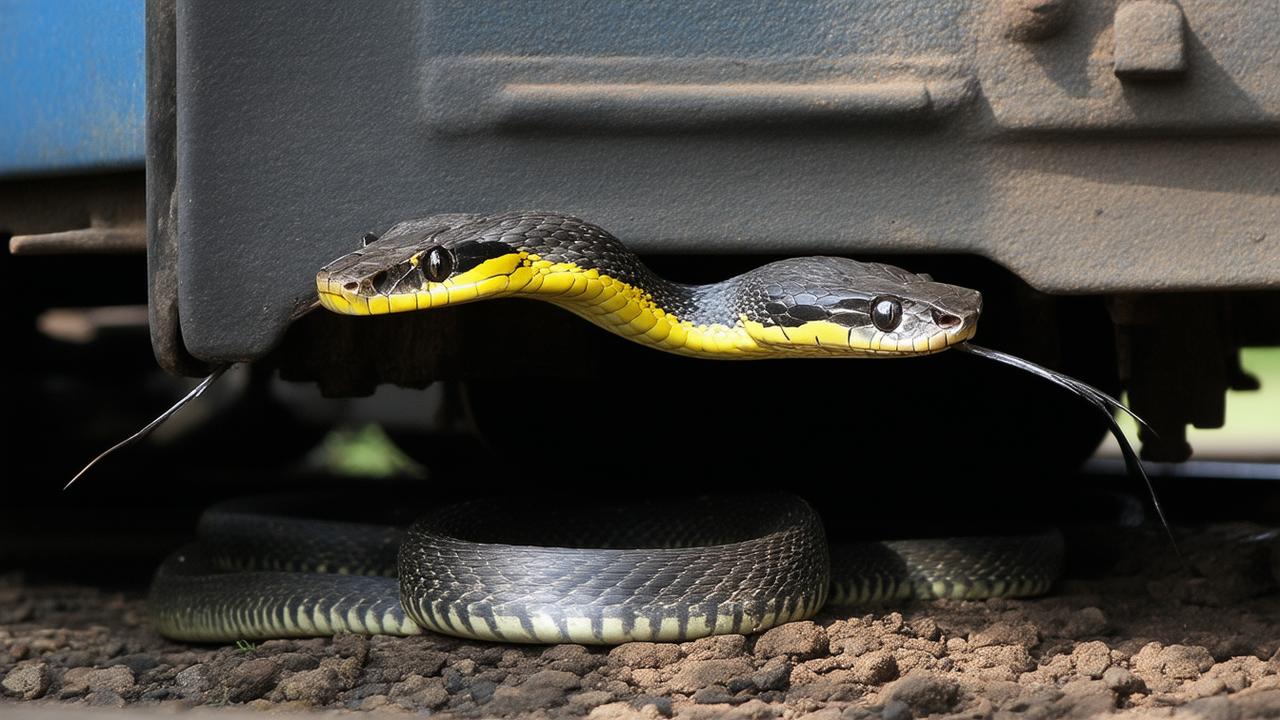
The train slid into the station long before dawn, its metal bones sighing and clattering as it slowed. Outside, the air in this corner of eastern India was thick with the sweet, damp smell of monsoon-soaked earth and chai simmering on a platform stall. Porters shouted, wheels screeched, and a chaos of human life spilled across the tracks. No one noticed the burlap sack in the last freight carriage—dirt-stained, loosely tied, forgotten in a half-lit corner. When the carriage jolted to a halt, something inside the sack shifted, uncoiled, and tasted the air with a slow, deliberate flick of a tongue. In the confusion, as workers slid the door open and began unloading crates of grain and fertilizer, a broad, olive-brown body slipped soundlessly into the shadows, vanishing beneath a stack of plastic tarps. Somewhere, a king had arrived without a crown, without ceremony, and certainly without a ticket.
The Uninvited Passenger
India’s trains are veins of steel, pulsing with people and produce, stories and secrets. They carry mangoes from coastal orchards, coal from smoky heartlands, cattle feed, textiles, cheap toys, expensive dreams. Increasingly, according to a growing number of field observations and local reports, they may also be carrying something else: king cobras.
In places where the forest brushes up against the rails, the line between wild and human territory blurs. Cargo is loaded under trees alive with birdsong; farmers stack sacks of rice or coconuts and cover them with old tarpaulin; laborers rest in the shade while dogs nose at the edges of the tracks. These are perfect conditions for a reptilian stowaway. A rat darts under a pile of sacks; a king cobra—specialist hunter of other snakes but not shy about opportunistic prey—follows. The train lurches forward, and suddenly that cobra is on a cross-country journey it never intended to take.
For decades, the spread of king cobras in India was largely thought to follow the logic of forests, rainfall, and climate—their range stretching along the Western Ghats, through the northeast, and into pockets of central and eastern India. But on-the-ground herpetologists, snake rescuers, and forest officials are increasingly telling a more complex story. One where these regal snakes are not just creeping through undergrowth but also, quite possibly, hitching rides in freight cars and luggage compartments.
The King of Snakes and the Iron Road
King cobras are unlike any other snake in India. Taller, more imposing, and oddly thoughtful in their movements, they can rise to meet a human’s gaze, hood flared, eyes flat and unnervingly steady. They are, despite their reputation, shy forest dwellers, built for bamboo thickets and dense undergrowth, not crowded platforms or concrete towns. Yet again and again, rescues are reported from railway yards, trackside villages, and small towns that, on paper, sit far from the heart of their “natural” range.
Talk to a forest guard who’s been stationed near a busy railway junction for a decade, and you’ll hear a pattern in their stories. A king cobra shows up in a village that never used to see them. Locals swear they’ve only seen rat snakes and cobras of the smaller, more familiar kind. Then, a conservation NGO steps in, captures the snake, and releases it back into forested land dozens of kilometers away. Sometimes, within weeks or months, another one appears—again, heartracingly close to the tracks.
Biologists are cautious people by profession; they don’t declare new theories lightly. But some are beginning to wonder aloud if India’s sweeping rail network is doing more than moving people and goods. Maybe it’s also softly redrawing the map of where king cobras live, nudging the boundaries of their range kilometer by kilometer, cargo wagon by cargo wagon.
When Forests Meet Freight
Imagine a patchwork landscape: rubber plantations, rice paddies, bamboo groves, and dusty villages stitched together by a single railway line. The edges of these habitats are where human life flows thickest, and where wild creatures learn to navigate a changed world. Rats and other small mammals follow grain and garbage. Smaller snakes follow the rats. King cobras, supreme snake-hunters, follow them all.
A freight train that loads up in a semi-forested region might carry with it the scent of rodents and reptiles tucked between sacks of produce or in dark, forgotten corners. A king cobra, pressed by hunger or disturbance, may slip into this maze of hiding places. Unlike many snakes, king cobras are surprisingly active and curious. They patrol large territories in the wild, sometimes covering several kilometers in a day. The leap from forest floor to freight carriage may not be as far-fetched as it sounds.
And once aboard, there is no clear line between departure and arrival. The snake doesn’t know it’s crossing states or ecological zones. It only knows the darkness of the carriage, the lure of potential prey, and eventually, a new smell in the air when the doors grind open again. This is accidental migration: unplanned, unguided, and yet, in the grand sum of countless trains and countless trips, potentially significant.
Patterns in the Scales
Reports from different corners of India paint a picture that is still fragmentary, like a mosaic with more gaps than tiles. In parts of the Eastern Ghats, local snake rescuers talk of “new” king cobras turning up near stations where they were rarely seen twenty years ago. Along some lines in the northeast, railway staff share stories of large, hooded snakes disappearing into drainage ditches after trains pass. Not all of these are confirmed as king cobras, but enough are verified to raise eyebrows among researchers.
The intriguing part isn’t just the presence of these snakes, but the timing. Sightings spike in the months when agricultural goods move most intensely—harvest seasons when freight traffic swells and goods trains become rolling marketplaces of grain, seeds, and animal feed. Cargo is packed hurriedly, corners are cut, sacks are reused, and inspections are more concerned with quantity than with who—or what—might be riding along.
To understand these patterns better, some researchers and citizen-science groups have started informally tracking king cobra sightings near specific railway corridors, pairing them with train schedules and seasonal freight records. It’s still early, still messy, but there are hints that certain busy lines may be acting like thin ecological bridges, connecting populations that were once more isolated, or introducing snakes into marginal habitats that they’d not have reached by slithering alone.
| Observation Type | Typical Location | Possible Rail Link |
|---|---|---|
| King cobra rescued near grain warehouses | Small towns with nearby rail yards | Likely arrived in freight carrying food commodities |
| First-time king cobra sightings in villages | Communities along long-distance rail corridors | Accidental dispersal along major rail routes |
| Repeated encounters near stations | Stations bordering fragmented forest patches | Local populations augmented by rail-borne arrivals |
Fear, Fascination, and the Human Response
For the people who share these landscapes, the idea that king cobras might be silently arriving by train is both electrifying and terrifying. In many parts of India, snakes occupy a charged space in the imagination—revered, feared, woven into myth and ritual. The king cobra, or “hamadryad” in older texts, holds a special place. It is not only the world’s longest venomous snake, but also one of the few that builds a nest and guards its eggs, a trait that makes it strangely relatable—even mammal-like—to villagers who watch over their own families with similar intensity.
Yet respect often walks hand in hand with fear. A sudden encounter with a five-meter snake in a paddy field or near a railway godown is not a moment of quiet wonder; it is a jolt of pure adrenaline. People shout, scatter, reach for sticks and stones. In some places, older traditions of snake worship and protective taboos have softened, leaving a more reactive, urbanized mindset in their place: eliminate the threat, quickly.
Here, the work of snake rescuers and conservation educators becomes critical. Many of them travel to these same railway-linked villages, teaching children and adults how to identify venomous snakes, how to respond calmly, and why the king cobra is more interested in other snakes than in humans. They explain that killing one out of fear not only breaks cultural and ecological ties, but also disrupts a delicate balance. When a top predator disappears, the consequences ripple down the food chain.
Ecological Consequences on the Move
If trains really are ferrying king cobras into new pockets of India, what does that mean for the ecosystems they enter? The answer is complicated, and scientists are still piecing it together. On one hand, the king cobra is a native species, an integral part of the subcontinent’s ecological story. Its spread along climatic and habitat corridors may simply be a natural extension of that story, nudged along by human infrastructure.
On the other hand, accidental translocation can create unexpected juxtapositions. A newly arrived king cobra might interact with local snake populations in novel ways—preying on species that historically had fewer such predators, or even interbreeding where related populations meet after long isolation. Over long timescales, this could alter the genetic fabric of regional populations, potentially increasing genetic diversity in some areas, or diluting local adaptations in others.
There’s also the human-wildlife conflict dimension. In highly fragmented landscapes, where forest has been carved into thin strips by fields and rail lines, a king cobra’s wide-ranging lifestyle can bring it into repeated contact with people. The more such encounters occur, the higher the chances of conflict, misidentification, and retaliatory killing.
➡️ How cleaning baseboards first shortens total cleaning time significantly
➡️ He hired a dog sitter then his home camera revealed the sitter was bringing unknown people into his apartment in ways he never expected
➡️ How often can you dye your hair without damaging it?
➡️ Keeping your bedroom door open at night might improve airflow enough to lower carbon dioxide levels and deepen your sleep
➡️ It’s now official: heavy snow is expected to begin late tonight as authorities urge residents to exercise extreme caution
➡️ Lidl is set to launch a Martin Lewis–approved gadget next week, arriving just in time to help households get through winter
➡️ Inheritance law shake-up confirmed: a new reform arriving in February will significantly change the rules for heirs
Between Curiosity and Caution
As the sun rises over a remote rail junction, you can stand at the edge of the tracks and feel the day gather itself. A whistle in the distance, the flutter of pigeons on a rusted roof, the metallic hum underfoot as another train approaches. Behind the romance of it all—the nostalgia of rail travel and the poetry of steel on steel—there’s an invisible, more-than-human story unfolding.
Some conservation thinkers argue that the railways should be taken seriously as ecological agents. Just as ships once carried rats and snakes across oceans, steel tracks may be reshaping wildlife movement across continents. This doesn’t mean trains are villains. Instead, it invites a different way of seeing: not as passive backdrops to nature, but as corridors along which life of all kinds flows, invited or not.
What, then, should be done? Completely preventing stowaway wildlife may be unrealistic, especially in a country as vast and frenetic as India. But awareness can go a long way. Better training for railway staff to recognize and safely report encounters, simple design tweaks to reduce obvious hiding spots in certain types of freight, community outreach in known snake-prone junctions—these are small steps, not grand solutions, but they mark a shift in attitude.
Traveling with the King
In the end, the idea of king cobras spreading by train sits somewhere between fact and unfolding hypothesis. There are confirmed rescues from rail-linked areas, strong circumstantial patterns, and a growing body of field wisdom. There are also gaps in the data, uncertainties, and a scientific community still working to turn stories into numbers, and numbers into solid conclusions.
But perhaps the most powerful part of this story lies not in the statistics, but in the image it leaves behind: a train hurtling through the darkness, monsoon rain slanting across the windows, and in the quiet belly of a freight car, a forest monarch curled behind a stack of crates, traveling a route its ancestors never knew existed.
When the train finally sighs into a distant station, doors grind open, light pours in, and the world changes again. Porters shout, tea boils, children lean out of windows to wave at something only they can see. Somewhere beneath their feet, in the tangle of weeds and sleepers and litter, a long, scaled body slides free, tasting a new landscape with every flick of its tongue. The king has disembarked, and the story of its journey—like the rails themselves—runs on far beyond the horizon.
FAQ
Are king cobras really spreading in India because of trains?
There is growing evidence that trains may be unintentionally helping king cobras move into new areas, especially along busy freight routes. Many reports link first-time or unusual king cobra sightings with railway yards, stations, and trackside villages, but more systematic research is needed to fully confirm and quantify this pattern.
Are king cobras dangerous to people?
King cobras possess potent venom and can deliver serious, sometimes fatal bites, but they are generally shy and avoid humans when possible. Most incidents occur when the snake feels cornered or is handled unsafely. With calm behavior, distance, and proper rescue support, conflict can usually be avoided.
What should I do if I see a king cobra near a railway station or my home?
Keep a safe distance and do not attempt to handle or provoke the snake. Alert local forest department staff, wildlife authorities, or a trained snake rescuer if one is available in your region. Ensure that bystanders, especially children, stay back and remain calm until help arrives.
Is the movement of king cobras by train bad for ecosystems?
The ecological impact is not fully understood. Since king cobras are native to India, their movement along climatic and habitat corridors may be partially natural. However, accidental translocation could alter local snake communities and genetic patterns. Researchers are still studying these long-term effects.
Can anything be done to reduce accidental wildlife transport by trains?
Complete prevention is difficult, but several measures can help: better inspection of certain freight types, reducing cluttered hiding spots in wagons, training railway staff to respond appropriately to wildlife encounters, and raising awareness in communities near stations. These actions can make the rail network safer for both people and animals.





