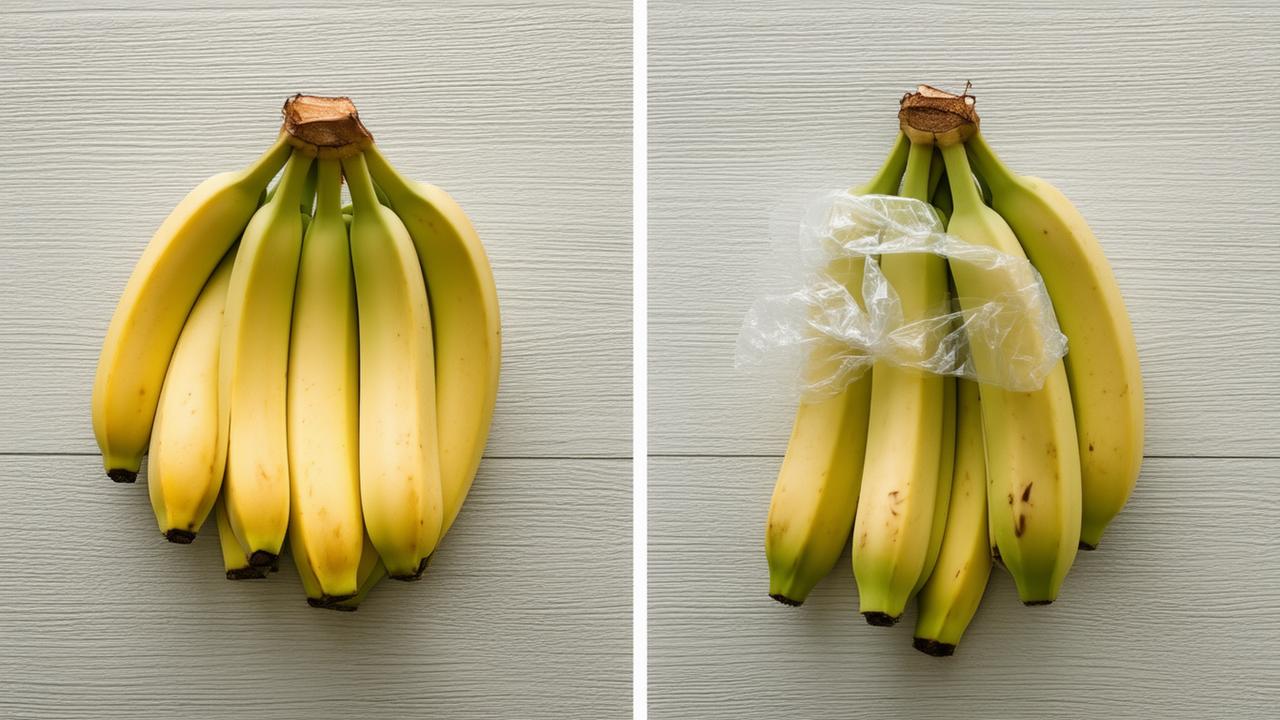
The bananas on your counter are already freckling when you notice them. Just three days ago, they were a perfect, cheerful yellow—smooth, unblemished, promising to be just the right balance of creamy and sweet. Now a dusting of brown spots is spreading like a whispered rumor across their skins. You can almost feel the clock ticking. You planned smoothies, quick breakfasts, maybe a banana bread if things got desperate. But you didn’t plan for them to rush headlong from green to overripe at the speed of… well, a banana. What if there were a way to press pause on that ripening? To keep them fresh and yellow for not just a few days, but up to two weeks—with nothing more than a simple household item sitting in your kitchen right now?
The Slow Drama of a Ripening Banana
Before we reach for that household item, it helps to slow down and actually watch what’s happening on that fruit bowl stage. A bunch of bananas is like a small, quiet drama unfolding in plain sight. They start green and firm, almost starchy. Over a few days, the color flushes into yellow, their flesh softens, and the perfume of ripeness begins to hover in the air. That change is powered by an invisible actor: ethylene gas.
Bananas are what scientists call “climacteric fruit,” which means they continue to ripen after they’ve been picked. Inside each banana, cells are working, breathing, converting starches into sugars. They release ethylene gas, a plant hormone that whispers to nearby fruit: “It’s time. Ripen.” The more they ripen, the more ethylene they release. It’s a feedback loop that turns your innocent fruit bowl into a small ripening factory.
There’s something strangely beautiful about this. The way their skin deepens in color, the way their perfume sweetens. But it can also feel wasteful, even frustrating, when that window of perfect ripeness is only a day or two long. You buy a bunch on Sunday for the week ahead, and by Wednesday, they’re moshing past their sweet spot into mush. The question is: can we interrupt that gas-fueled conversation they’re having with each other?
The Quiet Little Trick Hiding in Your Kitchen Drawer
Here’s where the simple household item comes in—one you’ve probably used a thousand times without ever wondering what else it might be capable of. It’s not a gadget, not an expensive container, not a chemical spray. It’s just an ordinary roll of plastic wrap or cling film.
If that sounds almost disappointingly simple, stay with me. Because the trick isn’t just what you use, but where and how you use it. The key lies in that quirky little area at the top of each banana: the stem, where the fruit was once attached to the plant. That stem is like the exhaust pipe of the banana’s ripening engine. It’s where a lot of ethylene gas is released, and where moisture can escape and air can sneak in.
By wrapping the stems of your bananas tightly with plastic wrap, you’re essentially putting a muffler on their ethylene emissions. It doesn’t shut the process down entirely—that would be like asking a river to stop flowing—but it slows it. And that small act of slowing is precisely what stretches your bananas’ golden moment from just a few days to as long as two weeks, especially if you pair it with a few supporting habits.
Why the Stem Matters More Than You Think
If you look closely at a bunch of bananas, you’ll see that the stems are all joined at the top in a sturdy, fibrous knot. That junction acts like a hub of communication between each banana. Ethylene gas released from one fruit collects and lingers around the cluster, triggering the others to join the ripening party much faster.
When you wrap that top stem area with plastic, you create a kind of barrier that slows down how much gas escapes and how easily it can circulate among the bananas. Some people even go a step further and separate the bananas, wrapping each individual stem. It’s a little like social distancing for fruit. Each banana is now less influenced by its neighbors, ripening more slowly and more independently.
The difference might not be dramatic on day one. But as the days stretch on, you notice something: while unwrapped bananas soften, spot, and lean toward brown, your wrapped ones hold onto that bright yellow stage noticeably longer. The skin stays firmer. The fruit stays sweeter and less mushy. Instead of being forced into banana bread mode by day four, you can still slice one onto your cereal on day ten and find it acceptable, even delightful.
How to Wrap and Store for Maximum Freshness
You don’t need special tools or complicated instructions to do this. The process is wonderfully plain, the kind of domestic ritual that can slip effortlessly into your kitchen routine.
Start with bananas that are mostly yellow with a hint of green—those are your best candidates for a long life. If they’re already heavily speckled, wrapping the stems will still help, but it won’t turn back time. Lay the bunch on your counter, then tear off a small sheet of plastic wrap. Press it snugly around the stem cluster, making sure it’s tightly sealed. If you prefer to separate each banana, gently pull them apart and wrap each stem individually, twisting the wrap to close it off.
Then consider where you’ll keep them. A cool, dry corner of your kitchen works best, away from direct sunlight, radiators, and the warmth that often builds near ovens or sunny windows. Bananas are tropical fruits, but counterintuitively, a bit of cool helps slow their ripening—just not the chill of the refrigerator at this stage, which can cause the peel to turn dark prematurely.
Combining the Trick with Smart Storage Habits
Wrapped stems are the main act, but your supporting habits can turn a simple trick into a quiet little art. One important move is to keep your bananas away from other ethylene-heavy fruits like apples, pears, and avocados. These fruits are also chatty in the language of ripening gas, and together they speed each other toward softness.
Another strategy is to use the refrigerator in stages. Let the bananas ripen on the counter with stems wrapped until they reach the shade of yellow you love. Then, and only then, transfer them—still with wrapped stems—into the fridge. The cold slows the inside of the fruit dramatically. Yes, the peel may darken over the next few days, but inside, the flesh will often remain pleasantly firm and sweet, extending that edible window even further.
If you really want to see the difference, try a simple home experiment. Leave three bananas unwrapped on the counter. Take three similar ones, wrap their stems, and store them nearby. Over the next ten days, watch–even smell–how they diverge. Your nose will pick up the deep caramel sweetness of the unwrapped bunch first, as they speed into overripe territory. The wrapped ones will trail behind, still yellow, still restrained, as if someone’s gently holding down the fast-forward button.
The Science Sitting Quietly Behind the Magic
This humble kitchen ritual is more than a hack from a friend-of-a-friend; it’s rooted in the quiet, consistent science of plant physiology. Ethylene gas doesn’t just appear randomly—it’s produced as part of the banana’s natural aging process. It signals cells to soften, pigments to change, and sugars to develop. It’s the reason green bananas can ripen even after they’ve been shipped across oceans, far from the plant that grew them.
The stem area, with its fibrous tissues and central position, is a major pathway for that ethylene to move and escape. By isolating it with plastic wrap, you’re altering how that gas diffuses. Instead of drifting freely and triggering all the fruit at once, some of the ethylene is essentially trapped or slowed, dulling its overall impact on the bunch.
There’s something almost poetic about it: you’re not fighting the banana’s nature, just negotiating with it—asking it to take its time. To stretch that delicious middle chapter between hard green and collapsing brown. It’s a gentle intervention, a way of cooperating with the fruit rather than trying to dominate it.
A Simple Comparison: Wrapped vs. Unwrapped
To see the effect more clearly, imagine tracking the changes in your bananas day by day. Here’s how that might look in an average kitchen:
| Day | Unwrapped Bananas | Bananas with Wrapped Stems |
|---|---|---|
| 1–2 | Mostly yellow, just starting to soften. | Similar appearance; firm, bright yellow. |
| 3–5 | Brown speckles appear; aroma stronger; softer texture. | Few or lighter speckles; still pleasantly firm; mild aroma. |
| 6–8 | Many spots; very soft; best for baking or smoothies. | Moderate speckling; edible for snacking; flesh still holds shape. |
| 9–14 | Heavily browned; may leak or collapse; often discarded. | More spots and some browning; often still usable, especially if also refrigerated after ripening. |
Of course, room temperature, humidity, and initial ripeness all nudge this timeline one way or another. But again and again, the pattern holds: a simple piece of plastic buys you time.
➡️ The streak-free window-cleaning method that still works flawlessly even in freezing temperatures
➡️ The quick and effective method to restore your TV screen to like-new condition
➡️ Thousands of passengers stranded in USA as Delta, American, JetBlue, Spirit and others cancel 470 and delay 4,946 flights, disrupting Atlanta, Chicago, New York, Los Angeles, Dallas, Miami, Orlando, Boston, Detroit, Fort Lauderdale and more
➡️ The sleep pattern that predicts alzheimer’s risk 15 years before symptoms
➡️ These zodiac signs are destined for major prosperity in 2026, according to astrological forecasts
➡️ The RSPCA urges anyone with robins in their garden to put out this simple kitchen staple to help birds cope right now
➡️ The RSPCA urges anyone with robins in their garden to put out this simple kitchen staple today
Living More Gently with What We Buy
Beyond the quietly satisfying feeling of outsmarting premature banana mush, there’s a deeper layer to this little trick. Food waste is a huge, invisible presence in many homes. We toss out softening fruit, wilted greens, and leftovers we meant to eat but didn’t. Often, it’s not out of carelessness, but because the timing doesn’t match the rhythm of our days.
Slowing down a banana’s rush to ripeness might seem like a tiny act, but it’s also a small rebellion against that waste. It means the fruit you picked with intention actually gets enjoyed the way you imagined it: sliced into yogurt, tucked into a lunchbox, blended into a smooth gold drink on a busy morning. That’s one less thing quietly molding in the compost or trash.
And there’s something almost grounding about it, too. In a world that feels constantly hurried, the idea of coaxing fruit to ripen more slowly—of extending the life of something simple and sweet—feels like a tiny alignment with slowness itself. A little domestic patience made visible in a row of yellow bananas that stay yellow for just a bit longer than they used to.
The Household Item You’ll Never Ignore Again
The next time you come home with a new bunch of bananas, imagine them as a promise stretched over days, not a race against time. Reach for that roll of plastic wrap with the quiet knowledge that you’re holding more than just a kitchen staple—you’re holding a tool that lets you gently negotiate with nature’s timeline.
Wrap the stems. Tuck the bunch into a cool corner. Keep them away from the basket of apples. Later, when you grab a banana ten, twelve, even fourteen days in and find it still usable—still more yellow than brown—you’ll feel that small, private satisfaction. The sense that, in this one corner of your kitchen, you’ve found a way to keep things fresh just a little longer.
Sometimes, the difference between waste and enjoyment is not a new gadget, not a complicated system, but a simple ritual repeated quietly, week after week. A roll of plastic wrap. A twist around a stem. A bright yellow fruit that lingers in its prime, waiting—patiently this time—for you.
Frequently Asked Questions
Does wrapping the stems of bananas really make them last longer?
Yes. Wrapping the stems with plastic wrap slows the release and spread of ethylene gas, which in turn slows the ripening process. It won’t stop ripening entirely, but it can noticeably extend the time your bananas stay yellow and firm.
Should I wrap the whole banana or just the stem?
Just the stem. Wrapping the entire banana can trap moisture against the peel and may encourage mold or uneven ripening. Focus on tightly sealing the stem area, either for the whole bunch or each individual banana.
Is it better to keep bananas in the fridge or on the counter?
Start them on the counter until they reach your preferred level of ripeness, with stems wrapped. After that, you can move them to the fridge to slow ripening further. The peel may darken in the fridge, but the inside often stays firmer and fresher.
Can I use something other than plastic wrap?
You can use reusable alternatives like silicone wraps or beeswax wraps, as long as they create a tight seal around the stems. The key is blocking or slowing ethylene exchange, not the specific material.
Why do my bananas ripen faster when stored near other fruit?
Fruits like apples, pears, and avocados also produce ethylene gas. When they’re stored close together, that gas builds up, and all the fruits ripen faster. Keeping bananas separate, especially with wrapped stems, helps slow that process.
How long can bananas really stay fresh and yellow with this method?
Depending on room temperature and starting ripeness, wrapped-stem bananas can often stay pleasantly yellow and usable for up to two weeks. In cooler kitchens or with smart use of the refrigerator, that window can sometimes stretch even longer.





