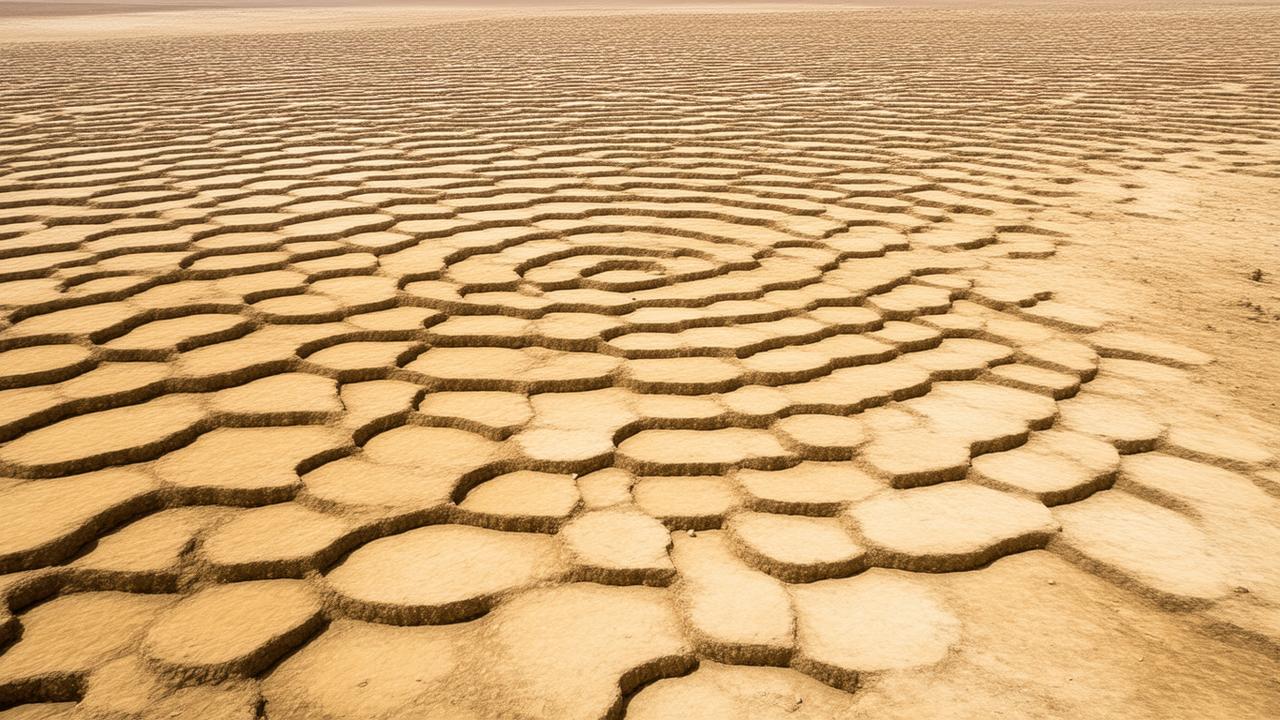
The wind arrives first. It pours down the Andean slopes, cool and thin, pressing against your jacket as you stand on a dusty ledge above Peru’s Pisco Valley. Below, the land ripples in browns and golds, a canvas of terraces, rocky outcrops, and ghost trails of old footpaths. And then you see them—thousands upon thousands of small, round depressions gouged into the earth, marching across the hillside in eerily straight lines. From a distance, they look like the marks of some giant, cosmic beehive. Up close, they feel even stranger: 5,200 hand-carved holes, each one big enough to cradle a basket or a pot or a parcel of something once valuable. For decades, no one could say with certainty why they were here. Were they tombs? Ritual pits? An ancient code? The place was a puzzle written into stone.
The Mystery That Refused to Sit Still
Local farmers had their own quiet stories about the holes at Bandurria and, more famously, at the site often called “Monte Sierpe” or simply Pisco’s stone grid. Guides would shrug and say, “Son antiguos”—they’re ancient—then point out that their grandparents and great-grandparents had never used them. Archaeologists who first surveyed the formations in the 20th century were baffled. The uniform spacing, the sheer scale—rows extending for hundreds of meters—suggested purpose, discipline, and planning. But of what kind?
From the sky, the site looked like a set of encrypted lines. Early aerial photos gave them an almost digital feel: pixel-like dots puncturing the desert slope. Some researchers proposed they were burial niches, though no human remains turned up in careful excavation. Others guessed they were for food storage, but the shallow depth and exposed positions on a windswept hillside seemed impractical for keeping crops cool and dry.
Theories multiplied. Were they astronomical markers charting the movement of the sun? A giant abacus for tracking time? A ceremonial field for unknown rituals? For decades, the holes sat between explanations, attracting fringe ideas and breathless speculation. The truth, it turns out, was less mystical—but no less astonishing.
The Day the Pattern Shifted
To understand what finally broke the mystery, you have to imagine the slow work of patient observation. Archaeologists began looking not just at the holes, but at everything around them: the nearby pathways, the direction of ancient roads, the way the light struck the slopes in different seasons, even the layout of other pre-Inca sites scattered across the coastal valleys.
They noticed something easily missed on a quick visit. The holes were not random hollows in one large mass; they were grouped into bands, a repeating pattern of clusters. The size of the holes varied subtly, forming series—almost like units and subunits. Nearby, fragments of pottery and textile impressions hinted at containers and wrapping, the paraphernalia of storage and exchange.
What if, someone suggested, these weren’t tombs or calendars at all? What if they were accounting?
An Economic Landscape in Stone
The Andes are famous for the Inca Empire, with its intricate system of quipus—knotted cords that functioned as a sophisticated recording technology. But long before the Inca rose to power, there were other cultures running their own networks of trade and tribute along these desert valleys. The pits carved into the stone, researchers began to argue, were part of a pre-Inca economic system: a massive, physical ledger spread across the land itself.
Imagine caravans of llamas arriving from the highlands with sacks of dried potatoes, salt, and wool. From the coast, fish and shellfish and cotton travel inland. Each community, each household, owes a portion of its goods as tax or tribute. There are no warehouses in the modern sense. Instead, the hillside becomes the warehouse—each hole a temporary docking station for bundles of value, each cluster of holes a “page” in a three-dimensional book.
In this reading, the pits are not about hiding things away; they’re about putting them on display in a controlled, organized fashion. Officials or administrators—perhaps priests, perhaps community leaders—could stand on the slope and read the state of the economy at a glance: which line of holes was full, which was half empty, which remained untouched. It was logistics turned into landscape.
Reading the Holes Like a Ledger
What makes the economic interpretation so compelling isn’t just the visual logic of the site, but the way it dovetails with what we know about Andean societies. Long before coins jingled in pockets, value here was tracked through labor, goods, and obligations. Accounting didn’t have to look like papyrus ledgers filled with ink. It could be knots and cords. And it could be stone.
The pattern of the holes suggests categories and counts. Some rows contain more uniform, larger cavities; others are smaller and more tightly spaced. This could represent grades of goods or different units of measurement. Archaeologists have compared the layout to later Inca storage complexes, which also relied on modular thinking: repeating structures, each one designed to hold a specific quantity, to be read collectively as a record of abundance or scarcity.
It’s worth pausing on the emotional texture of this idea. Standing in front of the holes, you can almost hear the bustle of an ancient market day. The thud of woven bags dropping into place. The murmur of voices as officials walk the rows, ticking off mental counts. A child watches from the sidelines, memorizing which band of pits belongs to which village. The hillside is not silent at all; it hums with transactions, negotiations, obligations met and promises made.
Touching the Past With Your Fingertips
If you kneel beside one of the pits and run your fingers along its rim, you’ll feel the irregularities of handwork. These weren’t drilled with machines; they were chipped and scraped, each stroke of stone on stone a small push against gravity and time. There’s a human scale to them—about the breadth of a chest or an armload of goods. They invite you to imagine lifting something precious and placing it gently down, knowing its position meant something to everyone around you.
Dust collects in the bottoms now, along with tiny shards of modern life—candy wrappers, a lost button blown in from a tourist’s shirt. But the design still holds. You can walk along a row and see, in your mind’s eye, how full it once must have been. How a nearly complete line of filled holes might have announced a successful harvest season, while the patchy emptiness of another year could have signaled trouble.
There is a particular kind of beauty in the idea that an entire community’s well-being could be read off the landscape. No spreadsheets, no glowing screens. Just rock and sky and methodical human effort, carving a record that would long outlive the hands that made it.
Why a Stone Accounting System Made Sense
To modern eyes, turning a hillside into a giant ledger might seem cumbersome. But on this desert coast, it was brilliant. The climate is dry, with little rain to wash things away. Large public works signaled political and ceremonial power; they showed that a region was prosperous and organized enough to invest huge amounts of labor into shaping the land. And in a world without paper, a permanent physical infrastructure for tracking goods solved a real problem: how do you scale up accounting beyond the memory of a few individuals?
Unlike a small storeroom, an open, monumental field of pits is inherently visible and, to a degree, transparent. People could see if tribute had been delivered or not, whether the regional center was filling up or standing empty. That visibility could foster trust—or exert pressure. After all, when everyone can see your obligations laid out in stone, it becomes much harder to pretend they don’t exist.
It may also have had a ceremonial dimension. In the Andes, the line between the sacred and the practical is often thin. Managing food and goods was not just an economic chore; it was a cosmological duty, part of maintaining balance between human communities, the mountains, the sea, and the sky. Arranging offerings—whether meant for gods or for governments—into carefully ordered spaces turned accounting into ritual.
➡️ The streak-free window-cleaning method that still works flawlessly even in freezing temperatures
➡️ The quick and effective method to restore your TV screen to like-new condition
➡️ Thousands of passengers stranded in USA as Delta, American, JetBlue, Spirit and others cancel 470 and delay 4,946 flights, disrupting Atlanta, Chicago, New York, Los Angeles, Dallas, Miami, Orlando, Boston, Detroit, Fort Lauderdale and more
➡️ The sleep pattern that predicts alzheimer’s risk 15 years before symptoms
➡️ These zodiac signs are destined for major prosperity in 2026, according to astrological forecasts
➡️ The RSPCA urges anyone with robins in their garden to put out this simple kitchen staple to help birds cope right now
➡️ The RSPCA urges anyone with robins in their garden to put out this simple kitchen staple today
A Glimpse of the System in Motion
To better picture the pre-Inca economic system encoded in these 5,200 holes, it helps to imagine a single cycle of activity—a year in which the hillsides become a stage for exchange. Below is a simplified way to think about how such a system might have worked, distilled into a compact overview.
| Stage | What Happened | Role of the Holes |
|---|---|---|
| 1. Collection | Villages brought goods—crops, textiles, dried fish, salt—to a central gathering point. | Each community’s contributions were placed in specific rows or clusters assigned to them. |
| 2. Sorting | Officials inspected the quality and type of goods. | Different bands of holes may have represented categories, such as food, fibers, or ritual items. |
| 3. Counting | Totals were calculated for tribute, redistribution, and storage. | The number of filled holes in each band acted as a visible count—like beads on a giant, immovable abacus. |
| 4. Redistribution | Goods moved along regional routes, supporting workers, specialists, and allied communities. | Emptying and refilling patterns over time recorded movement and obligations fulfilled. |
| 5. Memory | The community remembered seasons of plenty and scarcity. | The carved grid itself stood as a permanent reminder of the system and its rules. |
As you trace this imagined cycle, the pits become less like curiosities and more like the structural bones of an entire economy. They are where narrative meets number: a story of who gave, who received, and how a desert society learned to bend its harsh environment into something livable, even generous.
Seeing Ancient Innovation With New Eyes
There is a temptation to think of ancient economies as simple, as if they operated only on barter and instinct. But the stone holes of Peru tell a different story. They remind us that complexity does not require our technologies; it only requires human minds willing to organize, categorize, and carve meaning into matter. This pre-Inca system, now increasingly understood as an economic infrastructure, shows a level of administrative sophistication that resonates uncannily with our own age.
Think of a modern warehouse, its aisles mapped and labeled, its shelves stacked with boxes tracked by barcodes. The hillside is the ancestor of that space, its pits functioning as analog, open-air barcodes of the past. Standing there today, you can feel a strange kinship with the people who once worked this grid. Like us, they worried about supply and demand, about feeding families, about honoring obligations and surviving drought years. Like us, they built systems bigger than any one person’s memory.
The mystery of the 5,200 holes isn’t entirely gone; archaeology rarely closes a case with absolute finality. New findings may refine the story, complicate it, add other layers—ritual, political, symbolic. But what has emerged with surprising clarity is this: far from being random scars or cryptic messages from an unknowable past, these holes were part of a living, breathing economic machine. A pre-Inca innovation that turned rock into a record, and a hillside into a heartbeat.
FAQ
Are the 5,200 holes in Peru definitely proven to be an economic system?
Current archaeological interpretations strongly support the idea that the holes were part of a pre-Inca system for organizing and counting goods, possibly tied to tribute or redistribution. While absolute proof is rare in archaeology, the layout, context, and comparisons with other Andean practices make the economic explanation the most convincing so far.
Who built the holes—were they made by the Inca?
Evidence suggests the holes predate the Inca Empire. They were likely created by earlier coastal societies whose influence extended along the Pisco and nearby valleys. The Inca later developed their own storage and accounting systems, such as quipus and vast storehouse complexes, but the holes belong to an older tradition.
Were the holes ever used as tombs or burial sites?
Excavations have not uncovered consistent human burials or grave goods in the pits, which weakens the burial theory. While isolated remains could appear due to later reuse or disturbance, the overall design and lack of funerary patterns point away from a primary function as tombs.
Can visitors see these holes today?
Yes, many of the carved holes are visible to visitors, often reached via local tours from coastal towns in Peru. Access conditions can change due to conservation efforts and local regulations, so travelers should check current guidance and visit respectfully, avoiding damage to the fragile formations.
Did the holes store food like a granary?
The pits may have held bags or baskets of food and other goods, but they were not deep, insulated silos like some highland granaries. Their exposed position suggests a short-term staging and counting role rather than long-term storage, forming part of a broader economic system that moved goods through the region.





