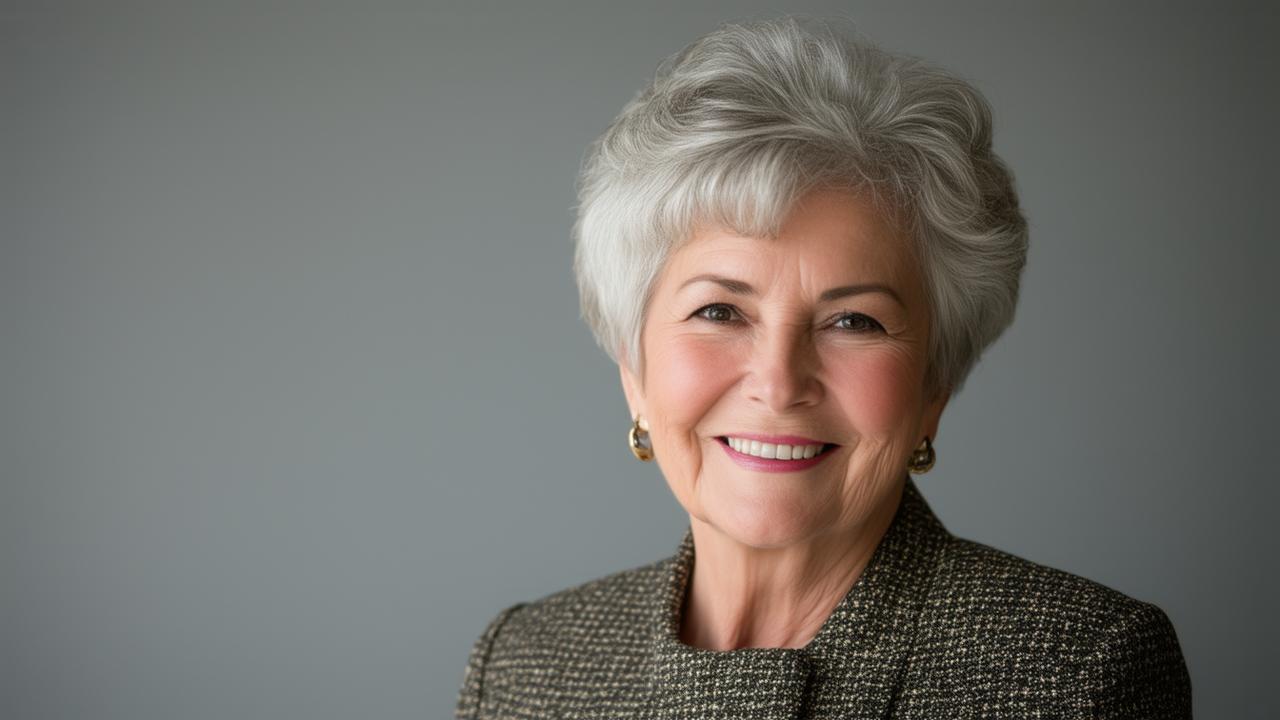
The first thing you notice is the sound. A low, comforting hum of hairdryers and gentle chatter, the soft snip of scissors keeping time like a metronome. The salon smells faintly of citrus and hairspray, and outside the window, the late afternoon light spills across a row of silver heads waiting their turn. But inside, something else is happening—something quiet and radical. Women in their sixties, seventies, even eighties, are stepping into the chair and asking not for “something age-appropriate,” but for hair that makes them feel alive. And increasingly, stylists are answering with one particular cut—a shape that has quietly dethroned the old “grandma” stereotype and is now considered the most youthful, flattering style for women over 60.
The Day the Old Rules Died
Ask any seasoned hairstylist about working with women over 60 a decade ago and you’ll hear the same story: boxy perms, stiff helmets of hairspray, the “just take a little off” trims that maintained a look more out of habit than happiness. The rules were clear and largely unquestioned—after a certain age, hair should get shorter, safer, and quieter.
But then something shifted. Maybe it was the slow cultural reimagining of aging, or all those silver-haired actors and authors on magazine covers who looked luminous instead of “well-preserved.” Maybe it was the pandemic and the months of unplanned hair growth, when women watched their natural texture and color reappear in the bathroom mirror and thought, Wait. I like this.
When salons reopened, stylists noticed the trend immediately: women over 60 were coming back not to reclaim the old version of themselves, but to reinvent it. They weren’t asking, “What’s appropriate for my age?” They were asking, “What will make me look and feel like myself—only lighter, fresher, freer?”
Across consultations, one haircut kept showing up on the “after” photos. Not the strict pixie that some felt had been pushed on them after menopause. Not the heavy bob that dragged the face downward. This cut was softer, more lived-in, somewhere irresistibly in-between.
The Most Youthful Cut: The Modern, Soft Layered Bob
Professionals call it different names—the soft layered bob, the French bob with movement, the airy layered lob (a slightly longer bob). But they all circle around the same idea: a bob-length cut that hits somewhere between the cheekbones and collarbones, with soft, face-framing layers and texture that moves instead of sitting still.
It’s not the sharp, severe bob of fashion editor lore, nor the stiff “set” style of past decades. This version is soft at the edges. The ends are often slightly feathered rather than blunt, the layers are invisible rather than choppy, and the hair floats around the jaw, neck, and shoulders. When you walk, it moves with you.
Stylists love it for women over 60 because it does something magical to the face. The length can be tailored to skim the jawline or sit just under it, visually lifting the lower half of the face. Soft layers around the cheeks create a gentle frame, softening lines without hiding them. Instead of drawing attention to sagging or thinning, the haircut redirects the eye to the eyes themselves, to the smile, to the whole expression.
And—crucially—it works with the hair you have now, not the hair you had at 30. Thinner strands, new cowlicks, wiry silver pieces that seem to rebel against every rule? The modern layered bob is built to incorporate them. The layers add movement to fine hair, remove bulk from thick or coarse hair, and give natural wave or curl space to breathe.
The Sensory Shift: How This Cut Actually Feels
There’s a quiet, physical thrill that happens when the cape comes off and your hand goes up, almost shyly, to explore a new shape. Women describe this cut in sensations as much as in words. It feels lighter at the nape, where heavy hair no longer clings to warm skin on summer days. It brushes just so against the collar of a favorite shirt. There’s that subtle swing when you turn your head, like the punctuation at the end of a sentence.
For those who’ve worn longer hair for years—often for sentimental or symbolic reasons—there can be a moment of shock. But it’s quickly replaced by something else: relief. “I didn’t realize how much my hair was dragging me down,” many tell their stylists. “I feel like my head is finally standing up straight again.”
The scalp can breathe. Shampooing becomes easier. Blow-drying doesn’t require a shoulder workout. The weight of obligation—of keeping up a style that no longer reflects who you are—lifts, little by little, fall of hair by fall of hair.
And there’s another pleasure: texture. With the right products, fingers can be used instead of brushes, and a few scrunches or a twist here and there are enough to coax out movement. The look isn’t “done” so much as “lived-in”—the kind of hair that looks like it belongs out on a walking path, by the ocean, laughing at the café table, not frozen under salon lights.
Why Stylists Say This Cut Looks So Youthful
The word “youthful” can feel loaded, but in the hands of good stylists, it doesn’t mean trying to look 30. It means capturing the energy, softness, and ease that we often associate with feeling young in ourselves.
Here’s what makes the modern layered bob so flattering:
- Lift and Light: Strategic layering removes weight from the bottom of the hair, so it doesn’t pull the face downward. The eye travels up instead of down.
- Soft Edges: Hard lines can emphasize tension or angularity in the face. Softer ends and gentle layering blur those edges, like flattering natural light.
- Movement: Movement in hair signals health and vitality. Even fine hair can look more energetic with subtle internal layers.
- Custom Length: Whether it hits at the jaw, below the chin, or at the collarbone, the line of the cut can be chosen to highlight your best features—cheekbones, neck, or shoulders.
- Versatility: It can be styled polished or tousled, tucked behind the ears or worn forward; that adaptability reads as modern.
Instead of shouting, “I am trying to look younger,” this cut whispers, “I know who I am, and I’m still very much here.”
Finding Your Version of the Cut
Within this family of modern bobs, the sweet spot is deeply personal. Stylists talk about creating a “signature variation” for each client. The key is not to copy a celebrity photo wholesale, but to translate the idea to your face, your hair, your routine.
| Hair Type / Concern | Modern Soft Bob Variation | Why It Works After 60 |
|---|---|---|
| Fine or thinning hair | Chin to collarbone length with subtle internal layers and a slightly blunt perimeter | Keeps density at the ends while adding gentle volume and movement around the crown. |
| Wavy hair | Mid-length bob with soft, graduated layers around the face | Lets natural wave form loose, youthful bends without heavy styling. |
| Curly hair | Rounded layered bob hitting between cheekbone and shoulder | Creates a flattering shape that defines curls while avoiding triangle bulk. |
| Very thick or coarse hair | Collarbone bob with internal debulking and softly textured ends | Removes heaviness so hair swings instead of sitting rigidly. |
| Silver or salt-and-pepper hair | Any soft bob variation with delicate face-framing pieces | Highlights the natural dimensions of gray, making it look intentional and luminous. |
Stylists will often stand behind you and, in the mirror, trace with their fingers where the length could land, asking you to imagine how it would feel on your neck, how it would sit on your shoulders. The right answer isn’t only what looks good—it’s what your body quietly says yes to.
Bringing photos can help, but bring a variety: one for length, one for texture, one for bangs or no bangs. Then give your stylist permission to adapt. “I love the softness here,” you might say. “But I don’t want to spend more than ten minutes styling it.” Those two sentences tell them nearly everything they need to know.
The Gray Area: Color, Texture, and Owning the Silver
Another revolution happening alongside this haircut is the great gray reveal. Many women in their sixties are choosing to transition away from all-over dye, embracing silver, white, or salt-and-pepper hair that has been patiently growing at the roots for years.
The modern layered bob is unusually kind to this transition. The shorter length makes it easier to cut away old, dark ends more gradually. The layers show off the natural highlights and lowlights that appear in gray hair—those streaks of bright white at the temples, the charcoal at the nape, the pearly crown of soft silver that catches the light.
Texture also changes with age. Gray hair is often drier, coarser, or more wiry. Instead of fighting that, this cut partners with it. A stylist might add a bit more layering to help gray hair bend and curve rather than poke out. Products become less about control and more about nourishment—light creams for moisture, airy mousses for body, a spritz of shine to bring out that metallic glimmer.
➡️ In 2008 china was building metro stations in the middle of nowhere and in we finally realised how naive we all were
➡️ I do this every Sunday »: my bathroom stays clean all week with almost no effort
➡️ Mixing vinegar and hydrogen peroxide sounds risky, but here’s what it’s actually used for and why experts advise doing it carefully
➡️ In just two weeks, the Game of Thrones universe returns with a brand-new series that promises to expand the saga in unexpected ways
➡️ How walking the exact same routes every day quietly reshapes how the brain handles uncertainty, novelty, and change
➡️ Goodbye to grey hair: the trick to add to your shampoo to revive and darken your hair
➡️ He hired a dog sitter and later discovered through his home camera that the sitter was bringing unknown people into his apartment in ways he never expected
What emerges isn’t an attempt to disguise time, but to collaborate with it. The haircut doesn’t pretend you’re not over 60; it announces that you’re here, fully present, carrying your years with a kind of luminous practicality.
Beyond Hair: What Changes When You Change the Cut
Talk to women who’ve made the leap to this modern bob after 60 and they rarely describe it as “just a haircut.” Instead, it marks a small turning point—a quiet declaration that this chapter of their life deserves its own look, not a hand-me-down from decades ago.
One woman describes stepping out of the salon and catching her reflection in a shop window, doing a double take not because she looked unrecognizable, but because she finally looked like the person she felt she had become—lighter, sharper in spirit, somehow less encumbered. Another tells of her granddaughter, running her fingers through the soft, swingy layers and saying, “You look like you, but more fun.”
There’s a subtle shift in posture, too. Without heavy hair dragging at the roots, the head sits a little higher. Shoulders roll back. Earrings suddenly matter. Scarves sit differently against the neck. Even the way the wind feels changes—cooler, more direct, more welcome.
In that sense, this haircut is less about chasing youth and more about claiming aliveness. It’s a way of saying: my story is not over, and my reflection doesn’t need to be locked in an earlier chapter. Just as forests regenerate, rivers change course, and birds molt and renew their feathers, our appearance, too, is allowed to evolve.
FAQs: Hairstyles After 60 and the Modern Layered Bob
Is short hair always better after 60?
No. “Short” isn’t automatically more flattering—proportion is what matters. A modern bob that hits anywhere from the jaw to the collarbone can be ideal because it balances the face without feeling severe. The best length is the one that complements your features and suits your lifestyle.
Will a layered bob work if my hair is very fine or thinning?
Yes, if the layers are done carefully. Stylists usually avoid heavy, choppy layers on fine hair and instead use subtle internal layering to create lift at the crown while keeping the ends looking full. The perimeter is generally left slightly blunt to avoid a wispy, see-through look.
Can I wear this cut if I have naturally curly hair?
Absolutely. Curly versions of the modern bob can be stunning. Your stylist may create a rounded shape with layers that follow your curl pattern, preventing the “triangle” effect. The key is cutting curls where they naturally live, often on dry or semi-dry hair.
Do I need bangs to look more youthful?
Bangs can soften lines on the forehead and draw attention to the eyes, but they aren’t required. Some women love light, wispy fringe or longer curtain bangs blended into the bob. Others prefer an open face. Talk with your stylist about your forehead, hairline, and how much styling you’re willing to do.
How much maintenance does this haircut require?
Most modern layered bobs need a trim every 6–10 weeks to keep their shape, depending on how fast your hair grows and how precise you like the line. Day-to-day styling can be very simple: a gentle blow-dry or air-dry with a bit of product for volume or texture. Many women find it significantly lower maintenance than longer hair.
Can I keep coloring my hair with this cut?
Yes. The cut works beautifully with both natural gray and colored hair. If you’re still coloring, soft highlights or lowlights can enhance the movement of the layers. If you’re transitioning to gray, this length is ideal for gradually blending out old color without a harsh line of demarcation.
What should I tell my stylist if I want this youthful, flattering look?
Use phrases like “soft layered bob,” “movement, not stiffness,” and “face-framing layers.” Mention your preferred length—jaw, chin, or collarbone—and how much time you want to spend styling. Bring a few photos that show the overall shape and texture you like, then invite your stylist to adapt it to your hair type and face.





