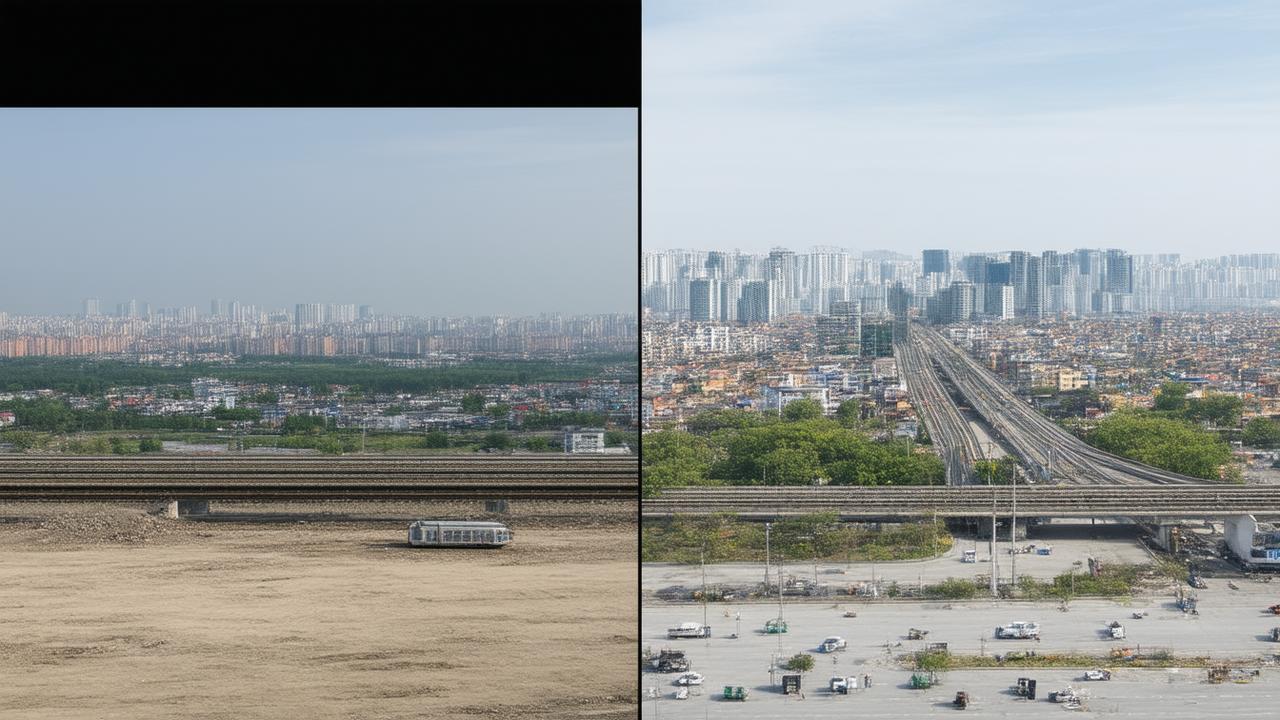
The first time I saw a photograph of a half-finished metro station surrounded by bare fields in China, it looked like a misprint. A sleek glass entrance, escalators gleaming, platform lights already wired in—and around it, nothing but dusty roads, scattered construction sheds, and a stubborn line of horizon. No city. No office towers. No shopping districts. Just a promise, poured in concrete, standing in the middle of nowhere.
The Stations That Arrived Before the City
Back in 2008, if you were following global news from a comfortable distance, it was easy to laugh. Commentators did it all the time. They called it vanity building, overreach, “bridges to nowhere” upgraded to “metros to nowhere.” Headlines rolled in: empty trains, silent stations, ghost cities. The photos were striking—wide boulevards with no cars, perfect new apartment blocks with no curtains in the windows, metro entrances rising from wheat fields like misplaced sculptures.
From a train window, it would have looked surreal. A brand-new station sign with a precise Chinese name, a tidy square of pavement laid out like a welcome mat in a landscape that still smelled of wet earth and cement dust. You might have stepped off just to see whether anyone actually used it. Maybe there’d be a guard in a faded uniform, a lone migrant worker napping in the shade, a vendor with a tiny plastic table selling instant noodles and cigarettes. Then the silence again.
From far away, in Europe or North America, we turned those images into memes and think pieces. Financial analysts waved graphs and spoke about “overcapacity” and “malinvestment.” Urbanists tutted about top-down planning. Ordinary people—scrolling through articles between emails—shook their heads and thought: What a waste. They have no idea what they’re doing.
We didn’t realise that we were looking not at a mistake, but at a time machine.
The Quiet Logic Beneath the Dust
To understand those empty metro stations in 2008, you have to remember what the world felt like back then. The global financial crisis was shredding confidence everywhere. Banks were crumbling, home values were collapsing, and infrastructure projects in many countries were the first things to be cut. Budgets shrank, timelines slipped, and the future started to feel smaller, not bigger.
In China, it was different. The state opened the tap. Railways, highways, power grids, airports, metro systems—blueprints flew from desks to job sites with dizzying speed. Digging began. Boring machines carved under cities whose edges were still fuzzy. And outside those city cores, in areas that most people still called farmland or outskirts, stations began to rise like out-of-place sentinels.
They looked absurd to us because we had trained ourselves to believe that infrastructure should follow demand. You prove you need a road by first enduring traffic jams. You prove you need a metro line by watching buses overflow and streets choke on cars. Only then do you argue for tracks and tunnels. We were used to scarcity, delay, and retrofit. We built for yesterday’s needs and called it “prudent.”
China was building for tomorrow’s bodies on platforms that, for the moment, didn’t exist.
When the Future Is the Client
There’s an unspoken rule in many Western cities: we will build where people already are. China flipped the script. It built where people were going to be—years, even decades before the crowds arrived. The “client” of those metro stations wasn’t the lonely guard sitting under a temporary awning in 2008. It was the factory worker’s daughter, who would graduate from a new university campus in 2018. It was the couple who hadn’t yet left their village, who would one day ride that line to their jobs in a tech park that wasn’t on any current map.
That wasn’t magic. It was ruthless, data-heavy planning mixed with political will. Population projections, industrial relocation plans, new university districts, housing quotas, five-year plans stacked on thirty-year visions. The metro lines were the skeleton, laid down before the flesh of the city arrived.
The Middle of Nowhere Has a Short Lifespan
Fast-forward. One morning, a decade or so later, someone arrives at one of those stations that once made the news as a punchline. Only it’s no longer in the middle of nowhere.
There’s a coffee shop on the corner, crowded with students staring into laptops over paper cups. Outside the station entrance, electric scooters stream past, whining softly. An LED billboard flashes an ad for a software company whose name didn’t exist when the station’s foundations were poured. Apartment windows are no longer dark squares of speculation; they glow at night with the light of televisions and kitchen stoves. A delivery rider shoulders past you, balancing insulated bags of noodle soup, racing the countdown on someone’s phone screen.
That same station building hasn’t moved an inch. The world around it has.
For years, satellite images quietly documented the shift. Where we once saw brown fields, new roofs multiplied like tiles on a dragon’s back. Roads extended, then branched. Green spaces appeared. Schoolyards. Hospital complexes. Malls with underground parking. What used to be “empty” now pulsed with the messy, loud business of daily life.
By the time many of us finally visited these places in person, we had to work hard to overlay the old “middle of nowhere” photos onto what lay before us. It was like trying to recognise a childhood friend in the face of a confident adult. The bones were the same, but the context—hair, clothing, posture, voice—had changed so completely that the old judgment felt faintly embarrassing.
What the Numbers Quietly Told Us
Even if you never set foot in China, you could watch the story unfold through numbers. New urban residents by the tens of millions. Car ownership surging, then stalling as metro and high-speed rail absorbed more and more trips. Commute times in some new districts settling into manageable ranges, not ballooning into the hours-long odysseys that plague many expanding cities elsewhere.
You could see it in more human details, too. Stories of schoolkids taking safe, predictable metro rides to enormous new campuses. Elderly people visiting hospitals or parks without needing a car. Factory workers changing jobs from one side of a metropolitan area to another because a subway ride made the leap feasible. All enabled by the same system we once mocked as empty and overbuilt.
| Year | Typical View Near Some New Stations | Global Commentary Tone |
|---|---|---|
| 2008 | Construction sites, fields, sparse traffic, isolated platforms | “Wasteful overbuilding, ghost infrastructure” |
| 2013 | Emerging housing blocks, first offices and malls, busier roads | “Maybe premature, but interesting experiment” |
| 2018 | Full districts, crowded platforms, established neighborhoods | “Surprisingly effective long-term planning” |
| 2024+ | Mature urban fabric, oriented around public transit | “Maybe we underestimated this—what can we learn?” |
The Moment We Realised How Naive We Were
Somewhere along the way—no single headline, no precise date—we realised that the joke had turned around on us.
We were the ones stuck in traffic in cities that had delayed new train lines for decades. We were the ones approving modest tram extensions while arguing over every tree that might be moved. We were the ones whose airports felt like patchwork quilts of temporary fixes, whose bridges aged faster than our political cycles could handle.
China, with all its contradictions and costs, had simply decided that the future was not something to tiptoe toward. It was something to build for, ahead of schedule and at a scale most of us couldn’t quite imagine. Those lonely metro stations in 2008 were not proof of foolishness; they were receipts for a future already paid for.
Naivety, it turned out, was believing that you could approach the twenty-first century’s tidal wave of urbanisation with the same cautious, incremental habits that had defined the twentieth. Naivety was assuming that because you couldn’t fill a station today, it meant you never would. Naivety was mocking a platform in a field instead of asking what would surround it in ten or fifteen years—and what would surround us if we chose not to build.
The Moral in the Concrete
None of this is to say that every Chinese station, line, or city district was perfectly planned or ethically built. There were miscalculations, speculative frenzies, social costs. Displacement, debt, environmental strains—these are real and heavy. But those “metros in the middle of nowhere” forced a kind of mirror in front of other nations.
➡️ He left his Tesla Cybertruck plugged in and went on holiday : two weeks later, the truck refused to start
➡️ I do this every Sunday »: my bathroom stays clean all week with almost no effort
➡️ Mixing vinegar and hydrogen peroxide sounds risky, but here’s what it’s actually used for and why experts advise doing it carefully
➡️ In just two weeks, the Game of Thrones universe returns with a brand-new series that promises to expand the saga in unexpected ways
➡️ How walking the exact same routes every day quietly reshapes how the brain handles uncertainty, novelty, and change
➡️ Goodbye to grey hair: the trick to add to your shampoo to revive and darken your hair
➡️ He hired a dog sitter and later discovered through his home camera that the sitter was bringing unknown people into his apartment in ways he never expected
In that mirror, we saw something uncomfortable: we had grown so used to managing decline—or, at best, nervously rationing growth—that the idea of building boldly for a future not yet visible felt almost irresponsible. Our planning systems had become masters of saying “not yet,” while the clock on climate, housing, and mobility kept ticking.
Watching those stations fill up over the years, watching cities congeal around them, we were invited to question our own timelines. Must a train line come last? Must infrastructure always lag behind need? Or can it lead, and shape, and invite a different pattern of life?
Standing on a Platform, Between Two Worlds
Imagine, for a moment, standing on one of those platforms right now.
The tiled floor is worn at the edges where thousands of shoes have passed. The announcement chimes echo in a familiar, almost comforting cadence. A small boy is tugging at his mother’s sleeve, pointing at the route map above the doors, his fingertip tracing colored lines like rivers across his future city. A teenager in a hoodie scrolls on her phone, earbuds in, the metro screen behind her advertising a concert. Two men in work jackets share a quiet conversation, helmets dangling from their hands, on their way home from a job site that probably looks like this place did fifteen years ago—half-empty, skeptical in the world’s eyes, already underwritten in someone’s spreadsheet of the future.
You look around and think back to that smug confidence in 2008. The headlines, the scoffing, the easy certainty that this was a mistake. Then the train rushes in, doors hiss open, and the crowd flows on and off with the unremarkable choreography of a system that has done its job so well, for so long now, that people barely notice it.
And you realise: the biggest thing we misjudged wasn’t China. It was time. How fast it moves. How quickly “nowhere” becomes “somewhere” when steel rails and electric lines lace through the landscape, inviting people to step into a different life.
We still argue about whether to build the next station in our own cities. We still hesitated, even after watching this experiment play out in front of us in real time. Old habits are thick. Budgets are thin. Politics is short-sighted. But the story is there, written in the dust and the glass and the hum of trains gliding into stations that used to be punchlines.
One day, perhaps, we’ll step onto a new platform in our own corner of the world—somewhere that, right now, still smells of wet soil and concrete. And instead of calling it the middle of nowhere, we’ll call it what those Chinese stations really were all along: the beginning.
FAQ
Why did China build metro stations in seemingly empty areas?
Many of those stations were part of long-term urban plans. They were built in anticipation of future population growth, new housing districts, industrial parks, and university campuses. Instead of waiting for congestion and overcrowding to prove the need, planners built infrastructure first to shape how growth would unfold.
Were those “metro stations in the middle of nowhere” actually used at the time?
In the early years, some stations had very low ridership and looked almost deserted. Over time, as surrounding neighborhoods, offices, and campuses were completed and occupied, usage climbed. In many cases, those once-empty stations are now busy parts of large urban networks.
Did this approach cause financial problems for China?
China’s rapid infrastructure build-out did contribute to high levels of local government debt and some overcapacity in certain regions. However, it also underpinned economic growth, improved mobility, and supported urbanisation. The overall balance of cost and benefit is still debated by economists, but the visible outcomes in many cities are significant.
Could other countries copy this “build first” model?
Parts of the model can be adapted—especially the idea of planning transport and land use together and building ahead of demand in strategic corridors. But it depends on political systems, financing mechanisms, and social context. Not every country can or should replicate China’s exact pace or scale, though many can learn from the long-term mindset.
What is the main lesson from these stations for future city planning?
The core lesson is that infrastructure doesn’t just respond to cities; it helps create them. Building transit early can guide sustainable growth, reduce future congestion, and make new neighborhoods more livable from day one. Waiting until “demand is proven” often means locking in car dependence and expensive retrofits later.





