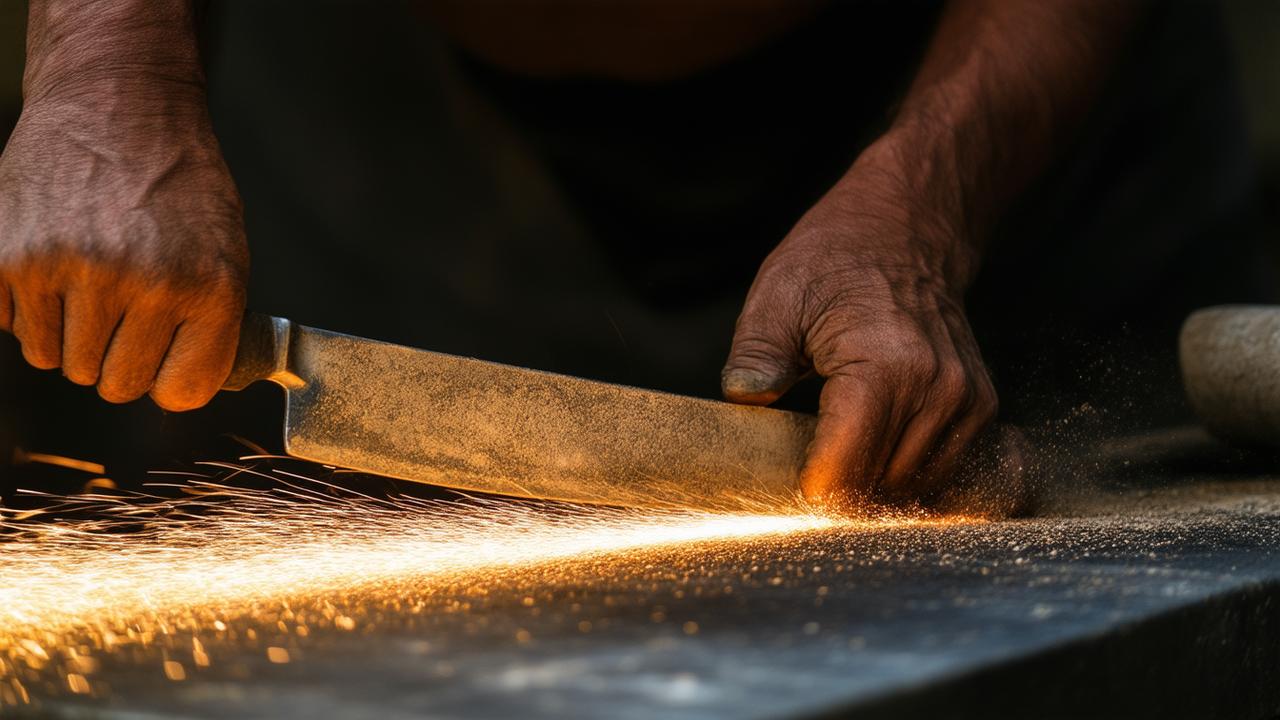
The first time I heard that sound, I thought something was about to explode. A high, sharp whine, like a bee trapped in a tin can. It cut straight through the chaotic music of an Indian street: honking rickshaws, sizzling samosas, vendors calling out prices for mangoes piled like small suns on wooden carts. I turned toward the noise and saw him—an old man on a bicycle, hunched but steady, pedaling slowly with a strange contraption mounted to the front wheel. Sparks flickered near his knees. And in his hands, held with the care of a jeweler studying a rare stone, was a kitchen knife.
The Bicycle That Turned Steel into Lightning
He had parked at the corner of a narrow lane in Jaipur, half in the shade of a banyan tree, half in the furnace of the afternoon sun. His bicycle looked like a hundred others at first glance—chipped blue paint, rusty handlebars, a squeaky chain. But welded to the frame near the front wheel was a spinning stone wheel, the color of river rock, humming as it turned. Every push of the pedals set the stone spinning faster.
A woman in a bright red sari stood nearby, cradling a bundle of knives in the crook of her arm. They looked like family heirlooms—old, darkened steel, wooden handles smoothed by years of chopping onions, tomatoes, coriander. She handed one to him. He nodded with the calm assurance of someone who’d done this a thousand times, then moistened the spinning stone with a quick splash from a small metal cup.
He held the blade against the wheel at a slight angle, firm but responsive, like a musician pressing fingers to strings. The contact made that loud, singing scrape. Tiny sparks leaped and vanished in the air. The woman watched, relaxed, as if she were seeing a familiar ritual. In under a minute, he dipped the knife into a bucket of water beside him, wiped it once on a cloth tied to the bike, and handed it back to her. She tested the edge on a piece of paper from her bag. It sliced like a quiet whisper.
Something about that moment grabbed me more than the palaces, the markets, or the temples had. It felt ancient and utterly practical at the same time. A few simple tools. A bit of technique. A man on a bicycle turning dull steel into lightning in sixty seconds.
The Lesson in the Street
I must have stared too long, because he caught my eye and gestured with a nod that was somewhere between “Curious, are you?” and “Come closer if you’re going to keep watching.” I stepped forward, heat from the pavement pressing up through my shoes, the smell of dust and fried snacks hanging thick in the air.
He didn’t speak much English, and my Hindi was limited to greetings and basic politeness, but the language of tools is mercifully simple. He pointed at my pocketknife—an old, neglected thing I’d carried on the trip. I pulled it out, embarrassed by its rounded, useless edge.
He examined it with the exaggerated seriousness of a doctor reading an X-ray, then smiled, as if to say, “We can fix this.” He motioned for me to watch closely.
What struck me was not just the process, but his attention. He adjusted the angle of the blade almost imperceptibly, feeling it rather than measuring it. His fingers moved with an easy intelligence, maintaining just enough pressure to kiss the stone, not fight it. Every few seconds he’d turn the knife, working evenly along both sides, moving from heel to tip in a steady rhythm that matched his pedaling.
He didn’t rush. To me, it looked fast; to him, it was simply the natural tempo of someone who could probably sharpen a knife in the dark and still get it perfect. In less than a minute, he stopped. Another dip in water. A wipe on the cloth. He offered the knife back.
I drew the edge lightly across a scrap of paper from my notebook. It sliced smoothly, no tearing. “Bahut accha,” he said—very good. I nodded, but what I meant was: I need to learn this.
Bringing India’s Edge Back Home
Back home, my kitchen drawer was a graveyard of old knives. Cheap supermarket chef’s knives. A sentimental paring knife from my first apartment. A heavy, once-expensive knife I’d stopped using because it had become more like a crowbar than a cutting tool. They all had one thing in common: dull, sad edges.
Before India, I’d half-believed that sharpening knives was some mysterious craft only professionals could really master. I’d tried a pull-through sharpener once—it screamed along the blade like it was furious with it, leaving a jagged edge that felt wrong. I’d watched a couple of online videos about whetstones but never stuck with it. It just seemed…fussy.
But that old man on his bicycle changed something in my mind. He used maybe three things: a spinning stone, water, and the right angle. No gadgets. No elaborate setups. Just repetition, feel, and respect for the steel.
So I decided to recreate the spirit of that technique at home, minus the bicycle.
Simple Tools, Old Knives, New Life
I started with a standard double-sided water stone—nothing fancy, just a medium grit on one side and a finer grit on the other. I’d seen plenty of people soak these stones and fuss over them, but I tried to remember how casual and confident the man in India had been. Stone. Water. Angle. Motion. That’s it.
I pulled my oldest, most abused chef’s knife from the drawer, its once-proud edge now as blunt as a spoon. It seemed like the perfect candidate—if I ruined it, nothing was lost. If I revived it, everything changed.
I placed the stone on a damp towel to keep it from sliding, dripped water across the surface, and held the knife the way I’d seen in India—with the blade angled just enough that the edge, not the side, kissed the stone. I remembered his steady rhythm, how the metal glided, not scraped. I tried to copy that motion: heel to tip, gentle, consistent, like spreading butter slowly across bread.
The sound was different from the bicycle wheel’s high shriek. This was softer, a sandy whisper, like a small stream over gravel. As the water clouded with gray, I realized that was the blade itself, shedding old metal, revealing a new line of possibility underneath.
And in that moment, I understood: this wasn’t mystical. It was just controlled abrasion. Remove the tired steel. Shape a new edge. Respect the angle. Be patient—but not that patient. Because to my surprise, after barely a minute of work, something subtle had changed.
The Moment a Blade Wakes Up
There’s a tiny thrill in testing a knife you’ve just sharpened yourself. I rinsed the blade, wiped it dry, and picked up an onion. Instead of crushing its layers, the knife slid in with almost no resistance, so cleanly the onion seemed briefly confused about being cut at all. The pieces fell away neatly, no ragged edges, no slipping.
But I wanted proof. I grabbed a sheet of paper and held it by one corner. The knife, once dull enough to struggle with tomatoes, now slipped through the paper with the same satisfying glide I’d seen on that Jaipur street. Not just sharper—but precise, confident. It felt alive in my hand.
That was the moment I realized: I could take almost any old knife in my kitchen and, in about a minute, bring it back from the dead.
The One-Minute Ritual
Now, whenever a knife starts to feel the least bit tired, I give it the same treatment. It’s become a quiet ritual, a small ceremony of steel and water before I cook:
- A quick splash of water on the stone.
- Blade at a steady angle, a handful of smooth strokes on one side.
- Flip. Repeat.
- Rinse. Dry. Test on paper or a tomato skin.
It rarely takes more than a minute. The knives never reach that depressing, fully dull state anymore. Instead, they hover in that sweet spot where cutting an onion feels like a satisfying glide rather than a chore.
It’s not magic. It’s simply staying close to the process, like the man on the bicycle—touching up frequently, not waiting until the blade is a lost cause. The real secret I learned in India wasn’t the tool, but the habit.
➡️ He hired a dog sitter and later discovered through his home camera that the sitter was bringing unknown people into his apartment in ways he never expected
➡️ I kept turning up the heat and still felt cold: experts explain this common home problem
➡️ Hanging bay leaves on the bedroom door: why it’s recommended
➡️ If you want your kids to respect you when they are older stop clinging to these 8 selfish habits
➡️ Goodbye microwave as households switch to a faster cleaner device that transforms cooking habits
➡️ Goodbye to the dining table : the new trend from abroad that replaces it for good in homes
➡️ Most people store cleaning products incorrectly, making them less effective
What I Actually Learned from That Bicycle
The bicycle sharpener in India could probably have used a fancy electric machine if he wanted. But the beauty of his setup was its simplicity. It brought home a few lessons I keep returning to every time I pick up a knife.
Respect the Edge, Not the Brand
In that busy Indian street, no one was talking about premium steel, imported chef’s knives, or designer handles. People handed him whatever they had—thin, wobbly blades, heavy cleavers, paring knives with chipped handles. He didn’t flinch. Steel is steel. A good edge is something you make, not something you buy.
Back home, I discovered that my cheapest knives, once given proper attention, cut better than an expensive brand-name knife I’d neglected. The logo etched on the blade matters far less than what you do with the first millimeter of metal along its edge.
The Rhythm Matters More Than the Tool
We love gadgets. Electric sharpeners, pull-through devices, elaborate multi-stone systems. But what the old man had was rhythm and repetition. His feet spun the wheel at a consistent pace; his hands moved the blade smoothly, no rush, no hesitation.
When I sharpen at home, I’m not trying to copy his exact movement. But I am borrowing his rhythm—steady, unhurried, confident. The more I do it, the more I feel the subtle feedback of the steel, the way the blade almost tells you when it’s ready.
A Small Table of What Changed for Me
Living with sharp knives versus dull ones transformed not just how I cook, but how I feel in the kitchen. Here’s how it breaks down in my daily life now:
| Before Sharpening at Home | After Learning the Indian Way |
|---|---|
| Knives crushed tomatoes and tore herbs | Clean slices through skins and leaves with no effort |
| I avoided cooking tasks that required a lot of chopping | Chopping became almost meditative, something I look forward to |
| Old knives sat unused, destined for the trash | Almost every old knife got a second life in daily rotation |
| I thought sharpening was a “pro-only” skill | Now I treat sharpening like washing dishes: just part of cooking |
| I bought new knives to solve a dullness problem | I fix the problem in about one minute, with water, stone, and habit |
Old Knives, New Stories
Sometimes, when I sharpen that first cheap knife I ever owned, I think of the man in Jaipur. I imagine him pedaling through heat waves rising off the road, the rasp of steel on stone ringing out between parked rickshaws and tea stalls. His world is far from my quiet kitchen, but the gesture is the same: a hand, a blade, a surface, a bit of water, and attention.
We’re not just restoring metal when we sharpen an old knife; we’re rescuing the stories tied to it. The knife a grandmother used for decades. The one that moved with you from apartment to apartment. The one that chopped vegetables for a first home-cooked meal with someone you love. These objects don’t deserve to be thrown away just because they lost their bite.
Now, when a friend complains about their dull knives, I don’t recommend a brand. I tell them a story instead—about a bicycle on a hot Indian street, about sparks in the sun, about an old man who trusted simple tools and his own hands. Then I show them what I learned: that in less time than it takes to boil water, they can wake a sleeping blade.
In that sense, every time I run steel across stone in my kitchen, I’m not just sharpening knives. I’m pedaling, in my own quiet way, through that same current of tradition—keeping alive a small, practical magic that travels easily from a crowded lane in India to wherever you happen to be standing with a dull knife and a minute to spare.
FAQ
Do I need special or expensive knives to sharpen them like this?
No. The beauty of this approach is that almost any basic kitchen knife can be made sharp again. Higher-quality steel may hold its edge longer, but even inexpensive knives become dramatically sharper with a simple stone and the right technique.
How long does it really take to sharpen a knife at home?
Once you get the hang of it, touching up a knife usually takes about a minute. Very damaged or heavily dulled knives may take a few minutes at first, but routine maintenance is quick.
Is sharpening on a stone difficult to learn?
It looks intimidating at first, but it’s mostly about consistency, not perfection. If you can hold the blade at a steady angle and move it smoothly over the stone, you can learn. After a few tries, your hands start to remember the motion naturally.
Do I need a bicycle-style wheel like the one in India?
No. The bicycle wheel is just a way to spin a sharpening stone using leg power. At home, a simple stationary water stone works very well. The principle is the same: a hard surface, some abrasion, water, and a steady angle.
How can I tell if my knife is truly sharp?
A sharp knife should slice cleanly through paper, glide easily through tomato skin, and cut onions without slipping or crushing. You should never have to force it. Light, controlled pressure should be enough to do most tasks.





