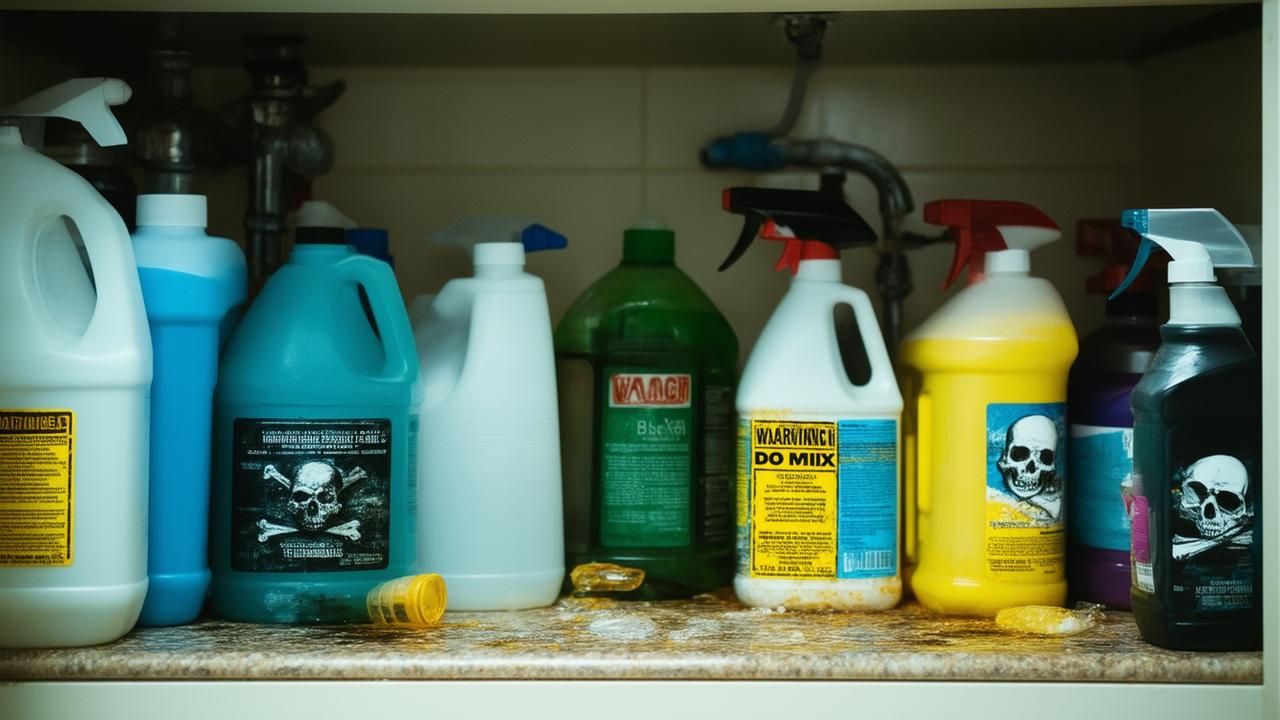
The vinegar smell hit me before I opened the door. Not the gentle, tangy hint of a well-wiped countertop, but the sharp, heavy wall of odor that says someone has been at war with germs. The closet was dark and overstuffed, shelves sagging under a strange, colorful skyline of spray bottles, half-crumpled refill pouches, and sticky tubs of mystery paste. A blue bottle lay sideways, its label half-peeled, its trigger crusted white. A spray of something had dried in a glittering arc across the doorframe. The whole space smelled like a hospital married a swimming pool and then moved into a damp basement.
The owner of this chemical city—my friend, Mara—stood behind me, arms crossed, a little proud and a little embarrassed. “At least I’m prepared,” she said. “I mean, I clean all the time.”
I picked up one bottle. It sloshed dully, a weak, watery sound. The label told another story: “Store in a cool, dry place. Keep tightly closed. Protect from heat and direct sunlight.” Someone had once written the purchase date in marker down the side. It read: April 2019.
Prepared, yes. Effective? That was another question entirely.
The Secret Life of Cleaning Products
Most people think cleaning products are like rocks: stable, inert, always ready for action as long as there’s still some liquid left in the bottle. But cleaners are more like fresh herbs than canned beans—full of volatile ingredients, sensitive to light and heat, quietly changing when you’re not looking.
Walk through any typical home, and you’ll see the same pattern repeating: bleach stashed under the kitchen sink next to the dishwasher’s warmth; glass cleaner sweating in a sunlit bathroom window; a collection of multipurpose sprays living on top of the dryer, where the air turns warm and lint floats like pale snow. Cupboards smell like a collision of pine, lemon, ammonia, and something not entirely identifiable.
On the surface, it looks like a sign of dedication. So many tools, so much sparkle. But underneath, many of those products are slowly becoming weaker, less reliable, and in some cases, more dangerous. We don’t think of storage as part of cleaning, but it’s the first quiet step that decides whether all that scrubbing will actually work.
Cleaning agents are built from reactive ingredients—acids, bases, surfactants, oxidizers. They are designed to do something: break down grease, eat soap scum, kill bacteria, dissolve mineral deposits. And anything that reacts is, by nature, a little unstable. Stored well, those reactions happen on your countertop or in your sink where you want them. Stored badly, they start happening inside the bottle instead.
The Warm Cupboard Problem
Imagine a hot summer afternoon. The kitchen hums with heat from the oven, the sun slants across the tiles. Under the sink, down in that cramped, half-forgotten space where the pipes sweat and the air never really moves, a cluster of plastic bottles stands like nervous soldiers. The temperature rises slowly, then stays there—for days, weeks, entire seasons.
This is where many of us keep our most powerful cleaners: disinfectant sprays, bleach, degreasers, drain openers. It makes sense. Under the sink is near the action but out of sight. The problem is, it’s one of the worst places in the house for delicate chemistry.
Heat acts like a fast-forward button on chemical breakdown. Bleach, for instance, is a solution of sodium hypochlorite. At moderate temperatures and with enough time, it starts to decompose, releasing oxygen and losing its disinfecting power. That bottle you pull out for a once-a-month bathroom deep-clean might already be a shadow of its former self. It will still smell strong—chlorine has a vivid presence even when the disinfecting punch has faded—but smell is a poor guide to effectiveness.
Then there’s humidity. Under-sink cupboards are often damp, especially below a leaky pipe or near dishwashers. Over time, moisture can seep into caps not fully tightened, dilute concentrates, or encourage labels to peel off and vanish—the very labels that tell you how to store the product and what not to mix with what. That dampness can also corrode metal parts of sprayers, introducing rust flecks or clogging triggers, leaving you with a bottle that wheezes rather than sprays a fine, even mist.
Yet we keep tucking more bottles under there, convincing ourselves that a crowded cupboard means a cleaner home, not realizing that we’re slowly turning a good-intentioned stash into an ineffective museum of once-powerful potions.
Sunlight, Seasons, and Quiet Chemistry
Now walk into an ordinary bathroom on a bright day. Light pools on the tiles, catching the edges of a glass cleaner bottle perched casually on the windowsill. Beside it, a plastic tub of scrubbing paste sits half-open, grains hardened around the rim like mineral cliffs.
Products that sit in sunlight age differently from those in the dark. Bright windows can be brutal on certain chemicals, particularly dyes, fragrances, and some active ingredients in specialized cleaners. Ultraviolet light nudges molecules into new shapes. Sometimes that just fades the color on the label. Other times, it quietly nibbles away at the product’s strength.
Think of that bright blue toilet cleaner that slowly turns a little duller as months pass, or the once-sharp citrus scent that now smells strangely flat. It’s a hint that more than the fragrance may be changing. While you scrub, you might feel reassured because the scent still screams “clean,” but the chemistry might no longer be fully backing up the performance.
Then there are seasonal shifts. Garages and utility rooms swing from chilly in winter to scorching in summer. Many people stash big jugs of detergent, bleach, or floor cleaner there, thinking of them as durable supplies that can handle anything. But freeze-thaw cycles can separate ingredients; extreme heat can swell bottles, warp caps, or speed up breakdown reactions. Over time, you get products that look a little layered, or oddly cloudy, or separated into swirling zones when you shake them.
Most of us shrug and use them anyway. “It’s just cleaner,” we say. “What’s the worst that can happen?” Often, the answer is simple: nothing. Or at least not much. That stain stays faintly visible. That invisible film remains on the counter. Germs linger in tiny colonies, unbothered by the weak dose your old disinfectant can now deliver.
The Dangerous Dance of Mixing and Crowding
Open a crowded cleaning shelf and you can read the story of a household in brands and promises. “Kills 99.9% of bacteria.” “Powerful degreaser.” “Industrial strength.” Bottles jostle for space, labels hidden as they press against each other. Sometimes caps get knocked loose. Sometimes a bottle leaks. Sometimes two products, never meant to meet, mingle in a sticky puddle at the back.
Here’s the part that quietly unnerves chemists: some of the most common household cleaning ingredients should never be stored near one another if there’s even a small chance of leaks or casual mixing.
Bleach alongside an acid cleaner—like that sharp-smelling toilet descaler for limescale—can spell trouble. If the liquids combine, even in a tiny amount, they can release chlorine gas, which can irritate or damage lungs and eyes. Ammonia-based cleaners, popular for glass and some multipurpose uses, are another bad partner for bleach. Even the fumes from strongly scented products can interact in poorly ventilated spaces, creating a soup of volatile compounds you’d never knowingly choose to breathe.
Yet we often throw everything into one basket or cupboard: bleach next to descaler, ammonia glass cleaner beside the drain opener, that all-purpose spray squeezed sideways so the trigger digs into the cap of another bottle. We rarely think about what would happen if one of those bottles tipped, cracked, or slowly leaked.
Crowding also makes it harder to see what you already own. So we keep buying more. Another bottle because we can’t find the one from last month. A new brand that promises to finally tackle the shower door. Slowly, older products drift to the back where they age in silence. When we rediscover them years later, we feel thrifty for using them up. We don’t see that, by then, they may be little more than scented water or weakened soap.
| Type of Product | Common Storage Mistake | What Happens Over Time |
|---|---|---|
| Bleach & Disinfectants | Kept in warm, damp cupboards or near stoves, stored next to acids or ammonia cleaners | Lose disinfecting power faster; risk of harmful gas if leaked or mixed with incompatible products |
| Glass & Window Cleaners | Left on windowsills in direct sunlight, caps half-open | Fragrances fade, solvents weaken slightly, streaking increases, performance becomes less reliable |
| Acid Descalers (limescale/removers) | Stored under sinks with metal items, close to bleach | Can corrode metal surfaces, labels, and caps; dangerous if combined with bleach products |
| Detergents & Laundry Liquids | Kept in hot garages, on dryers, or freezing sheds | Ingredients separate or thicken; cleaning efficiency drops; can leave residue on fabrics |
| Powdered Cleaners | Left open in humid rooms like bathrooms | Clump and harden, become difficult to measure, and can lose some scrubbing and cleaning ability |
Creating a “Cool, Dry Place” in a Real Home
Almost every label carries the same quiet request: “Store in a cool, dry place.” It sounds like it belongs on a farm, not in a third-floor apartment or a small house with one overworked closet. But “cool and dry” doesn’t have to mean perfect. It just means: away from extremes, away from obvious sources of heat and moisture, and away from accidental mixing.
It might be the hallway closet where coats hang and shoes line up on a mat. It might be a high shelf in the laundry room that doesn’t get direct sun. It might even be a simple plastic bin stored on a bedroom closet floor, where temperatures stay fairly stable year-round. The goal is not to make cleaning products the honored guests of your home, but to stop treating them like they’re indestructible.
One of the most powerful acts you can take is surprisingly gentle: go through what you already have. Pick up each bottle and look at it like a naturalist examining a strange species. Is the liquid still clear, or has it turned cloudy? Does it smell the way it did when you first bought it, or oddly sour or “off”? Has the label faded so much that the warning text is barely readable? Is there residue crusted around the cap?
➡️ If you want your kids to respect you when they are older stop clinging to these 8 selfish habits
➡️ Goodbye microwave as households switch to a faster cleaner device that transforms cooking habits
➡️ Goodbye to the dining table : the new trend from abroad that replaces it for good in homes
➡️ Heating: the 19°C rule is outdated: experts reveal the new recommended temperature
➡️ Michael Schumacher, the new separation
➡️ Marine biologists warn of a troubling shift in orca interactions with vessels
➡️ IKEA brings a cult sofa back from the dead after 50 years – design fans rush to get one
You’ll start to see a pattern: some products hold up well, others less so. You’ll also see which bottles you reach for again and again, and which ones you’ve never really trusted or liked. This quiet audit is the moment your cleaning cupboard stops being a chaotic archive and becomes an intentional tool kit.
Choosing Fewer, Better, and Better-Stored
Most homes don’t really need a dozen specialized cleaners. A few well-chosen products, stored with care, will do more for your counters, floors, and air than an army of half‑effective bottles aging in the dark. A solid routine might be built around an all-purpose cleaner, a reliable disinfectant, a bathroom descaler, a glass cleaner, and a laundry detergent. Add a gentle scrub or paste for stubborn spots if you like.
Instead of buying more varieties, invest a little attention in where they live. Give them a shelf that isn’t over a heater or behind a hot appliance. Keep them in a caddy or bin so if something leaks, it stays contained, not spreading into mysterious puddles. Store bleach on its own or at least separated from acids and ammonia-based cleaners, even if that means two smaller caddies instead of one giant one.
And consider time. Most cleaning products don’t carry dramatic expiration dates, but many lose strength after a year or two, especially once opened. A simple marker note—“Opened May 2025” on the bottom of the bottle—can quietly guide you. If a disinfectant has been open and half-used for years, it may be worth replacing, not out of panic, but for the same reason you wouldn’t keep old salad greens in the fridge indefinitely: freshness matters for performance.
The Clean You Can’t See
Cleaning is always partly about feelings. The citrus scent that says “Saturday chores done.” The shine on a faucet that makes the whole bathroom seem more hopeful. The satisfying slap of a freshly mopped floor under bare feet. But beneath those sensory rewards lies something less visible: chemistry doing its work—or not.
When we store products casually, we lean heavily on illusion. A strong smell stands in for disinfection. Foam stands in for grease-cutting power. Labels with words like “power” and “deep clean” stand in for the quiet, precise work of molecules breaking bonds and lifting dirt.
If you’ve ever scrubbed a shower twice and wondered why the soap scum still ghosts the glass, or wiped the kitchen counters religiously only to keep catching colds, storage might be part of the hidden story. The bottle you trust may no longer be what you think it is.
Standing in Mara’s closet that day, we made a small ritual of it. We pulled everything out, lining bottles on the floor like a strange, colorful tide pool. We checked labels, dates, colors, even scents. We recycled plastic that had gone brittle, disposed of questionably old chemicals safely, and kept only what still seemed fresh and useful. Then we moved the survivors to a cooler, drier hallway shelf, separating bleach and acids, tightening caps, marking dates.
It didn’t feel like cleaning. It felt like editing. Like pruning a wild hedge into something healthy and intentional. Weeks later, she texted me after a quick bathroom scrub: “Is it my imagination, or is the cleaner…actually working better now?”
It wasn’t her imagination. It was simply this: when we treat our cleaning products as living chemistry instead of immortal potions, they return the favor by doing the job we bought them for in the first place. Your home doesn’t need more bottles. It needs ones that are alive to their task, sheltered just enough from heat, light, and chaos to stay potent.
And somewhere, in a quiet, cool, dry corner of your home, that work can begin.
Frequently Asked Questions
How often should I replace my cleaning products?
In general, most opened cleaning products are best used within 1–2 years, with bleach and disinfectants closer to 1 year for full strength. If a product has changed color, smell, or texture significantly, or the label is unreadable, it’s usually time to replace it.
Is it really dangerous to store bleach near other cleaners?
Yes, especially near products containing acids (like limescale removers) or ammonia (found in some glass and multipurpose cleaners). Leaks or accidental mixing can create harmful gases. Store bleach separately or in its own clearly marked bin.
What’s the best place in my home to store cleaning products?
Choose a cool, dry, well-ventilated area away from direct sunlight, heat sources, and extreme temperature swings. A hallway or bedroom closet shelf often works better than under the kitchen sink or in a hot garage.
Can old or poorly stored cleaners damage surfaces?
They can. Separated or altered formulas may leave residue, streaks, or dullness on surfaces. In some cases, increased acidity or concentration due to evaporation can make a product harsher than intended. If a product looks or smells “off,” avoid using it on delicate materials.
Do natural or “green” cleaners need special storage too?
Yes. Many plant-based or biodegradable formulas can be even more sensitive to heat and light because they rely on less stable natural ingredients and fewer preservatives. Store them cool, dry, tightly closed, and follow any label guidance closely.





