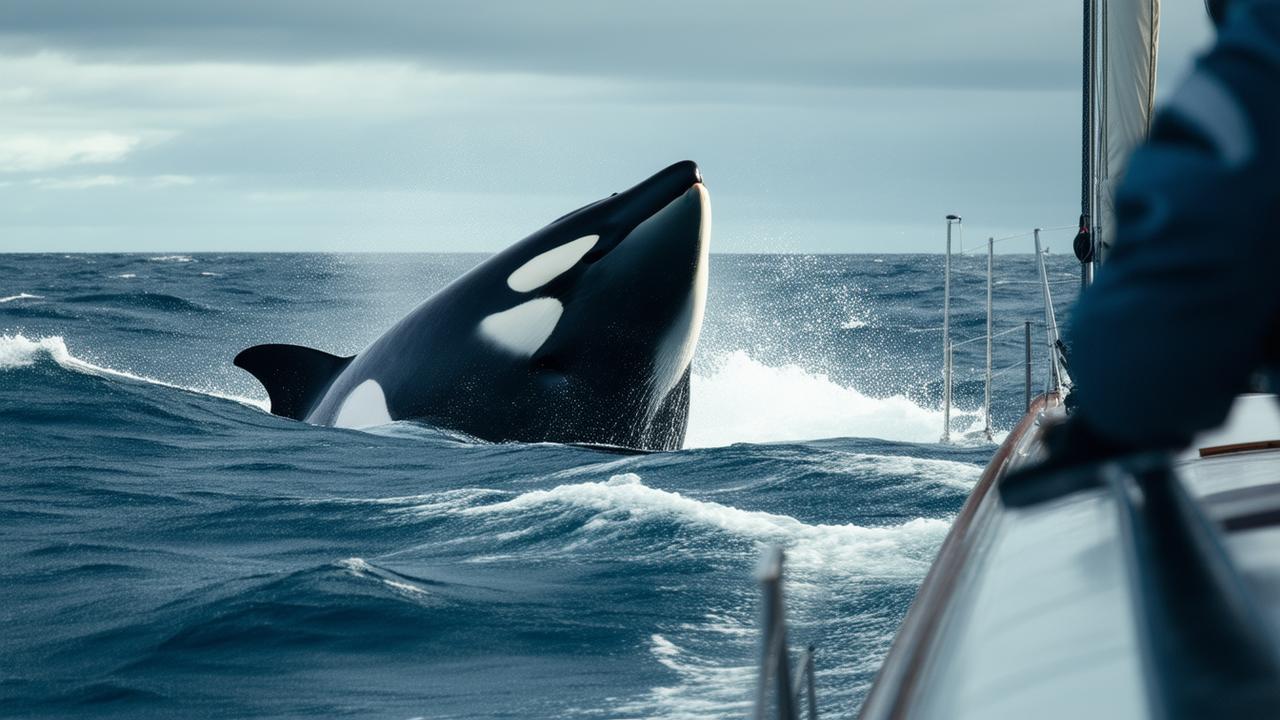
The first time a boat stopped dead in the water off the coast of Spain, the captain thought something had snagged the rudder. The sea was calm, the sky a clean blue sheet, and the only sound was the steady chug of the engine. Then came the thud—deep, hollow, like a fist on a wooden door. Another struck a moment later. And another. Beneath the surface, a small pod of orcas circled the vessel with unnerving focus, not as curious onlookers, but as deliberate actors. Within minutes, the steering was gone. The humans on board, suddenly very small in the vast, glittering Atlantic, realized they were no longer in control.
When Curiosity Turns Into Contact
For years, orcas were the ocean’s patient shadows—slipping silently along hulls, surfacing like ink-black punctuation marks in the wake of ships. Sailors spoke of them with wary respect, but also with affection. These were the “wolves of the sea,” yes, but intelligent, social, often more interested in each other than in the slow, lumbering silhouettes of human boats.
Then, almost without warning, the stories began to change. Off the Iberian Peninsula, especially near the Strait of Gibraltar, yachts and smaller sailing vessels started reporting unnerving encounters. Not just sightings. Not just playful bow-riding or distant breaches. The orcas were making contact—forceful, targeted, and sometimes destructive contact.
Marine biologists listened carefully as incident reports rolled in: rudders smashed or stripped, steering systems disabled, hulls rammed again and again. Crews described the animals as focused and coordinated, singling out a vulnerable part of the boat and working at it with grim persistence. What might have once been interpreted as play started to look uncomfortably like strategy.
The Pattern Scientists Can’t Ignore
At first, it was easy to dismiss as anecdote. A strange episode here, an odd encounter there. But data has a way of sharpening hunches into warnings. Researchers compiling reports from sailors, coast guards, and maritime agencies began to see a pattern: these were not random events sprinkled across distant oceans; they were clustered in particular regions and often involved the same groups of animals.
In some pods, scientists watched specific individuals—often younger orcas—taking the lead in interactions with boats. They would approach the stern, dive beneath the hull, and strike the rudder with their heads or jaws. Other pod members watched, learned, and soon joined in. It resembled cultural transmission, the same process through which orcas learn hunting techniques, song variations, or migratory routes.
Marine biologists now refer to these incidents more cautiously, as “interactions,” but beneath that neutral language sits a persistent unease. Something has changed in the relationship between orcas and vessels, and while no single explanation has emerged, the urgency is undeniable. Researchers are not just counting encounters—they are racing to understand what, exactly, has shifted in the orcas’ world to trigger them.
A Troublesome Blend of Stress, Play, and Culture
Ask three marine biologists why orcas are doing this, and you may get three slightly different answers, each tinged with humility. No one can see the ocean entirely through an orca’s eyes. Yet several threads keep rising to the surface, weaving a picture of an animal responding to a rapidly changing sea.
There is the idea of play. Orcas are famously curious and inventive. They toss kelp, harass seabirds, surf in boat wakes, and teach calves new games the way human adults show children how to skip stones. Some scientists believe these boat interactions may have started as an experimental behavior—perhaps one young orca discovered that striking a rudder made the entire vessel shudder, an irresistibly dramatic reaction. Others imitated, and the behavior spread, like an oceanic fad.
But if this is play, it is not harmless. And play alone may not be the whole story. Another layer may be stress—the background hum of human pressure that orcas cannot escape. Ship traffic, underwater noise, dwindling prey, entanglements, and injuries turn their once-spacious realm into a maze of hazards. In some cases, specific orcas have been observed with wounds or scars that may be linked to vessel strikes or fishing gear. It is not unreasonable to wonder whether some interactions are tinged with aggression or a kind of defensive testing of a dangerous presence in their environment.
Cultural memory also matters. Orcas live in close-knit, matrilineal societies. They share knowledge across generations, and behaviors can ripple through a population like news through a village. Once this focused attention on boats entered the orcas’ repertoire, it may have been carried forward not by a single motive—play, anger, curiosity—but by the simple fact that it worked. It produced a big, noticeable response from an object that usually ignored them. In a sea of changing certainties, that might be compelling enough.
The Human Side: Fear, Awe, and Uncertainty
On board, the experience is visceral. One sailor described the sound of a rudder strike as “like a car crash happening underwater.” Another recalled the uncanny sensation of being watched—huge eyes rising beside the hull, unblinking, assessing. The line between wonder and fear blurred as they realized the animals were not just passing by; they were engaging, intentionally, with the boat itself.
It is here, in the trembling gap between agency and misunderstanding, that the emotional stakes become clear. Humans are used to manipulating the ocean—plotting routes, setting engines, cutting through waves with an assumption of control. When a pod of orcas disables your steering in minutes, that control evaporates. You are suddenly at the mercy of currents, wind, and the choices of a group of apex predators just meters away.
Many sailors still speak of profound awe—a sense of proximity to an intelligence that feels, in some ways, parallel to our own. Yet as encounters increase, so does anxiety. What happens if a damaged vessel is far from shore? What if there are children aboard? Where is the line between coexisting with wild animals and being placed in their path as uncomprehending participants in a drama they did not script?
Marine biologists worry not only for people, but for the orcas themselves. A frightened or desperate crew might respond with flares, loud noises, or even weapons. Authorities might feel pressure to “solve” the problem in ways that put the animals at risk. Without careful guidance, misunderstanding could escalate into conflict—between a species that has survived industrial whaling, pollution, and ecosystem collapse, and the modern maritime world that has pushed them to the brink.
Reading the Data Beneath the Waves
To move beyond anecdotes, scientists are working to map these encounters more precisely. They compile logs from sailors, GPS tracks, photographs, and video recordings, layering them with biological data on known orca families. Who is involved? When and where do they approach? How long do interactions last, and how do they end?
The picture is complex, but certain trends are beginning to emerge. Many interactions occur in predictable seasons, often overlapping with the migration of tuna or other key prey species. Some pods appear much more inclined to interact with vessels than others, suggesting that this is a learned, localized culture rather than a global orca uprising.
Researchers also compare orca-boat interactions with broader environmental shifts. Warmer waters, shifting fish stocks, increased shipping routes, and noisier seas all create a backdrop of instability. In this context, each rudder strike is not an isolated anomaly, but a data point in a story of adaptation, experimentation, and—perhaps—protest against a world transformed by engines and steel.
| Aspect | Key Observations |
|---|---|
| Typical Location | Coastal waters, particularly off the Iberian Peninsula and near busy straits and shipping routes. |
| Vessels Involved | Mostly sailing yachts and smaller recreational boats, occasionally fishing and research vessels. |
| Primary Target on Boats | Rudders and steering components, rarely the main hull. |
| Orca Behavior | Coordinated approaches, repeated ramming or biting, apparent observation and imitation among pod members. |
| Human Responses | Cutting engines, staying quiet, calling authorities, occasionally using deterrent sounds or devices. |
Sharing the Sea Without Turning It Into a Battlefield
While scientists work to decode motives, they are also issuing practical guidelines—thin lines of strategy drawn across a shifting seascape. These recommendations are as much about protecting orcas from humans as they are about guarding humans from orcas.
Many experts now advise slowing down or cutting the engine if orcas approach, avoiding sudden maneuvers that might ignite a chase response. Crews are encouraged to stay calm, move people away from the stern, and resist the impulse to strike the animals or throw objects into the water. Transmitting location and situation to coastal authorities can speed assistance if the vessel becomes disabled.
➡️ If you want your kids to respect you when they are older stop clinging to these 8 selfish habits
➡️ Goodbye microwave as households switch to a faster cleaner device that transforms cooking habits
➡️ Goodbye to the dining table : the new trend from abroad that replaces it for good in homes
➡️ Most people store cleaning products incorrectly, making them less effective
➡️ Heating: the 19°C rule is outdated: experts reveal the new recommended temperature
➡️ Michael Schumacher, the new separation
➡️ IKEA brings a cult sofa back from the dead after 50 years – design fans rush to get one
Regulators, meanwhile, are exploring temporary exclusion zones, route adjustments, and speed limits in key orca habitats. These interventions are imperfect and sometimes unpopular, but they carry an important message: coexistence requires restraint. It means accepting that the ocean is not a blank blue highway built solely for human passage, but a living, contested space where other minds and other needs must be taken into account.
For sailors, the reward for that restraint may be something intangible but profound—a continued chance to share the water with a species that has long fascinated us. For scientists, it is the opportunity to watch culture unfolding in real time in another species, a rare window into non-human societies reacting to the shockwaves of the Anthropocene.
What the Shift in Orca Behavior Tells Us About Ourselves
Ultimately, the orcas are holding up a mirror. As their interactions with vessels grow more assertive, they are forcing us to reckon with a question we often avoid: how much room does our way of living leave for other forms of life to thrive, or even simply to exist without constant intrusion?
The troubling shift that marine biologists are warning about is not just a change in orca behavior. It is a symptom of a larger imbalance—an ocean increasingly shaped by our noise, our hunger, and our haste. The orcas, with their sudden thuds against fiberglass and steel, are one of the few voices loud enough to cut through the hum of engines and the comfort of distance.
Standing at the rail of a disabled boat, listening to their exhalations rise like mist into the air, you might feel fear, or awe, or an unexpected kinship. Here is another family, moving through a world they did not choose, adapting as best they can to forces far beyond their control. Their strikes on our vessels are not a message in any human language, but they are unmistakably a response.
What we do with that response—whether we answer with curiosity or confrontation, humility or dominance—will help decide not only the fate of these encounters, but the character of our shared ocean for generations to come.
Frequently Asked Questions
Are orcas intentionally trying to sink boats?
There is no evidence that orcas are deliberately trying to sink boats to harm humans. Most interactions focus on the rudder and steering components rather than the structural hull. While some vessels have been badly damaged, scientists believe these behaviors stem from a mix of curiosity, play, learned culture, and possibly stress, rather than a calculated attempt to cause catastrophic failure.
Is it still safe to sail or kayak in areas where orcas are present?
In most regions, encounters with orcas remain rare and non-aggressive. However, in areas with repeated vessel interactions, sailors are advised to stay informed about local advisories and recent incidents. Following guidelines—such as slowing down, avoiding sudden turns, and not approaching orcas deliberately—helps reduce risks for both people and animals.
Why do orcas focus on the rudder specifically?
The rudder is a moving, protruding part of the vessel that responds visibly and physically when struck. Orcas may find this dynamic feedback interesting or stimulating. Once one individual discovered this response, the behavior likely spread through social learning, with other pod members copying the technique.
Could the increase in interactions be linked to declining prey?
It is possible that a changing food supply contributes indirectly, by increasing stress or altering orca movement patterns. However, there is no clear evidence that orcas are attacking boats to obtain food. The interactions observed so far do not involve attempts to access people or supplies on board, suggesting non-feeding motivations.
What should I do if orcas start interacting with my boat?
Experts generally recommend slowing or cutting the engine, keeping people away from the stern, and avoiding attempts to touch, feed, or scare the animals with physical contact. Document the encounter if it is safe to do so, and report it to local authorities or marine research organizations. These reports help scientists track patterns and refine advice to better protect both humans and orcas.





