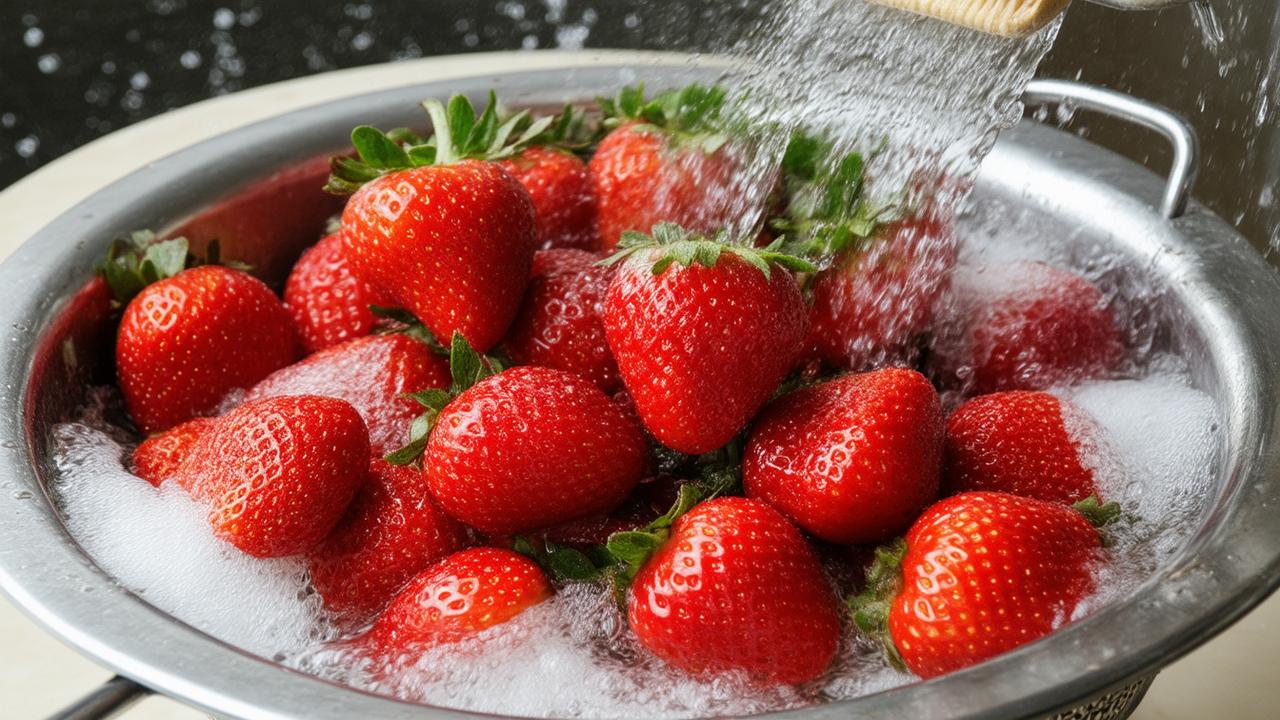
The strawberries sat in their cardboard basket like a pile of rubies, still cool from the morning air. You could smell them before you even reached out—a sun-warm sweetness, faintly grassy, edged with that wild, almost floral scent that belongs only to fruit picked at its peak. You imagine biting into one, the skin giving way with a soft snap, juice running down your fingers, that delicious rush of sugar and tartness bursting across your tongue. But instead of rinsing them quickly under the tap like a scene from a commercial, you pause. A question hangs in the kitchen air, heavier than the strawberry scent: what’s actually clinging to their glossy red skin? And is a quick rinse enough to send it all swirling harmlessly down the drain?
When a Strawberry Is More Than Just a Strawberry
Most of us want to believe that something that looks so innocent must be innocent. Strawberries feel like the essence of summer, of childhood, of simple pleasures. But behind that sweetness is a complicated story of modern agriculture, one that often includes pesticides, fungicides, and other chemicals we don’t exactly picture when we’re arranging berries on a breakfast bowl.
Walk through a commercial strawberry field at dawn and you’ll see rows of plants dressed in dew, leaves shining and fruit glowing red against dark soil or plastic mulch. Hidden in that beauty is a chemistry set: compounds meant to keep molds from blooming in damp weather, insects from chewing through tender leaves, and weeds from competing for nutrients. These sprays don’t vanish the moment they dry. Many cling to the tiny seeds dotting the surface, nestle into the dimpled skin, or linger in the microscopic creases where the green cap meets the berry.
Strawberries often rank high on lists of produce with detectable pesticide residues. That doesn’t mean every berry is dangerous, but it does mean our old standbys for washing—like a perfunctory tap-water rinse or a splash of vinegar in a bowl—aren’t as effective as we’d like to think. The question isn’t whether to wash, but how to wash in a way that respects both your body and the fruit itself.
The Myth of “A Quick Rinse Is Enough”
Picture the typical routine: you come home from the market, set the berries in the sink, twist the faucet, and let cool water rain down over them for a few seconds. Maybe you run your hand across the top of the pile, feel the fruit tumble and clack softly against one another, then call it done. They look clean, they smell clean, and the water running off them has turned faintly pink. It feels reassuring, almost ritualistic.
But surface rinsing works best on things that sit on the skin—dust, loose dirt, a bit of grit. Pesticides are sneakier. Some bind tightly to the outer layer. Some are slightly oily, resisting water the way a droplet of rain beads and slides off a waxy leaf. Others sink into microscopic pores or stay trapped around the calyx, that leafy green crown you often grab when you pop a berry into your mouth.
Plain tap water does help, of course. It can remove bacteria, bits of soil, and a fraction of water-soluble residues. It’s better than nothing. But when scientists have compared simple rinsing to other washing methods, water alone rarely comes out on top for reducing a broad range of pesticide residues. You wouldn’t try to wash a greasy pan with plain water and no soap. Strawberries, in a way, are that pan—only much more fragile.
Why Vinegar Isn’t the Magic Answer Either
Enter the internet’s favorite solution: vinegar. You’ve probably seen it—those earnest posts and glossy videos recommending a vinegar bath for berries. The idea is enticing: a cheap, natural, kitchen-cupboard ingredient that promises to strip away nasties and leave the fruit virtuous and safe. You pour vinegar into a bowl, dilute it with water, soak the berries, and imagine the residue dissolving like guilt in confession.
The reality is murkier. Vinegar does have antimicrobial powers; it can help reduce certain bacteria and mold spores, and that’s valuable if you’re trying to stretch the life of your berries in the fridge. But when it comes to pesticides, vinegar is not a universal solvent. Some residues may budge a little; many don’t. And there’s a trade-off: soak too long or use too high a concentration, and the acetic acid starts to attack the delicate skin of the strawberry. The berries soften, their flavor shifts, and that vibrant snap turns to a dull, waterlogged bite.
There’s also the sensory side. Even rinsed, vinegar-treated berries can carry a faint tang, an echo of pickling that doesn’t belong anywhere near a strawberry shortcake or a bowl of cream. The kitchen doesn’t fill with that pure, sun-warm perfume anymore. Instead, there’s a faint whiff of salad dressing.
So if water alone is not quite enough, and vinegar is not quite right, what actually works?
The Surprisingly Simple Science-Backed Soak
Imagine standing at your counter with a bowl, a tap, a container of baking soda, and a basket of strawberries that still smell like the field. The solution to your pesticide puzzle lies in that humble white powder—sodium bicarbonate. No exotic ingredient, no harsh chemicals, just something that lives quietly in most pantries, waiting for cookies and cakes and, it turns out, strawberries.
Research exploring the removal of certain pesticide residues from produce has pointed toward a mild baking soda solution as one of the most effective home methods, often outperforming simple rinsing and various commercial produce washes. The chemistry is modest but meaningful. Baking soda raises the pH of the water, which can help degrade or dislodge certain pesticide molecules, especially those that don’t yield easily to plain water. Think of it as giving the rinse a gentle but clever upgrade.
Here’s how you can turn that idea into a quiet little ritual every time strawberries come home with you:
- Step 1: Prepare the bath. Fill a clean bowl with cool water—enough to fully submerge your strawberries without crowding. For every liter (about 4 cups) of water, stir in roughly 1 teaspoon of baking soda until dissolved.
- Step 2: Add the berries, gently. Place the strawberries in the solution, making sure the water covers them. Keep the green tops on; they help protect the fruit’s structure while you wash.
- Step 3: Let them soak, but not for long. Allow the berries to sit in the baking soda bath for about 10–15 minutes. During this time, some of the pesticide residues on the surface begin to loosen or break down.
- Step 4: Swirl softly. Midway through, gently move the berries with your hands so that all sides meet the water. Listen to the faint clink of fruit against the bowl, the soft bubble of displaced water.
- Step 5: Rinse thoroughly. Lift the strawberries out with your hands or a slotted spoon, then rinse them under cool running water for at least 15–20 seconds. This step washes away both loosened residues and any lingering baking soda.
- Step 6: Dry with care. Spread the strawberries on a clean kitchen towel or paper towels and pat them dry. They should gleam, not soak.
What you end up with is a strawberry that looks and tastes like itself: the flesh still firm, the perfume intact, the sweetness unbothered—yet with far less of the invisible baggage that came in from the field.
| Method | Pros | Cons | Overall Effectiveness* |
|---|---|---|---|
| Quick tap-water rinse | Fast, no extra ingredients, removes dirt and some bacteria | Limited impact on many pesticide residues | Low–moderate |
| Vinegar + water soak | Helps reduce some microbes and mold, easy to do | Can affect flavor/texture, not consistently strong on pesticides | Moderate (mainly for microbes) |
| Baking soda solution + rinse | Gentle on fruit, science-backed for many residues | Requires brief soaking time, needs thorough final rinse | Moderate–high |
| Commercial produce wash | Designed for fruits/vegetables, sometimes helpful for waxy produce | Extra cost, uneven evidence, not always better than baking soda | Variable |
*Effectiveness can vary depending on the specific pesticides used and how the fruit was grown.
Listening to the Fruit: Texture, Flavor, and Timing
Strawberries are not patient fruit. They soften with every hour on the counter, every degree of warmth in the room. Washing them correctly is as much about honoring that fragility as it is about removing what we don’t want to eat.
The moment water touches their skin, the clock ticks a little faster. Wash too early, and moisture clings to their surface and seeps into tiny nicks and bruises, inviting mold and mush. Wash too roughly, and the skin tears microscopically, turning tomorrow’s berry into a slumped memory. The right pesticide-removal method needs to be both thorough and gentle, like washing silk by hand instead of tossing it into a machine.
A good rhythm emerges if you listen to what the fruit needs:
- Only wash the strawberries you plan to eat that day or the next. Leave the rest dry in the fridge, ideally in a breathable container lined with a towel to wick away condensation.
- Use cool, not icy, water. Extremes in temperature can shock the fruit and hasten breakdown.
- Handle them with your fingertips, not your palm, cradling rather than grabbing. You’re not scrubbing potatoes; you’re tending to something closer to a flower.
After their baking soda bath and rinse, the berries should still smell bright and wild, that signature strawberry perfume now carrying the quiet satisfaction of knowing you’ve peeled away at least some of what the field left behind.
➡️ Nasa receives 10-second signal sent 13 billion years ago
➡️ Is it better to turn the heating on and off or leave it on low ?
➡️ If the ATM keeps your card this fast technique instantly retrieves it before help arrives
➡️ Never leave your bedroom door open at night even if you think it is safer open the shocking truth that firefighters and sleep experts do not want you to ignore
➡️ How to make a rich, restaurant-quality pasta sauce at home using only 4 simple ingredients
➡️ Probably F?15s, F?16s, F?22s And F?35s : Dozens Of US Jets Now Converging On The Middle East
➡️ Nivea : I applied the blue cream every night to only one side of my face for a week, here’s what happened
Beyond Washing: Choosing Strawberries With Fewer Pesticides
Even the best washing routine is just one part of the story. The other begins long before the berries reach your kitchen—out in the fields, in the choices farmers make about how to handle pests, soil, and disease. While you can’t control every step of that journey, you can tilt the odds in your favor.
Buying from small local growers you can talk to at a market allows you to ask how they manage pests. Some may not be formally organic but still use minimal, targeted spraying or rely heavily on physical barriers and beneficial insects. Others might be certified organic, which restricts certain synthetic pesticides altogether, though not all residues vanish from organic practices either.
In your own garden or on a balcony planter, strawberries can become an experiment in ultra-low-input growing—a living rebuttal to the idea that strawberries and pesticides must always walk hand-in-hand. The berries will still need washing, because soil and microbes don’t read labels, but you’ll know more of their story. And that knowledge, combined with good washing practices, shifts the balance of what you bring to the table.
How to Turn Washing Into a Small, Mindful Ritual
There is a quiet pleasure in not rushing the moment between harvest and bite. Instead of treating washing as a chore, you can let it become part of the way you savor your food: a short, sensory pause between the noise of the day and the sweetness of the fruit.
You fill the bowl, listening to the hush of water. The baking soda dissolves like snow in a river. The strawberries go in with a soft splash, their red brightening under the water’s refracted light. While they soak, you might notice faint bubbles catching on the tiny seeds, like morning dew on a hillside. When you swirl them gently, they move slowly, bumping and rolling with the lightest touch.
On the towel, they rest like cooled embers—shiny, breathing the scent of summer into your kitchen. When you finally taste one, you’re not just tasting sugar and acid and juice. You’re tasting a choice: to pay attention, to accept that modern food comes with complexities, and to meet those complexities with both science and care.
Neither tap water alone nor vinegar is the full answer. The right way is quieter, simpler, and more grounded in what we know about how residues cling and how fruit behaves. A bowl, a spoonful of baking soda, a little time, and a gentle hand—that’s all it takes to meet your strawberries halfway between field and mouth.
Frequently Asked Questions
Do I really need to wash strawberries if they look clean?
Yes. Even spotless strawberries can carry pesticide residues, soil particles, and microbes you can’t see. Washing is less about visible dirt and more about removing what your eyes can’t detect.
Can I use salt water instead of baking soda?
Salt water can help reduce some microbes but is not as well supported by research for removing a range of pesticide residues. It may also draw moisture out of the fruit, affecting texture. Baking soda is generally a better choice.
How long is too long to soak strawberries?
Around 10–15 minutes in a mild baking soda solution is usually enough. Longer soaking can make the berries waterlogged and more prone to bruising and spoilage.
Should I remove the green tops before washing?
It’s better to leave the green tops on while washing. They help protect the interior from absorbing too much water. You can remove them gently just before eating or using the berries in a recipe.
Does washing remove all pesticides from strawberries?
No home method can guarantee complete removal, especially for residues that have penetrated deeper into the fruit. But a proper baking soda soak followed by a thorough rinse can significantly reduce many surface residues, which is an important and practical step you can take.





