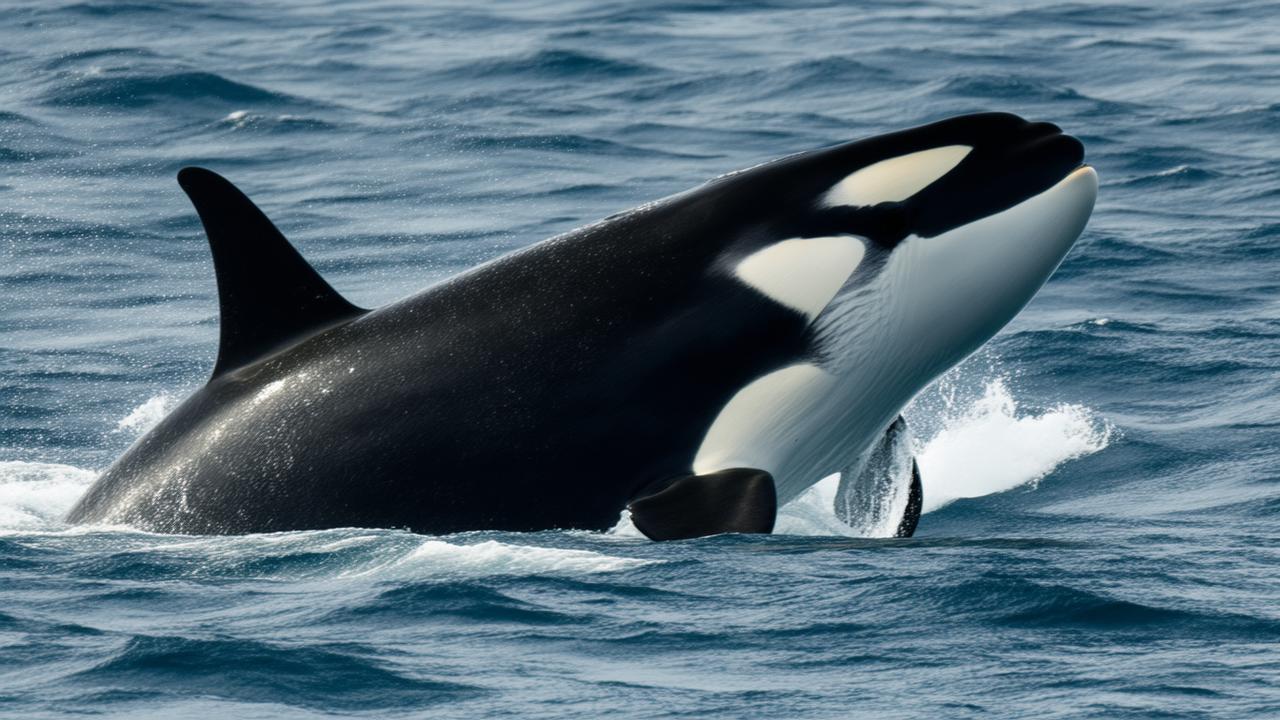
The sea was glassy when they first appeared—sleek dorsal fins slicing the surface, black and white bodies moving like brushstrokes across blue water. A small sailboat drifted under a mild Atlantic sun, its crew relaxed, lulled by the soft slap of waves against the hull. Then came the sound they still remember most clearly—not a roar or a crash, but a deep, splintering groan as something powerful struck the rudder from below. The wheel jerked hard, the boat shuddered, and beneath the water, a shape as long as a car rolled languidly on its side, eye turned upward, as if inspecting its work.
The Day the Ocean Changed Mood
It’s a peculiar thing to feel watched in the middle of open water. The crew on that sailboat later said the orcas didn’t seem enraged, exactly. Curious, yes. Deliberate, absolutely. They circled in coordinated arcs, surfacing in pairs and trios, exhaling sharp blasts of mist that drifted briefly in the sunlight. The captain tried to keep his voice even as he radioed for assistance, but everyone on board knew something was off.
Stories like this are no longer rare. Over the past few years, from the Strait of Gibraltar to parts of the Iberian coast and beyond, marine authorities have been issuing increasingly urgent warnings: groups of orcas have, according to a growing number of reports, begun showing aggressive—or at least highly disruptive—behaviour toward passing vessels. Rudders are being rammed, hulls nudged, boats spun helplessly in slow circles. Some smaller craft have even had to be abandoned after serious damage.
The ocean hasn’t changed physically, of course—the swells still rise and fall, tides still breathe in and out—but for those who work or wander on the water, there’s a new tension humming just below the surface. It feels as if a line between human and whale, long kept politely blurred, is suddenly being redrawn in sharper strokes.
What the Warnings Actually Say
Step into the modest offices of a coastal harbor authority these days, and between the tide charts and weather reports, you’ll likely find something new pinned to the wall: advisories about orcas. Some are simple notices, printed on regular office paper: “Increased orca interactions reported in this area. Mariners advised to proceed with caution.” Others come with full-page diagrams showing where rudders tend to be hit, how to cut engines safely, what to do—and what not to do—if a pod approaches.
Radio chatter tells its own steady story. Coast guards and rescue centers field calls from skippers whose calm professionalism starts to crack around the edges: “We’ve had three impacts on the stern… We’ve lost steering… They’re still here, circling…” It’s not constant, but it’s frequent enough that patterns are emerging. Certain coastal corridors. Certain seasons. Certain types of vessels, especially those with smaller or more exposed rudders.
Marine authorities, caught between protecting human life and respecting highly protected wildlife, are threading a narrow channel with their advice. Most recommend slowing or stopping engines when orcas approach, avoiding sudden maneuvers, and crucially, not attempting to “deter” them using weapons, noise-makers, or other aggressive tactics. The message is clear: right now, we are the visitors, and the best option is to become as uninteresting as possible.
Patterns in the Encounters
Researchers and sailors alike are keeping informal tallies—on whiteboards in research stations, in logbooks stained with salt, in shared digital maps where each new report lands like another pin on an increasingly crowded chart.
| Reported Pattern | Common Observation |
|---|---|
| Target area on boats | Rudders struck or twisted; stern frequently approached first. |
| Type of vessel | Sailing yachts and smaller motorboats more frequently affected than large commercial ships. |
| Behaviour of orcas | Repeated nudging, ramming, and circling; often in small groups. |
| Duration of events | From a few minutes up to an hour, according to mariner reports. |
| Outcome for vessels | Rudder damage, loss of steering, rare cases of hull breach or abandonment. |
On the charts, it can look clinical—dots and lines and shaded zones of “heightened interaction.” On the water, it feels anything but clinical. A fisherman off the coast feels his boat’s stern lift suddenly, as if he’s hit an invisible reef. A charter skipper hears passengers gasp as an orca slides past within arm’s reach, then feels the sharp shudder of another impact below.
Each event is a story, but collectively they form something more unsettling: the sense that a very intelligent marine predator is paying us specific, focused attention.
Why Would Orcas Do This?
When humans don’t understand a wild animal’s behavior, we tend to reach for simple labels: “aggressive,” “playful,” “vengeful,” “curious.” But the truth is usually messier, layered like the ocean itself. Orcas, with their complex family structures and astonishing capacity for learning, resist neat categories.
Some scientists suspect it may have started as play—curiosity about the moving parts on the backs of boats. A rudder is, after all, a responsive, pivoting object that reacts dramatically when pushed. Imagine being strong enough to turn an entire vessel with a nudge and then feeling that power ripple back through the water. For a young orca, that might be irresistible.
Others have floated more somber theories: that at least one orca may have been injured by a boat in the past, and that the behavior could have spread through social learning. Orcas are known to pass hunting techniques and even eccentric “fashions” or fads through their pods—a new way of handling prey, a novel sound, even a peculiar interaction with floating objects. If interacting with rudders became a learned behavior, it might not matter how it started; what matters is that it can persist and spread.
What makes this especially challenging is that we’re peering into a culture, not just a species. Different orca populations around the world exhibit distinct behaviors that can last generations—some chase herring into tight bait balls, others ambush seals from ice floes, others silently stalk dolphins. When a new trend emerges, we are witnessing not just animal behavior, but social change under the waves.
Predators with Personalities
Spend time talking to people who’ve watched orcas for years—scientists, whale-watching guides, coastal residents—and a common theme arises: these animals feel alarmingly, almost uncomfortably, aware. They recognize individual boats. They alter strategies together. They experiment.
That sense of agency complicates how we interpret these vessel encounters. If a shark bumps a boat, we call it mistaken identity, curiosity, or feeding investigation. When a coordinated group of orcas repeatedly targets the same part of a vessel, it feels less like random experimentation and more like intent, even if we can’t quite decipher what that intent is.
And yet, amid the chaos, one fact stands out: the overwhelming majority of reports describe damage to boats, not people. Orcas seem keenly interested in our machines, not our bodies. It’s a small comfort when your rudder has just been snapped like a matchstick, but it suggests something crucial about how they view us—not as prey, but as moving puzzles in their environment.
On the Water: Living with the Warnings
For those who make a living at sea, the warnings are no longer abstract documents. They’re part of the pre-departure ritual. Skippers brief crews not only on lifejackets and flares, but on the “orca plan.” What to do if fins appear near the stern. How to keep everyone calm if the boat suddenly loses steering. Why no one should lean over to touch that breathtaking black-and-white head that surfaces within reach.
Imagine a night passage, wind steady, stars hidden behind a low, gray ceiling. The only constants are the red and green glow of the navigation lights and the soft whirr of the autopilot. Then, without warning, the boat lurches as if struck by a moving wall. The wheel spins free. In the darkness, you hear the exhale of air, close and powerful, followed by another thud. In that moment, every advisory you skimmed in the harbor becomes intensely, personally relevant.
Marine authorities urge mariners to report every incident, no matter how minor. Those reports feed into decisions about route advisories, seasonal closures, and guidance for recreational sailors. Some regions are beginning to suggest alternative paths along certain coastlines during peak interaction periods. Others are experimenting quietly with acoustic monitoring, trying to pinpoint pods before they surprise unsuspecting vessels.
Yet there is a limit to how much control we can exert. The sea is a shared space, and in many ways it was theirs long before we drew shipping lanes across it.
Rethinking Our Place in the Food Chain
For centuries, humans have behaved as though our machines elevate us above the dynamics of the natural world. Steel hulls, diesel engines, GPS, radar—we move across the ocean with a sense of assurance that technology will protect us from its unpredictability. Then along comes a creature that weighs as much as a truck, can match the speed of our fastest sailboats, and operates with a level of social intelligence that would not be out of place in a primate study.
Feeling a rudder snap under the force of a single strike is a visceral reminder: we are not at the top of every hierarchy. On the open sea, surrounded by animals that have perfected their relationship with this environment over millions of years, our high-tech gear can suddenly feel very fragile.
And yet, this isn’t a story of war between humans and whales. It is, more accurately, a story about a renegotiation of space and power—a reminder that coexisting with other intelligent beings means accepting that sometimes, we will be the ones adjusting course.
➡️ Nasa receives 10-second signal sent 13 billion years ago
➡️ Is it better to turn the heating on and off or leave it on low ?
➡️ If the ATM keeps your card this fast technique instantly retrieves it before help arrives
➡️ Never leave your bedroom door open at night even if you think it is safer open the shocking truth that firefighters and sleep experts do not want you to ignore
➡️ How to make a rich, restaurant-quality pasta sauce at home using only 4 simple ingredients
➡️ Probably F?15s, F?16s, F?22s And F?35s : Dozens Of US Jets Now Converging On The Middle East
➡️ Neither tap water nor Vinegar: The right way to wash strawberries to remove pesticides
Between Fear and Awe
It’s tempting to let this narrative slide into one of two easy grooves: fear or romanticization. On one side, headlines whisper about “killer whales attacking boats,” inviting images of sea monsters and sinking ships. On the other, social media swirls with almost gleeful commentary about nature “fighting back,” as if these encounters were some coordinated uprising against human arrogance.
The reality is quieter and more complicated. Out there on the water, fear and awe often stand side by side. Sailors who have had their vessels badly damaged still describe a strange, lingering respect for the animals that did it. They talk about the precision of the impacts, the coordinated movements, the chilling moment of eye contact. One skipper, whose boat had to be towed to port after losing its steering, later admitted that a part of him felt honored to have been “noticed” by such creatures—even as he swore never to sail that route again in peak season.
This duality—terror laced with wonder—may be the most honest way to experience wild nature. Orcas are not symbols or metaphors or agents of human morality; they are apex predators with cultures and strategies of their own. To share space with them is to accept that sometimes, the script will not be ours to write.
Listening to the Ocean’s New Story
Marine authorities can issue warnings, scientists can publish papers, sailors can trade advice over coffee in dim portside bars. But beneath all of that, something subtler is happening: the ocean is teaching us a new story about itself, using the blunt language of broken rudders and shaken nerves.
In that story, orcas are not bit players. They are active participants in shaping how and where we move. They force us to reconsider simplistic notions of “harmless” wildlife and “safe” travel. They remind us that our ships, no matter how advanced, are ultimately guests on someone else’s turf.
For now, the warnings will keep coming. Some will be pragmatic checklists, others careful advisories framed in cautious language. Mariners will adapt, routes will be reconsidered, insurance policies will be updated. And under the surface, the orcas will go on living their complex lives—hunting, teaching, socializing, perhaps continuing this new, disconcerting habit of interacting with our vessels.
The sea is never static, and neither are the beings who inhabit it. We can be frightened by that fact, or humbled by it. Most likely, we will be both.
Frequently Asked Questions
Are orcas really attacking boats, or is it just play?
Reports describe orcas deliberately striking rudders and sometimes causing serious damage. Whether this is “attack” or “play” is hard to define from a human perspective. The behavior appears intentional and targeted, but motives are still under study. What is clear is that the impact on vessels is real, regardless of how the orcas perceive it.
Have there been human injuries from these incidents?
Most reported encounters involve damage to boats rather than harm to people. Passengers and crew are usually frightened but physically unharmed. Authorities still treat these events as safety risks because loss of steering or structural damage at sea can quickly become dangerous.
What should sailors do if orcas approach their boat?
Guidance varies by region, but common advice includes slowing or stopping the engine if safe to do so, avoiding sudden movements, keeping hands and objects inside the boat, and refraining from trying to scare the animals away. After the encounter, mariners are encouraged to report details to local marine authorities.
Why do orcas focus on rudders specifically?
Rudders move, pivot, and seem to “respond” when pushed, which may make them particularly interesting to curious orcas. Some researchers think the animals have learned that striking the rudder creates a strong reaction from the boat, turning it into a kind of interactive object.
Are marine authorities closing areas to boat traffic because of orcas?
In some regions, authorities are considering or testing route advisories or seasonal guidance to reduce interactions in known hotspots. Full closures are rare and typically limited to specific conservation zones, but recommendations to alter course or avoid certain areas at certain times are becoming more common.
Is this behavior spreading among orca groups?
There are indications that within some orca populations, the behavior may be learned and shared socially, especially among closely related individuals. However, not all orca groups worldwide exhibit this pattern. It appears to be localized to specific populations and regions.
What does this mean for the future of sailing and boating?
For now, it means increased awareness and preparation. Sailors may need to adjust routes, follow updated advisories, and include orca encounter protocols in their safety planning. Long term, it may reshape how we think about our presence in key marine habitats and how we design and operate vessels in areas where highly intelligent marine predators live.





