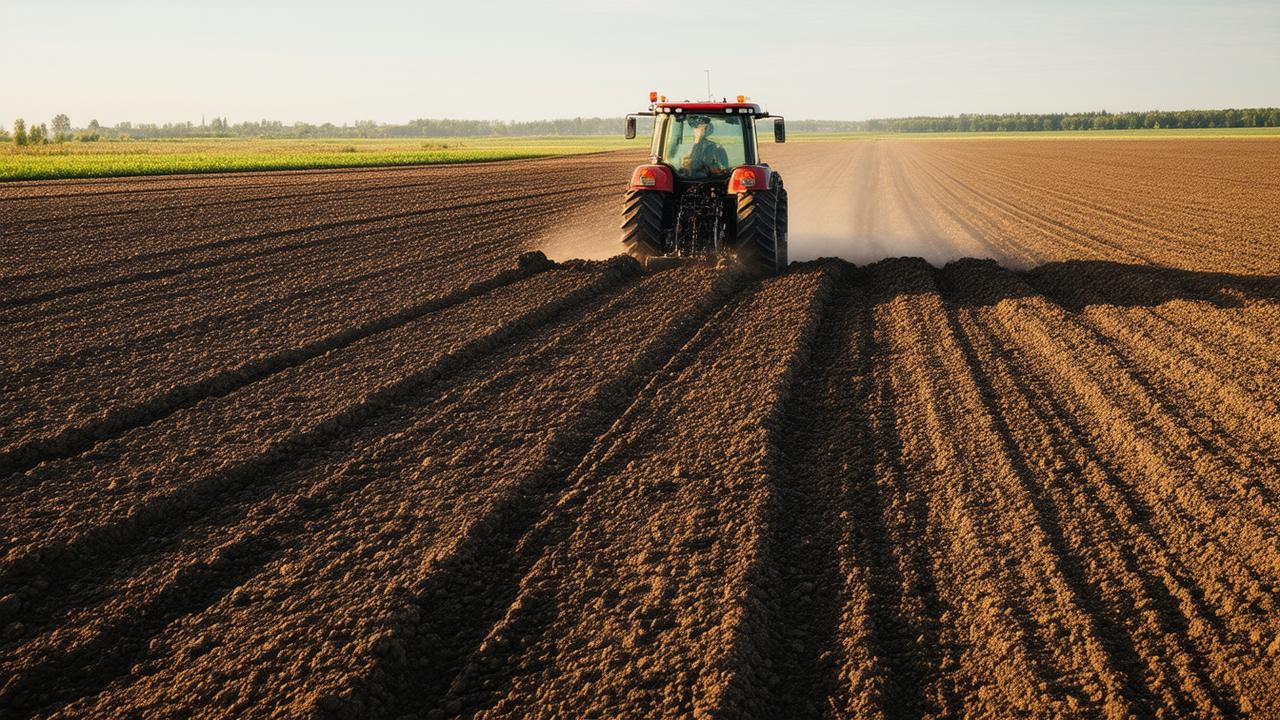
The soil in your hand is colder than you expect. It crumbles like chocolate cake between your fingers, leaving a black dust on your skin that refuses to brush off. When you lift it to your nose, there’s a smell—damp leaves, rain after a long dry spell, a faint sweetness of things long dead and quietly transformed. This is chernozem, the “black earth,” and people have been fighting over places like this for as long as there have been plows and borders and hungry cities.
The Quiet Power Beneath Our Feet
Stand on a chernozem field in late spring and the landscape doesn’t shout its importance. It’s just wind, and sky, and a wide, unbroken expanse of green. Larks spiral upward, tractors crawl at the horizon, and the air tastes faintly of dust and diesel. Yet, beneath your boots lies one of the most strategic resources on Earth—one that you can’t lock in a vault or stack in a warehouse.
Chernozem, from the Russian words for “black earth,” stretches in a great, dark ribbon across parts of Ukraine, Russia, and Kazakhstan. It doesn’t glitter like oil, and it doesn’t ring like iron, but it feeds more people than either. In some places, this soil runs as deep as a person is tall—up to one meter of rich, humus-laden earth, dark as coffee grounds and loose as sifted flour.
Farmers call it “black gold.” Not because it fuels cars, but because it fuels civilizations. Grain grown on these soils helped feed empires, stabilize governments, and calm restless streets. In a world where the price of bread has toppled rulers and sparked revolutions, this silent, black layer becomes more than a geological curiosity; it becomes a geopolitical prize.
The Anatomy of “Black Gold”
To understand why chernozem is so special, you have to get your hands dirty—literally. If you were to dig a clean, vertical slice through a chernozem field, you’d see a cross-section that looks almost edible: a thick, dark upper layer gently fading into lighter browns and grays below. That top meter or so is where the magic lives.
This blackness is not just color; it is concentration. Over thousands of years, countless grasses grew, died, and decayed on these cold and windy plains. Their deep roots sank year after year, drawing minerals upward, leaving organic matter behind. Every blade, every root, every microorganism added another faint trace of carbon to the soil. Over time, these traces stacked up into something extraordinary—a living, breathing reservoir of fertility.
Put simply, chernozem holds onto life. It grips water the way a sponge holds rain, balancing moisture so that plants neither drown nor starve. It stores nutrients—nitrogen, phosphorus, potassium—like a pantry that never quite empties. And its structure, a crumbly, granular texture, lets air sneak between particles, giving roots room to breathe and dig deeper.
Scientists talk about soil organic carbon, cation exchange capacity, and aggregate stability. Farmers just say: “You can see it in the plants.” Wheat on chernozem tends to stand taller, its stalks thicker, its leaves a more luminous green. In dry years, roots can chase moisture further down. In wet years, the soil drains just enough to keep the field from turning into a heavy, suffocating paste.
The Black Belt of Eurasia
Across the Eurasian steppe, chernozem forms a broad belt that has quietly shaped maps, diets, and trade routes. Nowhere is this more apparent than in Ukraine, where roughly a third of the world’s total chernozem deposits are found. Here, in the “breadbasket of Europe,” whole generations have grown up with the idea that soil itself is destiny.
Drive across central Ukraine in late summer and the horizon turns into an impressionist painting. Sunflower fields blaze yellow under a white-hot sun; wheat stubble lies shaved and neatly lined; combines parade like slow orange insects. Tilt your eyes downward, though, and the real drama is underfoot: the ground is so dark it almost seems wet, even when the sky hasn’t offered rain in weeks.
This same band of black earth runs eastward into southern Russia and northern Kazakhstan, where endless steppe has been turned, over the last century, into a checkerboard of cultivated land. These soils made it possible for the Soviet Union to become a grain superpower, shipping millions of tons of wheat and barley across continents. Later, they underpinned the export economies of modern Russia and Ukraine, feeding not just Europe but vast swaths of the Middle East, Africa, and Asia.
In global food markets, the chernozem belt is like a quiet but decisive shareholder. When harvests are good in these regions, bread and noodles and porridge are a little cheaper in Cairo, Dhaka, and Lagos. When drought, war, or export bans disrupt the flow of grain, this absence is felt in supermarket aisles and street markets half a world away.
Soil as a Strategic Asset
When we speak of strategic assets, we usually picture oil fields, rare-earth mines, or shipping lanes. But as the twenty-first century advances, fertile soil is slipping into that same category—especially soil as generous as chernozem.
A meter-deep layer of black earth cannot be manufactured in any meaningful human timeframe. It is the slow work of ecosystems, climate, and time, measured not in decades but in millennia. Yet it can be damaged or lost in a single human lifetime. Exposed, plowed too deep, or stripped of its protective plant cover, chernozem begins to erode. Wind carries its finest particles away; torrential rains carve gullies that bleed dark mud.
That fragility gives it a strange, double-edged power. Countries that sit on vast reserves of chernozem—Ukraine, Russia, Kazakhstan—hold more than land. They hold the means to turn sun and water into grain on a scale that can influence global nutrition, trade balances, and even political stability in importing nations.
In times of conflict or tension, control over those exports becomes leverage. A halted shipment here, a raised tariff there, and suddenly bread prices tremble in distant capitals. Unlike oil, food cannot simply be “used less” for long; people must eat. In that sense, the black soils of the steppe are not just agricultural assets; they are instruments of soft, and sometimes hard, power.
The Human Scale of a Global Resource
For all the geopolitics, the story of chernozem is also intensely local, written in calloused hands and inherited fields. Ask a Ukrainian farmer what this soil means, and the answer may come with a shrug and a half-smile: “It’s what we have.” But watch them walk a field after rain—stooping to crumble a clod, tasting a grain still soft with milk—and you see reverence.
There is pride in coaxing yield after yield from the same patch of ground, pride in knowing that your harvest will cross borders and seas to feed strangers you’ll never meet. There is also anxiety. Climate is changing. Rainstorms arrive out of season, or not at all. Winters swing between bare and brutally cold, disrupting the rhythms that built these soils in the first place.
Older farmers remember when snow lay longer on the fields, when spring thaw came more predictably, when the soil seemed infinitely forgiving. Younger farmers are less confident. They talk about deeper plowing, new seed varieties, precision fertilization, and irrigation—all expensive ways of asking the same question: How long can this black earth keep giving?
| Region | Share of Global Chernozem | Typical Chernozem Depth | Key Crops |
|---|---|---|---|
| Ukraine | ≈ 30% | 0.6–1.0 m | Wheat, maize, sunflower, barley |
| Russia (southern belt) | Significant, exact share debated | 0.5–0.9 m | Wheat, barley, sugar beet, oilseeds |
| Kazakhstan (northern steppe) | Major steppe chernozem zone | 0.4–0.8 m | Spring wheat, barley, fodder crops |
| Other regions (e.g., parts of Canada, Romania) | Smaller pockets | 0.3–0.6 m | Cereals, oilseeds, mixed crops |
Fragile Abundance: Erosion, Loss, and Hope
The story of the black earth isn’t only one of abundance. Where humans have rushed, chernozem has retreated. In parts of the Eurasian steppe, decades of intensive plowing have torn apart the natural structure that took centuries to form. Heavy machinery compacts the soil; fields left bare between crops invite the wind to steal the finest, most fertile particles.
From the air, you can sometimes see the scars: dusty plumes trailing from tractors, pale streaks across what should be dark fields, a faint whitening where topsoil is thinning. With every millimeter lost, the soil’s capacity to hold water and nutrients shrinks. What remains is more vulnerable: to drought, to heatwaves, to sudden floods that rush off instead of sinking in.
Yet not all is decline. Some farmers are turning to practices that echo the steppe’s original rhythms. They plant cover crops to shield the soil from sun and wind, leave crop residues on the surface to feed future humus, and switch to no-till or low-till systems that disturb the underground architecture as little as possible. Field trials show that these methods can slow or even reverse organic matter loss, helping the soil rebuild its carbon bank.
➡️ It’s official and it’s good news: from February 12, gas stations must display this new mandatory information at the pump
➡️ Many people don’t realize it, but cauliflower, broccoli and cabbage are all different varieties of the very same plant
➡️ Marine authorities issue warnings as orca groups increasingly, according to reports, show aggressive behaviour toward passing vessels
➡️ It’s official, and it’s good news: from February 12, gas stations will have to display this new mandatory information at the pump
➡️ Major breakthroughs in diabetes care are marking a medical turning point that could soon make many of today’s treatments obsolete
➡️ I only learned this at 60: the surprising truth about the difference between white and brown eggs that most people never hear about
➡️ Moist and tender: the yogurt cake recipe, reinvented by a famous French chef
On a cool autumn morning, a no-till chernozem field looks slightly untidy compared to a freshly plowed one. Old stalks lie crisscrossed, stubble pokes through the surface. But kneel, push your fingers into the ground, and you’ll find earthworms weaving their tunnels, fine roots stitching clods together, moisture hiding just below the surface. It is less a factory floor than a crowded city, all life and quiet industry.
Black Earth, Shared Future
In the end, chernozem is more than a local treasure or a regional bargaining chip. It is part of a global network of soils that collectively decide how many people our planet can feed, and how resilient our food systems can be in the face of shocks.
As populations grow and diets change, demand for grain and animal feed increases. Pressure mounts on fertile regions to produce “just a little more”: another ton per hectare, another field brought under the plow, another forest or grassland converted. The temptation is clear; the risk is quieter. Overwork the black earth, and it may eventually lose the very qualities that made it famous.
There is another dimension too. Chernozem is a vast storehouse of carbon. Disturb it heavily and much of that carbon escapes into the atmosphere as CO2, adding to climate change. Protect it, build it, and these soils become allies in moderating the climate that shapes them. In this way, the black earth of Ukraine, Russia, and Kazakhstan is woven into the fate of glaciers, oceans, and forests far beyond Eurasia.
Running dark soil through your fingers, it’s easy to think it’s endless, that there will always be more. But chernozem whispers a slower truth: some riches come only once. The meter-deep layer under your boots is an inheritance, not a guaranteed income. How we treat it—how carefully we farm it, how wisely we trade its harvest, how fiercely we protect it from erosion and short-sighted use—will echo in the price of bread, the stability of governments, and the health of landscapes we may never see.
The black gold of agriculture does not roar like oil when it burns. It speaks instead through the rustle of wheat heads, the weight of a grain sack on a worker’s shoulders, the softness of a loaf torn open on a family table. It lies quietly beneath our feet, determining far more about our future than most of us ever realize, asking only that we remember what it truly is: not a commodity, but a living, finite miracle of earth and time.
Frequently Asked Questions
What exactly is chernozem?
Chernozem is a very fertile, dark-colored soil rich in organic matter (humus). It typically forms under grassland ecosystems in temperate climates and is known for its great depth, good structure, and exceptional ability to store water and nutrients.
Why is chernozem called “black gold of agriculture”?
It earns this name because of its deep black color and high fertility. Fields with thick chernozem layers can produce high yields of crops like wheat, maize, and sunflower with relatively fewer inputs compared to poorer soils, making it extremely valuable for agriculture and food security.
Where is chernozem mainly found?
The largest continuous areas occur in Ukraine, southern Russia, and northern Kazakhstan. Smaller pockets are found in parts of Eastern Europe, Central Asia, and even in some regions of North America, such as the Canadian Prairies, where similar black soils exist.
How long does it take for chernozem to form?
Forming a thick chernozem layer is a very slow process. It develops over thousands to tens of thousands of years as grasses grow and decay, building up organic matter and creating the rich, dark topsoil we see today. This is why it is considered effectively non-renewable on human timescales.
Can damaged chernozem be restored?
To some extent, yes. Practices like no-till farming, cover cropping, reduced plowing, and adding organic amendments can help rebuild organic matter and improve soil structure. However, fully restoring a deeply eroded or degraded chernozem to its original state may take many decades or longer, so prevention is far better than repair.
How does chernozem affect global food security?
Because it underlies major grain-producing regions in Ukraine, Russia, and Kazakhstan, chernozem plays a large role in global wheat and grain markets. Good or bad harvests on these soils can significantly influence global food prices and availability, especially in countries that rely heavily on imported grain.
Is climate change a threat to chernozem soils?
Yes. Changes in temperature, rainfall patterns, and the frequency of extreme weather events can increase erosion, alter decomposition rates, and stress crops. If not managed carefully, these changes can lead to loss of organic matter and reduced fertility in chernozem regions, weakening one of the world’s most important natural food-producing assets.





