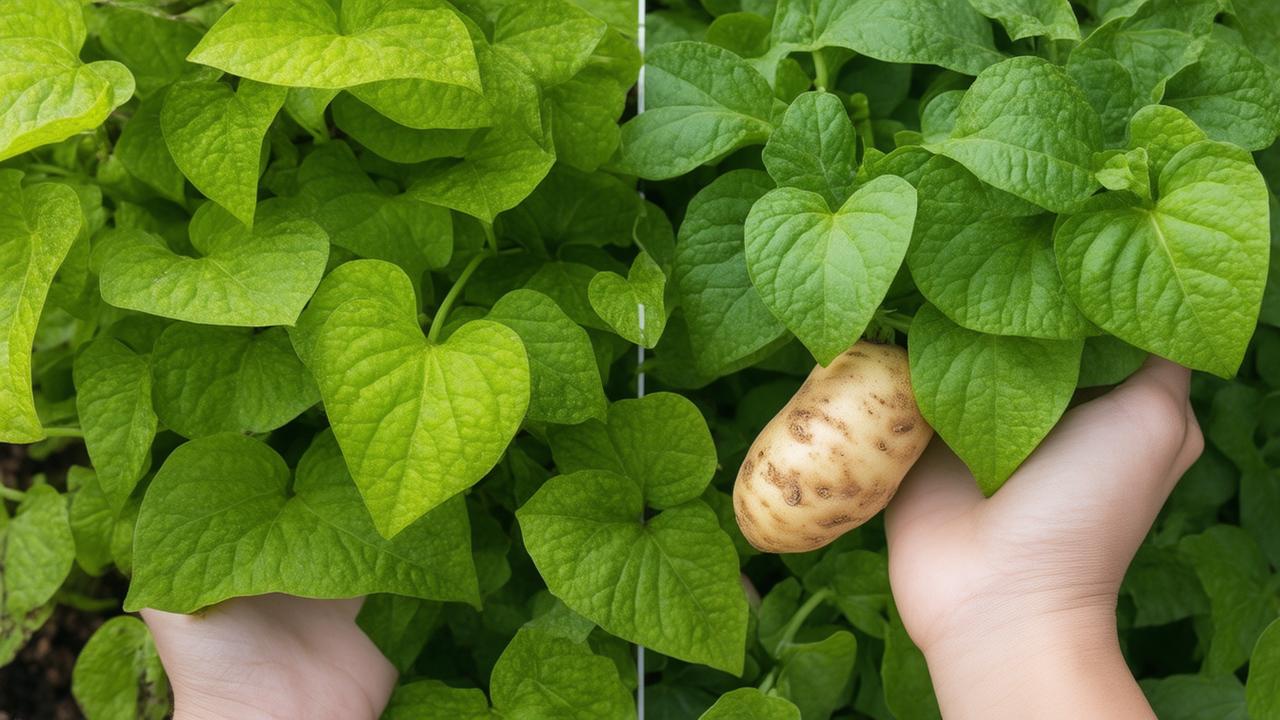
The kitchen was already warm when the argument started. Steam curled from a pot on the stove, a cutting board was crowded with vegetables, and somewhere between peeling and dicing, someone said, “Sweet potatoes are just healthier potatoes, right?” A pause. Two orange slices of sweet potato glowed on the board, right beside a heap of starchy, pale potato cubes. They certainly looked like cousins—siblings, even. We mash them, roast them, tuck them into pies and stews, all under the same cozy word: potatoes. But science, as it often does, has a way of quietly raising an eyebrow at our assumptions. Because the truth hiding in that humble kitchen scene is this: sweet potatoes and regular potatoes are not close relatives at all. In fact, their family trees barely wave at each other across the evolutionary canyon.
The Illusion of Family: How Our Plates Trick Our Brains
Part of the confusion comes from the way we experience food. Our brains are pattern-making machines. We see a knobbly, underground tuber. We peel it, boil it, and it fills us up with that same satisfying, starch-laden weight. Potato. Our minds file them together in the same mental folder, the way we place all birds under “bird,” whether it’s a hummingbird or an ostrich.
Slice into a russet potato and you’ll get that crisp, chalky snap, the white flesh cool and almost squeaky under the knife. Cut through a sweet potato, and the blade slows; the flesh is denser, moist, leaving a faint sugary scent on your fingers, a hint that something else is going on inside. Yet they both end up on the same plate: fries, wedges, gratins, soups. From the dining table’s point of view, they do the same job, deliver the same comfort.
But if you zoom out—far beyond the cutting board, past the fields where they grow, and into the invisible logic of plant evolution—these two roots are strangers wearing similar disguises. Their resemblance is not about shared ancestry. It’s about convergent needs: different plants, from different families, solving the same problem of how to store energy underground, safe from teeth and weather and time.
What Science Sees That We Don’t
Botanists don’t group plants by flavor or familiarity. They follow ancestry, down to flowers and chromosomes and the microscopic architecture of plant cells. When science looks at a sweet potato and a regular potato, it doesn’t see siblings. It sees two branches of life that split apart millions of years ago, wandering off in separate directions and ending up, quite coincidentally, in our kitchens.
To science, your regular potato—whether it’s a russet, Yukon Gold, or fingerling—belongs to the Solanaceae, the nightshade family. That’s the same large and sometimes notorious clan that includes tomatoes, eggplants, bell peppers, tobacco, and several poisonous plants. Sweet potatoes, by contrast, live over in the Convolvulaceae family—the morning glory family. Yes, those delicate trumpet-shaped flowers that twist in hedges and fences in the early light? They’re closer kin to sweet potatoes than any “normal” potato will ever be.
Two Very Different Family Trees Underground
Imagine walking through a global garden of related plants. In one bed, tall tomato vines tangle with pepper plants. A few steps away, eggplants hang like glossy purple lanterns. Nestled in the soil among them: potato plants, their leaves unassuming, their white or violet flowers gently nodding. This is the nightshade section, a family both beloved and dangerous, rich with food and laced with poison.
Now keep walking. Eventually, the air changes. A trellis rises, and pale blue and violet blossoms bloom like little trumpets, unfurling in morning light—morning glories. Follow their twisting stems back down toward the soil and you’ll find a different kind of underground treasure: the sweet potato. Same general idea—an edible root storing energy—but living in a completely different genetic neighborhood.
Nightshade vs. Morning Glory: The Lineage Split
On the evolutionary tree of flowering plants, the nightshade and morning glory families are not next-door branches. They both belong to a broad umbrella group (the asterids), but their paths diverged long ago, before humans ever thought to farm or cook. Their flowers, seeds, leaf shapes, and even their chemical defenses reveal their separate histories.
Nightshades like potatoes and tomatoes often carry alkaloids—bitter compounds that can protect the plant from hungry animals. In potatoes, this includes solanine, a toxin that concentrates in green or sprouted tubers. Morning glory relatives, like the sweet potato, play by different chemical rules. While sweet potatoes also defend themselves with various natural compounds, their toolkit is distinct, shaped by their own evolutionary pressures and pollinators.
One Plant Is a Tuber, the Other a Swollen Root
The differences go deeper than family labels; they’re written right into the parts we eat. We casually call both “roots,” but botanically speaking, they are not the same thing at all.
The Potato: A Buried Stem With Eyes
If you pick up a regular potato and look closely, you’ll notice the “eyes”—those tiny dimples scattered across the skin. Each eye is a bud, a potential stem waiting to grow. That’s because a potato isn’t a root at all. It’s a swollen stem called a tuber, grown underground. In nature, those eyes can sprout into new plants, a clever way of cloning itself and surviving winter or drought.
Slice a potato and you’re cutting through a storage stem, not a root. Even its internal structure under a microscope tells this story: the arrangement of vascular tissue (the plant’s internal plumbing) looks like a stem’s blueprint, repurposed for storage.
The Sweet Potato: A True Storage Root
Now pick up a sweet potato and hunt for those same stem-like eyes. You’ll find little marks or scars, but they’re not the same kind of organized buds. That’s because sweet potatoes are true roots, more specifically “storage roots.” They form when part of the root system swells and becomes specialized for storing starch and sugar.
In a sweet potato, the plant’s plumbing runs differently, in patterns that match root anatomy, not stem. The sugar-rich flesh you taste is the product of a root that has transformed into a pantry. While you can sprout new vines from a sweet potato (those curling green slips you sometimes see emerging in the pantry), it doesn’t reproduce in exactly the same clonal, tuber-eyed way a regular potato does.
How Their Nutrition Reflects Their Separate Paths
On the table, of course, most of us aren’t thinking about tubers versus storage roots. We’re wondering something simpler: which one is “healthier”? The answer, unsurprisingly, is more nuanced than the internet’s neat slogans. But once again, their distant relationship shows up in the nutritional fingerprint of each.
| Feature (per 100 g, cooked) | Regular Potato | Sweet Potato |
|---|---|---|
| Calories | ~87 kcal | ~90 kcal |
| Total Carbohydrates | ~20 g (more starch, less sugar) | ~21 g (more natural sugars) |
| Fiber | ~1.8 g | ~3.3 g |
| Vitamin A (as beta-carotene) | Minimal | Very high (orange varieties) |
| Vitamin C | Moderate | Moderate |
| Notable Strength | Potassium, versatile starch | Beta-carotene, fiber, sweetness |
Side by side, you can see that neither is a nutritional villain or a saint. Regular potatoes bring potassium and satisfying starch, while sweet potatoes pile on fiber and beta-carotene, the pigment that gives them their vivid orange glow and converts to vitamin A in the body. The difference in color is a clue to their separate biochemical worlds, painted by different sets of plant pigments, evolved along those distant family lines.
Why One Spikes Blood Sugar Differently
Because sweet potatoes have more fiber and a different balance of starches and sugars, they often have a lower glycemic impact than a typical mashed or baked potato, especially when cooked gently and eaten with the skin. Regular potatoes, especially when overcooked or turned into fluffy mash or fries, can release their starch quickly as glucose.
But again, that’s not about one being “a healthy potato” and the other “an unhealthy one.” It’s about two unrelated plants that happen to share a job on our plates—filling, comforting carbohydrates—while carrying very different evolutionary baggage in their cells.
How Culture Blurs the Lines Even More
Language and tradition complicate things further. Around the world, names for these plants overlap, twist, and tangle almost as much as their vines.
➡️ Light fast apple cake made with oil and yogurt for effortless desserts
➡️ Known as the most fertile soil on Earth, the “black gold of agriculture” has chernozem layers up to 1 meter deep and turned Ukraine, Russia and Kazakhstan into one of the world’s biggest breadbaskets and strategic assets
➡️ I learned it at 60: few people actually know the difference between white and brown eggs
➡️ Hygiene after 65 : not once a day, not once a week, here’s the shower frequency that keeps you thriving
➡️ How to make hardwood floors shine brilliantly using one unexpected pantry item that homeowners swear by
➡️ If you grew up in the 1960s or 1970s, you were likely taught life lessons that have quietly disappeared from modern education
➡️ If the ATM keeps your bank card this fast little technique instantly retrieves it before help arrives
In some regions, what English speakers call “yams” are actually sweet potatoes. True yams belong to yet another family altogether, the Dioscoreaceae, mostly grown in parts of Africa, Asia, and the Caribbean. Yet in many American grocery stores, those orange-fleshed sweet potatoes are labeled “yams,” thanks to historical marketing and habit. So you can end up with three totally different roots—potato, sweet potato, and true yam—masquerading under just a couple of names.
The Power of a Familiar Shape
Part of why we lump sweet potatoes and potatoes together is the persuasive power of shape and role. They are both underground storage organs, both starchy, both staple foods. They live in the same section of the supermarket and the same mental category of “things you can roast with salt and oil.” Their differences get steamed and mashed into sameness.
Science, though, keeps the categories clear. Different families, different organs (tuber versus root), different flowers, different defense chemicals, different nutrient profiles. What looks unified on the dinner plate is, from a plant’s-eye view, a story of parallel solutions to the same survival problem.
Seeing Your Dinner as an Evolutionary Story
The next time you stand at the counter, knife in hand, about to choose between a mottled brown potato and a smooth orange sweet potato, you’re not just picking flavors. You’re choosing between stories. One story begins in the high Andes, where wild potatoes once eked out a living under harsh skies, bundling energy into tubers while evolving just enough toxin to discourage a careless bite. The other threads through tropical regions, vines of morning-glory kin threading across warm soils, roots quietly swelling into sweet, dense storage organs.
They meet now in your kitchen, not as family, but as neighbors—unrelated wanderers that found a permanent home in human agriculture. On your plate, the illusion of kinship will likely persist. You’ll still call them both potatoes, dress them with butter or olive oil, and serve them beside a piece of fish or a handful of beans.
But somewhere in the back of your mind, there might be a small, delighted awareness that you are eating two very different pages from the book of plant evolution. That the golden fries and the caramelized sweet potato wedges are not brothers but strangers who happen to excel at the same role: turning sunlight, soil, and time into something that tastes like comfort.
And when someone at the table insists, “Well, a sweet potato is just a healthier kind of potato,” you might smile, glance at the plate, and know that beneath the salt and steam, science is quietly telling a richer, stranger story.
Frequently Asked Questions
Are sweet potatoes and regular potatoes from the same plant family?
No. Regular potatoes belong to the nightshade family (Solanaceae), along with tomatoes and eggplants. Sweet potatoes belong to the morning glory family (Convolvulaceae), making them only distant relatives at best.
Is a sweet potato a root and a regular potato a tuber?
Yes. Sweet potatoes are true storage roots, while regular potatoes are swollen underground stems called tubers. This difference is visible in their anatomy and the presence of “eyes” on regular potatoes, which are stem buds.
Which is healthier: sweet potatoes or regular potatoes?
Both can be healthy, depending on how you cook them and what you eat them with. Sweet potatoes tend to have more fiber and a lot more beta-carotene (vitamin A precursor). Regular potatoes are rich in potassium and provide satisfying starch. Neither is inherently “bad” or “good”; context and preparation matter.
Are sweet potatoes the same as yams?
No. True yams belong to a different plant family (Dioscoreaceae) and come from different parts of the world. In many supermarkets, orange-fleshed sweet potatoes are mislabeled as “yams,” which adds to the confusion.
Why do both sweet potatoes and regular potatoes feel so similar in meals if they’re not closely related?
They both evolved underground storage organs to hold energy, so they share a starchy, filling quality. Human cultures adopted them as staple foods, often using them in similar ways—boiled, baked, fried, mashed—which makes them feel like culinary cousins, even though science places them on separate branches of the plant family tree.





