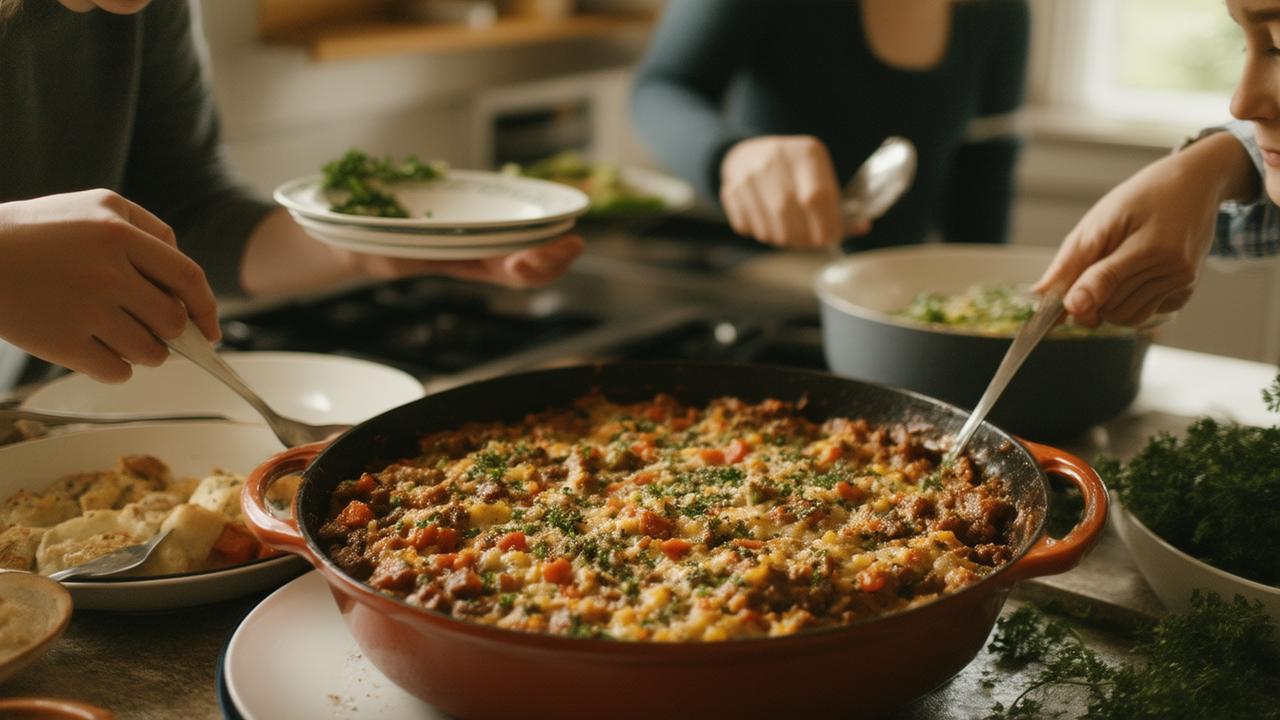
The first thing you notice is the quiet. The kind that settles over a house right before everyone walks in, dropping backpacks, kicking off shoes, shouting half-finished stories about their day. In the kitchen, a pot on the stove sends up gentle curls of steam, and the smell is so familiar it almost feels like a memory made physical—warm, savory, a little buttery, threaded with herbs. It’s not just dinner. It’s a promise: no matter how rushed the day has been, no matter how many schedules have collided, something simple and comforting is waiting at the center of it all.
The Gentle Gravity of a Simmering Pot
Comfort food has this quiet power, like gravity. It pulls people in from different corners of the day—late meetings, soccer practice, homework at the dining table, the last-minute grocery run—and gathers them around something shared and steaming.
Maybe it’s a pot of chicken and vegetable stew, the kind that doesn’t rush you. The broth thickens in its own time, the carrots soften, the onions go glossy and sweet, and the kitchen turns into the warmest room in the house. You stir lazily, leaning into the rhythm, feeling your own day slow down with every circle of the wooden spoon.
Outside, headlights sweep past the windows. Inside, the light is softer: the range hood casting a glow on the stove, the low thrum of the dishwasher, the muted clink of cutlery being set on the table by a child half-distracted by a story they’re dying to tell. You taste the broth and it’s almost there—just a bit more salt, maybe a squeeze of lemon to wake it up. Simple decisions, small pleasures.
What makes this kind of warm, familiar meal fit so naturally into a modern family schedule isn’t just that it’s easy. It’s that it waits. A big, dependable pot of something hearty doesn’t demand your full attention; it simmers and softens while life swirls around it. You can step away to help with math homework, fold a load of laundry, or answer that late email. When you come back, the kitchen hasn’t judged you for leaving—it’s just gotten cozier.
Why Warm Comfort Food Belongs in Busy Weeks
There’s a quiet magic in meals that meet you where you are. Not aspirational feasts, not elaborate experiments, but dishes that understand: the calendar is crowded, people are hungry at different times, and somehow you’re supposed to glue all of that together with dinner.
Warm comfort foods—stews, casseroles, slow-baked pastas, sheet-pan roasts—fit gracefully into the chaos. They don’t demand precision timing. They forgive late arrivals. They keep well, taste even better reheated, and often come together from the same few humble ingredients that end up in every family’s cart: potatoes, onions, carrots, beans, chicken, rice, pasta.
They’re also built for repetition. Cook once, eat twice (or three times). The leftovers become tomorrow’s quick lunch, or a second, even richer dinner with just a few small additions—fresh herbs scattered over the top, a side of crusty bread, a bright salad pulled together while the rest of the family sets the table.
And there’s something grounding in that repetition. In a world where everything seems to change constantly—new apps, new schedules, new rules at school or work—your family knows that on certain evenings, the house will smell like baked cheese and tomatoes, or slow-roasted garlic and rosemary. Tradition, without needing a special occasion.
The Quiet Choreography of Weeknight Cooking
Watch any family kitchen around 6 p.m., and it looks like a dance. Someone is lining up lunch boxes for tomorrow. Someone else is unloading the dishwasher one clink at a time. A teenager slides in, pulls open the fridge, and asks, “What’s for dinner?” without looking up from their phone. Somewhere, a backpack zipper refuses to cooperate.
In the middle of this, a meal that works with your timing instead of against it feels like a gift. Take a hearty one-pot pasta bake or a creamy, vegetable-laced risotto made in a wide pan. You chop once—onions, garlic, a few vegetables—and from there, most of the work is stirring, watching, tasting. It’s the kind of cooking you can do with one ear listening for the washing machine’s angry buzz and the other tuned into the story your child is telling you about a science project gone spectacularly wrong.
The real beauty isn’t just in the finished dish; it’s in the way it moves with you. Need to pause to take a call? Turn the heat to low. Want to help someone find a lost sneaker? Put a lid on the pot. These recipes don’t fall apart if you step away; they reward you for trusting the slow, steady heat.
And when you ladle the food into bowls, there’s this moment of collective exhale. The room gets a touch quieter. Spoons clink, someone blows on a too-hot mouthful, someone else asks for seconds before they’re even halfway through their first serving. It’s little, but it’s real: a pocket of calm you’ve carved out of a noisy day.
Comfort Food That Adapts to the Clock
The most reliable dishes aren’t just warm and filling; they’re flexible. They understand that some nights you have twenty minutes, and on others you have the luxury of letting something bake for an hour while the rest of life keeps spinning.
Think of a simple, slow-baked rice dish with vegetables and broth. You assemble it in five or ten minutes—spread the rice, tuck in the vegetables, pour over the seasoned liquid—and slide it into the oven. It quietly transforms while you help with flash cards or reply to a teacher’s email. Or a big tray of roasted chicken thighs and root vegetables: you toss everything with oil, herbs, salt, and pepper, then let the oven do the heavy lifting while you wrangle the day back into some kind of order.
These kinds of meals don’t just accommodate your timing; they reform the edges of the evening. Instead of dinner being one more deadline, it becomes an anchor point—soft but firm—around which everything else can shift.
Meals That Stretch, Change, and Show Up Again
Another quiet superpower of warm comfort food is its ability to stretch—not only to feed extra mouths, but to evolve over a couple of days. The pot of soup tonight might become something slightly different tomorrow, reshaped by whatever the day demands.
Imagine a big batch of tomato-based lentil stew. On night one, it’s ladled into bowls, maybe sprinkled with cheese or a swirl of yogurt, eaten with generous slices of toasted bread. On night two, it thickens into more of a sauce—poured over pasta or rice, or spooned into wraps with some chopped greens for a quick handheld dinner right before everyone runs back out the door.
The same thing happens with a tray of roasted vegetables: the first day, they’re the main event alongside baked chicken; the second day, they tuck into a pan of bubbling, cheesy pasta or form the backbone of a grain bowl that takes maybe ten minutes to assemble.
These meals don’t require a fresh creative spark every single evening. They let you be a little tired, a little distracted, without giving up on the idea of something homemade and nourishing. They’re like having a friend in the fridge—one who never minds being reheated.
Building Warmth from Simple Ingredients
At the core of most comfort dishes are the same small, honest ingredients: onions, garlic, a carrot or two, a potato, a handful of rice or pasta, a can of beans, a bit of stock or water. They’re not flashy. They don’t come with labels that shout about superfoods or trends. But what they turn into, together, feels like abundance.
There is something deeply reassuring in chopping an onion at the end of a long day. The sharp, green smell gives way to sweetness in the pan. Garlic hits the oil and suddenly the kitchen smells like hope. Carrots and celery follow, then broth, then time. You don’t have to perform miracles; you just have to let heat and patience do what they’ve always done.
And the beauty is, these same basics can be rearranged to match different moods and weeks. Some nights, you lean into creaminess—maybe a baked macaroni laced with wilted spinach or peas. Others, you want brightness: lemony chicken soup with herbs, or a tangy tomato and bean stew. The pattern remains: start simple, build slowly, let the meal gather itself together.
Making Space for Everyone at the Table
Family schedules today rarely move in neat, matching lines. One person’s still at work, another’s at practice, someone has a late rehearsal, and someone else just wants a quiet corner and a book. Sitting down together every night feels, some weeks, like a nice idea from another decade.
➡️ What psychology reveals about people who feel emotionally drained after small social interactions
➡️ I stopped timing my cleaning sessions and my house became easier to maintain
➡️ I made this simple recipe and didn’t change a thing
➡️ If your flowers fade quickly, temperature stress is often the reason
➡️ Why your body feels heavier on some days even when nothing is wrong
➡️ A small daily habit that helps your body feel more balanced
➡️ Climate panic or scientific fact Februarys predicted Arctic collapse and extreme anomalies split experts and fuel public distrust
But warm comfort food doesn’t insist on perfection. It doesn’t demand that everyone arrive at exactly the same moment. It holds. A pot of chili on low heat or a casserole resting under a foil blanket keeps the invitation open for whoever walks through the door next. The first person fills a bowl, the second reheats a portion later, but each one is stepping into the same flavor, the same warmth.
Even the small rituals matter: the ladle scraping the bottom of the pot, the sound of the oven door opening, the steam spilling out when someone lifts the lid. These quiet, repetitive acts say, in their own way, “You’re home. There’s a place for you.”
And maybe that’s the real reason these foods fit so naturally into family schedules: not because they’re efficient, though they often are, but because they’re forgiving. They forgive lateness and distraction. They forgive long days and short tempers. They sit on the back burner, or in a warm oven, and wait for the moment when everyone finally lets themselves stop for a while.
A Small Map for Easier Evenings
If you were to sketch a simple guide to weeknight comfort food that respects busy lives, it might look something like this:
| Meal Type | Time You Have | How It Fits Your Day |
|---|---|---|
| Slow Simmering Stews & Soups | 60–90 minutes (mostly unattended) | Start early, let it simmer while you do chores, homework help, or unwind. Stays warm for late arrivals. |
| Baked Casseroles & Pasta Bakes | 40–60 minutes (assembly + baking) | Assemble quickly, bake while you shower, catch up on emails, or set up for the next day. |
| Sheet-Pan Roasts | 30–45 minutes | Minimal chopping, one pan cleanup. Perfect for late starts or days when energy is thin. |
| One-Pot Stovetop Dishes | 25–35 minutes | Great for busier nights; constant but light attention while other small tasks happen nearby. |
| Make-Ahead & Reheat Meals | Weekend prep, 10–15 minutes to reheat | Ideal for the most chaotic evenings—heat, serve, and sit down fast. |
It doesn’t ask you to do more. It simply suggests a gentle way to match the food you cook to the kind of day you’ve had—and the kind of night you hope to have.
Finding Your Own Version of “Home” in a Bowl
Every family has its own definition of comfort. For some, it’s a bubbling dish of baked pasta with browned cheese edging the pan. For others, it’s rice cooked in broth, topped with tender meat or vegetables and plenty of herbs. Maybe it’s a bean chili, thick and smoky, or a simple chicken soup with the exact shape of noodles someone’s grandmother always used.
But the feeling beneath all those specifics is the same: warmth you can hold. A scent that meets you at the door. A bowl or plate that doesn’t just fill you up, but helps you loosen your shoulders, take a real breath, and remember that you belong somewhere.
On the busiest nights, when the calendar looks impossible and the house feels more like a train station than a sanctuary, that might be the quietest, strongest kind of nourishment there is. Not a perfect meal, not a perfect schedule—just something warm, waiting, and ready when you finally sit down.
A pot on the stove, an oven humming softly, the familiar clatter of dishes. People drifting in, at slightly different times, but all drawn by the same thing: the promise that in this house, no matter how wild the day has been, there will be comfort enough to go around—and often, enough left over for tomorrow.
FAQ
What makes a meal “comfort food” for a family?
Comfort food is less about strict recipes and more about feeling. It’s warm, familiar, filling, and usually easy to share. These are the meals people request again and again because they feel safe and satisfying—soups, stews, casseroles, baked pastas, roasted vegetables and meats, creamy rice dishes, and hearty bean-based meals.
How can I fit homemade comfort food into a very busy weekday?
Choose dishes that can simmer or bake while you do other things. One-pot stews, sheet-pan dinners, and casseroles let you do a short burst of prep, then step away. Planning one or two bigger, batch-cooked meals early in the week also helps, since leftovers can be reheated quickly on hectic nights.
What are some good ingredients to always keep on hand?
Stock or broth, onions, garlic, carrots, potatoes, rice or pasta, canned beans, canned tomatoes, frozen vegetables, and a few basic spices (salt, pepper, paprika, dried herbs). With these, you can create many different comforting, adaptable dishes without needing a complicated shopping list.
How do I make comfort food healthier without losing the cozy feeling?
Use plenty of vegetables, swap some cream for milk or broth, use herbs and spices for flavor instead of relying only on cheese or butter, and mix whole grains (like brown rice or whole-grain pasta) into your meals. You can still keep the warmth and heartiness while adding more nourishment.
Can comfort food work for families with different eating schedules?
Yes. That’s where soups, stews, and baked dishes shine. They hold well on low heat or reheat beautifully in the oven or microwave. One person can eat at six, another at seven-thirty, and both still get essentially the same, freshly comforting meal.





