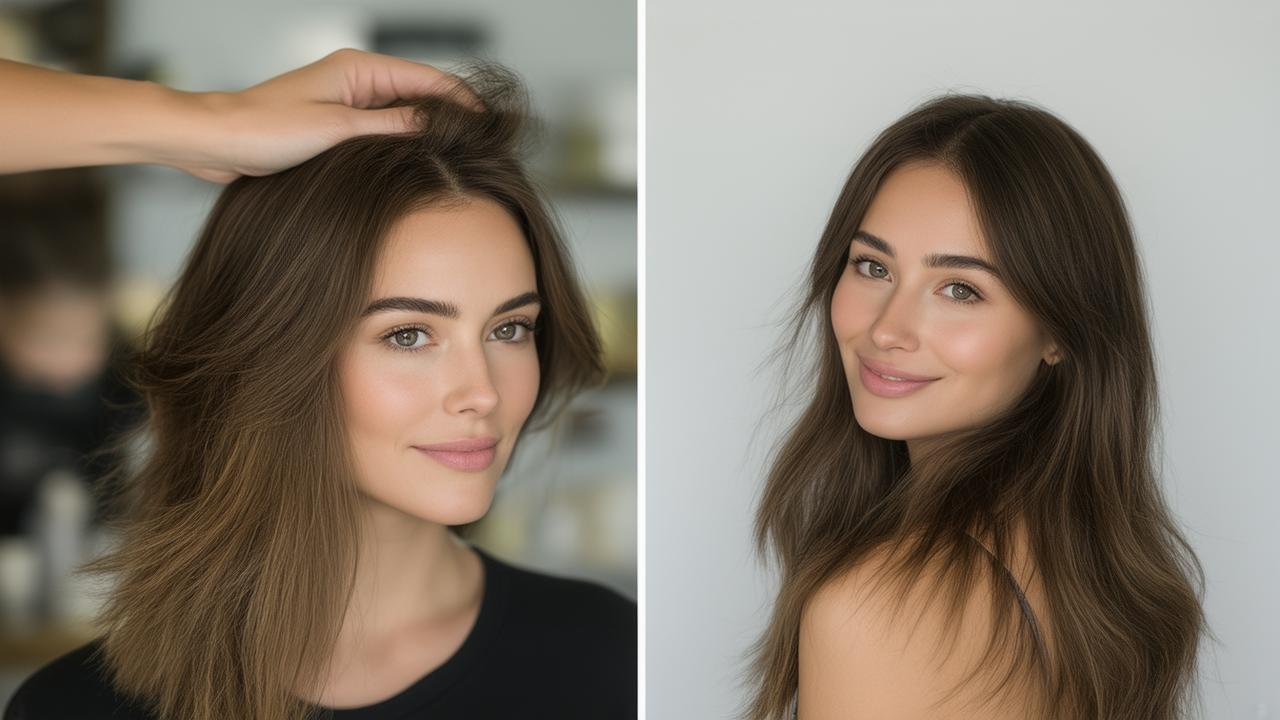
The first snip is always the loudest. It echoes in your ears, ricocheting off the mirrors and the low murmur of hairdryers and quiet conversations. You sit there beneath the cape, fingers tucked under your thighs so you don’t fidget, staring at your own reflection and wondering, not for the first time, if this is a terrible idea. The salon smells faintly of citrus shampoo and warm metal from hot tools cooling on their stands. Someone laughs two chairs down. Somewhere behind you, a blow dryer roars to life. Your stylist stands at your shoulder, comb in hand, asking that impossible question: “So… what are we doing today?”
The Quiet Panic of the Salon Chair
For people who love change, this is the fun part. They pull out screenshots, inspired photos, bold curtain bangs, and sharp bobs; they talk about “going shorter” with the same casual thrill some people reserve for booking flights. But if you’re afraid of change, that question hits differently. It feels like a pop quiz on your own identity.
You look at your hair in the mirror. It’s not exactly what you want, maybe, but it’s familiar. It falls in the same pattern it has for years—over your shoulders, around your jaw, into that one stubborn wave that never behaves, no matter what products you use. The idea of walking out looking like an entirely new person? That’s not exciting. It’s terrifying.
Hairdressers see this all the time. The nervous shoulder shrink. The faint, panicked laugh. The “oh, I don’t know, just a trim?” offered like a shield. And slowly, over thousands of these conversations, stylists have come to an easy, gentle truth: if you’re scared of making a change, there is one kind of haircut that’s almost always the safest landing place.
Not a daring pixie, not a sharp jaw-length bob, not even a full set of bangs. The safest haircut isn’t a specific “look” at all. It’s something softer, more forgiving, and far kinder to your nerves.
The Safest Haircut: A “Soft Shift” of What You Already Have
When hairdressers talk about the safest cut for change-averse clients, they rarely name a trendy style. Instead, they describe a strategy: keep your overall shape, and gently refine it. Think of it as a “soft shift” rather than a makeover.
It might mean keeping your length but adding barely-there layers. It could mean subtle face-framing pieces that kiss your cheekbones instead of crashing into them. It might be a soft reshaping of your ends from blunt to slightly feathered so your hair moves a little differently when you walk—but still very much looks like you.
One stylist I spoke to calls it “the 15% rule.” If you’re nervous, don’t change more than about 15% of what you already have. That’s enough to notice, but not enough to shock you. Just enough to make you catch your reflection in a shop window and think, Something’s different. I like it. I still recognize myself.
This is the haircut hairdressers quietly recommend when your shoulders tense up at the word “layers” or you say, “I’m not good with change.” It honors your fear but doesn’t let you stay completely stuck. It’s the haircut that edges you forward without shoving you off a cliff.
How Stylists Read Your Fear (Before You Say a Word)
Good hairdressers are part artist, part therapist, part detective. They notice the way you hold your jaw when you talk about length. They see the white-knuckle grip on your phone as you scroll through inspiration photos but never settle on one. They hear the hesitation in “maybe shorter?” that really means “please don’t let me regret this.”
They also read your hair. Hair tells a story of habits and comfort zones: old color clinging to the ends, a permanent part that’s been in the same place for ten years, breakage along the front from that one time you tried to style your own fringe and then grew it out in quiet regret. Your stylist uses all of this as a map.
Instead of offering you a radical transformation, they might say, “What if we kept your length but lightened it up a bit?” Or, “How about we just soften around your face and clean up the ends—see how you like the movement?” They’re not underselling you. They’re giving you a landing pad.
What a “Safe” Haircut Actually Looks Like
A safe haircut doesn’t have to be boring. In fact, it can feel oddly luxurious, like discovering the best version of what you already naturally do. Think of it as your personal baseline cut—the one that works on your laziest days and still looks intentional on your busiest ones.
Here’s how hairdressers often build that kind of cut, quietly, gently, and very deliberately:
- Length: They’ll likely keep your overall length within a comfortable range—usually no more than a couple of inches off, unless you specifically ask for more.
- Ends: Instead of chopping in a blunt line that shocks you, they’ll soften or “dust” the ends, removing damage and bulk without visually shortening too much.
- Layers: If layers appear, they’re often long, seamless, and blended—movement without drama.
- Face-framing: The biggest visible change often happens here, but even then, it’s gentle: starting around the collarbone or jaw, not above.
- Styling compatibility: The cut is designed so you can walk out of the salon, attempt to recreate it on your own, and not feel like you’ve failed.
To visualize the idea, imagine this table as a quiet guide for change when you’re nervous:
| If You Currently Have… | “Scary” Change | Safer Hairdresser Suggestion |
|---|---|---|
| Long, one-length hair | Chin-length blunt bob | Keep length, add soft long layers + light face-framing |
| Collarbone-length cut | Shag or heavy, choppy layers | Gentle shaping around the face, micro-trim at the back |
| Medium layers | Very short pixie | Subtle refinement of existing layers, slightly shorter but same silhouette |
| Natural wave or curl | Super blunt straight-across cut | Curly-friendly shaping that follows your pattern, minimal length loss |
In other words, the safest haircut is always this: a refined version of what already works for you.
The Sensory Shift: How a Safe Cut Feels, Not Just Looks
What’s surprising about this approach is that the biggest change you feel often doesn’t show up most clearly in photos—it shows up in small, physical moments. Your hair no longer snags in your brush every morning because the ends are healthier. A light breeze suddenly lifts your strands instead of dragging on heavy, tired length. When you tuck your hair behind your ear, it falls a little differently, framing your cheek instead of hanging like a curtain.
You might notice the sound too: less harsh scraping when you pull it into a ponytail, less thud when you twist it into a bun. The weight softens. The texture shifts. The change seeps into your daily rituals—the way you shampoo, the way your hair slides between your fingers as you squeeze out water with a towel. You haven’t transformed into an unrecognizable version of yourself. You’ve just removed the static from what was already there.
And because that change is sensory and gradual rather than visually drastic, your brain has time to catch up. You don’t look in the mirror and startle. Instead, you slowly notice: this is easier. This is lighter. This feels more like how I’ve always wanted my hair to behave.
Talking to Your Hairdresser When You’re Afraid of Change
Stylists aren’t mind readers, but they are excellent interpreters of honesty. If you’re afraid of ending up in a TikTok “I asked for this and got this” horror story, the safest thing you can do isn’t to say “do whatever you want.” It’s to say exactly what scares you.
You can be as plainspoken as you like:
➡️ Bad news for city dwellers who love silence after lunch a new ban on mowing lawns between noon and 4 p.m sparks anger among gardeners and splits neighborhoods
➡️ Driver’s license : good news for motorists, including elderly people
➡️ Sorry, the Matrix doesn’t exist: new mathematical proofs suggest the universe cannot be a simulation
➡️ People in their 60s and 70s who keep these old-school habits report higher happiness than tech-focused younger adults
➡️ An old-school moisturizer with no luxury branding is crowned the number one choice by dermatology experts
➡️ Day will slowly turn to night as the longest total solar eclipse of the century passes across several regions, creating a rare and spectacular event that scientists say will captivate millions
➡️ Gray hair: 5 habits to adopt to enhance salt and pepper hair without the “granny” effect, according to a hairstylist
- “I’m really nervous about losing length.”
- “I want it to look fresh, but I still want to feel like myself.”
- “I’m not good with styling; I need something low-maintenance.”
- “I hated when I cut bangs before; I don’t want anything like that.”
From there, your stylist can suggest a safe route. They might outline it like this: keep the length, remove damaged ends, add long layers only below the cheekbones, introduce very soft angles in front. They may even show you how much hair they plan to cut between their fingers before the scissors close, giving you a clear visual.
Most hairdressers quietly prefer this kind of collaboration. They want you to come back. They want you to trust them. A safe haircut—one that feels like a gentle evolution, not a whiplash pivot—is often the foundation of that trust.
The Beauty of Small, Reversible Steps
The real genius of the “soft shift” haircut is that it’s almost entirely reversible with time. If you cut three inches, they’ll grow back. If you add long layers and decide you preferred blunt ends, you can grow and reshape on your next visit. You’re not locked into an identity.
This matters more than people admit. Hair is one of the few things you wear every day, in every photo, in every season. No wonder it feels like a big deal. But change doesn’t have to be all or nothing. There’s quiet power in a small step.
The safest haircut, the one hairdressers suggest when your voice wavers, isn’t a single, named style plastered across social media. It’s a philosophy: protect what you love, gently release what you don’t, and move only as far as you can comfortably go today. The rest can wait.
So the next time you sit under that cape, smelling the citrus and hearing the soft metallic click of scissors, you don’t have to fake bravery. You can simply say, “I’m afraid of big changes. Can we just refine what I already have?”
Your stylist will likely smile, comb through your hair like they’re reading a familiar book, and say, “Absolutely. We’ll keep you you—just a little bit lighter.”
FAQ
What exactly is the “safest” haircut if I’m afraid of change?
Generally, it’s a softened version of your current cut: minimal length removed, damaged ends cleaned up, and very gentle shaping or long layers that keep your overall look the same while making it healthier and more polished.
How much should I ask to cut off if I’m nervous?
Ask your stylist to start with a “dusting” or light trim—usually about 1–2 cm—focused on removing damage. If that feels okay, you can always agree to a little more while you’re still in the chair.
Are layers safe if I’m scared of change?
Yes, as long as they’re long and blended. Ask specifically for “subtle, long layers for movement, not choppy layers for volume.” That tells your stylist you want softness, not a dramatic shift.
What should I tell my hairdresser so they don’t cut too much?
Be clear and specific: mention your fear of losing length, say how many centimeters or inches you’re comfortable with, and ask them to show you before they cut. You can even say, “I’d rather cut too little than too much.”
How often should I get a safe, minimal-change cut?
Every 8–12 weeks works for most people. That schedule lets you maintain your shape, keep ends healthy, and make small, low-stress adjustments over time instead of one big, overwhelming change.





