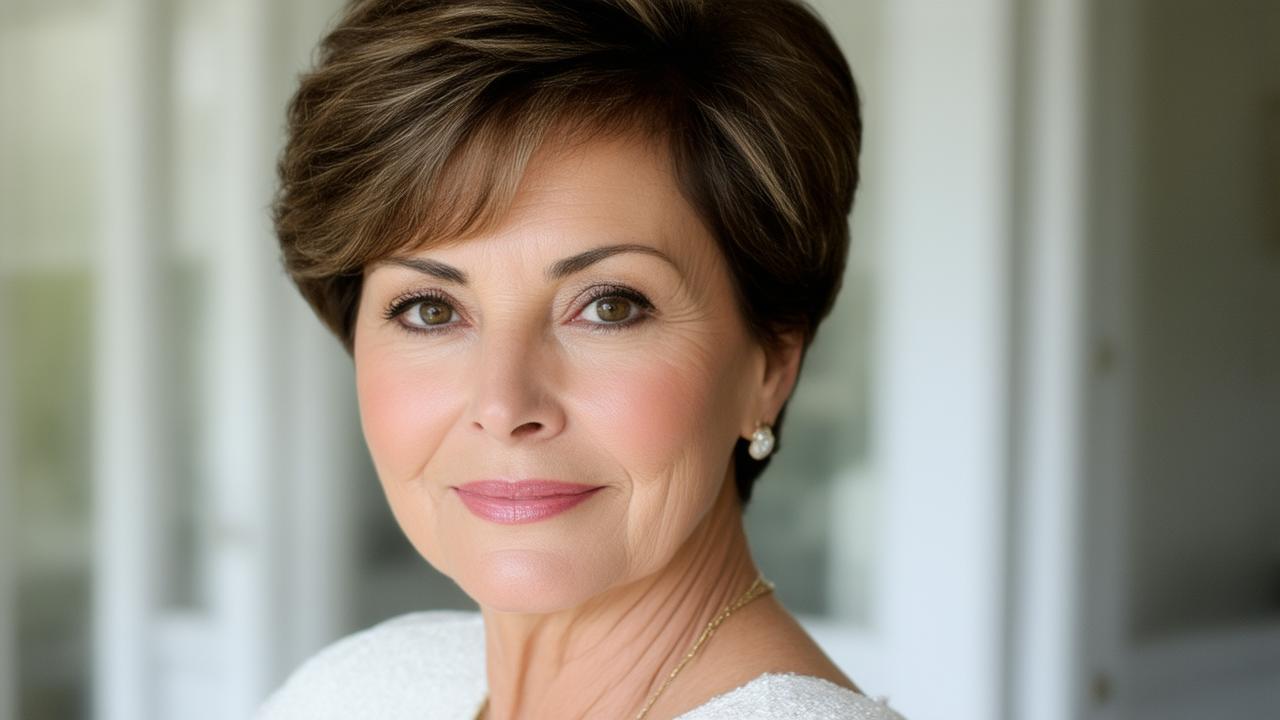
The first thing you notice is the sound. A gentle hiss of the blow dryer, the soft snip of scissors, the low hum of conversation. Outside, late-afternoon light is sliding down the storefront windows, but in here time feels softer, kinder. In the mirror, a woman in her early 60s tips her chin to the side, watching as a handful of silvered hair falls gracefully to the floor. She looks…lighter. Not just because of the hair she’s losing, but because of something else that’s quietly being shed: an old idea of what she’s “supposed” to look like at this age.
The Quiet Confidence of a Cut That Just Works
“Turn your head just a bit. Perfect. Now look at your jawline.”
Her hairdresser, Mia, steps back, comb resting against her wrist. They’ve opted for a softly layered, chin-to-shoulder-length cut—what Mia simply calls “the forever flattering cut.” It moves when her client laughs, curves gently around the face, and never sits like a helmet.
“This is the cut I can always trust,” Mia tells me later, sweeping clippings into a neat pile. “On women in their 60s, 70s, even 80s, it does something special. It frames the face, softens the lines we’re a bit self-conscious about, and still looks modern. And it’s easy to live with. Hair should be lived in.”
It isn’t one exact, rigid hairstyle so much as a family of cuts: somewhere between the chin and collarbone, light layers through the lengths, a bit of lift at the crown, and movement that follows the natural texture rather than fighting it. It can be worn sleek, tousled, curled, or blown out for volume. It’s endlessly adaptable, which, hairdressers say, is exactly why it stays flattering as we move through our 60s and beyond.
The Shape That Loves the Face You Have Now
Walk into any salon on a weekday morning and you’ll see a pattern: women around their 60s sliding into the chair with the same half-apologetic phrase. “I want something…fresh. But not like I’m trying too hard.” Their hairdresser will smile; they’ve heard this a hundred times, and they usually have the same answer.
“We start with the face, not the birthday,” says Daniel, who has been cutting hair for three decades. “The magic of a mid-length, softly layered cut is that it honors the bone structure without exposing everything. Short crops can look fantastic, but they put your whole face on display. Long, heavy hair can drag things down. This in-between length is like good lighting.”
As we move into our 60s, the face changes in ways no cream can entirely undo. The jaw softens. The cheeks lose a bit of volume. The neck, that notoriously honest part of us, starts to tell its story. A well-designed mid-length cut responds to all of that:
- Face-framing pieces skim along the cheekbones and jaw, softening edges rather than hiding them.
- Gentle layering adds lift near the temples and crown, visually opening the eye area.
- Strategic length around the collarbone or just above keeps the neck from feeling “bare” while avoiding that dragged-down look of very long hair.
“When I bring those shortest layers to the cheek or the jaw, the whole expression changes,” Daniel says. “My clients sit up straighter. They lean into the mirror instead of away from it.”
Why Hairdressers Trust This Cut
Hairdressers are, in many ways, quiet observers of time. They see how hair thins or coarsens, how gray appears first at the temples, how a part that stayed faithfully in one place for decades suddenly feels too harsh. They also see how a single, well-balanced cut can seem to ignore all of that and simply make a woman look…like herself, but easier.
“I can adjust this cut in tiny ways as my client ages,” says Naomi, a stylist who specializes in mature hair. “A little more layering one year, a softer fringe the next, shift the length up or down an inch. But she still feels like her. That’s why this shape survives trends.”
Texture, Tilt, and the Secret Architecture of Movement
If you look closely at the kinds of cuts hairdressers recommend for women in their 60s, you’ll notice something they all share: movement. Not chaotic frizz, not stiff perfection—just an easy, lived-in flow that makes the hair itself feel younger, even when it’s silver.
“Movement is everything,” Mia insists, running her fingers through a client’s still-damp hair. “As we get older, we lose some natural density. If I make the cut too blunt or heavy, the hair sits flat and announces every place it’s thinning. With soft layers, the eye sees shape and swing, not scarcity.”
The mid-length layered cut allows stylists to work with different textures:
- Fine hair gains much-needed body from invisible layers and a slightly shorter back.
- Wavy hair becomes the star—those waves are encouraged to form, not ironed into submission.
- Curly hair can be cut in longer, curved layers that respect the curl pattern while giving lightness around the face.
What you won’t see in this kind of cut is harsh geometry. No brutally straight lines across the bottom, no severe angles slicing into the face. Even when a stylist uses angles, they soften them with texture so nothing feels like it’s fighting the natural fall of the hair.
The Often-Overlooked Detail: The Back View
“Women forget people see the back of their head all the time,” Daniel laughs. “At the grocery store, at dinner, walking down the street. That’s where this kind of cut really shines.”
From behind, the best version of this style has a very gentle graduation: slightly shorter at the back, easing longer toward the front. That subtle tilt does two things: it gives instant lift at the crown, and it keeps the hair from crowding around the neck and shoulders.
“You know when you see someone with shoulder-length hair and it’s just kind of…sitting there, heavy?” Naomi asks. “That’s what we avoid. With a small angle and layers, it looks like the hair is in motion, even when you’re just standing in line at the bank.”
Why This Cut Ages With You Instead of Dating You
Styles come and go with dizzying speed, but some shapes act like chameleons, subtly updating themselves as the years pass. This is one of them. Hairdressers point out that the same basic structure can look quietly classic or effortlessly modern depending on small choices: the length, the part, the fringe, the finish.
“The thing that can date a look fastest is rigidity,” Mia explains. “Over-set curls that don’t move, bangs that form a hard line across the forehead, or hair sprayed so much it doesn’t dare shift. When hair looks too ‘done,’ it can make the whole face look older. This cut invites a bit of mess, and that’s actually more youthful.”
There’s also a psychological layer to its timelessness. Women in their 60s today came of age in eras that celebrated self-expression through hair: the long, middle-parted freedom of the 70s, the big, bold shapes of the 80s, the sleek precision of the 90s. Many still carry a quiet fear of a “mumsy” cut—something that feels like giving up.
“I always tell my clients: this is not a compromise cut,” says Daniel. “It’s not the haircut you get when you’re ‘too old’ for long hair. It’s the cut you get when you want your hair to look intentional but relaxed, stylish but not like you raided your granddaughter’s Pinterest board.”
The Role of Color and Shine
Hairdressers emphasize that the structure of the cut is only one part of the story. Color—or the decision to go fully gray—plays a huge role in how flattering it feels.
“This length is perfect for showcasing silver, actually,” Naomi notes. “When the hair moves, those cooler tones catch the light. If the cut is too long and heavy, gray can look dull. If it’s too short, it can feel severe. Mid-length with movement? It’s like soft light on satin.”
For women who still color their hair, subtlety is key: softer transitions, gentle highlights that echo natural sun-kissed strands, lowlights for dimension. Whatever the color, shine matters more than ever. Treatments, glosses, and good home care make this lived-in style look intentional rather than tired.
Everyday Ease: The Cut That Fits a Real Life
The true test of any haircut isn’t how it looks walking out of the salon; it’s how it behaves on a Tuesday morning when your coffee is cooling too fast and you’re already five minutes behind. This is another reason hairdressers swear by this shape for women in their 60s: it’s forgiving.
➡️ Bad news for city dwellers who love silence after lunch a new ban on mowing lawns between noon and 4 p.m sparks anger among gardeners and splits neighborhoods
➡️ Driver’s license : good news for motorists, including elderly people
➡️ Sorry, the Matrix doesn’t exist: new mathematical proofs suggest the universe cannot be a simulation
➡️ People in their 60s and 70s who keep these old-school habits report higher happiness than tech-focused younger adults
➡️ An old-school moisturizer with no luxury branding is crowned the number one choice by dermatology experts
➡️ Day will slowly turn to night as the longest total solar eclipse of the century passes across several regions, creating a rare and spectacular event that scientists say will captivate millions
➡️ Gray hair: 5 habits to adopt to enhance salt and pepper hair without the “granny” effect, according to a hairstylist
“Most of my clients don’t want to wrestle with a round brush for 40 minutes,” Mia says plainly. “They want to be able to rough-dry it, maybe smooth the front pieces, and feel done.”
For that to work, stylists quietly engineer the cut for low-maintenance charm:
- Enough length to tuck behind the ears or clip back if needed.
- Layers placed so the hair falls into shape even when air-dried.
- Ends softened so they don’t flip wildly in every direction.
This is where personalization really comes into play. A woman who wears glasses might have lighter, shorter layers around the temples to keep the frame visible and the face open. Someone with arthritis in their shoulders might opt for slightly shorter length so drying is easier. Another might ask for a longer fringe that can be swept aside on days she doesn’t feel like styling it.
“There’s an ease that comes in your 60s,” Daniel muses. “You know yourself better. The right cut respects that. It doesn’t ask you to be someone you were ten hairstyles ago.”
How Often to Maintain It
Hairdressers usually recommend a trim every 6–10 weeks for this kind of cut, depending on how fast your hair grows and how polished you like it to look. Let it go too long, and the shape blurs; the layers sink and the hair starts to feel weighed down again.
“You don’t have to be precious about it,” Naomi says, “but a little maintenance goes a long way. Think of it like tuning an instrument. You’re keeping the vibration— the movement—just right.”
Finding Your Version of the “Forever Flattering” Cut
The women who walk into these salons are not all the same. Some arrive with decades of long hair trailing behind them like a story they’re not quite ready to close. Others appear with harsh, grown-out bobs they got “to look more professional” years ago. Some come clutching magazine clippings; others show only their reflection, quietly asking, “What do you see?”
Hairdressers, at their best, translate all of that into something that feels both comforting and daring: a cut that says, in its own quiet way, “This is who I am now—and I like her.”
Below is a simple way stylists often adjust this flattering mid-length, layered cut based on your features and lifestyle:
| If you… | Ask your hairdresser for… | Why it helps |
|---|---|---|
| Have fine or thinning hair | Soft, internal layers and length between chin and collarbone | Adds volume and movement without sacrificing fullness at the ends. |
| Want to soften lines around mouth and jaw | Face-framing pieces that hit between cheekbone and jaw | Draws the eye to the cheekbones and away from deeper lines. |
| Have a softer or fuller neck area | Length that brushes the collarbone with gentle graduation at the back | Skims rather than exposes the neck, giving a graceful outline. |
| Dislike heavy styling | Low-maintenance layers tailored to your natural texture | Allows for air-drying or quick blow-drying without precision work. |
| Wear glasses | Light layering around the temples and sides, optional soft fringe | Opens up the eye area and prevents hair from crowding the frames. |
“Your 60s aren’t about hiding,” Mia tells me as she unclips a fresh section of hair from another client’s crown. “They’re about editing. You keep what feels true and let the rest fall to the floor. This cut just happens to be one of those things that keeps earning its place.”
In the mirror, the woman from earlier is smiling now, turning her head slowly from side to side. Her new, softly layered hair brushes her jaw and catches the light as she moves. It doesn’t look like she’s trying to be younger. It looks like she’s decided to be fully, comfortably herself—and the haircut simply agrees.
Frequently Asked Questions
Is shoulder-length or mid-length hair really better for women in their 60s?
Not better for everyone, but it is more universally flattering than very long or very short cuts. Mid-length hair lets stylists frame the face, add movement, and balance the neck and jawline without overwhelming your features.
Can this kind of cut work with naturally gray or white hair?
Yes. In fact, it can make gray hair look luminous. The movement from layering helps gray strands catch the light, and the mid-length shape prevents silver hair from feeling heavy or dull.
What if my hair is very fine and thinning?
A skilled hairdresser can use subtle internal layers and careful shaping to create volume and lift without exposing the scalp. The key is not going too long or too blunt; a mid-length, softly layered cut keeps fine hair looking fuller.
Do I need bangs for this cut to be flattering?
No. Bangs are optional. Some women love a soft, side-swept fringe to soften the forehead; others prefer no bangs and use face-framing layers instead. Your stylist can help you decide based on your forehead, hairline, and how much styling you’re comfortable with.
How do I explain this cut to my hairdresser?
Describe it as a mid-length cut between chin and collarbone with soft, blended layers for movement and face-framing pieces that flatter your cheekbones and jaw. Bring a few photos of women with similar hair texture and age, and talk honestly about how much time you want to spend styling day to day.





