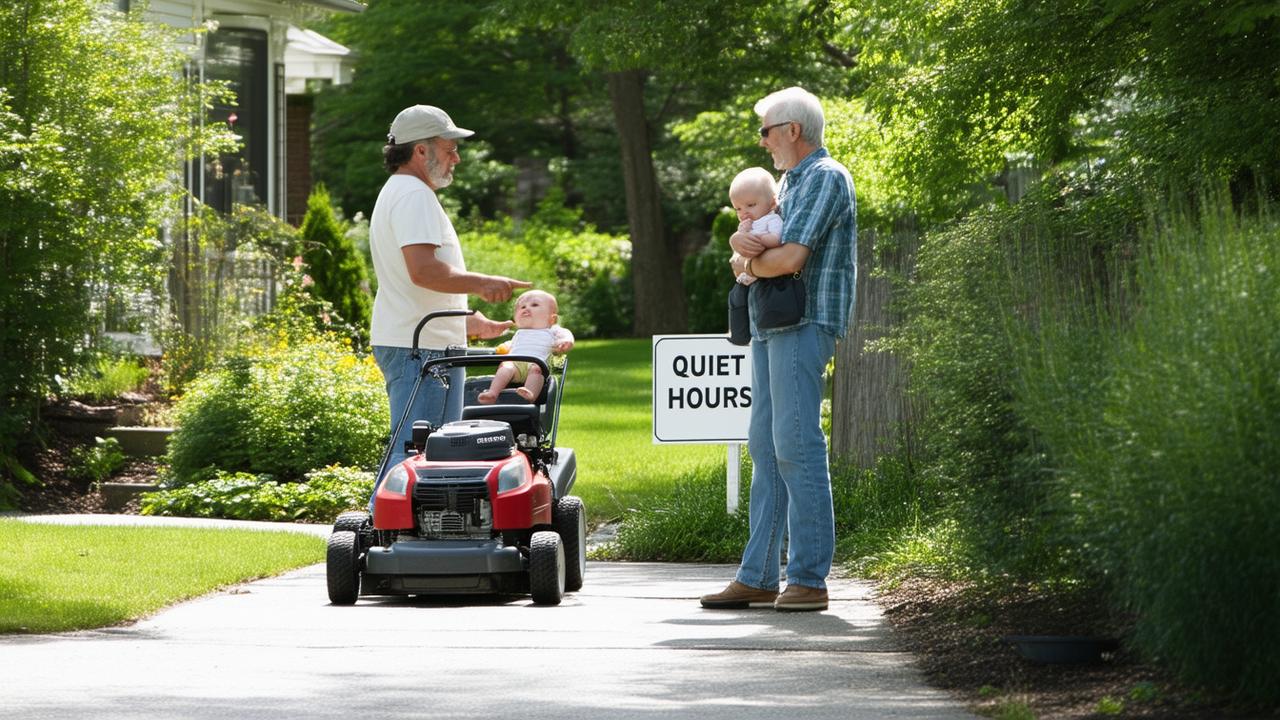
The first thing you notice is the silence—big, blank, unnatural. It settles over the neighborhood like a wool blanket just after lunch. No whine of lawn mowers, no hedge trimmers snarling, no leaf blowers howling up and down the street. Just birds, the distant hum of traffic, and the clink of someone rinsing dishes in a kitchen sink. It should feel peaceful. But in this city, the midday quiet has turned into a battleground.
The Day the Lawns Went Quiet
It started, as city stories often do, with a complaint. Or rather, a whole inbox full of them.
For years, people had grumbled about the noise—the Saturday morning mowers that began before the coffee finished brewing, the weekday blowers that roared through someone’s only hour of lunch break, the never-ending mechanical chorus of suburban ambition. Grass could no longer grow without a soundtrack of small engines.
When the city council finally decided to act, they didn’t go after the early birds or the late-night landscapers. Instead, they struck at the heart of the day: noon to four. The hottest, brightest, most languid four hours of the afternoon—now declared a “quiet window.” A new bylaw, neatly typed and calmly worded, made it official: no lawn mowing, no powered trimmers, no blowers between 12:00 p.m. and 4:00 p.m.
Few expected what came next. The city had tried limits on noise before: leaf-blower bans after 8 p.m., construction cutoffs at 6 p.m. But this was different. This was the sanctity of the afternoon, the beloved post-lunch time slot when retirees tended roses, landscapers chased schedules, and home gardeners finally got home from the morning’s errands and stepped out with shears in hand.
The rule passed. The engines went quiet. And the neighborhoods, ironically, got louder than ever—at least in spirit.
The Battle Over the Quiet Hours
The first weekend under the new rule, tempers boiled before the air did.
On Oakridge Lane, a narrow cul-de-sac where lawns are more competition than decoration, the change was impossible to ignore. Before, the early afternoon had been a rotating concert of neighbors mowing in shifts. Now, the soundscape had shifted. You could hear the jostling of cutlery from lunch tables, the shuffle of newspapers, the whistle of the 1:15 train at the edge of town. You could also hear the whispers—the ones that came with every side-eye glance at another’s overgrown lawn.
At 11:55 a.m., lawn mowers fired up in a frantic rush. At 11:59, you could almost sense the tension in the air as blades made their last desperate runs over striped grass, and engines snapped off like someone had cut power to the entire street. Then came the four-hour vacuum.
For some, it was bliss. For others, a nightmare.
“This is my only time,” said Daniel, a shift worker who often returned home close to noon. “I’m not trying to annoy anyone, I’m just trying to keep the place from becoming a jungle. By the time four o’clock hits, I’m either back at work or the sun’s too low to get it done. How is my lawn the city’s business?”
Across the street, on her shaded porch, retired schoolteacher Maria had another take. “I’ve lived here thirty years,” she said, watching a pair of sparrows argue at the bird feeder. “For once, I can sit after lunch and hear myself think. The other day, I heard an owl. In the middle of the day. An owl. You want to tell me that’s not worth a bit of taller grass?”
When Peace and Practicality Collide
City officials had their reasons. Rising noise complaints. Research on the health impacts of constant urban noise—stress, poor sleep, elevated heart rates. Environmental advocates pointed out that people often mow in the hottest hours, exposing themselves to heat stress. The quiet window, they argued, was a buffer for both human and non-human residents.
Yet the new rule hit working people, gardeners, and landscapers like a thrown brick.
Landscaping crews, already squeezed by tight schedules and thin margins, found four crucial hours clipped from their day. A crew used to stack three or four jobs between noon and four; now, they had to either start earlier or cram everything into the late afternoon and early evening, where neighbors already grumbled about end-of-day noise.
Home gardeners felt squeezed too. Those who lovingly curated vegetable patches and flower beds often relied on that bright, post-lunch window. The soil was warm, the shadows still short, and the afternoon breeze just starting to move. Now, they were limited to hand tools unless they wanted to risk a fine—or the disapproving glare of a neighbor who suddenly saw themselves as a guardian of the quiet.
Ironically, the law meant that some of the noisiest activity was pushed into early mornings and late evenings, right when people are trying to wake up gently or unwind. The midday silence, intended as a gift, began to feel more like a rearranged problem than a solved one.
The Neighborhood Split: Birds, Blades, and Bad Blood
If rules reveal anything, it’s where our values clash.
In some streets, the ban became a line in the sand. On one side were the “Silence Defenders”—a mix of remote workers, retirees, parents of napping toddlers, and anyone who believed that lunchtime quiet was a sacred urban right. On the other side were the “Greenkeepers”—gardeners, lawn-proud homeowners, gig workers, and landscapers who saw the rule as one more reminder that the city listened more to complaints than to practical lives.
It wasn’t long before the conflict spilled into neighborhood group chats and community boards. One resident posted a photo of a neighbor mowing at 1:30 p.m. with the caption, “Some people think they’re above the rules.” Another fired back, asking if taking a picture instead of having a conversation was really the spirit of community.
Naturally, rumors spread faster than dandelions. People whispered about fines in the thousands (in reality, rarely issued and much smaller). Some believed electric mowers were exempt (they weren’t). Others claimed that if you were “just finishing” a mow when the clock hit noon, you had an invisible grace period (you didn’t).
The lawns themselves told a quieter story. People began delaying mowing, letting grass grow a little longer. Daisies and clover dotted front yards. Bees and butterflies started to appear where once there had only been short, disciplined turf. What looked like neglect to some looked like life returning to others.
A Midday Truce with Nature
The birds didn’t know about the bylaw, but they benefited from it.
In the enforced midday lull, something rare happened in the city: sound levels actually dropped low enough for the softer things to be heard. Children’s distant laughter, pages turning, the chirp and chatter of sparrows taking ownership of unhurried hours. Without the mechanical roar, wind in the trees sounded louder. A neighbor’s radio playing quietly from a kitchen window wasn’t drowned out by a two-stroke engine.
Urban ecologists spoke up in cautious praise. They argued that animals in cities were already adapting to constant human noise—singing louder, calling at different hours, moving around at night to avoid us. A mandatory daily pause, they suggested, was like a small breathing space in a crowded schedule; a predictable gap where non-human neighbors could move, feed, and call without shouting over the mowers.
Some gardeners, too, began to adapt rather than resist. They shifted their routines, using the quiet hours for slow, hand-based tasks: deadheading roses, tying up tomatoes, pulling weeds by hand, mulching, watering. The afternoon became less about domination—cutting, trimming, conquering—and more about observation. You notice more when your hands are busy but your ears are free: the way the soil smells after the noon sun, the faint rustling from under the hedge, the way the light pours like honey over the lawn.
➡️ Gardeners are rethinking soil turning after noticing long-term damage
➡️ If your plants seem healthy but attract recurring problems, the cause may be underground
➡️ Over 60 and experiencing stiffness in the morning? This is what your body needs most
➡️ Over 65? This overlooked part of the foot plays a key role in stability
➡️ Restoring sight without major surgery: the quiet revolution behind a new clear eye gel
➡️ Add just two drops to your mop bucket and your home will smell amazing for days, no vinegar, no lemon needed
➡️ Space almost ignited a serious conflict between China and the United States over secret military ambitions no one wants to admit
How Residents Are Adjusting Their Routines
Not everyone, of course, can just rearrange their days around a four-hour window. But slowly, routines began to bend, if not happily, then at least creatively. A few patterns started to emerge—imperfect compromises between practicality, peace, and habit.
| Resident Type | Old Mowing Time | New Strategy |
|---|---|---|
| Shift workers | Midday after arriving home | Shorter, more frequent mows in early morning or on days off |
| Remote workers | Scattered through the afternoon | Evening mowing sessions after 4 p.m., with quieter electric tools |
| Landscaping crews | Continuous schedules from morning through late afternoon | Front-loading mowing into the morning and reserving midday for pruning, planting, and cleanup |
| Retirees and hobby gardeners | Early afternoon under full sun | Hand work between noon and 4 p.m., mowing in the cooler early evenings |
It wasn’t a perfect system, but it was a living one—a city learning, sometimes clumsily, to share its hours as well as its spaces.
Anger, Adaptation, and the Question Underneath
Underneath the arguments about mowers and hours is a more intimate question: what kind of city do we want to live in?
Is it the kind of place where every spare minute is filled with productivity—grass cut shorter, hedges sharper, leaf piles vanquished as soon as they fall? Or is it a place that can tolerate a bit of mess in exchange for quiet, where the sound of a blackbird’s song is not the rare pause between engines, but part of the normal afternoon soundtrack?
The new ban has exposed how differently people imagine home. For some, a perfectly cut lawn is a sign of pride, order, even respect for neighbors. For others, that same intensity feels like intrusion—a roar that breaks through walls and demands attention even inside closed rooms.
In neighborhood meetings, cooler voices began to emerge. A few suggested block-level agreements: shared mowing schedules, designated “quiet Saturdays,” gentle nudges instead of fines. Some argued for exceptions for small electric mowers, or for limited “appointment windows” for professional crews. Others saw the ban as a starting point—a reminder that not all progress hums and buzzes; some of it simply turns the volume down.
Learning to Listen Between the Machines
Stand on a city sidewalk at 1:30 p.m. now, and the change is almost uncanny. You can hear your own footsteps. You can hear the minute hand in your watch if you lean against a quiet wall. The silent hours have not healed every conflict, nor have they erased the frustrations of those who feel time-poor and rule-bound. But they have made something audible that was once buried under the engine drone.
Maybe the most unsettling part of the new rule is not the fines, or the inconvenience, or even the uneven lawns. It’s what the silence puts back in our ears: the rustle of a neighbor’s argument, the far-off siren, the uneasy feeling that this is not how cities are “supposed” to sound anymore—and the conflicting realization that this might be how they once did.
In the end, the lawns will still get mowed. The hedges will be trimmed. The blowers, inevitably, will grow louder in their shortened windows. But even if the law changes again—if the hours are loosened or tightened or thrown out altogether—something has already shifted. People have felt, even briefly, what it’s like when the city stops roaring at midday. The gardeners have felt the pinch, the silence-lovers have savored their afternoons, and the neighborhoods have had to talk, argue, and listen to each other a little more.
And in that thin, bright slice of afternoon, when the machines are still and the grass is allowed, for just a few hours, to simply be—maybe the city is learning a strange new skill: how to live together not only in shared space, but in shared sound.
Frequently Asked Questions
Why did the city choose noon to 4 p.m. for the lawn mowing ban?
The city focused on noon to 4 p.m. because it’s a peak period for both noise complaints and heat. Many residents use this window for rest, remote work, or naptime for children, and officials wanted to create a consistent daily quiet period.
Does the ban apply to electric mowers and small tools?
In most cases, yes. The ban typically covers all powered lawn equipment, including electric mowers, trimmers, and blowers. Hand tools like shears, rakes, and manual push mowers are usually allowed.
How are landscapers supposed to cope with the restrictions?
Landscapers are adjusting by shifting mowing to mornings and late afternoons, and using the quiet hours for tasks like planting, pruning, cleanup, and planning. It’s inconvenient, but many are reorganizing routes and schedules to stay compliant.
Can neighbors report someone for mowing during the restricted hours?
Yes, but enforcement varies. Some cities rely on complaints to trigger warnings or fines, while others emphasize education first. Many neighborhood conflicts can be reduced by talking directly before involving authorities.
Could this type of quiet-hour rule spread to other cities?
It’s possible. As urban noise and heat concerns grow, more cities may experiment with similar rules. Whether they last will depend on how well they balance residents’ need for peace with the practical realities of work and home maintenance.





