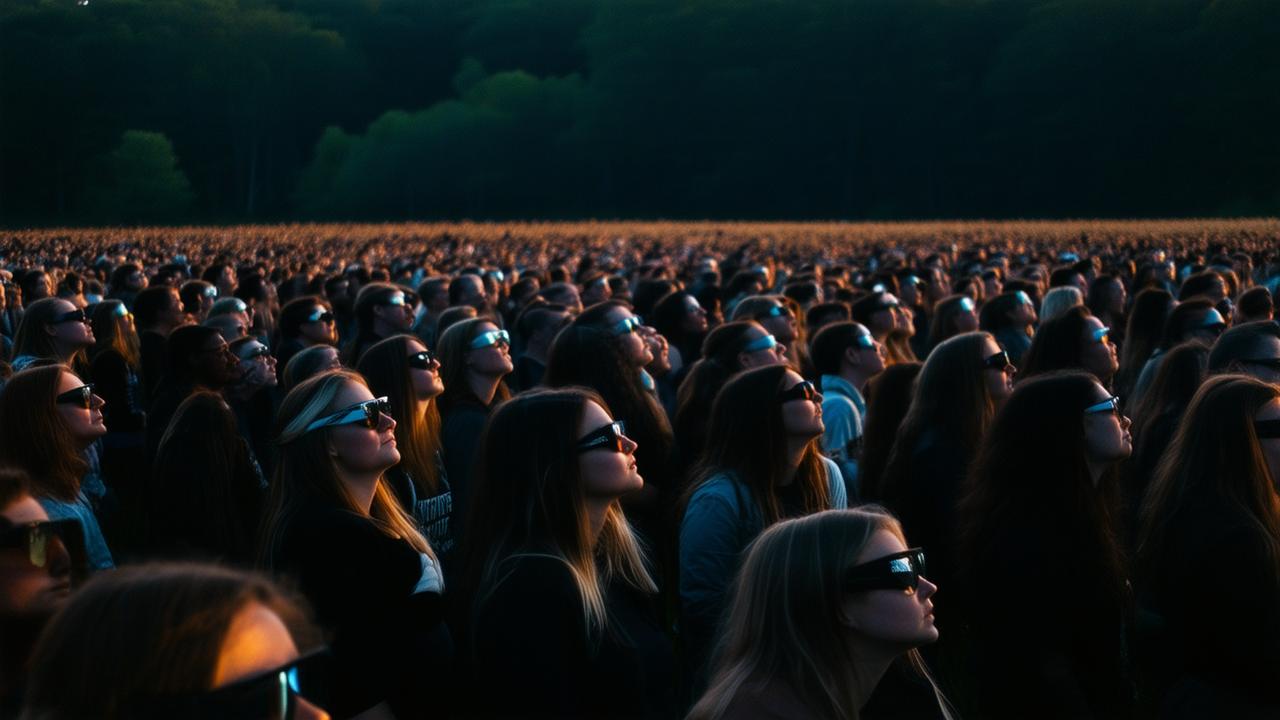
The first sign will be the shadows. They’ll sharpen, then begin to look strangely wrong, like someone quietly tweaked the settings on the world. Leaves will cast crescent-shaped patterns on sidewalks, the light will turn a color you don’t have a name for, and the day—sure as the ticking of a second hand—will begin to dim. People will step out of offices, spill onto balconies and rooftops, cluster in fields, parking lots, and school yards, faces tipped skyward behind cardboard glasses. On this day, the longest total solar eclipse of the century will slowly pull daylight off the planet like a curtain, and for a few breathless minutes, millions of us will stand together in the dark and stare at the sun.
The Slow Dimming of a Busy Day
It will start inconspicuously, the way big things often do. Most of the world will keep moving at first—emails sent, traffic lights cycling, a barista handing over another coffee. Overhead, though, something subtle will change. The sun, that familiar unblinking disk, will begin to look slightly shaved at the edge, as though an invisible bite has been taken out of it.
In cities along the eclipse path, someone will point up between high-rise towers, asking, “Is it starting?” Outside small-town diners, people will drag lawn chairs into parking lots. On farms, workers will pause between rows, using darkened film or official eclipse glasses to check the sky. On quiet suburban streets, neighbors who rarely talk will wander outside with cereal-box projectors and children restless with anticipation.
The light will soften and then grow oddly stark, as if the world has been run through an old camera filter. Colors will flatten; shadows will sharpen into crisp, knife-edged lines. On the edge of awareness, you’ll feel it more than you see it: the day doesn’t feel like afternoon, evening, or stormy weather—it feels like something entirely new. The air may cool slightly on your skin. Birds will falter mid-song, confused. Somewhere nearby, a dog may start to whine.
The Longest Shadow of the Century
This eclipse is not just any celestial coincidence. Astronomers have been waiting for this one for years, tracing its path with quiet excitement and calculating its extraordinary duration. Total solar eclipses sweep over Earth fairly regularly, but most last only a few fleeting minutes. This one will linger, stretching out the moment of totality for longer than any other eclipse this century.
Imagine a dark river of shadow, the Moon’s umbra, racing across the face of the Earth at thousands of kilometers per hour. Its path will cross oceans, plains, mountains, and cities, carving a narrow band where people will see the sun fully blotted out. Outside that narrow track, millions more will witness a deep partial eclipse—still dramatic, still uncanny, but not quite the full plunge into temporary night.
Scientists can tell you exactly when the shadow will fall on each town and when it will lift again, down to fractions of a second. They know where the eclipse will be best seen, where totality will last longest, and how dark the sky will get. Huge telescopes and small homemade ones will be turned toward the sky. But when the moment comes, even the most seasoned astronomer often falls quiet, struck by something older and deeper than any chart: an ancient, instinctive awe.
| Region | Eclipse Phase | Approximate Local Time of Maximum | Estimated Duration of Totality / Peak Coverage |
|---|---|---|---|
| Coastal City in Western Path | Total | Late Morning | 4–6 minutes of totality |
| Inland Rural Region | Total | Midday | 6–7+ minutes of totality (longest stretch) |
| Eastern Metropolitan Area | Total / Near Total | Early Afternoon | 3–5 minutes of totality or >90% coverage |
| Regions Outside Main Path | Partial | Varies by location | Up to several hours of partial phases |
The Moment the Stars Return at Noon
Those who make their way into the narrow central path, where the eclipse turns total, will experience something that can be hard to properly describe to anyone who’s never seen it. As the Moon slides entirely over the Sun, a hush often falls over the crowd, whether it’s a handful of stargazers in a remote valley or thousands gathered in a city park.
The last sliver of sunlight will break into shimmering “beads” as it shines through the mountains and craters along the Moon’s edge—Bailey’s beads, astronomers call them. Then, for a fleeting instant, the light may look like a glowing diamond on a ring: the famous diamond ring effect. And then, suddenly, the Sun’s bright face will vanish.
A black disk will hang in the sky where the Sun should be, encircled by an otherworldly halo of light—the solar corona, the Sun’s outer atmosphere, usually washed out by the glare of daylight. Delicate, pearly-white streamers will stretch outward in twisted, feathery shapes, sculpted by the Sun’s magnetic field. In those minutes, it will feel less like you are watching the sky and more like you are peering directly into the machinery of the universe.
Stars and bright planets will appear, shy but visible, in the darkened daytime sky. Streetlights may flicker on. Temperature will dip a few degrees, enough that you might feel goosebumps rise on your arms. Some animals, tricked by the sudden darkness, will stir as if it were dusk: crickets chirping, birds beginning their evening routines before the light returns and confuses them all over again.
Scientists Chasing a Shadow
Amid the collective wonder, another kind of story will be unfolding—one of data, instruments, and careful planning. Scientists and eclipse hunters will have positioned themselves along the path like beads on a string, each ready to capture a different slice of this fleeting event.
Telescopes tuned to different wavelengths will study the Sun’s corona with a clarity that’s hard to achieve at any other time, trying to unlock lingering mysteries: Why is the corona so much hotter than the Sun’s surface? How do solar storms flare and twist out from this ghostly halo? Sensitive cameras will capture high-speed images to watch subtle changes from second to second. Some teams may launch high-altitude balloons to get above the thickest layers of the atmosphere, chasing a cleaner view.
Elsewhere, researchers will study Earth’s response to this passing shadow. They’ll track rapid changes in temperature, wind patterns, and atmospheric electricity. Ecologists will stand with notepads or audio recorders in fields and forests, observing how birds, insects, and mammals react when day turns to night and back again in less than an hour.
For scientists, eclipses are windows—brief, precise chances to study both our star and our planet under rare conditions. For many of them, too, it’s personal. Ask an astronomer what first pulled them into their field, and more often than you’d expect, they’ll tell you about the day they saw their first total eclipse and felt, in their bones, how big the universe really is.
How to Watch the Day Go Dark
For most people, this eclipse will be experienced not with lab equipment but with simple tools: a pair of eclipse glasses, a pinhole in a piece of paper, maybe a shared telescope at a community event. The basic rules, though, are the same everywhere: respect the Sun, protect your eyes, and give yourself enough time to really notice what’s happening around you.
During the partial phases—when the Moon is covering only part of the Sun—it is never safe to look directly at the Sun without proper eye protection. Ordinary sunglasses won’t do; certified eclipse viewers or solar filters are essential. If you don’t have them, you can still watch the event indirectly. A small hole in a sheet of cardboard, held above another surface, will project a tiny image of the crescent Sun. Even the gaps between leaves on a tree can turn the ground into a canvas of shimmering crescents.
Only during the brief window of totality—when the Sun is completely hidden—is it safe to look with the naked eye, and even then, you must be absolutely certain that the bright Sun has vanished entirely. The instant it begins to reappear, your eclipse glasses need to come back on. If you’re watching from the edge of the path, where the eclipse never becomes total, you must keep your eyes protected the entire time.
Beyond the technicalities, the best way to watch might be surprisingly simple: arrive early, get comfortable, and let yourself pay attention. Notice how the light changes on buildings and trees. Listen to the birds. Feel the temperature on your skin. Watch the expressions on the faces around you as the sky transforms. For a phenomenon measured in seconds and arcseconds, the experience itself unfolds on a human scale—breath by breath, heartbeat by heartbeat.
A Shared Shadow Across Regions and Lives
The path of totality will cross borders and landscapes that rarely share a story quite like this—mountain villages, coastal cities, farmlands, crowded neighborhoods, quiet deserts. In each place, people will bring their own reasons for looking up. Some will travel hundreds or thousands of kilometers just to stand in that strip of shadow for a few minutes. Others will step outside their front doors and find, to their surprise, that the universe has come directly to them.
In one town, schoolchildren will squeal as the world darkens, clutching paper glasses and clutching each other. In another, elders will sit on folding chairs, remembering stories of earlier eclipses, of times when such events were read as omens. Somewhere on a rooftop, a teenager will glance up beyond their phone for once, feeling something shift inside they don’t yet have words for.
➡️ Gardeners are rethinking soil turning after noticing long-term damage
➡️ If your plants seem healthy but attract recurring problems, the cause may be underground
➡️ Over 60 and experiencing stiffness in the morning? This is what your body needs most
➡️ Over 65? This overlooked part of the foot plays a key role in stability
➡️ Restoring sight without major surgery: the quiet revolution behind a new clear eye gel
➡️ Add just two drops to your mop bucket and your home will smell amazing for days, no vinegar, no lemon needed
➡️ Space almost ignited a serious conflict between China and the United States over secret military ambitions no one wants to admit
The same Moon will slide over the same Sun for all of them. The same shadow will sweep across their faces. In that short lived dusk, humanity’s usual distances—political, cultural, personal—may feel, for a moment, slightly thinner. We may not agree on much, but nearly everyone understands what it means to fall silent before a sky that has suddenly changed.
When the Light Returns
As the Moon’s shadow moves on, the world will brighten again in reverse. The Sun’s first bead of light will burst from behind the Moon, another flash of the diamond ring, and then daylight will flood back with startling speed. Birds will restart interrupted songs. People will blink, laugh, maybe clap or cheer. In a few minutes, the extraordinary will begin to feel ordinary again.
Traffic will resume. Phones will buzz with photos and videos: grainy black disks, shaky shots of the sky, loved ones’ faces glowing in strange half-light. Scientists will start the long, patient work of sifting through their data. Somewhere, a child will ask when it’s going to happen again and learn that, at least in this place, it may not be for decades.
But for those who stood in the shadow, something will linger. The experience of watching day soften into twilight and then into an impossible, star-pricked noon has a way of lodging itself deep in memory. You might find that, weeks later, you still think about the strange color of the light, or the way the air felt, or that hush that fell over hundreds of strangers at once.
The longest total solar eclipse of the century will be measured in minutes on a scientist’s chart, but it will be remembered in a different kind of time: the private calendar of the heart, where a few rare days glow a little brighter—or darker—than the rest. Long after the math has faded, the feeling of standing under a briefly vanishing sun will remain, a reminder that our familiar daytime world is, at its core, a delicate, moving dance of shadow and fire.
Frequently Asked Questions
What exactly is a total solar eclipse?
A total solar eclipse occurs when the Moon passes directly between Earth and the Sun, completely blocking the Sun’s bright disk for viewers along a narrow path on Earth’s surface. During this brief period, known as totality, the sky darkens, stars and planets can become visible, and the Sun’s outer atmosphere—the corona—can be seen as a glowing halo.
Why is this eclipse considered the longest of the century?
The length of a total eclipse depends on the exact distances and alignments between the Earth, Moon, and Sun. In this event, the Moon will be at a favorable distance from Earth, and the geometry of the alignment allows the Moon’s shadow to linger longer along parts of its path. As a result, some locations will experience several minutes of totality—longer than any other total solar eclipse in this century.
Is it safe to look at the eclipse with the naked eye?
It is only safe to look at the Sun without eye protection during the brief period of totality, when the Sun is completely covered by the Moon. At all other times, including partial phases before and after totality, you must use proper eclipse glasses or solar filters. Ordinary sunglasses, smoked glass, or exposed film are not safe.
Do I need special equipment to enjoy the eclipse?
No. While telescopes and cameras can enhance the experience, they are not necessary. With certified eclipse glasses or a simple pinhole projector, you can safely watch the changing shape of the Sun. Many people find that putting equipment aside for at least part of the event helps them fully absorb the changing light, temperature, and surroundings.
Will animals really behave differently during the eclipse?
Yes, many animals respond to the sudden change in light and temperature. Birds may stop singing or head for roosts, insects that are active at dusk may emerge, and some mammals may appear restless or confused. These behaviors are one reason ecologists are interested in eclipses as natural “experiments” in rapid environmental change.
What if I’m outside the path of totality?
If you are outside the narrow path where the eclipse becomes total, you will still see a partial eclipse, with the Moon covering part of the Sun. The Sun will look like a growing and shrinking crescent. While you won’t experience full darkness or the corona, the light will still change in dramatic ways, and it can be a memorable event—just be sure to use proper eye protection throughout.
When will another eclipse like this happen?
Total solar eclipses occur somewhere on Earth every couple of years, but any given location may wait decades or even centuries between total eclipses. An eclipse as long as this one—among the longest of the century—is particularly rare. Astronomers publish eclipse forecasts far into the future, so if this event sparks your curiosity, you can plan to chase future shadows across other parts of the world.





