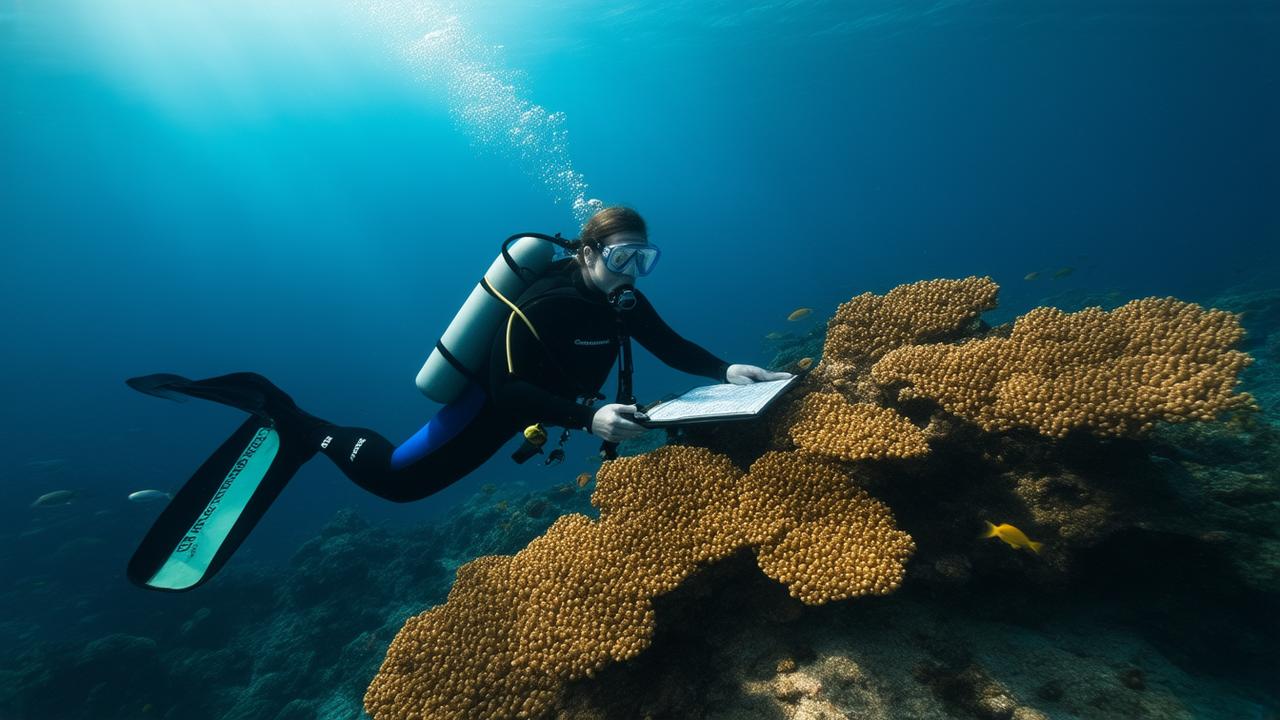
The boat hums softly as it cuts across the glassy surface of the Coral Sea, its wake a brief white scar that disappears almost as soon as it forms. The sun is already high, scattering diamonds of light across the water, but no one on board is looking at the horizon. Every eye is on the screens, the datasheets, the dive slates. Somewhere beneath the hull, a reef that has bleached again and again is either dying quietly—or learning, in its own slow, alien way, how to live with heat. Today, a small team of Australian marine biologists has come to find out which.
A Science of Return: What Recovery Really Looks Like
Ask a coral scientist what “recovery” means, and you won’t get a simple answer. Recovery is not a single number ticking upward, not a perfect “before and after” photo. It’s texture, smell, sound: the soft crunch of parrotfish grazing, the faintly salty, living scent of algae and sponges, the blurred tapestry of colors that says a reef is busy, breathing, full.
For Australian marine biologists working on the Great Barrier Reef and other reef systems, tracking coral recovery after repeated bleaching events has become a kind of long, careful listening. Bleaching—triggered mainly by heat stress as oceans warm—strips corals of their symbiotic algae, turning them ghost-white. Some die quickly. Some hang on, pale but alive. A few, surprisingly, bounce back stronger, as if the experience rewires their tolerance to heat.
But that “bouncing back” is messy. Recovery can mean baby corals settling by the thousands on a dead reef flat. It can mean a surviving patch of sturdy branching coral expanding outward like a slow-motion explosion. It can even mean the reef changing shape entirely, with some coral species vanishing and others quietly taking their place. The question scientists are asking now is no longer just “Will the reef survive?” but “How is the reef changing—and can we nudge that change in a better direction?”
Underwater Notebooks: How Biologists Actually Track Change
The romantic idea of a scientist drifting over the reef with a notebook isn’t completely wrong—it’s just more complicated, more crowded with hardware. On a calm morning off Queensland, a team rolls backwards into the water, fins slicing through a shimmer of bubbles. Each diver wears not just a tank and mask, but a checklist of tasks: photograph this transect line, scan that patch with a laser, record the color, height, even the shadows cast by the coral.
For decades, the backbone of coral monitoring has been simple: lay a tape measure along the reef, then record what lives beneath each segment—a fan of soft coral here, a patch of dead rubble there, a cluster of branching Acropora a little further on. These surveys, repeated year after year, build a timeline of the reef’s fate. After a bleaching event, the same lines are surveyed again, marking which colonies survived, which died, and which are showing signs of regrowth—new branches, fresh tissue creeping over old skeleton.
But lately, Australian teams are bringing in a new toolbox. High-resolution 3D photogrammetry lets them stitch together thousands of overlapping images into detailed digital models of specific reef patches, accurate down to the centimeter. With each visit, they can rescan the same patch and compare.
| Method | What It Measures | Why It Matters |
|---|---|---|
| Transect Surveys | Coral cover, species presence, visible damage | Builds long-term trends in who lives and who dies on the reef. |
| 3D Photogrammetry | Reef structure, complexity, and growth shapes | Shows how the “architecture” of the reef recovers for fish and other life. |
| Coral Health Indices | Color, tissue condition, algal overgrowth | Reveals subtle early signs of stress or recovery. |
| Larval & Recruitment Counts | New baby corals settling on the reef | Indicates whether future generations are replacing what’s been lost. |
Looking at one of these models on a laptop in the boat’s cabin is like peering into a tiny, perfect diorama of the reef—a miniature world of knobbly outcrops and shadowed crevices. When biologists compare models from before and after bleaching, they can see not just that corals died, but that whole ridges crumbled, fish refuges vanished, and then—months or years later—new fingers of coral start to reclaim that lost space.
Listening to the Night Reef: Sound, Smell, and Spawning
Tracking recovery happens after dark, too. On a warm, still November night, the reef feels almost expectant. The water is thick with plankton, and the surface reflects a sky crowded with stars. Below, scientists float in the dark, their dive lights mostly off, waiting for one of nature’s quietest miracles: mass coral spawning.
On certain nights each year, many coral species release eggs and sperm in synchrony, turning the water into a slow, swirling blizzard of pink and white bundles. For a reef that has just endured a bleaching event, a strong spawning is like a deep, steady pulse—proof that survivors are still reproducing, still sending out offspring that might settle on damaged areas and start again.
Australian researchers gently scoop these spawn slicks into nets and containers, counting and analyzing them. They track how many larvae form, how many are viable, and where they might drift on currents. Increasingly, they’re using clever techniques like placing small ceramic tiles or specially designed “settlement plates” around damaged reef areas. Months later, divers return to check which baby corals have attached, survived, and begun to grow.
Recovery is also being tracked with sound. Healthy reefs are surprisingly noisy: the crackle of snapping shrimp, the pops and grunts of fish, the scratch of grazing. After bleaching, the reef’s voice quiets. By leaving underwater microphones—hydrophones—on the seafloor, marine biologists can record how that soundscape slowly returns, or fails to. More noise, over time, often correlates with more life, more complexity, more opportunities for young corals and fish to thrive.
Heat Survivors: The Corals That Refuse to Quit
Not all corals suffer equally. As bleaching events stack up—2016, 2017, 2020, and beyond—Australian marine biologists are noticing a pattern. Some individual colonies, and some species, seem to withstand heat better than others, or recover more quickly afterward. These are the reef’s endurance athletes, and scientists are learning to recognize them.
Divers mark these standout colonies with small tags or GPS coordinates, returning again and again to monitor their health. Samples are carefully taken—tiny fragments snipped off and carried back to the lab. Under the microscope and in tanks that can be warmed or cooled on command, the secrets begin to emerge: certain types of symbiotic algae more tolerant of heat, shifts in coral physiology, changes in the genes switched on during stress.
This detective work feeds into a controversial but increasingly important field: assisted evolution. Instead of passively waiting to see which corals make it, some Australian labs are experimenting with selective breeding of heat-tolerant individuals, or exposing young corals to mild heat stress to “train” them, like athletes in altitude camps, to perform better in future temperature spikes. These boosted corals are then out-planted on damaged reefs, carefully monitored over months and years.
To track whether these interventions are paying off, biologists compare growth rates, survival, and reproductive success of assisted corals with their wild cousins. Are they bleaching less? Are they spawning more? Do they integrate into the reef community without disrupting it? Every tagged coral carries a story, an ongoing experiment written in skeleton and tissue.
From Satellites to Seafloor: Blending Big Data with Faded Reefs
Some of the most important tracking doesn’t happen on boats at all, but in climate-controlled offices, bright with the glow of monitors. Satellite imagery covers the Great Barrier Reef and other Australian reef systems in sweeping, pastel maps of sea-surface temperature, turbidity, and light. Algorithms scan for patches of ocean that have spent too long above normal temperatures—red flags for potential bleaching.
When those alerts go out, field teams mobilize. Planes and drones fly over remote sections of the reef, taking aerial images that reveal pale stripes and patches where corals have lost their color. These images are cross-checked with diver surveys and underwater photographs, tying together the big-picture view from space with the close-up details of individual coral colonies.
Over time, this layered dataset lets biologists not just see where bleaching happened, but how different areas respond. Some reefs, even after repeated bleachings, stubbornly spring back—often because currents bring cooler water, or because local conditions limit other stresses like pollution. Others degrade rapidly and fail to recover, their structures smothered in algae or eroded by storms.
By mapping these differences, Australian scientists are effectively drawing a survival map for the future reef: refuges worth fiercely protecting, vulnerable areas needing careful management, and potential corridors where larvae might drift from healthier reefs to help reseed damaged ones. Recovery, it turns out, is not evenly distributed. It’s patchy, place-specific, and deeply tied to both global climate patterns and local human choices.
The Human Tide: Local Clues, Local Guardians
Along the Queensland coast, in small towns where the reef is not just a scientific wonder but a neighbor, fishers, tourism operators, and Traditional Owners are becoming part of the tracking effort. Their observations—fish disappearing from a favorite bommie, a patch of reef looking strangely pale after a hot summer, a sudden burst of juvenile fish in an area that was silent last year—are increasingly fed into structured monitoring programs.
➡️ Across Australia scientists are mapping a silent rise in urban heat islands
➡️ Why Australian sleep researchers are rethinking blue light guidance for modern households
➡️ Inside the Kimberley where ancient rock art is reshaping Australian heritage protection debates
➡️ Australia’s coastal planners are revising sea wall strategies as storm surges intensify
➡️ What Australia’s bushfire science reveals about the future of smoke exposure in cities
➡️ The quiet shift in Australian coffee culture as climate pressures reshape bean supply
➡️ Researchers identify a specific type of adult stem cell with exceptional potential to regenerate human teeth and repair bone
Some Australian projects train citizen scientists to conduct basic coral cover surveys, take standardized photographs, or report bleaching using simple, repeatable methods. These locally gathered data, when added to the scientific records, give researchers a far richer picture of how recovery is unfolding on the ground—or rather, under the waves.
For Indigenous sea Country custodians, whose cultural knowledge of these waters has been passed down for countless generations, the reef’s recovery is more than a metric; it’s a living relationship. Stories of historical coral conditions, changes in species behavior, and shifting seasonal patterns offer long timelines that complement the scientists’ more recent datasets. Together, they build a shared understanding: this reef used to be like this; now it looks like that; what happens next is up to all of us.
Is Recovery Enough in a Warming World?
If there is a difficult question hanging over every survey, every dive, it is this: How many more times can the reef come back?
Tracking recovery has revealed something both hopeful and sobering. Yes, many Australian reefs can, and do, show remarkable resilience. Corals spawn again, baby colonies settle, soundscapes revive, 3D models slowly refill with life. But the intervals between bleaching events are shrinking. The ocean is not giving the reef much time to heal, to grow robust, to lay down thick skeletons that withstand cyclones and erosion.
So marine biologists continue to measure, to tag, to map. The work is painstaking, sometimes heartbreaking. It is also a kind of promise: that if the world can limit warming, the reef has a chance—and we will know, with precision, where that chance is strongest and what it looks like, colony by colony, ridge by ridge.
On the boat, as divers climb the ladder, dripping and laughing softly through their regulators, someone pulls up the day’s images on a small screen. There, in the flickering blue, a patch of reef that was bone-white two summers ago is now faintly, stubbornly green-brown again—algae and symbionts returning, tissue thickening, branches extending a few millimeters more. It’s not the riot of color people imagine when they picture the Great Barrier Reef. Not yet.
But it is a beginning. And around Australia, teams of marine biologists are watching, measuring, and quietly cheering those beginnings into data, into action, into stories that might just help the reef survive the century.
Frequently Asked Questions
Why do corals bleach in the first place?
Corals bleach primarily when water temperatures get too high for too long. The heat stresses the coral and its symbiotic algae (zooxanthellae), causing the coral to expel these algae. Without them, the coral turns white and loses a major source of food. If conditions improve quickly, some corals can recover; if not, they may die.
How do scientists know if a reef is truly recovering?
Recovery is measured over years, not weeks. Scientists look for increases in live coral cover, diversity of coral species, successful spawning events, new juvenile corals settling on the reef, and the return of a complex reef structure and soundscape. They combine field surveys, photos, 3D models, and long-term data to confirm real recovery.
Can coral reefs adapt to climate change?
Some corals show promising signs of adaptation, such as hosting more heat-tolerant algae or evolving greater stress tolerance. Assisted evolution and selective breeding aim to support this. However, the pace of climate change is very fast compared to natural adaptation, so limiting global warming remains critical.
Are all parts of the Great Barrier Reef affected equally?
No. Some regions experience more frequent or intense bleaching due to local temperature patterns, currents, and other stressors like pollution or poor water quality. Other areas act as refuges, staying cooler or recovering more quickly. Scientists map these differences to prioritize protection and restoration efforts.
What can non-scientists do to help coral recovery?
Individual actions matter: reducing personal carbon emissions, supporting policies that cut greenhouse gases, choosing reef-safe tourism operators, minimizing plastic use, and backing water quality improvements on land. In some areas, people can join citizen science programs that help monitor reef health and contribute valuable data.





