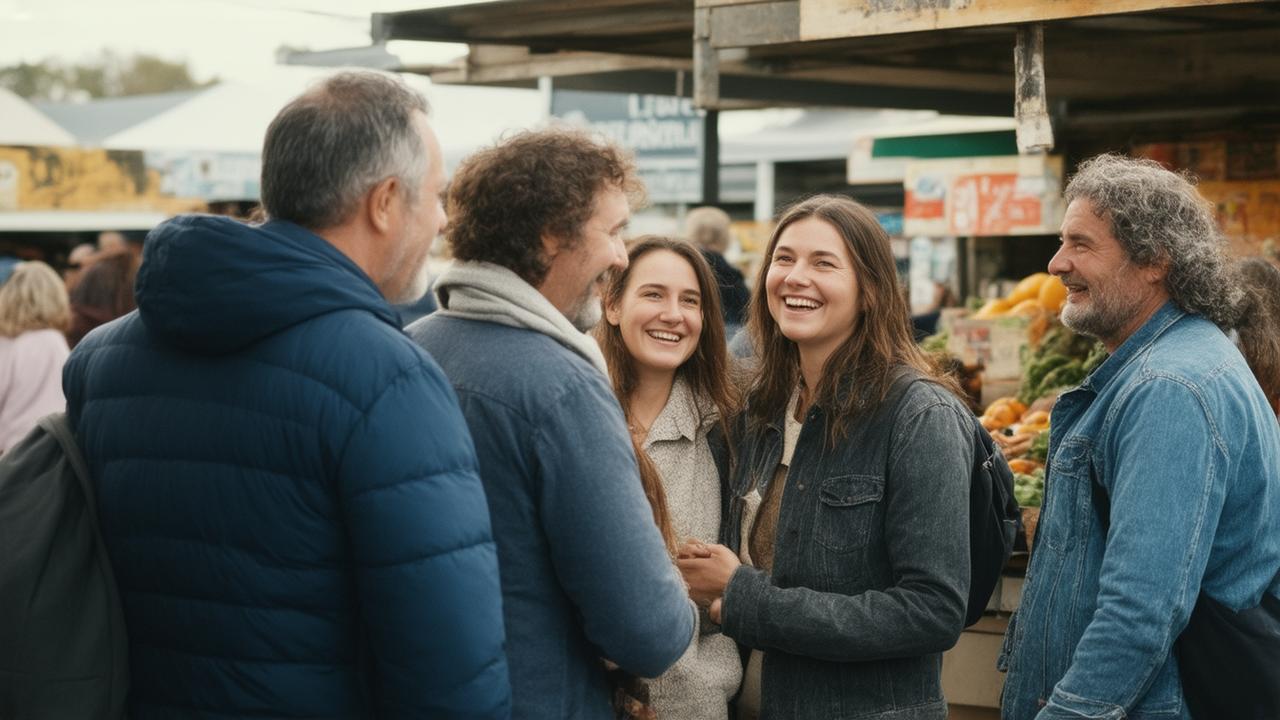
The magpies start first—those liquid, warbling notes pouring through the thin morning light—then the hiss of a milk frother joins in from a nearby café. On a small Sydney street, bins clatter, someone laughs in Spanish, a child argues with their dad in a mix of English and Vietnamese, and a delivery driver mutters into his phone in Hindi before turning to shout, “All good, mate?” as he wheels a trolley past. If you stand still for a minute, you can almost hear the country changing in real time. This is Australia’s migration story, not as a line in a textbook, but as a living, breathing soundtrack—and it’s re‑writing the way people think about identity, belonging, and even the ordinary words they use every day.
The footpath as a crossroads of worlds
On a Saturday morning, walk through Melbourne’s Footscray or Brisbane’s Sunnybank or Perth’s Northbridge and watch how people carry their histories on their tongues. A barista with Greek and Sri Lankan parents hands over a flat white and says, “Here you go, cuz,” to a customer who grew up in Auckland but whose grandparents left Samoa in the 1970s. Behind them, a couple slides from Mandarin into what sounds like perfect Australian English, punctuated with “hey bro,” “deadset,” and “so hectic.”
For decades, Australia told itself a neat, simple story—a wide, sunburnt land with one main cultural thread. But the reality has always been far more layered. Long before the first ships of British colonisers arrived, more than 250 Indigenous languages—each with its own way of seeing and naming the world—were woven across this continent. The waves of migration that followed didn’t just add different faces; they brought entire universes of metaphor, humour, and rhythm.
Today, one in three people in Australia was born overseas or has at least one parent who was. In many suburbs, English is just one of a chorus of daily languages: Arabic, Punjabi, Tagalog, Italian, Cantonese, Dinka, Dari, Somali, Greek, and dozens more. You can hear the country reorganising itself on a single footpath—the mesh of slang and syntax acting like a social handshake. Every “mate,” every “yallah,” every “eh, cuz,” is a tiny migration story, trimmed down to one syllable.
The kitchen table: where identity gets negotiated
Inside a red-brick house in Adelaide, the smell of garlic and coriander fills the kitchen. A mother calls out, “Dinner is ready, hurry up, habibi!” and her teenage son replies from the hallway, “Coming, mum, chill, I’m just finishing my homework.” He turns the corner and kisses her on the cheek, switching to Arabic to ask about the sauce, then back to English to complain about an assignment. At this table, identity is not a fixed label; it’s a dance, a negotiation, a habit.
For many second‑ and third‑generation migrants, “Australian” feels too small a word to hold everything they are. It can be fused with, or stretched around, other words: Lebanese‑Australian, Chinese‑Australian, Afghan‑Australian, Italian‑Australian. Yet in daily life, the hyphen fades away. In the mess of school lunches, online games, group chats and sports practice, these young people are fusing cultures the way a DJ blends tracks—taking pieces of heritage and samples of the mainstream, mixing them into something new.
Their language is a kind of homemade creation. An insult borrowed from Arabic wrapped in an Australian drawl. A Turkish term of endearment dropped into an otherwise English sentence. A Nigerian expression of surprise—“chai!”—punctuating a joke told in a Melbourne accent. For their parents, who might have spent their early years learning to sound “properly” Australian to avoid being singled out, this wild code‑switching can be shocking, even thrilling. It means their children feel confident enough to claim the in‑between space, to speak from it unapologetically.
When new words become everyone’s words
Step into any high school playground in Western Sydney and you’ll encounter a lexicon that would puzzle many adults just a few suburbs away. Words like “eshay,” “staunch,” “wallah,” “yum cha,” and “aunty” (used for any respected older woman, not only relatives) roll off tongues with ease. Some of these began in specific communities—Lebanese, Pacific Islander, Vietnamese, Aboriginal—and then leaked outward, adopted, tweaked, and mainstreamed.
Within a generation, what once sounded “foreign” becomes simply “Australian.” Think of how “ciao” from Italian, “souvlaki” from Greek, or “laksa” from Malay and Chinese communities have settled into everyday speech. Or how “bogan” and “woop woop,” once seen as deeply local and rural, now live comfortably beside “hijabi,” “pho,” and “sari” in daily chat. Menus, street signs, and even real estate listings carry hints of migration: “cosmopolitan,” “vibrant food scene,” “multicultural hub”—all polite code for “you can taste the world on this corner.”
Language doesn’t just because diverse people live side by side; it evolves because those people need new tools. They create fresh ways to tease, comfort, flirt, and argue across cultural boundaries. “Deadset, that’s halal as,” someone laughs, blending a strict religious term with easy‑going Australian emphasis. Meanwhile, Indigenous slang like “yarn,” “mob,” and “blackfulla” appears in mainstream conversations, television dialogue, and social media, quietly asserting that the oldest languages of this continent were always here, even if they were long ignored.
Everyday speech as a map of migration
Most people don’t notice how often migration slips into their speech until they slow down and listen. Consider a simple café order in a city laneway: “Can I grab a flat white and a banh mi, thanks.” In one sentence, you get traces of British coffee culture, Italian espresso traditions that reshaped Australian cafés in the mid‑20th century, and Vietnamese street food that arrived with refugees after the war. Say it quickly and it sounds ordinary. Unpack it, and you have a map of the last hundred years.
Even the way Australians introduce themselves has shifted. Where “Where are you from?” once meant “Which suburb?”, it can now open a layered, careful conversation. Many people with migrant backgrounds have learned to answer in stages: “I’m from Melbourne… my parents are from Pakistan… my grandparents moved there from India.” Others push back gently: “I’m from here, just like you.” These small exchanges carry centuries of tension—colonisation, exclusion, assimilation campaigns—but they also show movement toward something softer, more curious.
In offices, construction sites, and hospital wards, colleagues swap food and stories. A Fijian‑Indian nurse teaches her team the phrase “vinaka vakalevu” for “thank you so much,” and soon they’re using it in jokes and text messages. A tradie from a Croatian family teaches his workmates how to swear (mildly) in his parents’ language; they, in turn, offer him their own favourite phrases in Samoan or Tongan or Noongar. Over time, these words stop feeling borrowed. They become part of how that group of people understands one another—ordinary, familiar, woven in.
A living dictionary on the street
Seen closely, the city starts to look like a rolling, constantly updated dictionary of migration. Shopfronts talk in half‑sentences: “Punjab Grocers,” “Roma Pasticceria,” “Halal Snack Pack,” “Island Style Cuts & Fades.” Posters in train stations announce Diwali festivals, Greek film nights, NAIDOC Week celebrations, and Lunar New Year parades—each event adding its own cluster of phrases to the urban vocabulary.
Below is a simplified glimpse of how some borrowed and blended words have become everyday Australian language. It barely scratches the surface, but it shows how migration quietly alters speech over time:
| Word / Phrase | Origin / Pathway | How it’s used today |
|---|---|---|
| Banh mi | Vietnamese communities | Standard term for a type of sandwich, used on menus nationwide. |
| Yallah | Arabic‑speaking communities | Used by many young people to mean “let’s go” or “hurry up.” |
| Mate / cuz / bro | British English, Pacific Islander, Māori, Aboriginal slang | Informal terms of closeness, now shared widely across backgrounds. |
| Mob | Aboriginal English | Used by Indigenous people for community or kin; increasingly recognised in mainstream speech. |
| Souvlaki, pho, laksa | Greek, Vietnamese, Malay/Chinese communities | Common food words now understood and spoken by many Australians. |
Each of these words carries more than a meaning; it carries a memory of arrival, of setting up a shop or a stall, of neighbours trying something new, of children translating for parents at the counter. Say “banh mi” casually, and you’re standing in the shadow of decades of Vietnamese settlement, resilience, and reinvention.
Between pride and pressure: the emotional weight of words
Migrants often speak about feeling like they have to earn their Australianness—through accent, knowledge of footy rules, or easy mastery of local jokes. The pressure to “sound right” can be fierce, especially in regions where difference has long been met with suspicion. For some, dropping an accent became a kind of survival tactic. Their children inherit that history as a quiet rule: don’t stand out, don’t be too loud, don’t let your other language slip into the classroom.
➡️ Why Australian psychologists are studying loneliness as a measurable public health risk
➡️ The surprising role of Australian wetlands in buffering floods and storing carbon
➡️ Australia’s renewed interest in nuclear submarines is reshaping Indo Pacific strategic planning
➡️ What Australian historians now believe about the early contact period along the northern coast
➡️ How Australian supermarkets are quietly changing portion sizes without changing prices
➡️ Why Australian scientists are watching Antarctic ice shelves with growing urgency
➡️ Australia’s new appetite for native ingredients is transforming restaurant menus nationwide
And yet, the reverse is happening in many younger communities. Speaking a heritage language in public can now be a statement of pride rather than a source of shame. A pair of teenagers on a tram chatter in Swahili, then laugh and slide into English to tell a story about their weekend. A young woman records her grandmother teaching her a song in Gujarati for TikTok, the subtitles rolling in perfect Australian English. Being “from somewhere else” is no longer something to hide; it’s a resource, a richness, a well of material for humour and storytelling.
Words become small acts of resistance or repair. Choosing to say “Country” with a capital C when talking about Aboriginal land is one such act, acknowledging the First Nations understanding that land is not just property but a living relative. Calling a place by its Indigenous name—Gadigal, Wurundjeri, Kaurna—rather than only by its colonial label is another. Around the edges of daily speech, a slow re‑education is underway.
New Australian identities in the making
What does it mean to be “Australian” now, when the sound of the country includes Sudanese Arabic, Cantonese lullabies, K‑pop choruses, Samoan prayers, and Yolŋu Matha alongside English? The answer is still forming—on basketball courts, in classroom debates, at bus stops after late shifts, in group chats full of memes that only make sense if you understand three languages at once.
For some, the word “multicultural” feels too flat. It implies parallel lanes of culture, running side by side but not quite touching. What’s happening on the ground is messier and more interesting: cultures colliding, overlapping, and remixing into something that belongs fully to no single heritage, yet feels absolutely local. The Lebanese bakery sells vegan options for the hipsters; the Chinese grocer stocks gluten‑free pasta; the Sudanese hairdresser plays 90s R&B for her mostly Pacific Islander clients. Identities blur around the edges, the way accents do.
Australia’s migration story is not a tidy chapter that begins and ends. It is ongoing: boats, planes, long drives across deserts, short bus rides from outer suburbs into the city. Every arrival adds new rhythms to the way people greet each other, argue on talkback radio, write music, and name their children. The old myth of a single Australian identity—one accent, one story, one type of face—no longer holds. In its place is something more honest: a chorus of voices, overlapping, occasionally clashing, but undeniably shared.
Questions & Answers
How has migration changed everyday Australian slang?
Migration has expanded Australian slang far beyond its Anglo‑Celtic roots. Young people blend Arabic, Pacific Islander, African, Asian, and Indigenous words with classic Aussie terms like “mate” and “reckon.” Words such as “yallah,” “wallah,” “cuz,” and “mob” now appear in schoolyards, music, and social media, reflecting the influence of communities that were once sidelined.
Is English still the main language in Australia?
Yes, English remains the dominant language used in government, media, and education. However, millions of Australians speak another language at home as well, and those languages increasingly influence how English is spoken—through loanwords, pronunciation, rhythm, and code‑switching.
What role do Indigenous languages play in modern Australian identity?
Indigenous languages are central to any honest understanding of Australian identity. They predate all migration and carry deep knowledge of Country and culture. As more people learn and use Indigenous place names and phrases like “yarn,” “mob,” and “Country,” these languages are slowly being recognised as foundational, rather than optional extras.
Why do many second‑generation migrants mix languages when they speak?
Mixing languages—code‑switching—is a natural response to living between cultures. Second‑generation migrants often feel at home in both their heritage language and English, so they draw on whichever word or phrase best fits their emotion, joke, or point. It’s also a way of showing solidarity and shared experience with friends who understand the same mix.
Will Australian English keep changing as migration continues?
Yes. Language always changes, and migration accelerates that process. As new communities arrive and settle, they bring expressions, food terms, and ways of storytelling that gradually seep into everyday speech. In a few decades, words that feel “new” now will seem completely ordinary—and future generations will wonder how Australians ever spoke without them.





